On this page
- 1. “The more places I see and experience, the bigger I realize the world to be. The more I become aware of, the more I realize how relatively little I know of it.”
- 2. “No matter how sophisticated you may be, a large granite mountain cannot be denied — it speaks in silence to the very core of your being.”
- 3. “Yesterday is yesterday. If we try to recapture it, we will only lose tomorrow.”
- 4. “Travel changes you. As you move through this life and this world you change things slightly, you leave marks behind, however small. And in return, life — and travel — leaves marks on you.”
- 5. “The problem with ideology is, if you’ve got an ideology, you’ve already got your mind made up. You know all the answers and that makes evidence irrelevant and arguments a waste of time.”
- 6. “There are no rules for good photographs, there are only good photographs.”
- 7. “The road to tyranny, we must never forget, begins with the destruction of the truth.”
- 8. “Wouldn’t it be better to learn why people die, and then teach everyone around you to save lives? Wouldn’t that save more lives?”
- Designing quote graphics for “Wisdom & Truth”
8 Quotes About Wisdom & Truth From Four Unlikely Teachers
We tend to picture wisdom as something that arrives with age and announces itself with certainty — the old sage, the finished answer. The four voices in this collection quietly disagree. A chef who spent his life eating his way around the world, a photographer who spent decades studying mountains, a former president who learned to distrust his own certainties, and an epidemiologist who wanted to be a doctor but was taught to ask why people die. None of them speak in declarations. They speak in the humility of the person who has seen enough to know how much they have not seen. This collection brings together eight of their most direct statements on what wisdom actually is: not a body of answers, but the discipline of staying open — to experience, to evidence, and to the truths we would rather avoid.
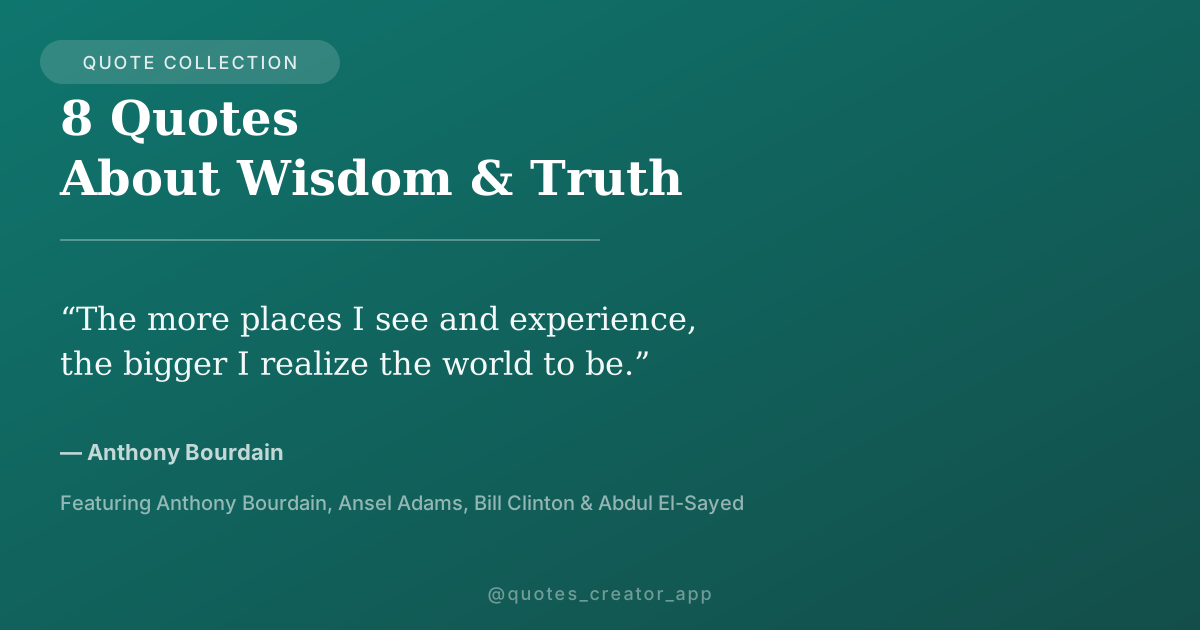
1. “The more places I see and experience, the bigger I realize the world to be. The more I become aware of, the more I realize how relatively little I know of it.”
Anthony Bourdain built a career out of going where he did not belong — and this sentence is the quiet philosophy underneath all of it. Most of us accumulate knowledge the way we accumulate possessions, expecting the pile to make us feel bigger. Bourdain describes the exact opposite trajectory: the more he traveled, the smaller he felt, and the more he understood how little he understood. That is the precise anatomy of wisdom — it is not the feeling of knowing, but the growing awareness of how much remains unknown. Every place he visited subtracted a certainty and added a question, and he treated that trade as a win. The wise person, in this account, is not the one with the most answers but the one who has earned the right to ask the biggest questions.
— Anthony Bourdain, from a 2008 interview
2. “No matter how sophisticated you may be, a large granite mountain cannot be denied — it speaks in silence to the very core of your being.”
Ansel Adams spent his life photographing the American West, and he came to believe that the most important lessons are not the ones we argue about but the ones that arrive in silence. A mountain makes no case, advances no thesis, argues nothing — and yet it can move a person more than any lecture ever could. Adams is describing a form of knowing that precedes language: the kind that happens in the body, in attention, in the willingness to stand still long enough to let something immense register. Wisdom, on his account, is not primarily an intellectual achievement. It is a capacity for reception — an openness to being reordered by what you encounter. The sophisticated person arrives expecting to explain the mountain. The wise person lets the mountain do the explaining.
— Ansel Adams, Ansel Adams: An Autobiography (1985)
3. “Yesterday is yesterday. If we try to recapture it, we will only lose tomorrow.”
Bill Clinton said this in a speech at the 200th anniversary of the University of North Carolina, and it is a compressed theory of how regret works. The most common way we lose the future is by trying to renegotiate the past — replaying a failure, defending an old position, returning to a version of ourselves that no longer exists. Clinton’s line names the arithmetic of that mistake: every hour spent recapturing yesterday is an hour stolen from tomorrow. Wisdom, in this reading, is a discipline of forward motion — not because the past does not matter, but because the only place it can do any good is in the choices we make now. You cannot edit what happened. You can only decide, with all that you now know, what happens next.
— Bill Clinton, speech at the 200th anniversary of the University of North Carolina
4. “Travel changes you. As you move through this life and this world you change things slightly, you leave marks behind, however small. And in return, life — and travel — leaves marks on you.”
Bourdain’s most quoted line is often treated as a slogan for wanderlust, but it is really a statement about the nature of experience. We like to imagine that we pass through the world leaving it untouched — that we can observe without being changed. Bourdain rejects that picture outright. To move through a place is to alter it, however slightly, and to be altered in return. Wisdom begins here, in the recognition that you are never a neutral observer. Everything you touch marks you, and the marks you leave are the inheritance of everyone who comes after. The person who understands this stops treating experience as a possession to be collected and starts treating it as an exchange — a transaction in which you are always the one who owes the debt.
— Anthony Bourdain
5. “The problem with ideology is, if you’ve got an ideology, you’ve already got your mind made up. You know all the answers and that makes evidence irrelevant and arguments a waste of time.”
Clinton said this at a Center for American Progress event in 2006, and it is one of the sharpest definitions of intellectual death ever delivered by a politician. An ideology is a closed system: it supplies every answer in advance, which means nothing new can ever enter it. The moment your mind is made up, evidence stops being information and starts being a threat — and argument becomes theater rather than inquiry. Wisdom is the exact opposite posture: it is the willingness to have your mind changed, to let the evidence reorganize your conclusions. The wisest people in any room are not the ones who hold their positions most firmly. They are the ones who still have questions that their own answers cannot silence.
— Bill Clinton, remarks at a Center for American Progress event (October 18, 2006)
6. “There are no rules for good photographs, there are only good photographs.”
Ansel Adams is remembered as a master of technique — the Zone System, the careful exposure, the technical precision — which makes this line all the more radical. The man who wrote the rulebook is the one who insists that rules are not the point. A photograph is good because it works, because it moves someone, because it tells the truth of a moment; no formula can guarantee any of that. The same principle applies to all of life’s hard judgments. We reach for rules because they promise safety — if I follow the procedure, I cannot be blamed. But the things that actually matter — a career choice, a relationship, a moral decision — cannot be resolved by procedure. Wisdom is the ability to recognize a good result when you see it, even when it follows no rule you were taught.
— Ansel Adams, attributed
7. “The road to tyranny, we must never forget, begins with the destruction of the truth.”
Clinton spoke these words at the dedication of the Thomas J. Dodd Archives and Research Center in 1995, and they carry a warning that has only grown more urgent. The most dangerous lie is the one that comes first — the lie that reality can be bent, that facts are negotiable, that history is whatever the powerful say it is. Once the truth is destroyed, everything else follows: trust, accountability, and finally freedom itself. Wisdom is often described as an inner quality, a private virtue. This quote insists that it is also a public one — that clear thinking is a form of citizenship, and that the person who protects the truth protects everything downstream of it. The wise society, like the wise person, begins by refusing to let reality be rewritten.
— Bill Clinton, remarks at the dedication of the Thomas J. Dodd Archives and Research Center (October 15, 1995)
8. “Wouldn’t it be better to learn why people die, and then teach everyone around you to save lives? Wouldn’t that save more lives?”
Abdul El-Sayed, now the Democratic nominee for Senate in Michigan, tells the story of a boy who wanted to be a doctor so he could save a life every day — and a father who asked whether it might be wiser to learn why people die and teach everyone to save them. The question is a perfect parable of wisdom because it redirects effort from the individual act to the root cause. Saving one life is heroic; understanding why lives are lost — and teaching others what you have learned — multiplies the effect beyond anything one pair of hands could do. Wisdom is not about being the person who rescues everyone. It is about being the person who makes rescue unnecessary by understanding the system that causes the harm in the first place.
— Abdul El-Sayed, 2007 University of Michigan commencement speech
Create your own quote graphics
These quotes are meant to be shared. A well-designed quote graphic can stop a scroll, start a conversation, and inspire someone at the right moment. Whether you are posting on Instagram, creating Pinterest pins, or designing WhatsApp statuses, Quotes Creator gives you ready-made templates, beautiful fonts, and custom gradients to bring any of these quotes to life in minutes.
Designing quote graphics for “Wisdom & Truth”
- ✓ Use deep teal and green gradients — calm, thoughtful, and quietly authoritative
- ✓ Serif fonts work best for wisdom quotes — timeless and literary, like the ideas themselves
- ✓ Pair quotes with landscape or natural imagery to suggest silence and perspective
- ✓ Keep text to 2–3 lines maximum on mobile-sized graphics
- ✓ Export in landscape format for Twitter and square for Instagram
Why we curated this collection
We chose wisdom because it is the least theatrical of all the themes in this library — it never arrives with a drumroll, and it almost always sounds like a question rather than an answer. Then we asked four people, all of whom are trending on Wikipedia this week for very different reasons, to say what they had actually learned. The pattern across all eight quotes is unmistakable. Anthony Bourdain describes wisdom as the humbling discovery that the more you see, the less you know — and that every experience marks you in return. Ansel Adams finds it in silence, in mountains, and in the recognition that no rule can substitute for the moment of genuine insight. Bill Clinton, from the most experienced perch in the collection, warns against the two great enemies of wisdom — the grip of ideology that makes evidence irrelevant, and the seduction of a past that steals tomorrow. Abdul El-Sayed’s father supplies the closing argument: learn why things fail, teach everyone you can, and let understanding replace heroics. Four fields — food, photography, politics, and public health — one shared conclusion: wisdom is not what you know. It is the humility to keep finding out.
— ThinkPeak Studio Editorial Team
Create your own quote graphic with this quote
Turn this line into a shareable graphic in seconds — free, no signup needed. For video quotes and 100+ templates, try the Android app.
Advertisement
Enjoyed this article? Get more like it in your inbox.