On this page
Author Spotlight: Abdul El-Sayed
From the son of Egyptian immigrants in the Detroit suburbs to a Rhodes Scholarship, the helm of Detroit’s health department, and now the Democratic nominee for United States Senate — the story of a man who has never stopped believing that systems can be rebuilt to serve the people they were meant to protect.
Who is Abdul El-Sayed?
Abdulrahman Mohamed El-Sayed was born on October 31, 1984, in Rochester Hills, Michigan, a suburb of Detroit, to Egyptian immigrant parents. His father, Mohamed, had come to the United States from Alexandria to pursue a PhD at Wayne State University; his mother, Fatten Elkomy, is a nurse practitioner. Raised in the Detroit area by his father and stepmother Jacqueline — both of whom are engineers — Abdul grew up at the intersection of two cultures: the Egyptian heritage of his immigrant parents and the blue-collar, Midwestern sensibility of southeastern Michigan. At Bloomfield Hills Andover High School, he was a three-sport team captain in wrestling, football, and lacrosse — an early sign of the competitive drive and discipline that would come to define his career. He went on to the University of Michigan, where he majored in biology and political science, played on the men’s club lacrosse team, and graduated Phi Beta Kappa with Highest Distinction in 2007. That year, he was chosen to deliver the university’s spring commencement speech — an address so powerful that former President Bill Clinton, who spoke immediately afterward, leaned into the microphone and told the audience: “I wish every person in the world who believes that we are fated to have a clash of civilizations, and cannot reach across the religious divides, could have heard you speak today.” It was a prophecy of the public life that lay ahead.
The moment that changed the trajectory of El-Sayed’s life arrived during his second year of medical school at Michigan, in a quiet conversation with his father. He had always wanted to be a doctor — to save lives directly, one patient at a time. But his father, a professor, posed a deeper question: wouldn’t it be better to learn why people die, and then teach everyone around you to save lives? That insight, at once simple and profound, redirected him from the bedside to the wider lens of epidemiology and public health. He won a Rhodes Scholarship and earned a DPhil in public health at Oriel College, Oxford, where he also captained the men’s lacrosse team and earned a full blue. He then completed an MD at Columbia University’s College of Physicians and Surgeons, funded by a Paul and Daisy Soros Fellowship for New Americans. At just 30 years old, he became the youngest health officer of a major U.S. city when Detroit Mayor Mike Duggan appointed him to rebuild the city’s health department in the aftermath of municipal bankruptcy — a job that meant restoring public trust in the very idea of government as a force for good. He later served as director of Wayne County’s Department of Health, Human, and Veterans Services from 2023 to 2025. Alongside his public service, El-Sayed built a parallel career as an author and communicator: he published over 100 scholarly articles, wrote three books — including Healing Politics and Medicare for All: A Citizen’s Guide — and launched the podcast America Dissected on Crooked Media, where he has dissected everything from the opioid crisis to the politics of pandemics for millions of listeners.
El-Sayed’s philosophy is rooted in a conviction that is both simple and radical: that government exists for the people and by the people, and that public institutions — when properly funded and ethically led — are among the most powerful tools for human dignity ever devised. His experience rebuilding Detroit’s health department after bankruptcy cemented this belief. He had seen firsthand what happened when government retreated: children poisoned by lead in their own homes, families without access to basic care, communities abandoned to market forces that had no incentive to serve them. His political platform — Medicare for All, abolishing ICE, regulated capitalism, climate action, and an arms embargo on Israel — flows from this same moral logic. He describes himself not as a socialist but as a capitalist “who understands how capitalism works”: someone who believes markets create wealth but that unchecked markets also create inequality, exploitation, and suffering that only democratic government can remedy. His Muslim faith informs his public ethics, particularly the Quranic teaching that saving one life is equivalent to saving all of humanity — a verse his father once read to him as a boy and that has echoed through every stage of his career.
On August 5, 2026, El-Sayed won the Democratic primary for Michigan’s open United States Senate seat, defeating a crowded field and notching a major victory for the progressive wing of the Democratic Party. If elected in November, he would become the first Muslim American to serve in the U.S. Senate — a milestone that would carry profound symbolic weight at a moment when Islamophobia remains a potent force in American politics. His candidacy represents something larger than one election: it is a test of whether a progressive vision built on multiracial working-class solidarity can win in the industrial Midwest, the very region whose defection delivered the presidency to Donald Trump a decade ago. Whatever happens in November, El-Sayed’s rise from the son of Egyptian immigrants to the cusp of the Senate — through the Rhodes Scholarship, the Detroit Health Department, and two statewide campaigns — is already a remarkable American story, defined not by what he was given but by what he was willing to fight for.
Abdul El-Sayed’s most memorable quotes
“My religion teaches that if one saves a life, she has saved all of humanity. I remember reading this verse with my father as a boy. ‘How great,’ I thought, ‘would it be then to save a life every day?’ … My father, a professor, thought for a moment, and reasoned, ‘Abdulrahman, wouldn’t it be better to learn why people die, and then teach everyone around you to save lives? Wouldn’t that save more lives?’ His reasoning stuck; but so did mine.”
The meaning behind these words
This passage — written by a 23-year-old medical student applying for the scholarship that would send him to Oxford — captures the precise moment El-Sayed pivoted from wanting to treat individual patients to wanting to transform the systems that produce illness in the first place. The exchange with his father unfolds like a parable: the son, animated by the desire to heal, confronts the father, who gently challenges him to think bigger. The father’s question — “wouldn’t it be better to learn why people die, and then teach everyone around you to save lives?” — is a masterclass in how to redirect ambition without extinguishing it. It redefines the problem without rejecting the impulse behind it.
The final sentence — “His reasoning stuck; but so did mine” — is what elevates this from a simple anecdote to a statement of philosophy. El-Sayed did not abandon the desire to heal; he expanded its scope. He would go on to earn both an MD and a PhD, to publish over a hundred scholarly articles on the structural causes of disease, and to build a political career around the idea that health is not merely a medical issue but a question of housing, income, environment, and justice. That unresolved tension — between the intimacy of individual care and the imperative of systemic change — has animated everything he has done since.
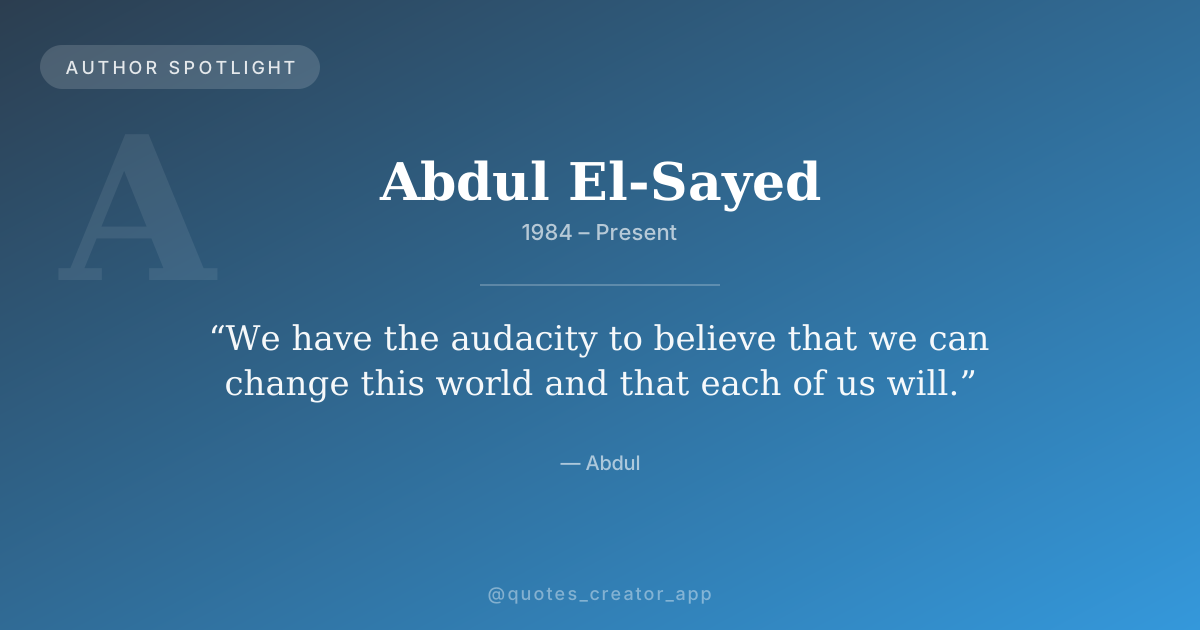
“It’s that we have the audacity to believe that we can change this world and that each of us will. That, my fellow graduates, University of Michigan Class of 2007, is the Michigan difference, and I’m humbled to have been a part of it, with you.”
The meaning behind these words
Spoken at age 22, when El-Sayed was a graduating senior with no public profile and no political aspirations, these words possess a youthful idealism that he has carried — remarkably intact — into every subsequent phase of his adult life. The word “audacity” is the key: it acknowledges that believing in change is itself an act of defiance against cynicism, against the inertia of broken systems, against the chorus of voices that insists things cannot be different. This is not naive optimism; it is optimism that knows what it is up against and chooses to persist anyway. Bill Clinton, seated on that same commencement stage, would later tell El-Sayed privately that he should consider a career in public service — a suggestion that, in retrospect, reads less like casual encouragement and more like the recognition of a rare talent.
The phrase “each of us will” is the quiet engine of the entire passage. It transforms a collective aspiration into an individual vow — a refusal to outsource responsibility to institutions, leaders, or history. In the nearly two decades since he delivered these words, El-Sayed has lived them out: rebuilding Detroit’s health department from the ruins of bankruptcy, running for governor at 32, launching a Senate campaign that no establishment figure believed he could win, and prevailing against long odds in the primary. The Michigan difference he spoke of that day — the audacity to believe — turned out to be a faithful description of his own life’s work.
“I just believe that capitalism has to be regulated. Forgive me for actually wanting to regulate trillionaires and billionaires so that we can build schools and roads. … It’s not that radical.”
The meaning behind these words
Delivered during a CNN interview in the heat of his Senate primary campaign, this quote reveals El-Sayed’s distinctive rhetorical skill: the ability to defuse the labels his opponents try to weaponize against him by refusing to accept the framing of the debate on their terms. By anchoring his position to concrete outcomes — schools and roads — rather than to abstractions like socialism or redistribution, he forces the conversation onto ground where most Americans actually agree: that billionaires should contribute more, that infrastructure matters, that a society is judged by what it builds together. The sarcastic “forgive me” is a controlled provocation, the verbal equivalent of an eye roll directed at the idea that asking the wealthiest people in history to pay their fair share is somehow extreme.
There is a deeper argument embedded here about what kind of Democrat can win in the Midwest. For decades, the conventional wisdom has held that economic populism scares off the moderate voters who decide elections in places like Michigan. El-Sayed is betting the opposite: that after years of deindustrialization, stagnant wages, and corporate consolidation, voters are not frightened by a candidate who names the problem plainly — they are hungry for one. By calling his position “not radical,” he is attempting to shift the Overton window in real time, treating the regulation of extreme wealth not as an ideological project but as the minimum baseline of a functioning society.
“If you can’t call it what it is, which is a genocide, then how are you going to stand up to Donald Trump? How are you going to stand up to pharma CEOs?”
The meaning behind these words
This is the sharpest expression of El-Sayed’s theory of leadership: that moral clarity is not a liability but a prerequisite for effective action, and that a politician who cannot name a wrong cannot be trusted to fight it. The quote functions as a kind of stress test: if you lack the courage to describe a humanitarian catastrophe in plain language, what possible reason is there to believe you will stand up to the concentrated power of a Trump administration or the pharmaceutical industry? The rhetorical structure — a question framed as a challenge — refuses to let the listener off the hook. It demands an answer, and in demanding one, it exposes the gap between the language of political caution and the reality of political courage.
The controversy this statement generated during the campaign is itself revealing. Critics argued that such frankness was politically reckless, that it would alienate voters El-Sayed needed to win. But the primary results suggested otherwise. In a state with a significant Arab American population — many of whom had watched the devastation in Gaza with horror — El-Sayed’s willingness to speak plainly was not a vulnerability but an asset. The broader point is that his supporters did not see moral clarity and electoral viability as opposites. They saw them as the same thing. The question he posed — “how are you going to stand up?” — implicitly framed him as the candidate who already was.
“The question, ultimately, is about whether or not we want a politics that dignifies equal rights.”
The meaning behind these words
In a single sentence, El-Sayed distills an entire worldview. He rejects the idea that the core political question of our time is about borders, national identity, or cultural grievance, and instead insists that it is about whether our politics treats every human being as deserving of the same rights, the same dignity, the same consideration. This is a universalist claim in an era defined by particularism — a quiet but firm insistence that the measure of a just society is not what it preserves for its own but what it extends to everyone. The word “dignifies” is doing the heavy lifting: it suggests that rights are not merely legal entitlements but acts of recognition, ways of telling people that they matter.
The context makes the statement even more pointed. El-Sayed was being pressed on his position regarding Israel and Palestine, a conversation in which American politicians almost reflexively retreat to calibrated talking points. Instead, he pivoted to first principles. Rather than litigate territorial claims or historical grievances, he reframed the issue as a question about the kind of politics Americans want to have — one rooted in equal rights, or one that makes exceptions. It was a move characteristic of his style: take a question designed to trap, and answer it with a principle that refuses the trap entirely. Whether or not one agrees with his conclusions, the method itself — reaching for the universal rather than the tribal — represents a distinct and deliberate choice about what politics can be.
Abdul’s legacy
It is too early to speak of Abdul El-Sayed’s legacy in the past tense, because his story is still being written — perhaps more dramatically now than at any previous moment. But certain contours are already visible. He has demonstrated that a candidate can be both a scholar and a street fighter, that rigorous public health expertise is not a liability in electoral politics but a credential that signals seriousness, and that the children of immigrants do not have to mute their identities to be embraced by the communities they seek to serve. In a Democratic Party that has spent years arguing with itself about whether progressive politics can win beyond the coasts, El-Sayed has offered a compelling piece of evidence: a Muslim son of Egyptian immigrants, running on Medicare for All and a clean break from corporate money, just won a Senate primary in the industrial Midwest. That fact alone will be studied, debated, and emulated for election cycles to come.
Beyond electoral politics, El-Sayed has already left a mark on American public health. The Detroit Health Department he rebuilt from the ashes of municipal bankruptcy now serves as a case study in what is possible when public institutions are led by people who believe in them. His three books — on systems science, on the politics of healing, and on Medicare for All — form a coherent intellectual trilogy: understand the system, diagnose what is broken, and build the alternative. And his podcast, America Dissected, has brought epidemiological thinking to millions of listeners at a time when understanding the difference between correlation and causation, between individual risk and structural vulnerability, has never mattered more. Whether or not he reaches the Senate, El-Sayed has already expanded the vocabulary of what an American public servant can sound like, look like, and fight for.
Create graphics with Abdul’s quotes
Abdul El-Sayed’s words carry the rare combination of precision and passion that makes them perfect for quote graphics. Whether you’re sharing on Instagram, designing a vision board, or looking for daily inspiration to stay engaged with the work of building a better world, Quotes Creator helps you transform these quotes into beautiful, shareable designs with custom fonts, gradients, and layouts.
Why we chose Abdul
We chose Abdul El-Sayed because his victory in the Michigan Democratic Senate primary on August 5, 2026 — the very week we are publishing this spotlight — marks a genuine inflection point in American politics. For the progressive movement, Michigan represents a crucial test of whether the coalition Bernie Sanders built can endure and expand. For Muslim Americans, El-Sayed’s candidacy is a landmark of representation that would have been unthinkable a generation ago. And for anyone who believes that public health, economic justice, and moral clarity belong at the center of our politics, his career — from the Detroit Health Department to the Rhodes Trust to the floor of the Senate — offers a template worth studying. In an age of sound bites and cynicism, El-Sayed has made the case that substance still matters. We think he’s right.
— ThinkPeak Studio Editorial Team
Create your own quote graphic with this quote
Turn this line into a shareable graphic in seconds — free, no signup needed. For video quotes and 100+ templates, try the Android app.
Advertisement
Enjoyed this article? Get more like it in your inbox.