On this page
Author Spotlight: Nana Patekar
He was born Vishwanath Gajanan Patekar in a coastal Maharashtra town and nicknamed “Nana” before he could choose anything about himself. He lost his family’s money at thirteen, painted film posters for thirty-five rupees a month and one meal a day, and discovered, in that hunger, the instrument he would use for the rest of his life. On screen he was the angry man, the maverick cop, the good-hearted gangster, the tragic father; off it he was a former soldier who served in the Kargil War, a farmer’s advocate who gave away his fees, an actor who lived in a 750-square-foot flat he bought for a lakh in 1980s Mumbai, and a man who refused politics on the grounds that “artistes are national property.” He won three National Film Awards and four Filmfare Awards, took the Padma Shri in 2013, and never once pretended to be glamorous. This is the life — and the words — of one of Indian cinema’s most singular forces.

Who is Nana Patekar?
Vishwanath Gajanan Patekar was born on 1 January 1951 in Murud-Janjira, a coastal town in Maharashtra’s Raigad district, the son of a man who ran a small textile-painting business. The family was comfortable until Patekar was in the ninth standard, when, as he told The Times of India decades later, “someone close to my father took away everything he had including his property.” The boy went to work. After school he walked eight kilometres each way to Chunabhatti, in Mumbai, to paint film posters for thirty-five rupees a month and a single meal a day. He would always say that those years were his only real training: “that humiliation and hunger taught me so much that I didn’t need to go to any acting school.” He studied instead at the Sir J. J. Institute of Applied Art and found his way onto the Marathi stage, where the director Vijaya Mehta staged his first play. He married Neelkanti in 1978; the couple had two sons, and lost the elder when he was two years old — a death Patekar spoke about, decades on, as the moment he learned how much of himself had been vanity.
His film debut came in 1978 with Muzaffar Ali’s Gaman, but the performance that changed his standing was in Mira Nair’s Salaam Bombay! (1988), a film that won the Caméra d’Or at Cannes and became only the second Indian feature ever nominated for the Academy Award for Best Foreign Language Film. The following year, Parinda made him a national name: his turn as the crime lord Anna Seth won him his first National Film Award for Best Supporting Actor and his first Filmfare Award. He turned director with Prahaar: The Final Attack (1991), for which he trained with the Indian Army, and then reinvented himself again as the gambler-hero of Krantiveer (1994), a performance that took both the National Film Award for Best Actor and the Filmfare Award for Best Actor. Between them came Angaar (1992), which won him his first Filmfare Best Villain prize, and Agni Sakshi (1996), which brought a second National Award for Best Supporting Actor.
The 2000s proved he could hold any register. He was the encounter specialist of Ab Tak Chhappan (2004), the ruthless politician of Apaharan (2005) — which earned him a second Filmfare Best Villain Award — and the disarmingly funny gangster Uday Shetty of Welcome (2007). But the role that may outlast them all was in Marathi: Ganpatrao “Appa” Belwalkar in Natsamrat (2016), a retired stage actor watching his life and art slip away, for which he won the Filmfare Award for Best Actor (Marathi). Alongside his film work ran an unusual second career. Patekar was commissioned into the Territorial Army as a captain in 1988, and during the 1999 Kargil War he obtained special permission from Defence Minister George Fernandes to join the troops, spending around sixty days with a Quick Reaction Team near the Line of Control before retiring in 2013 as an honorary Lieutenant Colonel.
Fame never tilted his idea of what an actor’s life should look like. He did not raise his needs, kept living in the same small Andheri flat, and poured much of what he earned into causes. In 2015 he co-founded the Naam Foundation with the Marathi actor Makarand Anaspure to support the families of farmers who had taken their own lives in drought-stricken Maharashtra; the foundation has since worked across Marathwada and Vidarbha with cash aid, tree-planting, group farming and village rehabilitation. He was awarded the Padma Shri in 2013 for his contribution to cinema and the arts. He died in Goa on 8 October 2026, aged 75, after a cardiac arrest; his last rites were performed with state honours at Donje, near Pune. Goa Police registered an unnatural-death case and said they would record statements from the family, a standard procedure in such deaths. At the time of his death he was still working, with a single line of dubbing left on the film The Confession of Mary.
Nana Patekar’s most memorable quotes
“That humiliation and hunger taught me so much that I didn’t need to go to any acting school.”
The meaning behind these words
This is the sentence that explains everything about Nana Patekar’s acting, and it is delivered not as a boast but as a piece of accounting. When he was thirteen, his family went “from being middle class to lower middle class and finally lower class,” and he began walking eight kilometres to paint film posters for thirty-five rupees a month. The craft that most actors acquire in a classroom — how to look hungry, how to beg without begging, how to carry humiliation in the body without announcing it — he learned by living it. He said as much in the same interview: confronted with the accusation that he was an angry man, he answered, “I was helpless and inferior and that eventually came out as anger.” Nothing in his filmography makes sense if you cannot hear that sentence underneath it.
The remark also contains a quiet rebuke of the profession he joined. Patekar was an alumnus of a fine-art institute, not a drama school, and he never stopped being suspicious of polish. His greatest performances — the truant son of Krantiveer, the raging cop of Ab Tak Chhappan, the discarded actor of Natsamrat — are not studies in technique; they are eruptions of something real that the camera happened to catch. To say that hunger was his teacher is to insist that a performance should come from a life, not a method. It is also, characteristically, a way of refusing to take credit: he did not choose to be taught this way. Life simply taught him, and he was honest enough to admit who the teacher was.
“If I had not become an actor, I would have been in the underworld. I am extremely serious about this.”
The meaning behind these words
Patekar spent his whole career being described as intense, and near the end of his life he decided to tell the truth about the intensity: it was not an artistic choice, it was a temperament he had to manage. The line comes from a candid late interview in which he discussed his violent streak, his temper and his well-documented falling-out with the director Sanjay Leela Bhansali. The theatre, he was saying, gave the rage a form and a set of walls. Without it, the same energy that made him frightening on screen might have taken him somewhere with no cameras and no cut. It is the most frankly autobiographical statement he ever made about the relationship between his art and his anger.
What makes the quote more than a piece of tough-guy self-mythology is everything around it. Patekar also said he had hit his adult son only once and that, when people made him angry, he often wanted to hit them and did not; he described his anger as a mask for the “helpless and inferior” boy he had been. The underworld was never a real career plan — it was the shape of the life he felt he had been saved from. Acting, in his telling, is a controlled way of putting dangerous feeling to work, and he was grateful to it in a way that most performers never allow themselves to be. The line is funny, frightening and entirely sincere at once, which is precisely the register he occupied better than anyone else in Hindi cinema.
“We all are Indians and that should be our only religion. What is the need to be called a Hindu, Muslim or Christian? Does anybody have any religion or caste at the time of birth?”
The meaning behind these words
Speaking in the Konkan, at a school function, Patekar turned a simple idea into a series of questions that are hard to answer without embarrassment. The argument is not abstract tolerance; it is the concrete observation that identity labels are learned, not born. Nobody arrives in the world stamped with a caste or a creed, so the divisions we defend so fiercely must have been installed after the fact. He delivered the point not as a politician courting a vote but as a man telling a hall of children what he had concluded after a lifetime of being asked to represent one group or another. In the same speech he added that “every religion says, look for God in a human being,” folding his secularism into a religious idea rather than setting it against one.
The quote also explains his most surprising refusal: he would not join politics. Parties came to him — he acknowledged in a 2015 interview that the BJP had recently courted him — and he explained his answer with a metaphor that has the unmistakable mark of his thinking: social reformers and actors are “national property” and should not be divided; “as artistes, we are emotional people and in politics there is no place for emotions.” To Patekar, the two statements belong together. If his only religion was to be Indian, then aligning himself with one faction would have been a contradiction of the self, and the work — including the Naam Foundation’s relief for farmers of every faith — was a more honest expression of the belief than any party card could be.
“Our biggest weapon is not the Bofors or the AK-47, but our soldiers.”
The meaning behind these words
This line is not a flourish but the summary of a decision Patekar actually made. When the Kargil War began in 1999, he went to Defence Minister George Fernandes and asked to serve. He has said he argued his case on practical grounds — he was a trained shooter, a national-level competitor, fit and willing — and was eventually cleared to join a Quick Reaction Team, spending around sixty days near the Line of Control at Dras, Leh, Kupwara, Baramulla and Sopore. He came back having dropped from 76 kilograms to 56. When he finally spoke about it, years later, he refused to treat it as heroism: “I felt happy. I could at least do this little bit for the country,” he said. The sentence about the Bofors and the AK-47 is the lesson he drew from the experience — that wars are decided by people, not hardware.
It is worth noting how out of step this is with the way film stars usually talk about themselves. Patekar did not publicise his Kargil service for years, and when he did, he declined to discuss what he had actually done there. He framed his presence as a small contribution from a civilian who happened to be a soldier by training, and then went back to a film career in which he would spend the next two decades playing officers, gangsters and fathers. That he insisted on the primacy of the ordinary soldier over the famous weapon is also a self-portrait of a sort. For a man who never looked like a leading man, who was mocked early on for not being handsome, the belief that character beats equipment was not a sentiment. It was a thesis he had staked his life on.
“Money has never been my life’s goal and I have no respect for people who can’t see beyond material compensation.”
The meaning behind these words
Patekar was one of the highest-paid and most bankable actors of the 1990s, and he spent his career conspicuously refusing the rewards that were supposed to go with it. The 2001 interview this line comes from catches him at the height of his commercial power, insisting that the point of the work was never the fee. He kept living in the same 750-square-foot flat in Andheri that he had bought for about ₹1.1 lakh — he told an interviewer, decades later, that nothing about his needs had changed — and he gave away money with a regularity that bordered on compulsion: his entire fee for Paathshaala to five charities, the cash portion of the Raj Kapoor award to drought relief, his earnings split among the families of indebted farmers.
The statement is easy to read as self-serving until you set it beside the other facts of his life. Patekar was a chain smoker who quit at 56, a man who spoke openly about his fearlessness of death and his obsession with it, and a performer who said that whether his film ran or not “doesn’t make any difference.” The refusal of money was not a pose of austerity; it was the same instinct that made him give away his Paathshaala fee and build the Naam Foundation into a permanent structure for helping farmers, rather than a one-time charity. In an industry that measures people in box-office figures, he kept insisting on a different arithmetic entirely — and, for a man who had gone hungry as a child, that choice carried a weight few of his peers could have matched.
Nana Patekar’s legacy
The record is unambiguous. Patekar won three National Film Awards — Best Supporting Actor for Parinda (1989), Best Actor for Krantiveer (1994) and a second Best Supporting Actor for Agni Sakshi (1996) — and four Filmfare Awards, in the Best Actor, Best Supporting Actor and Best Villain categories, a triple that only a handful of performers in Hindi cinema have ever completed. He received the Padma Shri in 2013. He worked across three languages and nearly five decades, from the art-house of Salaam Bombay! to the mainstream comedy of Welcome, and he did it without a conventional leading man’s face, which he turned into an argument: “I know I’m not beautiful,” he said, “but I wanted to make my performances beautiful.”
But the deeper legacy is one of refusal. Patekar declined politics when he could have had it, declined glamour when it was offered, and declined, at the end, to soften the temper that both fuelled and endangered him. He modelled a kind of stardom built on presence rather than image — the intense, unpredictable, unglamorous man who could hold a screen against anyone. Off it, he built the Naam Foundation into a durable response to the farm distress he had seen up close, and he served his country in uniform when the country was at war. Tributes after his death came from across that whole range: the actor’s craft and the citizen’s conscience, remembered in the same breath. For half a century he told anyone who would listen that he was not a hero; the size of the audience that came looking for him on the morning he died suggested the country had quietly decided otherwise.
Create graphics with Nana Patekar’s quotes
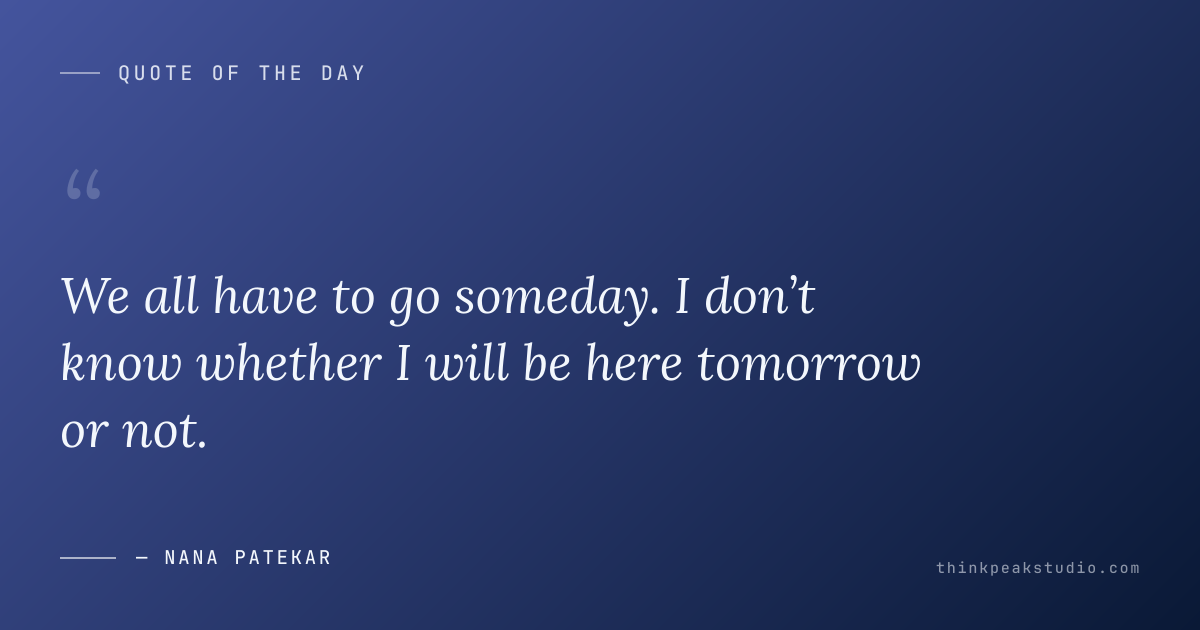
Nana Patekar’s words carry the same charge as his performances — blunt, unadorned, and impossible to ignore. Whether it is the admission that hunger was his only acting school, the confession that acting saved him from his own anger, the simple creed that being Indian was his one religion, the salute to the soldier over the weapon, or the insistence that money was never the point, Quotes Creator lets you turn these lines into elegant, shareable designs with custom fonts, gradients and layouts.
Why we chose Nana Patekar
Nana Patekar enters this spotlight because on 8 October 2026 India lost one of its most singular screen presences, and the country went looking for him all at once. The scale of the surge tells the story: according to the Wikimedia Pageviews API, his English Wikipedia biography was drawing between roughly 1,100 and 1,450 readers a day through the first week of October, ticked up slightly on 5 October, and then exploded to 1,756,167 on 8 October — the day of his death. Even after the first news cycle passed it held 318,213 readers on 9 October and 106,266 on 10 October. That is not the traffic of a nostalgia act. It is the traffic of a figure whose work had quietly become part of the national furniture. He had never appeared in this series before.
The five quotes we have selected trace the mind rather than the filmography. They begin with the hunger that trained him, turn to the anger that acting saved him from, move to the secular creed he called his only religion and the soldiers he called India’s greatest weapon, and end with the money he would not let define him. Taken together they describe an actor who spent fifty years insisting that a performance is a life, not a technique — and who proved it, from Parinda to Natsamrat, every time the camera rolled. He never wanted to be a star. He became something rarer: an institution, and a conscience, that happened to work in the movies.
— ThinkPeak Studio Editorial Team
Create your own quote graphic with this quote
Turn this line into a shareable graphic in seconds — free, no signup needed. For video quotes and 100+ templates, try the Android app.
Advertisement
Enjoyed this article? Get more like it in your inbox.