On this page
Author Spotlight: Alexandria Ocasio-Cortez
She was a twenty-something bartender running a long-shot campaign out of a paper grocery bag hidden behind a Union Square taqueria, dismissed by nearly everyone who counted in politics. Two years later she was the youngest woman ever elected to the United States Congress — and the most watched, most attacked, and most consequential new voice in American public life. This is the story of Alexandria Ocasio-Cortez, told through the words that built her.
Who is Alexandria Ocasio-Cortez?
Alexandria Ocasio-Cortez was born on October 13, 1989, in Parkchester, a working-class neighborhood of the Bronx, into a Puerto Rican family. Her father, Sergio Ocasio-Roman, was an architect born in the Bronx; her mother, Blanca, was born in Puerto Rico, raised in Arecibo, and worked as a house cleaner and school bus driver. When Alexandria was five, her parents pooled their savings to move the family to a small house in suburban Yorktown Heights — a move made, she has said, so their children could attend better public schools. She was a serious and evidently gifted student: at Yorktown High School she placed second in the microbiology category at the Intel International Science and Engineering Fair, presenting research on the effect of antioxidants on the lifespan of nematode worms. Her father died of lung cancer in 2008, during her second year at Boston University, plunging the family into a years-long probate battle over his estate. She would later say the experience taught her “firsthand how attorneys appointed by the court to administer an estate can enrich themselves at the expense of the families.” She graduated cum laude from Boston University in 2011 with a double major in international relations and economics, then returned to the Bronx, where she tended bar and waited tables to help keep her mother from losing the family home.
Before she was a candidate, she was an organizer. Ocasio-Cortez worked on Bernie Sanders’s 2016 presidential campaign, and after the election she drove across America — to Flint, Michigan, and to the Standing Rock reservation in North Dakota — a trip she later called a tipping point, the moment she understood that ordinary people could stand up to the most powerful forces on earth. In 2017, while still working shifts behind the bar, she launched a primary challenge against Joe Crowley, a ten-term incumbent and the fourth-ranking Democrat in the House of Representatives. She was outspent nearly eighteen to one. On June 26, 2018, she won with 56.7 percent of the vote — an upset that national observers immediately called the biggest of the year. That November she took the general election with 78 percent, and in January 2019 she was sworn in at twenty-nine, the youngest woman ever elected to Congress. Her first floor speech broke C-SPAN’s record for the most-watched Twitter video of any House member. Within months she had introduced the Green New Deal resolution, made “Medicare for All” a mainstream phrase, and become, by one measure, the second-most-talked-about politician in America after the president.
Ocasio-Cortez describes herself as a democratic socialist in the tradition of the Democratic Socialists of America, and her politics cohere around a single, simple conviction: that government should deliver material improvements to working people’s lives. She advocates Medicare for All, a $15 minimum wage, tuition-free public college, a federal jobs guarantee, the abolition of ICE, and a Green New Deal to decarbonize the economy within a decade. She is careful to reject the state socialism she calls “undemocratic” and “easily corrupted,” arguing instead for worker cooperatives and strong unions. The through-line of her worldview is class: she speaks of a “ruling class” of corporations and a “very small elite” that has captured government, and she frames even climate change as a pocketbook issue — clean air and clean water for the South Bronx, not a luxury for the affluent. Her tools are as modern as her message. She has wielded social media with an effectiveness no politician had demonstrated before, using Instagram Lives, Twitch streams, and a relentless, plainspoken presence to bypass the gatekeepers and speak directly to millions.
A decade after she first walked into a union hall, Ocasio-Cortez has become something larger than a congresswoman. She is a leader of “the Squad,” the informal bloc of young progressives that has repeatedly shifted the Democratic Party’s center of gravity. In 2024 she delivered a prime-time address at the Democratic National Convention. In 2025 she crisscrossed the country on Bernie Sanders’s “Fighting Oligarchy Tour,” raising $9.6 million in a single quarter at an average of $21 per donation. She is now the subject of open speculation about the presidency and widely regarded as the heir to Sanders’s movement. In 2026, serving on the powerful Energy and Commerce Committee, she won renomination by an overwhelming margin and remains at the center of every argument about what the Democratic Party should be.
Alexandria Ocasio-Cortez’s most memorable quotes
“The world is going to end in 12 years if we don’t address climate change and your biggest issue is how are we gonna pay for it?”
The meaning behind these words
This sentence, tossed off in a 2019 interview, became at once a rallying cry and a weapon turned against her. The “12 years” referred to a 2018 United Nations climate report warning that emissions had to be cut dramatically within roughly a dozen years to avoid the worst effects of warming. Ocasio-Cortez’s framing was deliberately stark: she wanted to collapse the distance between scientific urgency and political complacency, to say out loud that the people deciding the “cost” question will not be the people paying the price. The sneering follow-up — “your biggest issue is how are we gonna pay for it?” — captures the entire gulf between her politics and the politics of the status quo. To her critics, “how do we pay for it” is the responsible question. To her, it is a category error, the wrong question asked by people who have never had to ask whether their neighborhood will survive.
The quote also reveals her rhetorical method: reduce a complex policy fight to a single, vivid, emotionally legible image, then let the image do the arguing. “The world is going to end in 12 years” is not, strictly, what the report said, and her opponents seized on the imprecision to brand her unserious. But the imprecision was the point. She was not delivering a footnote; she was delivering a deadline. The line became a defining test of who took climate change seriously and who did not, and it prefigured the central role the Green New Deal would play in reshaping her party’s agenda. In the years since, as record heat, floods, and fires have made the abstract concrete, the sentence has aged from hyperbole toward prophecy — and “how are we gonna pay for it?” increasingly sounds like the last question anyone should still be asking.
“Any job that pays $2.13 an hour is not a job, it is indentured servitude. All labor has dignity, and the way that we give labor dignity is by paying people the respect and value that they are worth.”
The meaning behind these words
This is Ocasio-Cortez at her most distilled, and the authority behind it is autobiographical. The federal minimum wage for tipped workers had been frozen at $2.13 an hour since 1991, a fact she knew from the inside — she had spent years living on tips behind bars and restaurant floors in the Bronx and Manhattan. When she returned to a Jackson Heights restaurant in 2019 to pour drinks and push the Raise the Wage Act, she was not performing solidarity. She was testifying. The word “indentured servitude” was chosen with precision: it names a system in which people work for survival wages while owing their livelihood to the arbitrary benevolence of customers and employers, a condition America prefers to call by the friendlier name “the service industry.”
The second sentence widens the claim from policy to philosophy. “All labor has dignity” is not a slogan about restaurant workers; it is a theory of value. Ocasio-Cortez is arguing that a society demonstrates its respect for work by how it compensates work — that dignity is not a feeling but a paycheck, not a sentiment but a wage. This is the core of her economic vision, and it explains why she so often returns to the experiences of the working class as the measure of every policy. A $15 minimum wage is not, in her framing, a handout; it is the recognition that the woman cleaning offices, the man washing cars, and the immigrant serving food are all performing work that has worth, and that an economy which refuses to pay them what they are worth is not merely unjust but dishonest about its own dependence on them.
“I think it’s wrong to say that what I’m proposing is polarizing the country. What we are seeing now is a ruling class of corporations and a very small elite that have captured government… I believe that I’m fighting for the American consensus.”
The meaning behind these words
This is the closest thing to a mission statement Ocasio-Cortez has ever given, and its central rhetorical move is a reversal: she is not the radical; the status quo is. She lists the numbers — 70 percent support Medicare for All, 90 percent want money out of politics, 80 percent believe climate change is an urgent systemic problem, 67 percent see immigrants as a positive force — to argue that the positions for which she is called extreme are, in fact, broadly popular. The actual extremism, in her telling, is a government captured by a “ruling class” of corporations and a tiny elite, a system in which senators “don’t cast a vote unless their sugar daddies tell ‘em what to do.” The label “socialist” is, from this angle, merely the word the powerful use to discredit the popular.
The phrase “the American consensus” is the sentence’s engine. It stakes a claim that would have been unthinkable for a freshman congresswoman a generation earlier: that the radical position is the mainstream position, and that the distance between what Americans want and what Washington delivers is the real measure of the problem. This reframing had consequences. It allowed Ocasio-Cortez to position ideas like Medicare for All, a wealth tax, and the Green New Deal not as fringe fantasies but as unfulfilled common sense, and it gave the broader progressive movement a template: stop defending your positions as bold, and start insisting they are ordinary. Whether the consensus she described was real or aspirational is debatable — but the framing worked, and within a few years much of what she proposed had moved from the margins of her party toward its center.
“True love is radical because it requires us to see ourselves in all people. Otherwise, it isn’t love. Love is revolutionary because it has us treat all people as we would ourselves — not because we are charitable, but because we are one.”
The meaning behind these words
Written on Christmas Day 2018, weeks before she took office, this is Ocasio-Cortez’s most unexpected statement, and it reveals the moral core beneath the policy fights. She is not invoking love as sentimentality but as a political technology. To “see ourselves in all people” is the precise opposite of the ethic of exclusion that dominates so much of contemporary politics — the ethic that draws a hard line between the deserving and the undeserving, the citizen and the stranger, the family and everyone else. For Ocasio-Cortez, love is “radical” precisely because it collapses that line. It refuses the comfortable distinction between the people we are obliged to care for and the people we are free to ignore.
The final clause sharpens the argument: “not because we are charitable, but because we are one.” Charity preserves hierarchy — the giver above the receiver, the fortunate above the needy — and asks for gratitude rather than justice. Solidarity, by contrast, is the recognition of a shared condition, the understanding that the fate of the border detainee and the fate of the senator are, in some deep sense, the same. This is the philosophical foundation for her policies. Medicare for All is not charity; it is the recognition that our health is connected. A Green New Deal is not charity; it is the recognition that we share one planet. Abolishing ICE is not charity; it is the recognition that no one is disposable. The tweet was, in its way, the whole of her politics compressed into two sentences — and it is why, for all the caricatures of her as a polarizing firebrand, her deepest appeal has always been to a kind of radical inclusiveness.
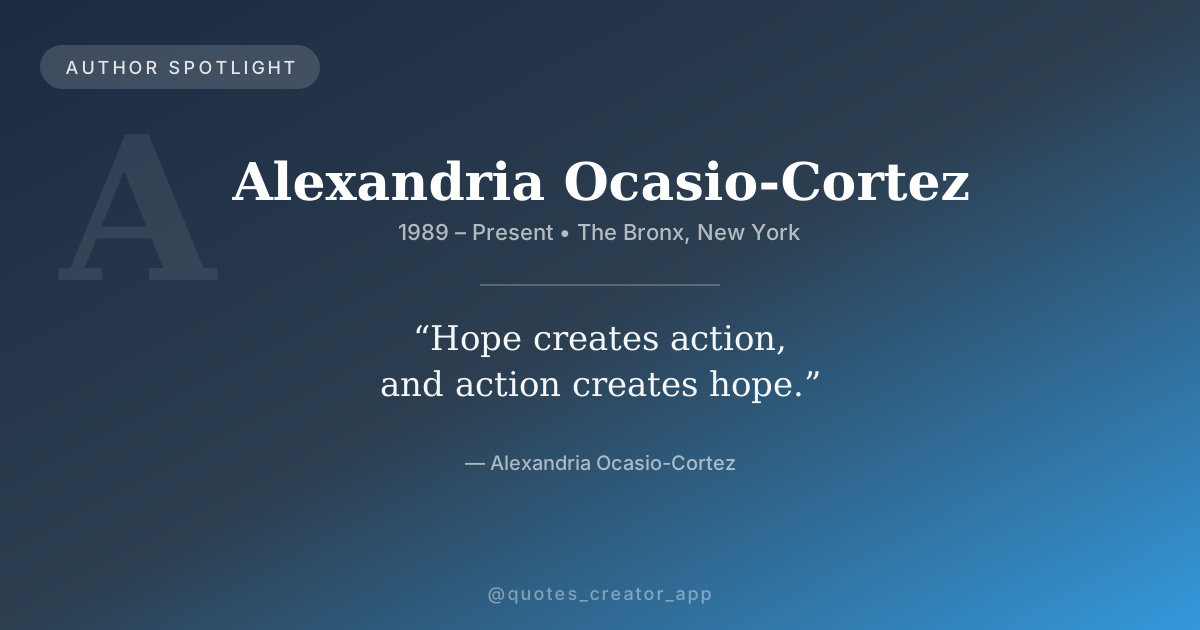
“Cynicism, I think, is a far greater enemy to the left than many others, because it is the tool that is given to us to hurt ourselves. And hope creates action, and action creates hope. And that’s how we scale forward.”
The meaning behind these words
By 2021, after the pandemic, the January 6 attack, and a string of legislative defeats, the temptation toward despair on the American left was strong. Ocasio-Cortez’s response was to name despair’s polite cousin — cynicism — as the real enemy. Her argument is tactical as much as moral: cynicism is “the tool that is given to us to hurt ourselves,” a form of political self-harm that convinces people that nothing can change and therefore nothing is worth trying. It is comfortable, seductive, and flattering — the cynic gets to feel superior to both the corruption and the hope — but it produces exactly nothing. Against this she sets a different equation.
”Hope creates action, and action creates hope” is Ocasio-Cortez’s most portable line, and it is, characteristically, a description of a feedback loop rather than a slogan. Hope is not a mood you wait to feel; it is something you generate by acting, and every small act of organizing — a phone call, a door knock, a union vote, a protest — produces a little more of the hope that makes the next act possible. This is the philosophy of a person who spent years losing before she won: her 2018 campaign, by every conventional metric, was hopeless until the moment it wasn’t. The line distills a lifetime of organizing into a sentence, and it explains why, even when she speaks of oligarchy and authoritarianism and a planet in crisis, she does not sound defeated. For Ocasio-Cortez, hope is not the opposite of the evidence. It is the strategy.
Alexandria’s legacy
Ocasio-Cortez’s legacy is still being written, but its outline is already visible. She did something no freshman legislator in a generation had done: she changed the conversation. Before her, Medicare for All and the Green New Deal were niche positions, held by a few and dismissed by many. After her, they sat at the center of the Democratic Party’s internal debate, endorsed by senators and presidential candidates, and, in softened form, absorbed into the party’s governing agenda. The scale of this shift is easy to underestimate precisely because it was so complete. She did it not through seniority or committee power — she had neither — but through the sheer force of a message and a mastery of the medium, proving that in the age of social media, a freshman with a phone could outcommunicate an entire political establishment.
But her deeper legacy may be the simple fact of her existence in public life. She is a young, working-class Latina from the Bronx who speaks openly about the probate lawyers who took her father’s estate, the tips that paid her rent, the sexual assault she survived, and the misogyny she still faces — and she refuses, in the face of all of it, to be either quieted or beaten. The death threats, the crude insults from colleagues, the relentless dehumanizing coverage: she has treated them not as reasons to retreat but as evidence of why she must stay. Whether she becomes president, or a senator, or simply the most influential progressive voice of her era, she has already changed the definition of what American political leadership can look like. The Bronx bartender who ran her first campaign out of a paper grocery bag now stands at the center of American politics — and, characteristically, she is not waiting for anyone’s permission.
Create graphics with Alexandria’s quotes
Alexandria Ocasio-Cortez’s words carry the same conviction as her campaigns: direct, unapologetic, and built on the belief that ordinary people can change their own circumstances. Whether you are looking for a reminder that hope is something you build, or a call to treat every job with dignity, Quotes Creator helps you turn these quotes into beautiful, shareable designs with custom fonts, gradients, and layouts.
Why we chose Alexandria Ocasio-Cortez
Alexandria Ocasio-Cortez enters this spotlight at a moment when her name is once again surging through the national conversation. In August 2026 she ranked among Wikipedia’s most-viewed living political figures, a spike driven by her high-profile role on the “Fighting Oligarchy Tour,” her dominance of the progressive wing during a midterm cycle, and the intensifying speculation — now open, and now from her own party’s establishment — about whether she will seek the presidency in 2028. But the timing is secondary to the substance. We chose her because few figures of this generation have proven the raw power of language the way she has: a bartender with no money, no endorsements, and no name recognition built a national movement almost entirely out of words, delivered with a precision and a fearlessness that Washington had never seen.
The five quotes we have selected trace the arc of her philosophy as a politician and as a person: the generational urgency she brought to climate change, the dignity she insists belongs to every worker, the radical claim that her positions are the American consensus, the conviction that love and solidarity are the same political act, and the hard-won belief that hope is not something you feel but something you build. These are not the careful sentences of a triangulating careerist. They are the unfiltered voice of someone who decided, early and permanently, that she would rather lose telling the truth than win telling a comfortable lie. In an era when political language is often a tool of evasion, Alexandria Ocasio-Cortez stands as a reminder that the right words, spoken plainly, can still move a country — and that they usually come from the people everyone else has already counted out.
— ThinkPeak Studio Editorial Team
Create your own quote graphic with this quote
Turn this line into a shareable graphic in seconds — free, no signup needed. For video quotes and 100+ templates, try the Android app.
Advertisement
Enjoyed this article? Get more like it in your inbox.