On this page
Author Spotlight: Andy Burnham
British politician, Prime Minister of the United Kingdom since July 2026, former Mayor of Greater Manchester known as the “King of the North”
Who is Andy Burnham?
Andrew Murray Burnham was born on 7 January 1970 and grew up in Culcheth, a village suspended between Liverpool and Manchester in Northern England. Raised in a Catholic family and educated at St Aelred’s Catholic High School, he was shaped by the industrial landscape and community spirit of the North West—a region where loyalty to place runs deep and where Westminster often feels a very long way away. He joined the Labour Party at just 15, drawn to politics not as an academic exercise but as a practical response to the inequalities he saw around him. After reading English at Fitzwilliam College, Cambridge, Burnham chose the path of public service over the literary career his degree might have suggested, beginning as a researcher for Tessa Jowell before becoming a special adviser to Culture Secretary Chris Smith.
Elected as MP for Leigh in 2001, Burnham rose steadily through government, serving as Chief Secretary to the Treasury, Culture Secretary, and Health Secretary under Tony Blair and Gordon Brown. As Culture Secretary, he launched the Hillsborough Independent Panel—a decision that would later prove instrumental in exposing decades of institutional cover-up. After Labour’s 2010 defeat, he served in the shadow cabinets of Ed Miliband and Jeremy Corbyn and twice contested the party leadership. But it was his election as Mayor of Greater Manchester in 2017 that truly defined him. Over nine years, he reorganised the region’s transport into the integrated Bee Network, fought for Northern communities during the COVID-19 pandemic—earning the moniker “King of the North”—and built an approval rating that stood in stark contrast to the declining popularity of the national party. In June 2026, he returned to Parliament by winning the Makerfield by-election. Four days later, Keir Starmer resigned, and on 17 July 2026, Burnham was elected unopposed as Leader of the Labour Party. On 20 July, he became Prime Minister—the first Labour and Co-operative Party MP ever to hold the office.
Burnham identifies as a socialist on Labour’s “soft left” and has developed a political philosophy that commentators have labelled “Manchesterism”—a conviction that power must be carried out of Westminster and placed in the hands of communities, that public services should be brought back under stronger public control, and that politics should be collaborative rather than combative. He believes the UK has spent four decades on a path that “simply hasn’t worked” and that the country now faces a genuine inflection point. His career has been defined not by ideological purity but by a dogged pragmatism rooted in place: the belief that you cannot govern a country well if you do not understand the streets, estates, and postcodes where most people actually live.
Already, Burnham’s legacy is being written at an extraordinary pace. His journey from a village in Cheshire to 10 Downing Street, via the mayoralty of Greater Manchester, represents something unprecedented in British political history: a regional leader who built a national mandate from the ground up, bypassing the traditional Westminster ladder. Whether his premiership succeeds or falters, his rise has already changed the conversation about where political legitimacy comes from. He stands as living proof that the distance between local government and national leadership is shorter than the British establishment ever imagined.
Andy Burnham’s most memorable quotes
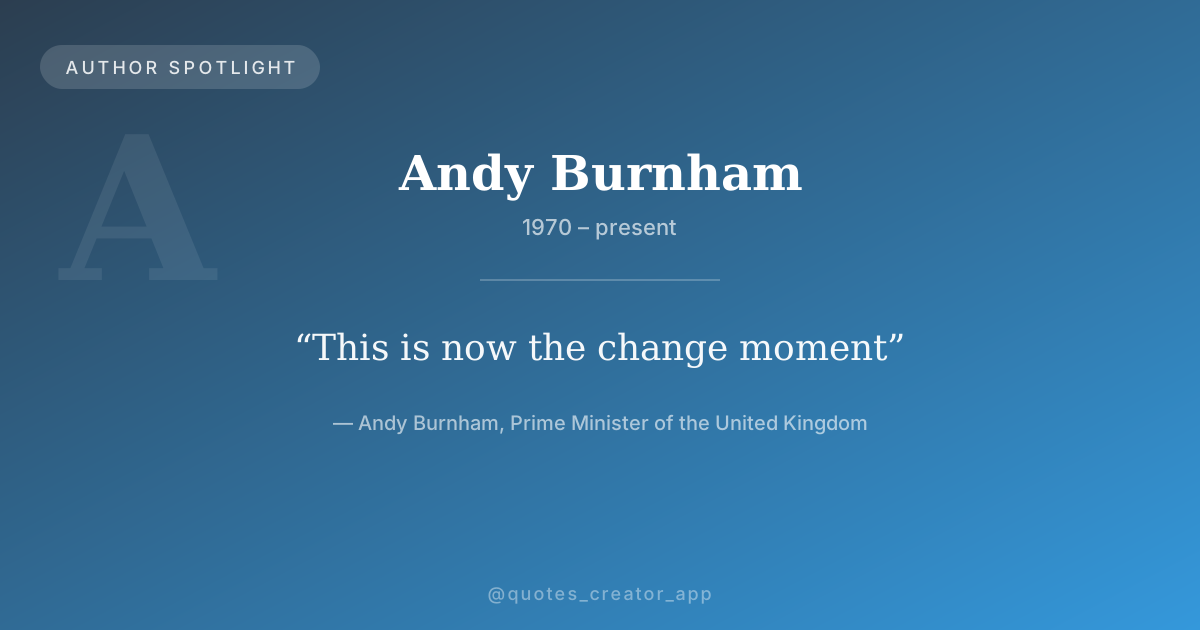
“We’ve been on a path for 40 years that simply hasn’t worked…this is now the change moment.”
The meaning behind these words
When Andy Burnham addressed supporters after winning the Makerfield by-election, this single sentence captured the thesis of his entire political career. The “40 years” he references stretches back to the mid-1980s—the era of Thatcherism, privatisation, and the deregulation that he argues hollowed out Britain’s industrial heartlands and concentrated wealth and power in London and the South East. For Burnham, this is not abstract economic history; it is the lived experience of the communities he has represented for over two decades, communities that watched their manufacturing bases erode, their public services fray, and their political influence diminish.
What makes the phrase “the change moment” so powerful is its deliberate openness. Burnham does not specify exactly what the change entails, because he is inviting the country to define it collectively. This is the rhetorical strategy of a politician who understands that mandates are built not by decree but by consensus. The brevity of the statement also reflects Burnham’s communication style: plain-spoken, free of jargon, and grounded in the conviction that the most important political messages are the ones that feel immediately true to ordinary people. He is not selling a policy agenda; he is naming a feeling that millions of voters already recognise.
“I want Labour solidly to be the party of working class people and working class communities and that requires a lot of change.”
The meaning behind these words
This quote, delivered during his campaign for the Makerfield selection, distills Burnham’s diagnosis of Labour’s identity crisis into a single sentence. He is making two distinct but connected arguments. First, that Labour has lost its claim to be the natural home of working-class voters—a loss evidenced by the erosion of the so-called “Red Wall” and the party’s declining appeal in post-industrial constituencies precisely like Makerfield. Second, that reclaiming this identity cannot be achieved through cosmetic rebranding or clever messaging; it requires “a lot of change”—structural, cultural, and philosophical transformation within the party itself.
Burnham’s insistence on using the term “working class” so unapologetically is itself a political statement. In an era when many politicians prefer euphemisms like “ordinary working families” or “hardworking people,” Burnham reaches for the older, sharper language of class. He understands that class is not merely an economic category but a cultural identity—a sense of belonging, of shared experience, of being rooted in communities that the political establishment has too often patronised or ignored. By speaking this language without embarrassment, he signals to voters that he sees them not as a demographic to be managed but as the people he comes from and intends to serve.
“What we’ve seen today is a deliberate act of levelling down. I don’t believe we can proceed through this pandemic by grinding people down. We need to carry them with us, not crush their spirit.”
The meaning behind these words
In October 2020, as the UK government imposed new COVID-19 restrictions on Greater Manchester without what Burnham considered adequate financial support, he delivered the speech that would define his mayoralty and earn him a national profile. The phrase “levelling down” was a deliberate inversion of the government’s own “levelling up” slogan, exposing what Burnham saw as the gap between Westminster rhetoric and the reality experienced by Northern communities. He was not merely negotiating for more money; he was articulating a moral argument about the relationship between the state and its citizens during a crisis.
The emotional architecture of this quote is revealing. Burnham moves from anger (“deliberate act of levelling down”) to a positive vision (“carry them with us”) and then to a warning (“crush their spirit”). This is the structure of effective political persuasion: name the injustice, offer the alternative, and make clear what is at stake. The word “spirit” is particularly significant. Burnham could have said “livelihoods” or “businesses” or “communities,” but he chose a word that speaks to something deeper—the morale, dignity, and sense of self-worth that prolonged hardship can erode. He was telling the government that its actions did not merely cause economic damage; they inflicted a kind of psychological harm that would take far longer to heal.
“We will change politics, to make it more collaborative, more about problem solving than point-scoring, and will take power out of here and carry it into every postcode in the land, so that they can do more, and in doing more, build a new economy where we put life’s essentials back under stronger public control to make them affordable to you again.”
The meaning behind these words
Delivered at the dawn of his premiership, this passage is Burnham’s most comprehensive articulation of his governing philosophy. It contains three distinct promises nested within a single sentence. The first is procedural: politics will become more collaborative and less adversarial, a rejection of the Punch-and-Judy culture of Prime Minister’s Questions that Burnham has long criticised. The second is structural: power will be devolved to “every postcode in the land,” a commitment rooted in his experience as mayor, where he learned firsthand that decisions made closer to communities tend to be better decisions. The third is economic: the essentials of life—water, energy, transport—will be brought back under stronger public control, a policy agenda that draws directly from his Co-operative Party roots.
The rhetorical genius of the passage lies in its movement from the abstract to the concrete. “Change politics” is a broad and familiar slogan. “Carry it into every postcode” makes it tangible. “Make them affordable to you again” makes it personal. Burnham is telling voters not just what he intends to do but why it will matter in their daily lives. The word “postcode” is a deliberate choice—a term that carries class connotations in Britain and signals that he is speaking to people for whom geography determines opportunity. It is the language of a politician who has spent the better part of a decade proving that governance from a distance does not work and that the people closest to a problem are usually the ones who understand it best.
“I am ready…I have a plan.”
The meaning behind these words
Six words, two sentences, a full stop and an ellipsis between them. This is Burnham’s communication style at its most distilled: direct, unhurried, and freighted with a quiet authority that needs no embellishment. The ellipsis between “ready” and “I have a plan” is doing significant work. It suggests a pause for breath, a moment of gravity, a man standing at the threshold of history and measuring the weight of what comes next. He is not rushing to fill the silence with promises; he is letting the moment speak for itself.
The second sentence—“I have a plan”—is a direct rebuttal to the charge often levelled against Burnham: that he is a man of passion and principle but short on specifics. By foregrounding the plan, he signals a shift from the campaigning phase of his career to the governing phase. It is the difference between someone who merely wants power and someone who knows what to do with it. In an era of political chaos and rapid leadership turnover, “I am ready” also functions as a reassurance. He is telling the country that this transition, however dramatic and sudden, is not a gamble. It is the culmination of two decades of preparation.
Andy Burnham’s legacy
It is unusual to speak of the legacy of a politician who has just entered 10 Downing Street, but Andy Burnham’s impact on British politics already extends beyond the office he now holds. As Mayor of Greater Manchester, he demonstrated that metro mayors could be more than transport administrators—they could be genuine political leaders with national mandates, capable of shaping policy debates and standing up to central government on equal footing. The Bee Network, his integrated public transport system, offered a tangible model for how public ownership could work in practice. His defiance during the COVID-19 pandemic gave a voice to regions that had long felt voiceless in Westminster. These achievements alone would constitute a significant political legacy, regardless of what follows.
His rise to the premiership also represents a structural shift in British politics that historians will study for decades. Burnham is the first Prime Minister to have used a regional mayoralty—a position that did not even exist when he first entered Parliament in 2001—as a springboard to national leadership. He proved that you do not need a safe London seat, a cabinet career in the traditional mould, or the backing of the party machine to reach the highest office. Whether his Manchesterism translates into effective national governance remains to be seen, but the door he has opened will not easily be closed. Future prime ministers, of whatever party, will now have to reckon with the possibility that the road to Westminster runs through the regions.
Create graphics with Andy’s quotes
Andy Burnham’s words have a plain-spoken power that makes them perfect for quote graphics. Whether you are sharing on Instagram, creating a vision board, or looking for daily inspiration, Quotes Creator helps you transform these quotes into beautiful, shareable designs with custom fonts, gradients, and layouts.
Why we chose Andy
Andy Burnham is currently one of the most searched figures on Wikipedia, having just become Prime Minister of the United Kingdom on 20 July 2026—the first Labour and Co-operative Party MP to hold the office. His journey from a village in Cheshire to 10 Downing Street, via a decade as Mayor of Greater Manchester, represents one of the most remarkable political ascents in modern British history. Beyond the headlines, Burnham’s words carry a rare authenticity: they emerge from years of frontline public service rather than focus-grouped messaging, and they articulate a vision of politics rooted in place, community, and the conviction that power should flow outward from Westminster to every postcode in the land.
— ThinkPeak Studio Editorial Team
Create your own quote graphic with this quote
Turn this line into a shareable graphic in seconds — free, no signup needed. For video quotes and 100+ templates, try the Android app.
Advertisement
Enjoyed this article? Get more like it in your inbox.