On this page
Author Spotlight: Andy Weir
American novelist who wrote The Martian and Project Hail Mary, blending hard science with humor and heart
Who was Andy Weir?
Andy Weir was born on June 16, 1972, in Davis, California, and grew up in Livermore, a city shaped by the presence of the Lawrence Livermore National Laboratory. His father was a physicist at the lab and his mother an electrical engineer, so science was woven into the fabric of his childhood. His parents divorced when he was eight, and as an only child, he found solace in the pages of Arthur C. Clarke and Isaac Asimov. By age fifteen, Weir was already working as a computer programmer for Sandia National Laboratories, a sign of the technical mind that would later define his fiction.
After studying computer science at UC San Diego without graduating, Weir spent years working as a programmer for AOL, Palm, MobileIron, and even Blizzard Entertainment, where he was fired for poor performance on Warcraft II. He began writing science fiction in his twenties and built a cult following through his webcomic Casey and Andy, which ran from 2001 to 2008. In 2009, he published a short story called “The Egg” on his website, a philosophical parable about reincarnation and interconnectedness that would go viral years later. But his breakthrough came when he started serializing a novel about an astronaut stranded on Mars, posting chapter by chapter for free online.
The novel, The Martian, became a self-publishing phenomenon. Readers demanded a Kindle edition, so Weir uploaded it for 99 cents. It hit the top of the Amazon bestseller list, and soon Crown Publishing signed him. The print edition debuted at No. 12 on the New York Times bestseller list, and Ridley Scott turned it into a 2015 film starring Matt Damon. Weir won the John W. Campbell Award for Best New Writer in 2016. His approach to science fiction was distinctive: meticulous research into orbital mechanics, botany, and space history, wrapped in a voice that was irreverent, optimistic, and relentlessly problem-solving.
In 2021, Weir published Project Hail Mary, a novel about a teacher-turned-astronaut who must save humanity from an extinction-level threat. It won the Audie Award for Audiobook of the Year, was nominated for the Hugo Award for Best Novel, and was adapted into a 2026 film starring Ryan Gosling and directed by Phil Lord and Christopher Miller. Weir, who has spoken openly about his fear of flying and his experience with aphantasia (the inability to visualize images mentally), continues to live in California with his wife Ashley and their son, writing the kind of hard science fiction that reminds us why we look up at the stars.
Andy Weir’s most memorable quotes
“Every time you victimized someone, you were victimizing yourself. Every act of kindness you’ve done, you’ve done to yourself. Every happy and sad moment ever experienced by any human was, or will be, experienced by you.”
The meaning behind these words
This passage from Weir’s most famous short story, “The Egg,” presents a radical vision of cosmic unity. In the story, a soul learns after death that every human who has ever lived is actually the same soul, reincarnated across time and space. The idea is both humbling and empowering: there is no true “other,” only different versions of yourself. This philosophical framework dissolves the boundary between self and other, making compassion not just a moral choice but an act of self-preservation.
What makes this quote so powerful is how it reframes everyday morality. It asks us to consider that every act of cruelty is self-inflicted and every kindness is a gift to ourselves. Weir, who describes himself as agnostic, wrote “The Egg” not as religious doctrine but as a thought experiment about empathy. The story has been adapted into YouTube videos with millions of views and inspired the concept of rapper Logic’s album Everybody, proving that a simple idea, well told, can ripple across culture in unexpected ways.
“As you can see, this plan provides many opportunities for me to die in a fiery explosion.”
The meaning behind these words
This single sentence captures everything readers love about Mark Watney, the protagonist of The Martian, and by extension, everything that defines Andy Weir’s narrative voice. Watney is stranded alone on Mars, his supplies are running out, and every solution he devises carries mortal risk. Yet he approaches each life-or-death calculation with a kind of gallows humor that transforms terror into comedy. The line is not just a joke; it is a coping mechanism, a declaration that even in the face of impossible odds, the human spirit can choose levity over despair.
Weir’s genius as a writer lies in this tonal alchemy. He takes the most dire circumstances imaginable and injects them with wit, making hard science not just accessible but genuinely fun. This quote became emblematic of the novel’s appeal: it promised readers that they would learn about orbital mechanics and botany, but they would laugh along the way. The Martian proved that science fiction could be both intellectually rigorous and emotionally uplifting, a formula Weir would refine in every book that followed.
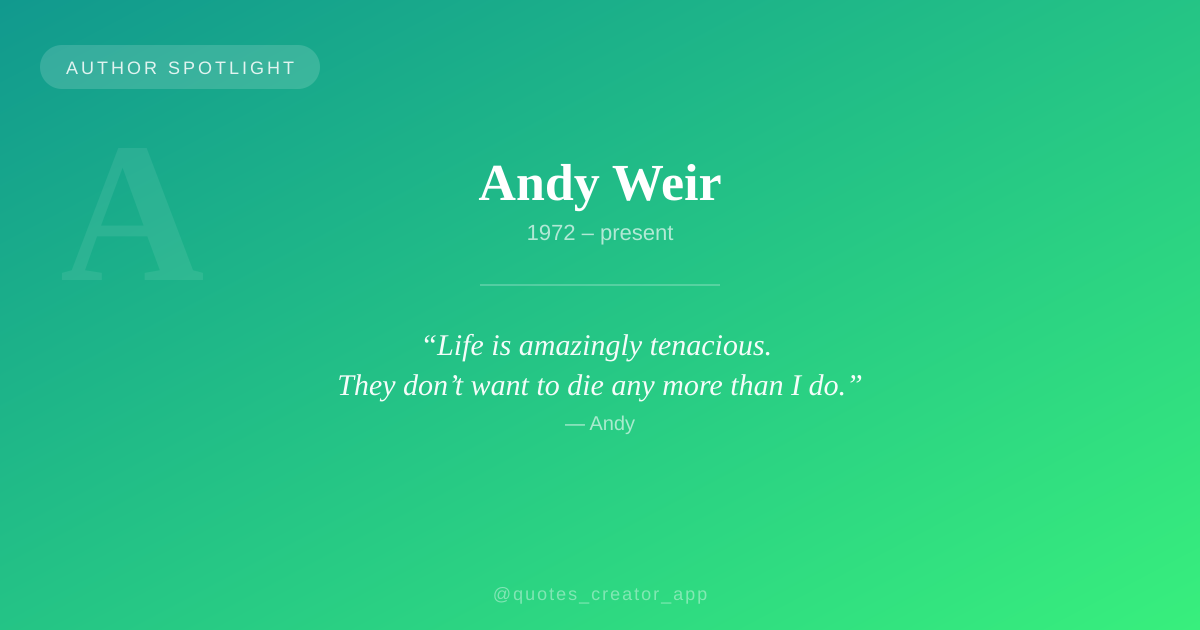
“Life is amazingly tenacious. They don’t want to die any more than I do.”
The meaning behind these words
In The Martian, Mark Watney discovers that some bacteria he exposed to the Martian surface have survived the vacuum and cold. His observation that life is “amazingly tenacious” becomes a metaphor for his own situation. He too is exposed to an environment that should kill him, and he too refuses to die. The line draws a direct parallel between microbial resilience and human will, suggesting that the drive to survive is not unique to us but is a fundamental property of life itself.
This moment reveals the deep ecological consciousness beneath Weir’s hard sci-fi exterior. He understands that life, in all its forms, fights to persist. The quote resonates because it flips the narrative of human exceptionalism: we are not special because we are smarter or more complex; we are special because we share the same stubborn refusal to give up that a colony of bacteria has. It is a humbling and beautiful thought, one that connects the vastness of space to the smallest forms of life on Earth.
“This allowed me to do what writers treasure more than anything else: catch the reader off-guard. There’s nothing better than knowing you’re going to outwit the reader. And the type of people who read sci-fi are very difficult to outwit.”
The meaning behind these words
In this essay appended to The Martian, Weir reflects on the craft of writing science fiction. He acknowledges that sci-fi readers are among the most intelligent and discerning audiences in literature; they have read widely, understand scientific principles, and can spot a plot hole from a hundred pages away. For Weir, this is not a problem to be solved but a challenge to be savored. He describes the joy of building a puzzle so meticulously that even the sharpest reader cannot see the solution coming, yet when it arrives, it feels inevitable.
This quote reveals Weir’s deep respect for his audience. He does not dumb down his science or simplify his plots. Instead, he trusts his readers to follow him through equations, engineering problems, and complex orbital mechanics because he knows they are along for the ride. His goal is not just to entertain but to engage, to create a partnership between writer and reader in which the payoff is earned through intellectual rigor. It is a philosophy that has earned him a fiercely loyal fanbase and elevated the standard for modern science fiction.
Andy’s legacy
Andy Weir’s impact on science fiction is difficult to overstate. At a time when the genre was increasingly dominated by dystopian visions and soft worldbuilding, Weir brought hard science fiction roaring back into the mainstream. The Martian alone inspired a generation of readers to care about orbital mechanics, botany, and the practical challenges of space exploration. NASA reported increased public interest in Mars missions after the book and film, and educators around the world used the novel to teach STEM concepts in engaging new ways.
Weir proved that a self-published author with no literary connections, no MFA, and no traditional path to publication could become one of the bestselling science fiction writers in the world. His journey from programmer to novelist is a testament to the power of persistence, technical knowledge, and authentic voice. As Project Hail Mary reaches theaters in 2026, Weir’s star continues to rise, and his influence on how we think about science, survival, and the human spirit will endure for decades to come.
Create graphics with Andy’s quotes
Andy Weir’s words have a timeless quality that makes them perfect for quote graphics. Whether you are sharing on Instagram, creating a vision board, or looking for daily inspiration, Quotes Creator helps you transform these quotes into beautiful, shareable designs with custom fonts, gradients, and layouts.
Why we chose Andy
Andy Weir is having a moment. With the release of the Project Hail Mary film starring Ryan Gosling in 2026, his readership is expanding faster than ever. But beyond the Hollywood adaptations, Weir represents something rare in modern publishing: a self-taught programmer who accidentally became one of the most beloved science fiction authors of his generation. His commitment to scientific accuracy, his irreverent humor, and his optimistic vision of human ingenuity feel especially vital in an era that often feels short on hope. We wanted to spotlight an author whose work reminds us that science is not cold or sterile, but deeply, beautifully human.
— ThinkPeak Studio Editorial Team
Create your own quote graphic with this quote
Turn this line into a shareable graphic in seconds — free, no signup needed. For video quotes and 100+ templates, try the Android app.
Advertisement
Enjoyed this article? Get more like it in your inbox.