On this page
Author Spotlight: Angela Lansbury
There has never been a career quite like hers, and there almost certainly never will be again. Angela Lansbury was onscreen in 1944, at seventeen, playing a cockney maid who torments Ingrid Bergman in Gaslight — and she was still working in 2022, at ninety-six, turning up for a final surprise appearance that made audiences gasp and cheer. In the eighty years between, she did everything the entertainment business has to offer and more besides: she was a teenage Oscar nominee, a Hollywood contract player typecast as a series of older, often villainous women, then a Broadway colossus who won four Tony Awards for Best Actress in a Musical, then, at fifty-nine, the most famous woman on television as the mystery writer Jessica Fletcher, then, at sixty-six, the singing teapot Mrs. Potts whose lullaby would be heard by generations of children who had no idea they were listening to a legend. “I’d like to be remembered as somebody who entertained,” she said, and the sentence turned out to be the quiet thesis of her entire life — a life that began in a comfortable London drawing room, was interrupted by a war and a father’s early death, and ended as the longest-running leading career of any actress of her era. This is the story of the woman who worked for eight decades and never stopped.
Who is Angela Lansbury?
Angela Brigid Lansbury was born on 16 October 1925 in Regent’s Park, central London — a birthplace she insisted upon over the Poplar that reference books often gave her — into a family that was at once comfortable and quietly extraordinary. Her father, Edgar Lansbury, was a wealthy timber merchant who had served as mayor of Poplar and belonged to the Communist Party of Great Britain; her mother, Moyna Macgill, was a Belfast-born Irish actress who worked the West End stage; and her paternal grandfather was George Lansbury, the towering leader of the Labour Party, a man she would remember as “a giant in my youth.” The household was steeped in politics and theatre in equal measure, and the little girl absorbed both. When she was nine, her father died of stomach cancer, and she retreated into the one thing that made the loss bearable: she began pretending to be other people, disappearing into invented characters as a way of escaping a world that had suddenly gone cold. She was educated at South Hampstead High School — a contemporary of Glynis Johns — but considered herself largely self-taught, a self-professed “complete movie maniac” who learned her craft from the cinema screen and from the stage where she watched her mother work.
The war upended everything. In 1940, as the Blitz began to fall on London, her mother took Angela and her twin brothers to safety in America, crossing the Atlantic aboard a ship carrying evacuee children and landing in Montreal before settling in New York, then Hollywood. The sixteen-year-old Angela took her first theatrical job singing Noël Coward songs in a Montreal nightclub, blithely claiming to be nineteen, and by 1942 she had graduated from drama school and signed a seven-year contract with MGM for $500 a week. The break came almost instantly. At a party thrown by her mother she met the screenwriter John van Druten, who was casting Gaslight, and he thought she would be perfect for the part of Nancy, the insolent cockney maid — a role she landed at seventeen, so young that a social worker had to sit with her on set. Her performance earned an Academy Award nomination, and the following year another, for The Picture of Dorian Gray. She was a star at eighteen. But MGM did not quite know what to do with her. “I kept wanting to play the Jean Arthur roles,” she said later, “and Mr. Mayer kept casting me as a series of venal bitches.” Again and again she was dressed up as a woman far older and colder than herself, and the young actress grew restless — a restlessness that would, in time, become the engine of her reinvention.
Her answer was to change the medium. In 1966, at forty, she opened on Broadway as the title character in the musical Mame, and the woman Hollywood had underused became the undisputed queen of the American musical theatre. Over the next dozen years she won four Tony Awards for Best Actress in a Musical — for Mame, Dear World, Gypsy, and Stephen Sondheim’s Sweeney Todd, in which her performance as the murderous pie-maker Mrs. Lovett is still regarded as one of the great turns in the history of the American stage. There was a cost to all of it, and it is the part of the story she refused to hide: during the early 1970s her children, Anthony and Deirdre, fell into drug addiction, and she and her husband, the producer Peter Shaw, uprooted the family to a farm in Ireland to rescue them — stepping away from the stage at the very height of her powers, because the work that mattered most was at home. The children recovered, the marriage lasted fifty-four years until Shaw’s death in 2003, and Lansbury returned to her career with a ferocity that had only deepened. She was, by any measure, the rarest kind of star: one who treated fame as an interruption and work as the point.
The last act made her immortal. In 1984, at fifty-nine, she took the role of Jessica Fletcher, the widowed mystery writer who solves murders between chapters, in the CBS series Murder, She Wrote — a part she expected to last a year or two and instead played for twelve seasons, co-producing the show with her husband and becoming one of the most recognizable faces on earth. Then came the roles that carried her across the century line: Mrs. Potts in Disney’s Beauty and the Beast, the Dowager Empress in Anastasia, the stately matriarchs of Nanny McPhee and Mary Poppins Returns. The honors piled up — six Tony Awards, six Golden Globes, an Olivier, three Oscar nominations, the National Medal of the Arts, a Kennedy Center Honor, an honorary Academy Award, and in 2014 a damehood from Queen Elizabeth II — but she wore them all lightly, always insisting that the job itself was the reward. Angela Lansbury died peacefully in her sleep at home in Los Angeles on 11 October 2022, five days short of her ninety-seventh birthday, one of the last surviving stars of Hollywood’s Golden Age and, by the time she left, the longest-working leading actress the medium had ever known.
Angela Lansbury’s most memorable quotes
“I’m eternally grateful for the Irish side of me. That’s where I got my sense of comedy and whimsy. As for the English half — that’s my reserved side … But put me onstage, and the Irish comes out.”
The meaning behind these words
This is the most personal thing Lansbury ever said about where her gift came from, and it is a small masterclass in self-knowledge. She splits herself down the middle — the reserved, contained, rather formal English half on one side, the comic, whimsical, expansive Irish half on the other — and then reveals the whole trick of her art in a single clause: the stage is the place where the hidden half is allowed to come out. There is a generosity in the framing that is easy to miss. She is not claiming that acting invented some version of herself that did not exist; she is saying that the performer everyone loved was always inside her, inherited from a Belfast mother and a theatrical bloodline, waiting for the moment when the lights went up and she was permitted to be entirely herself. The reserved half, in her telling, is not a mask that falls away onstage; it is simply the part that has learned to step back.
The quote also explains the peculiar chemistry that made her so beloved, because it describes a tension rather than a resolution. Lansbury was at once the most dignified of presences — that exquisite, almost regal composure, that crystal diction — and the most playful, able to tilt a scene into farce or warmth with the twitch of an eyebrow. Audiences sensed both halves at once, and the friction between them is what made her mesmerizing. She is offering, quietly, a philosophy of identity that applies far beyond the footlights: that no one is one thing, that the self is a partnership of inherited temperaments, and that the goal of a life well lived is not to choose between them but to give each its proper stage. For her, that stage happened to be a literal one. But the deeper lesson is for anyone who has ever kept a part of themselves hidden — that the reserved half is not the enemy of the comic half, and that the whole person emerges only when both are allowed their turn.
“I was never going to get to play the girl next door. And I was never going to be groomed to be a glamorous movie star. And I sort of realized that. So I had to make peace with myself on that score.”
The meaning behind these words
This is the sentence of a woman who looked honestly at what the world was offering and decided to stop grieving what it was not. Lansbury came up in a Hollywood that had a very precise idea of what a female star should be — young, glamorous, romantically available, the girl next door — and she knew, from almost the first moment, that she was never going to be cast in that image. What is remarkable is not that she recognized this early; it is that she made peace with it and built something greater on the other side of the disappointment. There is no bitterness in the sentence, no trace of the grievance that would have been hers to nurse. There is only the calm, clear-eyed acceptance of a working actress who understood that the path to a remarkable career was not to wish she were someone else but to become the best possible version of the person she actually was.
And that acceptance turned out to be the most liberating decision of her life. Because she was never chasing the girl next door, she was free to take the parts no one else wanted — the villains, the eccentrics, the women decades older than herself, the roles that required teeth and intelligence rather than glamour — and it was precisely those roles that made her one of the great character actresses of the century. The quote is, at bottom, an argument against comparison and for vocation. The world keeps trying to hand each of us a template, a picture of who we were supposed to be; Lansbury’s example is the refusal to spend a life measuring herself against it. “I had to make peace with myself,” she says, and the phrase matters — the peace was not made with Hollywood, or with fate, but with herself, which is the only peace that ever really holds.
“Any actress will tell you that evil roles to play are the best. You can go to town, you know?”
The meaning behind these words
There is a delight in this sentence that tells you everything about the kind of artist she was. Lansbury had spent years being handed the most unpleasant women in the studio system — the blackmailing maid, the cold mother, the scheming adventuress — and instead of resenting the typecasting, she had discovered its secret: that the villain is the most fun person in the room to play. “You can go to town” is the giveaway. The good girl is constrained by the obligation to be liked, to be virtuous, to stay inside the narrow lines of sympathy; the villain is free to be anything — cruel, funny, brilliant, seductive, tragic — because the audience has already released her from the duty of being lovable. For a serious actress, that is not a burden but a playground, and Lansbury understood that the characters everyone loves to hate are often the ones an actor loves the most.
There is a deeper insight here about freedom, and it is the reason she was so good at it. The greatest villainous performances — her Mrs. Iselin in The Manchurian Candidate, her Mrs. Lovett in Sweeney Todd — are great not because they are evil but because they are whole, because the actor refused to flatten a human being into a warning and instead played the full, contradictory, entirely alive person inside the wickedness. Lansbury called one of these women “the Lear among movie women,” and the comparison is precise: like Shakespeare’s king, her great villains carry the entire weight of a life, not just a sin. The quote is a small celebration of the craft’s dirty secret — that the most liberating thing an actor can be asked to do is stop being nice. And it is a quiet reminder, for the rest of us, that the parts of ourselves we are told to hide are often the most interesting, the most truthful, and the most alive.
“When I first started Murder, She Wrote, I thought it would last maybe two, three years … I was sort of trapped — happily trapped — for twelve years with it. And I’m still playing Jessica from time to time and loving it. I wouldn’t want to let go of that lady.”
The meaning behind these words
“Happily trapped” is one of the most honest things any actor has ever said about success, and it contains a whole philosophy in two words. Lansbury is being wryly candid about the bargain at the heart of a hit: the role that makes you famous also owns you, demands your time for a decade, becomes the thing people shout at you on the street. Most performers spend their careers desperate for exactly that captivity and then complain about it the moment they have it. Lansbury did something rarer — she admitted the trap, and then she chose it, cheerfully, for twelve years, because she understood that being adored by millions as a character you actually respect is not a cage at all but a gift. She never resented Jessica Fletcher; she felt about the character the way the audience did, with affection and a little pride.
The deeper meaning lies in why she loved the part, and it is the reason the show mattered. Jessica Fletcher was a woman of a certain age who was still the center of her own story — vital, curious, fearless, attractive in a way television had almost never allowed older women to be — and Lansbury knew she was doing something quietly revolutionary by playing her. She described Jessica as embodying “all of the qualities that I like about women … valiant and liberal and athletic and exciting and sexy and all kinds of good stuff that women are of a certain age and are not given credit for.” That is the real subject of the quote: not a career, but a correction. For twelve years, in living rooms across the world, Angela Lansbury stood in the middle of the screen and proved that a woman did not stop being the heroine of her life simply because she had turned sixty. She never wanted to let go of that lady, she said — and a generation of women was grateful she did not.
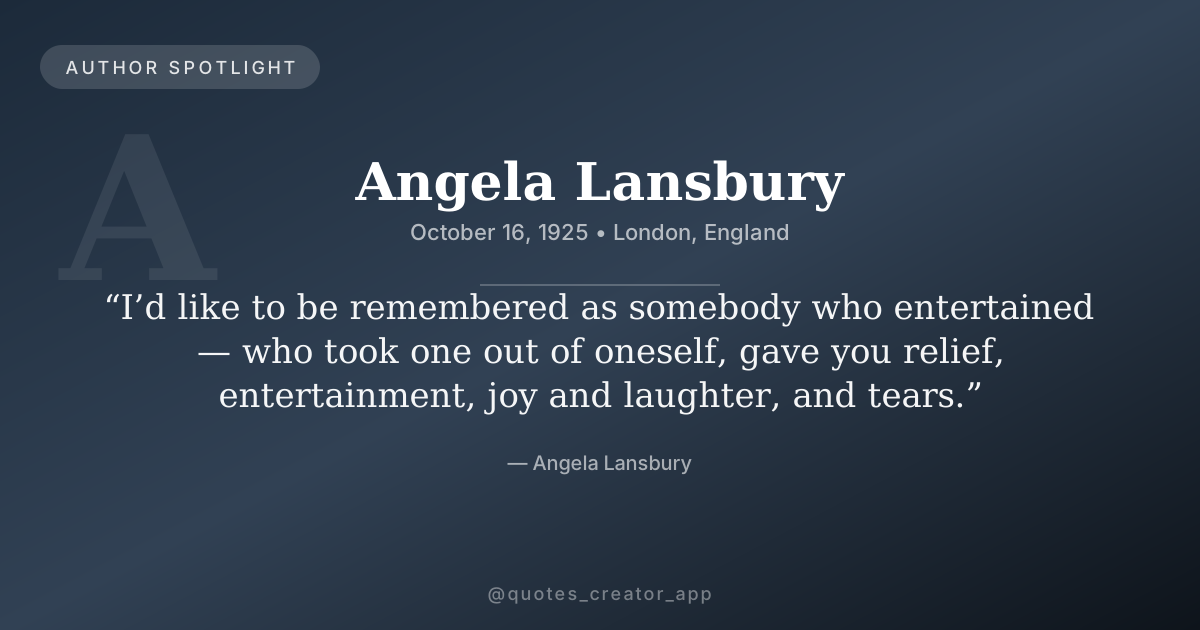
“I’d like to be remembered as somebody who entertained — who took one out of oneself — for a few minutes, a few hours — transported you into a different venue — gave you relief, gave you entertainment, and gave you joy and laughter, and tears — all those things.”
The meaning behind these words
Asked how she would like to be remembered, a woman with six Tonys and an Oscar nomination before she was twenty and the longest leading career in the history of her medium did not reach for any of it. She did not mention the awards, the damehood, the box office, the applause. She reached instead for the word that best describes what she actually spent her life doing: she entertained. And then she defined what she meant with a tenderness that borders on the devotional — to take a person out of themselves, out of their own worries and griefs, and carry them somewhere else for a while; to give them relief, and joy, and laughter, and even tears, the full range of what it means to feel. In her accounting, the actor’s job was not self-expression but service, not the pursuit of glory but the relief of strangers. It is a startlingly humble self-portrait from a woman who had every right to describe herself in grander terms.
And that humility is exactly what made her great, because it is the secret of her longevity. An artist who sees her work as service never runs out of reasons to keep doing it; there is always another stranger who needs to be transported, another living room where a familiar face can make an evening softer. She did not chase novelty or reinvention for its own sake; she simply kept showing up, decade after decade, doing the same generous thing in a hundred different costumes. The phrase “all those things” is the key — joy and laughter and tears held together in a single breath, because the whole point of entertainment, as she understood it, was to make a person feel alive across the entire register of the heart. It is a definition of art as an act of love, and it explains why, when she died, the grief felt so personal to so many: she had spent eighty years giving herself away to an audience, and the audience had come to think of her as family.
Angela Lansbury’s legacy
The measurable legacy is easy to state and, on its own, almost unbelievably long. Angela Lansbury worked for eighty years — from Gaslight in 1944 to her final screen appearance in 2022 — and in that span she won six Tony Awards, six Golden Globes, and an Olivier; earned three Academy Award nominations and eighteen Emmy nominations; received the National Medal of the Arts, a Kennedy Center Honor, an honorary Academy Award, and a damehood from the Queen. She was the last surviving star of Hollywood’s Golden Age, the woman who could claim to have shared the screen with Ingrid Bergman and been a friend to Elizabeth Taylor, the voice of Mrs. Potts singing children to sleep in Beauty and the Beast, the face of Jessica Fletcher that ran in living rooms in dozens of languages for twelve straight seasons. Any one of those lines would have been a career. She had them all, stacked end to end, and she earned every one through the least glamorous virtue there is: she simply never stopped working.
The deeper legacy is the shape she gave to the idea of a woman’s career, and it is the reason her name means more than the sum of her credits. Lansbury was cast aside by Hollywood in her twenties as too plain, too odd, too hard to categorize — and instead of accepting that verdict, she rebuilt herself on Broadway at forty, became a global television star at fifty-nine, and kept going, beloved and in demand, until she was ninety-six. She proved, over and over, that a woman’s story does not end at the age the industry said it ended — that talent has no expiration date, and that a woman of sixty, seventy, eighty could still be the vibrant, interesting, fully alive center of a narrative rather than its footnote. Jessica Fletcher was not just a character; she was an argument, made weekly for twelve years, that age is not an ending. No actress before her had demonstrated that proposition so completely, so publicly, or for so long, and every older woman who works on screen today does so in the shadow of the door Angela Lansbury kicked open.
And there is, finally, the legacy of the thing she asked for, the only epitaph she ever wanted. She said she hoped to be remembered as somebody who entertained — who took people out of themselves and gave them joy and laughter and tears — and by that measure her legacy is not a trophy case but a feeling, reproduced in a billion separate rooms across eighty years. This is the rarest achievement in a business built on novelty and noise: Angela Lansbury became a comfort. Her voice, her face, her unshakeable presence became something people reached for when the world was too much — a reliable kindness in the form of a woman who never let them down. Stars are forgotten; comforts are remembered. She was both, and it is the second of those that explains why, nearly four years after she left, her pageviews still surge and her name still carries the warmth of someone who was, for an impossible span of time, part of the family. “I would like to be remembered as somebody who was capable of doing that,” she said — the gentlest of understatements from a woman who spent a century proving she was capable of everything.
Create graphics with Angela Lansbury’s quotes
Lansbury’s words carry the same quality as her performances — warm, clear-eyed, and built to last. Whether you need a line about making peace with yourself, about the parts of you that come out on stage, or about wanting to be remembered for the joy you gave, Quotes Creator helps you turn these quotes into beautiful, shareable designs with custom fonts, gradients, and layouts.
Why we chose Angela Lansbury
Angela Lansbury enters this spotlight at a moment when her name is, once again, a quiet fixture of the cultural conversation. Her Wikipedia pageviews surged past fifty thousand in a single day this week — a figure that speaks less to any single news event than to the permanent, unkillable affection the public still holds for a woman who worked for eight decades and never once disappointed. But the timing, as it always is with these spotlights, is secondary to the substance. We chose Lansbury because her life is one of the rare ones that works as both a story and a lesson — the evacuee schoolgirl who fled the Blitz and became a teenage Oscar nominee, the contract player Hollywood discarded who rebuilt herself as the queen of Broadway, the fifty-nine-year-old who became the most famous woman on television, the ninety-six-year-old who was still, impossibly, showing up.
The five quotes we have selected trace the spine of that story. They begin with her clearest account of her own gift — the Irish half that came out the moment she stepped onstage. They move through the acceptance that freed her, her refusal to grieve the glamorous leading lady she was never going to be. They reach the joy she found in the villains nobody else wanted to play, and then the “happily trapped” twelve years of Jessica Fletcher, the role that quietly rewrote what television believed an older woman could be. And they end where she ended, with the epitaph she chose for herself — that she wanted to be remembered as somebody who entertained, who took people out of themselves and gave them joy and laughter and tears. These are not the maxims of a comfortable life. They are the words of a woman who understood, better than almost anyone, that work is a kind of love, that age is not an ending, and that a career spent giving strangers a few hours of relief is a career with no expiration date.
— ThinkPeak Studio Editorial Team
Create your own quote graphic with this quote
Turn this line into a shareable graphic in seconds — free, no signup needed. For video quotes and 100+ templates, try the Android app.
Advertisement
Enjoyed this article? Get more like it in your inbox.