On this page
Author Spotlight: Ann Widdecombe
British politician, author, and television personality known for her uncompromising social conservatism, fierce Euroscepticism, and razor-sharp wit
Who was Ann Widdecombe?
Ann Noreen Widdecombe was born on 4 October 1947 in Bath, Somerset, the only daughter of a senior Ministry of Defence civil servant. Her childhood was shaped by discipline and duty—she attended the Royal Naval School in Singapore before returning to England for convent schooling at La Sainte Union in Bath. An academically gifted student, she read Latin at the University of Birmingham before pursuing Philosophy, Politics and Economics at Lady Margaret Hall, Oxford, where she served as both secretary and treasurer of the Oxford Union. Before entering Parliament, she worked at Unilever and as an administrator at the University of London—a grounding in the real world that would inform her no-nonsense political style for decades to come.
Widdecombe’s political career spanned over three decades, beginning with her election as Conservative MP for Maidstone in 1987. She rose through the ministerial ranks under John Major, serving as Minister of State for Employment and later as Minister of State for Prisons—a role in which she famously visited every prison in the United Kingdom. In opposition, she became Shadow Health Secretary and then Shadow Home Secretary under William Hague, establishing herself as one of the most recognisable and formidable voices on the Conservative frontbench. Her 2001 leadership bid, though unsuccessful, cemented her reputation as a politician who would rather lose on principle than win through compromise. After retiring from the Commons in 2010, she reinvented herself as a television personality—tangoing across the Strictly Come Dancing ballroom and finishing runner-up on Celebrity Big Brother—before returning to frontline politics with the Brexit Party in 2019 and later serving as Reform UK’s immigration and justice spokesperson.
At the core of Widdecombe’s worldview lay an unshakeable religious faith and a conviction that principles must never be sacrificed to popularity. A convert from Anglicanism to Roman Catholicism, she described leaving the Church of England as the culmination of years of disillusionment with an institution that, in her view, had compromised on everything. Her social conservatism—opposition to abortion, to same-sex marriage, to assisted dying—was grounded not in malice but in a coherent moral framework she had held since her agnostic youth. She supported the reintroduction of the death penalty for the most serious murders, called for zero tolerance on cannabis, and was a passionate opponent of fox hunting. On every issue, from climate change scepticism to Euroscepticism, she followed her own compass. “Never judge something by whether it is popular or not,” she insisted—a maxim she lived by, often at considerable political cost.
Widdecombe never married and had no children—a fact she addressed with characteristic candour, once describing herself as “toothy, dumpy, ugly, overweight, a spinster—what the hell?” She retired to a cottage on Dartmoor, finding solace in rolling scenery, wildlife, and her cats, far from the Westminster village she had both served and skewered. On 9 July 2026, she was found dead at her Devon home at the age of 78. Devon and Cornwall Police launched a murder investigation—a tragic end that has shocked the nation and prompted an outpouring of tributes from across the political spectrum. Even those who disagreed with her most fiercely acknowledged that she was, in the truest sense, one of a kind.
Ann Widdecombe’s most memorable quotes
“Never judge something by whether it is popular or not. You don’t have to follow trends. No one thought William Wilberforce was right at first.”
The meaning behind these words
This is perhaps the single most defining statement of Widdecombe’s political philosophy—a belief that moral truth is not determined by majority opinion and that courage means standing alone when necessary. Her invocation of William Wilberforce, the MP who spent decades fighting the slave trade against overwhelming public indifference and hostility, was no casual reference. Widdecombe saw herself in that tradition: a parliamentarian who measured success not by approval ratings but by fidelity to conscience. Throughout her career, she voted against her party whip, spoke against the prevailing wind, and accepted the consequences—including being passed over for Cabinet positions because her pro-life views made her, in the eyes of party managers, unsuitable for the health portfolio.
What makes this quote particularly resonant is its complete absence of self-pity or moral superiority. Widdecombe was not lamenting her outsider status; she was explaining a methodology. She believed that ideas must be tested against principle, not polling data, and that political courage is the willingness to risk being wrong in public. In an era of focus-grouped soundbites and triangulated messaging, her words read as both a critique of modern politics and a challenge to anyone who would enter public life. They remind us that history often vindicates those who were dismissed in their own time—and that the first person to say something true usually says it alone.
“I am toothy, dumpy, ugly, overweight, a spinster—what the hell?”
The meaning behind these words
In a world of carefully curated political imagery, Widdecombe’s self-deprecation was genuinely radical. This quote—delivered with the wry half-smile that became her trademark—encapsulated her refusal to play the image game that consumed so many of her colleagues. By listing every conventional criticism of her appearance and then dismissing them all with a cheerful “what the hell?”, she performed a kind of rhetorical jiu-jitsu: acknowledging the superficial standards by which public figures are judged while simultaneously rendering them absurd. It was a liberation strategy—once you have named the worst things anyone could say about you and declared them irrelevant, there is nothing left for critics to weaponise.
The quote also reveals something deeper about Widdecombe’s relationship with her own life choices. She was a woman who built an extraordinary career in a male-dominated institution, who served at the highest levels of government, who wrote four novels and became a beloved television personality—and yet she was perpetually defined by what she was not (married, conventionally attractive, ideologically compliant). Her response was not to protest the framing but to laugh at it, and in doing so, to expose how narrow our definitions of a successful life really are. It was a masterclass in refusing to be shamed for choices that were never anyone else’s business.
“History is not merely a procession of people in fancy dress fighting wars. It is crucially the story of man’s evolution from grunting cave dweller to serious thinker, from cruelly retributive law to merciful law, from casual barbarism to care and compassion.”
The meaning behind these words
This quote reveals a dimension of Widdecombe that was often overlooked by commentators who reduced her to a collection of controversial positions. Here was a politician with a genuinely philosophical mind, shaped by her classical education and her deep engagement with the Western intellectual tradition. She viewed history not as a catalogue of dates and battles but as a moral arc—a slow, uneven, but unmistakable progression from barbarism toward civilisation. For a woman often caricatured as reactionary, this was a profoundly optimistic vision: the belief that humanity has, on the whole, moved in the direction of greater mercy and understanding.
The framing is also instructive. Widdecombe anchors progress not in technological achievement or economic growth but in the evolution of law from retribution to mercy, and of society from casual cruelty to care. This was the lens through which she understood her own work as prisons minister—not merely as punishment, but as an opportunity for rehabilitation and moral improvement. It also explains why, despite her hardline positions on some issues, she could also be found campaigning for animal welfare, visiting every prison in the country, and writing with genuine warmth about the forgotten and the marginalised. Her conservatism was not about freezing society in place but about stewarding its moral development.
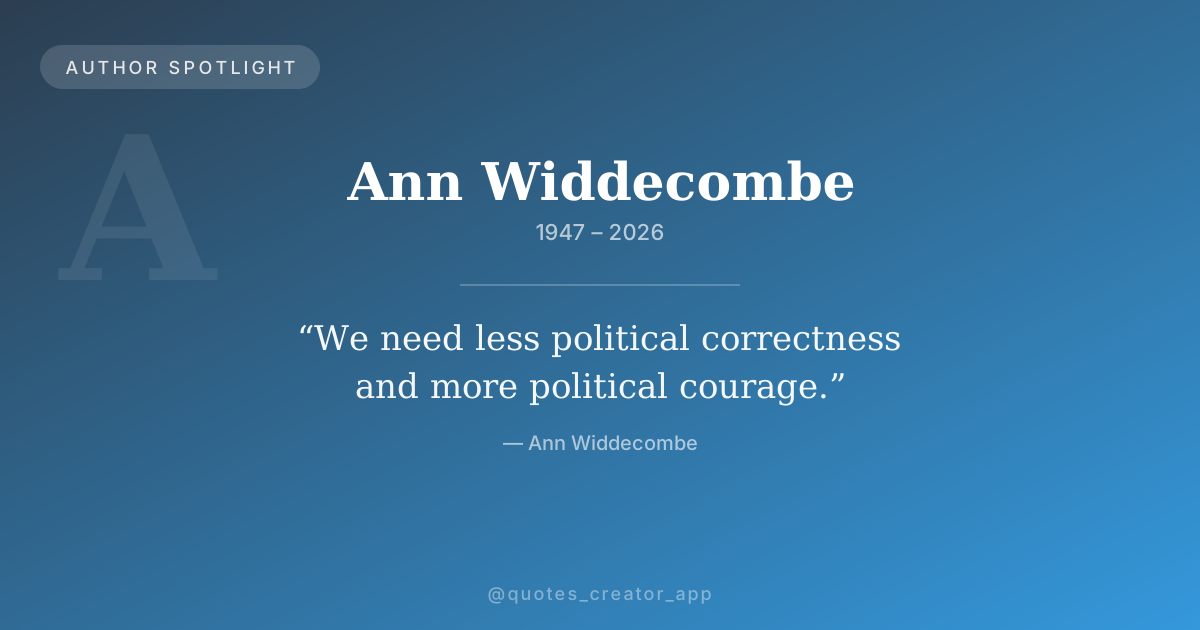
“We need less political correctness and more political courage.”
The meaning behind these words
If one sentence could be engraved on Widdecombe’s political tombstone, this would be it. The quote distils her entire critique of modern public life into eleven words: that an obsession with not causing offence has paralysed genuine debate, and that the true vocation of a politician is not to be liked but to be honest. Widdecombe drew a sharp distinction between courtesy—which she valued—and political correctness, which she saw as a cowardly avoidance of difficult truths. She believed that telling people what they wanted to hear was not kindness but condescension, and that real respect meant engaging with disagreement openly and without pre-emptive apology.
This philosophy explains both her most admired and most controversial moments. It is why she could describe her own appearance with brutal honesty, why she could tell the Conservative Party establishment that Michael Howard had “something of the night about him,” and why she could switch parties twice without a hint of embarrassment. Consistency, for Widdecombe, was not about tribal loyalty but about intellectual integrity. The quote invites a question that remains urgently relevant: in a culture that increasingly polices language and punishes deviation from orthodoxy, who is brave enough to say what they actually think?
“I left the Church of England because there was a huge bundle of straw. The ordination of women was the last straw, but it was only one of many. For years I had been disillusioned by the Church of England’s compromising on everything. The Catholic Church doesn’t care if something is unpopular.”
The meaning behind these words
This quote illuminates the spiritual engine beneath Widdecombe’s entire political project. Her conversion to Catholicism in 1993 was not a sudden revelation but the culmination of years watching an institution she believed had traded doctrinal clarity for cultural relevance. The ordination of women was merely the final catalyst; the deeper issue was her perception that the Church of England had become an organisation that followed rather than led, that adjusted its teachings to fit the temper of the times rather than holding the temper of the times to account. When she found in Catholicism an institution that “doesn’t care if something is unpopular,” she found a spiritual home that matched her political temperament.
The quote also reveals the theological consistency behind positions that often seemed contradictory to secular observers. Why would a woman oppose the ordination of women? Why would a fiercely independent thinker submit to an authoritarian religious hierarchy? For Widdecombe, the answer was simple: truth is not determined by democratic vote or cultural fashion. The Catholic Church’s willingness to hold unpopular positions was, in her view, evidence of its authenticity, not its error. This same logic underpinned her Euroscepticism, her social conservatism, and her climate scepticism. She was not contrarian for its own sake; she was searching, always, for institutions and ideas that would not bend to the prevailing wind.
Ann’s legacy
Ann Widdecombe leaves behind a legacy as complex and uncompromising as the woman herself. To her supporters, she was a beacon of principle in an age of political plasticity—a politician who said what she meant, meant what she said, and accepted the consequences without complaint. Her willingness to cross the floor, to criticise her own side, and to retire from the Commons on her own terms rather than cling to office marked her as a genuinely independent spirit in a system that rewards conformity. Her post-parliamentary reinvention—from Strictly contestant to Big Brother runner-up to MEP to Reform UK spokesperson—demonstrated a remarkable refusal to be defined by any single role or institution. She was, in the deepest sense, her own woman.
To her critics, Widdecombe represented a strain of conservatism that was unyielding to the point of cruelty, particularly on issues of sexuality, gender, and reproductive rights. Her opposition to same-sex marriage, her defence of conversion therapy, and her resistance to equalising the age of consent placed her on what many considered the wrong side of history. Yet even her fiercest detractors could not deny her authenticity. In an era when politicians increasingly resemble algorithmic outputs designed to maximise approval, Widdecombe was refreshingly, sometimes infuriatingly, human. Her sudden death in July 2026—under circumstances that remain the subject of an active police murder investigation—has only deepened the sense that Britain has lost one of its most singular public figures. She will be debated, admired, and criticised for generations to come—which is, perhaps, exactly what she would have wanted.
Create graphics with Ann’s quotes
Ann Widdecombe’s words have a timeless quality that makes them perfect for quote graphics. Whether you are sharing on Instagram, creating a vision board, or looking for daily inspiration, Quotes Creator helps you transform these quotes into beautiful, shareable designs with custom fonts, gradients, and layouts.
Why we chose Ann
Ann Widdecombe was chosen for this Author Spotlight because she embodies a quality increasingly rare in public life: the courage to be unpopular. Across more than three decades in politics, television, and literature, she never once trimmed her sails to catch a favourable wind. Her death on 9 July 2026, at a moment when the nation was suddenly and sharply reminded of her significance, made this the right time to reflect on a life lived with conviction. Whether you agreed with her or not—and she would not have expected you to—there is something to be learned from a person who genuinely did not care what anyone thought, and meant every word she said.
— ThinkPeak Studio Editorial Team
Create your own quote graphic with this quote
Turn this line into a shareable graphic in seconds — free, no signup needed. For video quotes and 100+ templates, try the Android app.
Advertisement
Enjoyed this article? Get more like it in your inbox.