On this page
Author Spotlight: Ansel Adams
He is, by any honest reckoning, the most famous photographer who ever lived — the man whose black-and-white prints of Half Dome and Yosemite Valley and the Sierra Nevada did not merely document the American West but became the way the country sees it. Yet Ansel Adams was never only a photographer. He was a trained concert pianist, a self-taught intellectual, a co-inventor of the most influential technical system in the history of the medium, and one of the most effective conservationists of his century — a man who insisted, with quiet ferocity, that a photograph was not a record of a place but an argument for saving it. “You don’t take a photograph, you make it,” he said, and the sentence turned out to be the operating principle of his entire life: a life that began with a broken nose in a great earthquake, unfolded across more than six decades of walking into the wilderness with a camera on his shoulder, and ended with the nation’s highest civilian honor and a mountain range carrying his name. This is the story of the man who taught America to see.
Who is Ansel Adams?
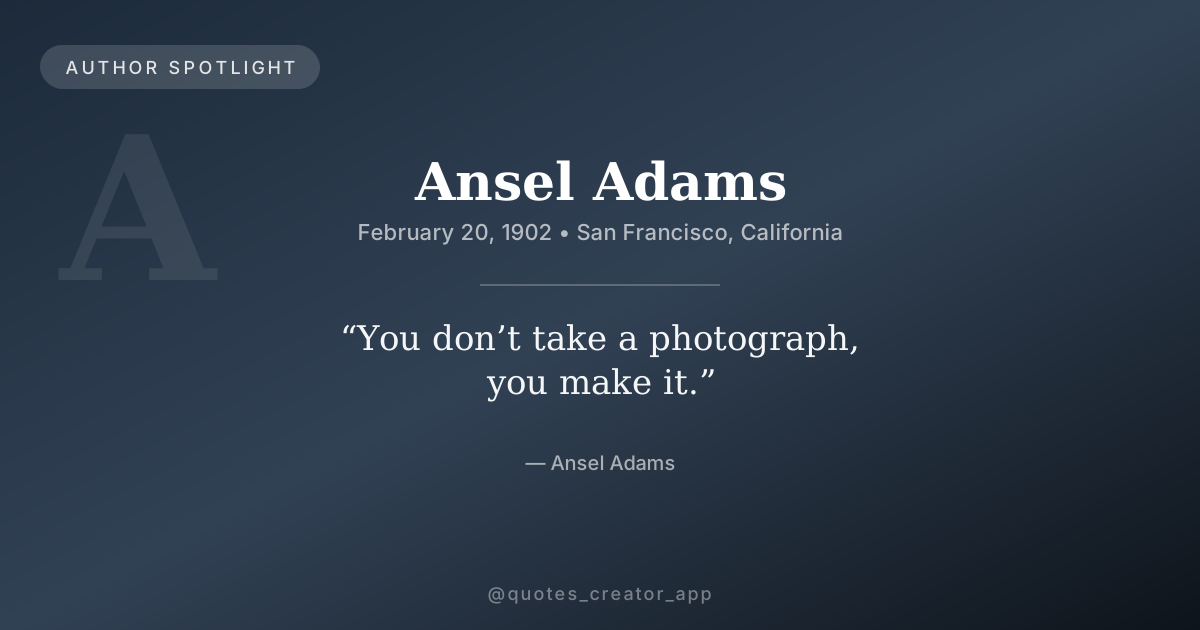
Ansel Easton Adams was born on 20 February 1902 in San Francisco, the only child of Charles Hitchcock Adams and Olive Bray Adams, into a family whose fortune had been built on timber — a fact he would spend the last decades of his life quietly undoing. When he was four years old, an aftershock of the great San Francisco earthquake threw him face-first into a garden wall, breaking his nose so badly that it remained crooked for the rest of his life; the distinctive profile became one of the most recognizable faces in American art. The family fortune, already shaken, collapsed in the financial panic of 1907, and his father spent years failing to rebuild it, while his mother fretted and brooded. Young Ansel was a restless, difficult child — almost certainly dyslexic and hyperactive in an era that had no words for either — and he loathed the regimentation of school so thoroughly that his father pulled him out in 1915, at thirteen, to be educated at home and in the world. The withdrawal was the making of him. Freed from the classroom, he poured himself into the piano, training seriously toward a career as a concert musician, and into long, solitary wandering in the sand dunes and wild country beyond the Golden Gate — the two disciplines that would, in time, fuse into his art.
The third ingredient arrived in 1916, on a family vacation to Yosemite Valley, when his parents gave the fourteen-year-old a Kodak Box Brownie camera. The valley transfixed him. He returned again and again, and in 1919, at seventeen, he joined the Sierra Club and took a job as custodian of its LeConte Memorial Lodge in Yosemite — a posting that gave him both a wilderness home and an audience for his photographs. For a decade he wavered between two futures, pianist and photographer, until a 1927 photograph of Half Dome, Monolith, settled the matter: standing on a cliff with a yellow filter and a gut instinct for where the light was going, he made an image so powerful that he later said it told him he was, at last, a photographer. He married Virginia Best in 1928, the daughter of a Yosemite studio owner, and the two of them built a life and, eventually, a gallery in the valley. In 1932 he helped found Group f/64 with Edward Weston, Imogen Cunningham, and others — a small, fierce movement devoted to “pure” photography, to sharply focused, unmanipulated, straight images that refused the soft, painterly haze of the pictorialists who then dominated the medium. It was, in its quiet way, a declaration of independence for photography as an art.
The intellectual work of Adams’s career came in the late 1930s and early 1940s, when he and Fred Archer developed the Zone System — a method of controlling exposure and development so precisely that a photographer could predict, before releasing the shutter, exactly how the final print would look. It sounds technical, and it was; but Adams always insisted its purpose was expressive, a tool for what he called visualization, the discipline of holding the finished image in the mind before the negative was ever made. Around the same time he codified the craft in a series of books — The Camera, The Negative, The Print — that remain the foundational texts of the medium. In 1941, driving through New Mexico at dusk, he glimpsed the moon rising over the village of Hernandez and, with a single plate remaining, made Moonrise, Hernandez, New Mexico, the photograph that would become the most reproduced image of his career and a monument to the value of knowing exactly what he was doing. He also used the camera to bear witness where others looked away: his 1944 project at the Manzanar internment camp, published as Born Free and Equal, documented the incarceration of Japanese Americans with a humane fury that cost him the book’s commercial reception. He helped establish the photography department at the Museum of Modern Art in 1940, founded the first academic photography program at the California School of Fine Arts in 1946, and co-founded the magazine Aperture in 1952 — institutions that, together, secured photography’s legitimacy as a fine art.
The last great thread of his life was conservation, and it was never separate from the photography. Adams served on the Sierra Club’s board from 1934 to 1971, and his images — collected in books like This Is the American Earth (1960), made with Nancy Newhall, and My Camera in the National Parks — became the visual engine of the modern environmental movement, credited with helping to persuade Congress to protect Kings Canyon as a national park and to establish the Redwood and Point Reyes seashores. He was not a mild advocate: in his eighties he attacked the environmental policies of Ronald Reagan and his interior secretary James Watt with an indignation undimmed by age. In 1980 President Jimmy Carter awarded him the Presidential Medal of Freedom, the nation’s highest civilian honor, citing his efforts “to preserve this country’s wild and scenic areas, both on film and on earth.” He died on 22 April 1984 in Monterey, California, at eighty-two, still working — and within a year the Minarets Wilderness had been renamed the Ansel Adams Wilderness and an 11,760-foot Sierra peak named Mount Ansel Adams, so that the man who spent his life photographing the mountains would be part of them forever.
Ansel Adams’s most memorable quotes
“You don’t take a photograph, you make it.”
The meaning behind these words
This is the shortest sentence Adams ever said about his medium, and it is the one that contains the whole of his philosophy. The verb is doing all the work. “Take” is what the tourist does — the passive, transactional act of pointing a lens at a scene and carrying off a souvenir of it, as though the image already existed and merely needed to be collected. “Make” is what an artist does — the deliberate, laborious act of building an image, of choosing the film and the filter and the moment and the development and the paper and the printing, until the photograph is not a record of what was there but a construction of what the photographer saw and felt. Adams spent his entire life insisting that the difference between the two was the difference between documentation and art. The camera, for him, was not a device that captured reality but an instrument that allowed a prepared mind to interpret it — and the greatness of his photographs came precisely from the refusal to be satisfied with what the lens happened to see.
There is a deeper meaning here about intention, and it is the reason the sentence has traveled so far beyond photography. Everything worth doing, Adams is saying, is made rather than taken — built by choice and skill and foresight rather than stumbled into by chance. This was not the romantic notion of the inspired artist who waits for the muse; it was the disciplined credo of a man who believed that the spontaneous moment is earned by years of preparation, that the perfect instant means nothing without the technique to receive it. His own life was the proof: the child who could not sit still in a classroom became, through decades of patient self-education, the master of a craft so technical that he could calculate the exact gray of a granite face before the sun had even risen on it. “You make it” is not a boast. It is a statement of responsibility — the photographer’s acknowledgment that the image, and everything it will mean to everyone who sees it, is his to create.
“You don’t make a photograph just with a camera. You bring to the act of photography all the pictures you have seen, the books you have read, the music you have heard, the people you have loved.”
The meaning behind these words
Here Adams expands his definition of the “making” of a photograph until it encompasses an entire life. The camera, he concedes, is the least important part of the equation — a box with a lens that anyone can buy. What actually makes the image is everything the photographer has ever seen and read and heard and loved, the whole accumulated weight of a human being brought to bear on a single fraction of a second. It is a startlingly unromantic account of romance: the artist is not a conduit for inspiration but a container of experience, and the photograph is not a gift from the world but a distillation of the self. The list is deliberately ordered, moving from the visual (pictures seen) through the verbal (books read) and the aural (music heard) to the intimate (people loved), until it reaches the thing that cannot be taught or bought — the capacity to love, which he quietly places at the summit of the sentence as the deepest source of seeing.
The sentence is also a confession about his own unusual life, and it explains why his images feel the way they do. Adams was a serious pianist who nearly chose the concert hall over the darkroom, and there is a musicality in his photographs — a sense of rhythm and counterpoint and crescendo — that a purely visual training could never have produced. He was a voracious self-taught reader, a man who left school at thirteen and spent the rest of his life devouring books, and his landscapes carry a literary patience, a willingness to let a place mean more than it says. And he loved the mountains the way other people love people — with a devotion so total that the Sierra Nevada became, in his work, a kind of beloved. When he says you bring the people you have loved to the act of photography, he is revealing the secret of his own power: that the reason Yosemite looks the way it does in his pictures is that no one ever looked at it with more love, or more of a whole life behind the eye.
“There are no rules for good photographs, there are only good photographs.”
The meaning behind these words
No sentence Adams ever spoke is more paradoxical, because it was spoken by the man who did more than anyone alive to codify the rules of photography. The Zone System, the technical trilogy, the relentless pedagogy of the exposure meter and the densitometer — Adams built an entire career on the premise that photography could be systematized, that craft was learnable, that a disciplined method was the surest path to a great image. And then he turned around and said, in effect, that the rules do not matter, that there are no shortcuts, that the only measure of a photograph is the photograph itself. The apparent contradiction is the point. Technique, for Adams, was never an end; it was a servant. The rules existed to be mastered so completely that the artist could forget them, the way a pianist forgets the mechanics of his fingers and simply plays. What he rejected was the worship of method for its own sake — the photographer who knows every rule and has never made a picture anyone would want to keep.
The deeper truth of the quote is an argument against the tyranny of checklists, and it is one that has outlived photography entirely. In every field, Adams is saying, there are people who mistake compliance for achievement — who follow the formula, tick the boxes, and produce work that is technically flawless and entirely empty. The rules can get you to competence; they cannot get you to art. A good photograph is its own justification, judged not against a standard but against the feeling it produces in a viewer, and no amount of process can manufacture that. This is why Adams, the supreme technician, was also the great anti-pedant of his medium: he knew better than anyone what the rules were worth, which is precisely why he refused to let them have the last word. Master the technique, he was saying, and then submit it to the only judge that matters — the thing itself, in front of you, whether it moves a human heart.
“A true photograph need not be explained, nor can it be contained in words.”
The meaning behind these words
This is the sentence of a man who spent his life making arguments with light, and it is a quiet rebuke to everyone who has ever asked what a photograph “means.” Adams’s deepest conviction was that the image is a language of its own — more immediate than words, more universal, capable of delivering an entire emotional and moral argument in the instant it takes to look at it. A true photograph, he believed, does not need a caption or an essay to justify it; it is complete in itself, and its meaning is precisely the thing that escapes any attempt to translate it into prose. This was not anti-intellectualism — Adams was a writer and lecturer of formidable clarity — but a defense of the irreducible: there are things a photograph can say that words, by their very nature, cannot, and to demand an explanation is to miss what is being offered. The image does not argue. It shows.
And this is the conviction that made him, in the end, a great conservationist rather than merely a great photographer. Adams understood — earlier and more deeply than almost anyone — that people are not moved to save a place by statistics or policy papers or even by eloquence; they are moved by the sight of it. He spent decades photographing the wild places of America not because he wanted to make beautiful pictures, though he did, but because he knew that beauty is the most powerful argument there is, that a single image of a granite valley at dawn could do what a thousand speeches could not. The photograph that refuses to be explained is the photograph that changes a mind without ever winning an argument. That is why his images helped turn vast stretches of the American West into protected land, and why, all these years later, they still do the same quiet work: they make you love a place you may never have stood in, and they make you want it to survive. He did not need words. He had Half Dome in the morning light.
Ansel Adams’s legacy
The measurable legacy is the easiest to state and, in its way, the least interesting. Ansel Adams produced a body of work that effectively became the visual identity of the American West — images of Yosemite and the Sierra, of the Tetons and the redwoods and the desert Southwest, that now hang in museums and sell at auction for hundreds of thousands of dollars and, more tellingly, hang in a million ordinary homes as the default idea of what wilderness looks like. He co-created the Zone System, the most important technical innovation in the history of the medium; he co-founded Group f/64 and the magazine Aperture; he wrote the books — The Camera, The Negative, The Print — that trained generations of photographers; and he helped establish photography as a legitimate fine art, in museums and universities, against the resistance of a century that refused to take it seriously. The Presidential Medal of Freedom, the honorary degrees, the mountain and the wilderness area that bear his name — all of it is on the record, and none of it quite captures what made him matter.
The deeper legacy is the marriage he forged between art and conscience, and it is the reason his name endures far beyond the photography world. Adams proved, as thoroughly as any American of his century, that an artist could change the material fate of the earth — that a picture of a place, made with enough love and enough craft, could move a legislature and preserve a landscape. His photographs helped create Kings Canyon National Park; they helped establish the Redwood and Point Reyes national seashores; they became the visual heart of the modern environmental movement, the proof that the wild places of the country were worth saving because they were, simply, beautiful beyond argument. He was, in William Turnage’s phrase, the artist-activist who believed “in both the possibility and the probability of humankind living in harmony and balance with its environment,” and he spent eight decades making that belief visible. The conservation movement has had more rigorous scientists and more fiery orators; it has never had a more persuasive witness.
And there is, finally, the legacy of the idea he spent his whole life insisting upon — that the way we see is a discipline, and that beauty is a moral force. “You don’t take a photograph, you make it,” he said, and the sentence turned out to mean more than he ever said aloud: that attention is a skill, that wonder can be trained, that a life spent looking carefully at the world is a life spent in its defense. The restless, dyslexic boy who could not sit still in a classroom became the man who taught a nation to slow down and look — at a granite face, a moonrise, a field of aspens — and to feel, in the looking, something worth protecting. In an age of infinitely many images and vanishingly little attention, his example cuts the other way: not more pictures, but better seeing. The mountains he photographed are still there, in no small part because he photographed them. And the wilderness, and the wilderness idea, will outlast us all — which is, in the end, exactly what he was making pictures for.
Create graphics with Ansel Adams’s quotes
Adams’s words carry the same quality as his photographs — precise, luminous, and built to last. Whether you need a line about the difference between taking and making, about the whole life poured into a single frame, or about the beauty that argues better than any speech, Quotes Creator helps you turn these quotes into beautiful, shareable designs with custom fonts, gradients, and layouts.
Why we chose Ansel Adams
Ansel Adams enters this spotlight at a moment when his name remains, more than four decades after his death, a fixture of the cultural conversation. His Wikipedia pageviews hold steady in the tens of thousands every day — a figure that speaks less to any single news event than to the quiet permanence of a man whose images have never stopped circulating, and whose ideas about seeing and stewardship feel only more urgent with each passing year. But the timing, as it always is with these spotlights, is secondary to the substance. We chose Adams because his life is one of the rare ones that works as both a story and a lesson. He was the restless, near-dyslexic child pulled from school who taught himself into the most influential photographic mind of the twentieth century — the pianist who became a photographer, the technician who insisted on art, the artist who became, without ever setting the camera down, one of the great conservationists of his country.
The four quotes we have selected trace the spine of that story. They begin with his signature belief — that you do not take a photograph but make it — the sentence that turned out to be the operating system of his entire career. They move through his insistence that a photograph is made of everything you have seen and read and heard and loved, the whole life behind the eye. They reach the paradox at the heart of his craft, that there are no rules for good photographs even from the man who wrote the rulebook. And they end with his defense of the image that refuses to be explained — the sentence that explains, better than any speech, how a photograph of a granite valley helped save it. These are not the tidy maxims of a comfortable life. They are the words of a man who understood, earlier than almost anyone, that beauty is a kind of power, that attention is a form of love, and that a picture made with enough of both can change what survives.
— ThinkPeak Studio Editorial Team
Create your own quote graphic with this quote
Turn this line into a shareable graphic in seconds — free, no signup needed. For video quotes and 100+ templates, try the Android app.
Advertisement
Enjoyed this article? Get more like it in your inbox.