On this page
Author Spotlight: Anthony Bourdain
He was a line cook who became the conscience of an entire industry, a recovering addict who became the most trusted narrator in travel, a man who spent his life eating and drinking and arguing his way across the planet and who turned the whole noisy business into something that looked, in the end, very much like wisdom. Anthony Bourdain did not invent food television; he rescued it. Before him, the genre was about recipes and technique and how to impress a dinner party. He showed up at forty-three with a memoir called Kitchen Confidential and told the truth nobody else would say out loud — about the heat and the drugs and the broken people who cook your dinner, and about the strange, tender, piratical honor of the kitchen — and the world was never quite the same. “Skills can be taught,” he liked to say. “Character you either have or you don’t have.” He had both, and he spent the second half of his life proving it, one bowl of noodles and one long conversation at a time. This is the story of the boy from New Jersey who found the whole world in a plate of food, and gave it back to us.
Who is Anthony Bourdain?
Anthony Michael Bourdain was born on 25 June 1956 in New York City — Manhattan, to be precise — and raised across the Hudson in the leafy, ordinary suburb of Leonia, New Jersey. The household was a study in the two appetites that would define his life. His father, Pierre Bourdain, worked in the classical music business as an executive at Columbia Records, a man of French lineage whose family came from Arcachon on the Atlantic coast; his mother, Gladys, was a copy editor at The New York Times, and it was she who, decades later, would push her restless son to put his wild kitchen stories on paper. The boy himself was bookish and unbiddable at once, a child who devoured comic books and Graham Greene and French crime fiction with the same hunger with which he would later devour a bowl of pho in a Hanoi alley. He was not a natural scholar — he would drop out of Vassar College after two years, having learned, as he put it, more about trouble than about literature — but he was, from the very beginning, a romantic. And the romance of his childhood had a single, unforgettable opening scene: the first oyster, eaten raw and still dripping with seawater on a fisherman’s boat in France, a taste he would spend his entire life trying to explain and, in the end, trying to give away.
The kitchen was where the trouble found a shape. As a teenager he took summer jobs washing dishes and prepping in the restaurants of Provincetown, Massachusetts, and there, among the pirates and burnouts and old salts of the line, he found the thing Vassar never gave him: a tribe. The kitchen was loud, profane, brutal, and absolutely honest in a way nothing else in his life had been, and the boy who had never fit anywhere fit there. He graduated from the Culinary Institute of America in 1978 and spent the next two decades doing the unglamorous, grinding work of the professional cook, climbing through a dozen kitchens, running the line, and fighting — and losing — a long private war with addiction. He was a heroin addict through much of the 1980s, and later a crack addict, and the fact that he survived at all is a matter of both luck and a stubborn, buried will to live. He got clean around 1987 and never stopped being honest about what the drugs had cost him; that honesty would become the foundation of everything he wrote. By 1998 he was executive chef at Brasserie Les Halles on Park Avenue, a forty-something veteran of the line with burned hands, a writer’s eye he had been quietly sharpening his whole life, and no idea that he was standing on the edge of a fame no line cook had ever been given.
The turn came in a single article. In 1999, at his mother’s urging, Bourdain published “Don’t Eat Before Reading This” in The New Yorker — a raw, hilarious, hair-raising tour of the restaurant underworld — and the response was immediate and enormous. The article became the book, and in 2000 Kitchen Confidential: Adventures in the Culinary Underbelly was published to a reception that can only be described as a detonation. It made Bourdain, at forty-three, one of the most famous men in America, and it changed food writing forever: nobody had ever described the restaurant business with such wit and such unflinching honesty, and nobody who read it would ever look at a Tuesday-night dinner the same way again. More books followed — A Cook’s Tour, The Nasty Bits, the novels Bone in the Throat and Gone Bamboo, the comics Get Jiro! and Hungry Ghosts — and then came television. A Cook’s Tour led to No Reservations, which led to The Layover and, finally, Parts Unknown on CNN, the show that won him multiple Emmy Awards and a Peabody and that would carry him, over five seasons, to more than eighty countries — and, in the end, to the doorstep of his death.
The man behind the camera was more complicated than the swaggering narrator he played. He married his high-school sweetheart, Nancy Putkoski, in 1985, and after that marriage ended he married Ottavia Busia in 2007, with whom he had his only daughter, Ariane. He was, by his own admission, a man who had spent his life running — from boredom, from himself, from the quiet rooms where his depressions gathered — and the fame that should have been the happy ending only gave him more places to run. In his final years he was in a relationship with the Italian actress and director Asia Argento, a romance conducted largely in public and under strain, and it was during that period, in the early summer of 2018, that he traveled to the Alsatian village of Kaysersberg to film an episode of Parts Unknown with his closest friend, the chef Eric Ripert. On the morning of 8 June 2018, Ripert found him dead in his hotel room. He was sixty-one years old, and he had taken his own life. The world’s most famous eater had starved, in the end, for a peace he could not find at any table, and the shock of that contradiction is still, for millions of people, the first and hardest thing they understand about him.
Anthony Bourdain’s most memorable quotes
“Skills can be taught. Character you either have or you don’t have.”
The meaning behind these words
This is the closest thing to a mission statement the kitchen ever produced, and it is pure Bourdain in its bluntness. He is drawing a line between two things that the rest of the world spends a great deal of effort confusing. Skill — the knife work, the timing, the thousand repetitions that turn a nervous recruit into a competent cook — is a product of time and teaching and patience, and any kitchen worth its salt can manufacture it. Character is the other thing entirely: the willingness to show up hungover and still do the job, the refusal to blame someone else when the order goes wrong, the quiet loyalty of a person who will not abandon the line in the middle of the rush. You cannot train someone into that. You can only discover whether it is already there, and Bourdain spent twenty years on the line learning to tell the difference in the first five minutes of a shift.
The sentence is also, like so much of what he wrote, a disguised statement of his own values. He came from a world that measured people by credentials — the good schools, the good families, the safe professions of the suburbs — and he spent his life arguing, in deed more than in word, that a person’s worth is not in their résumé but in their spine. The kitchen was his proof. It was a democracy of heat, a place where a drug-addicted dishwasher and a CIA graduate stood shoulder to shoulder and were judged on nothing but whether they could be counted on. When he said that character was something you either had or didn’t have, he was not being fatalistic; he was being exact. And the word “character,” in his mouth, meant something specific and unglamorous — it meant being the kind of person who shows up, who does not lie, who does not leave a mess for the next man. It was the only credential he ever really trusted, and it is the reason the people who worked with him loved him.
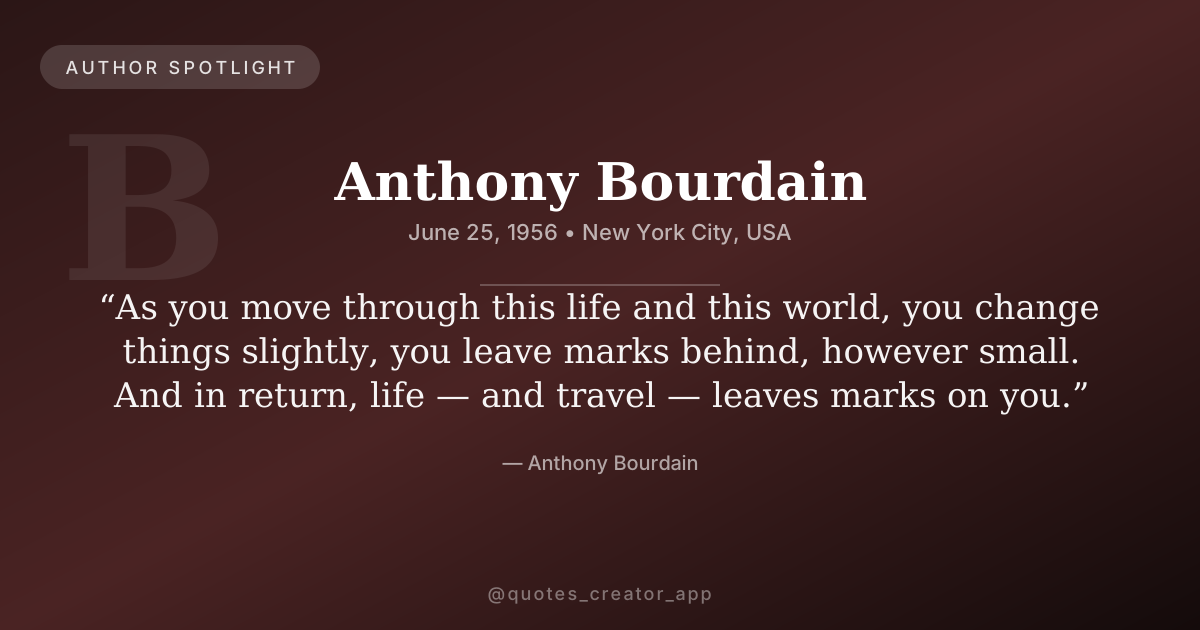
“As you move through this life and this world you change things slightly, you leave marks behind, however small. And in return, life — and travel — leaves marks on you.”
The meaning behind these words
This is the quiet thesis of No Reservations and Parts Unknown, and it is the most complete thing Bourdain ever said about why he kept going. Notice the direction of the sentence. Travel, in the popular imagination, is a thing you consume — a list of sights collected, a passport of stamps, a series of photographs that prove you were somewhere. Bourdain inverts the whole arrangement. He is not interested in what you take from a place; he is interested in the exchange, the two-way traffic of change between a traveler and a world that does not exist for your entertainment. You leave marks behind — the money you spent, the impression you made, the small kindness or small harm — and the place leaves marks on you in return. Neither party is untouched. The word “marks” is doing the essential work here, because marks are not souvenirs; they are scars and stains and calluses, evidence of genuine contact rather than passing through.
And there is a humility buried in the phrase that explains why he was trusted in places where cameras were resented. Bourdain did not travel as a conquering expert descending to explain a culture to a home audience. He traveled as a guest, aware — and willing to admit — that he would be changed by what he ate and who he met, and that the changing was the entire point. He sat down in the kitchens and living rooms and noodle stalls of the world as an equal, not a judge, and the result was a body of work that did more than any diplomat to make distant people feel familiar and familiar people feel strange. The sentence is, at bottom, an argument for a certain kind of openness — the willingness to be marked, to be altered, to let a meal or a stranger get inside you and rearrange things. It is the opposite of tourism as conquest, and it is the reason his shows feel less like television and more like an invitation.
“Maybe that’s enlightenment enough: to know that there is no final resting place of the mind; no moment of smug clarity. Perhaps wisdom … is realizing how small I am, and unwise, and how far I have yet to go.”
The meaning behind these words
Here is the great surprise of Bourdain’s thinking, and the thing that separates him from almost every other famous man with a television show. He was, on the surface, the most confident person in the room — the raised eyebrow, the unlit cigarette, the deadpan verdict delivered in that rasping voice — and yet his definition of wisdom is the exact opposite of confidence. Wisdom, for Bourdain, is not arriving at the answer. It is the permanent suspicion that you have not arrived at all. He is dismantling the whole fantasy of the guru, the expert who has read enough and seen enough to finally stop asking questions. There is no “final resting place of the mind,” no plateau of smug clarity where a person gets to coast. The honest position, the only honest position, is the one he names at the end: realizing how small you are, and how unwise, and how far you still have to go.
This is not modesty for its own sake; it is an epistemology, a theory of how a person ought to move through the world, and it is the intellectual engine of everything he made. It is why he kept going to places that contradicted him, why he sought out the meals and the people and the opinions that unsettled him, why a show that could have coasted on his celebrity instead kept pushing him — and its audience — into harder and harder conversations about war, poverty, addiction, and the things Americans preferred not to see. A man who believes he has arrived has no reason to travel. Bourdain traveled because he believed the opposite, and the restless, self-interrogating quality of his best work — the sense of a mind still moving, still doubting, still hungry — is the direct expression of this single idea. He was not offering answers. He was offering the more valuable and far rarer thing: a demonstration of what it looks like to keep asking.
“An ounce of sauce covers a multitude of sins.”
The meaning behind these words
On its face this is a cook’s joke, a wink at the old professional secret that a great sauce can rescue a mediocre dish. But it is also, like all of Bourdain’s best one-liners, a whole philosophy of grace compressed into eight words. The kitchen taught him that perfection is a lie and that survival — of a dinner service, of a career, of a life — depends less on never making mistakes than on knowing how to cover them when they happen. The sins are unavoidable; the point is the ounce of sauce, the single small thing done so well and with such confidence that it transforms the whole. He is describing competence, but he is also describing forgiveness: the recognition that everything in this world arrives a little burned, a little under-seasoned, and that the difference between failure and something beautiful is often just one well-chosen, generous flourish.
And the line cuts both ways, which is what makes it so characteristic of him. The same man who preached the saving grace of a good sauce was also unsparing about the people who used it to hide a lack of substance — the restaurants and the celebrities and the politicians whose polish concealed nothing worth eating. Bourdain could smell the difference instantly, because he had spent his life on both sides of the line: a man who had hidden his own damage behind charm and swagger and wit, and who knew exactly how much a confident performance can conceal. The ounce of sauce was, for him, never an excuse for a sin, but a mercy extended to one. It is the most forgiving and the most unforgiving of his maxims at once — a chef’s rule that says, in effect, that we are all imperfect, and that what matters is whether we brought something good to cover the mess.
“I’m not going anywhere. I hope. It’s been an adventure. We took some casualties over the years. Things got broken. Things got lost. But I wouldn’t have missed it for the world.”
The meaning behind these words
He spoke these words at the end of No Reservations, in 2012, as a farewell to the show that had made him a household name, and there is a poignancy in them now that he could not have intended and we cannot escape. The sentence is a toast, the kind a man raises at the end of a long, wrecked, magnificent night — and it is the most honest account of a well-lived life he ever gave. Look at the accounting. He does not list the prizes or the countries or the famous meals. He lists the casualties, the broken things, the things that got lost. This is not a man pretending the adventure was painless. It is a man who is telling you, with his usual unsentimental clarity, that the pain was part of the price and that he would pay it again. “I wouldn’t have missed it for the world” is not a boast about how good it was; it is a declaration that the whole thing, wounds and all, was worth it.
And then there is that terrible little qualification: “I’m not going anywhere. I hope.” It reads, in hindsight, like a wish he made against his own deepest fear — the fear, which he never hid, that the restlessness would one day win, that the darkness he had outrun for so long would finally catch him at a table where no meal could save him. Six years later, in a hotel room in France, it did. But to read the line only as foreshadowing is to do him a disservice, because the man who said it was not surrendering; he was promising to stay, and promising to keep going, and the fact that the promise proved too heavy does not make it false. The words are a valediction, but they are also, and more importantly, a definition of the life he actually lived: an adventure, with casualties, that broke things and lost things and was, for all of that, immeasurably worth having. It is the toast he would have wanted, and it is the one we are left holding.
Anthony Bourdain’s legacy
The measurable legacy is easy to state and, on its own, astonishingly broad. Anthony Bourdain wrote more than a dozen books, of which Kitchen Confidential alone has sold millions of copies and is still, a quarter century on, the book people hand to anyone who dreams of a life in restaurants — as warning and invitation in equal measure. His television career spanned nearly two decades and multiple networks, and Parts Unknown, the show that defined its final, finest act, won a Peabody and a shelf of Emmy Awards while taking American audiences to more than eighty countries, from the beaches of Senegal to the alleyways of Hanoi to the war-scarred streets of Beirut. He changed the food memoir, the food show, and the food essay so completely that an entire generation of writers and cooks now works in a world he essentially invented, and they say so, constantly, by name. There is no one making serious food television or writing seriously about eating who does not, in some measure, owe him.
The deeper legacy is an idea, and it is the reason his name means more than the sum of his credits. Bourdain’s great argument — made over thousands of meals and hundreds of hours of television — was that food is the most democratic doorway into another human being, that sitting down to eat with someone is a radical act of curiosity and respect, and that the surest cure for fear of the unfamiliar is to break bread with it. He did not go to distant places to exoticize them; he went to humanize them, to show that the people on the other side of the world love their children and argue with their in-laws and take pride in their cooking exactly as we do. He was, in the phrase he coined for himself, “an advocate for moving” — as far as you can, as much as you can — and he practiced what he preached until the road itself became his home. In an age of walls and suspicion, that is not a small legacy. It is the central one, and it has outlived him in every traveler who has ever sat down at a strange table and, instead of flinching, said yes.
And there is, finally, the legacy of his honesty, which is the hardest part to reckon with and the most important. Bourdain refused to lie about the hard things — about addiction, about depression, about the wreckage of his own life — and in doing so he gave an enormous, largely voiceless population a name and a face. The man who wrote so frankly about the drugs that nearly killed him, and who spent his last years telling anyone who would listen that the darkness does not care how famous you are, became, almost by accident, a patron saint of the struggle he did not survive. His death in 2018 was a tragedy, and it should not be softened into a lesson. But his life was a triumph, and it should not be reduced to its ending either. Since he left, the world has named a day — his birthday, 25 June, now marked as Bourdain Day — and has kept watching his shows and reading his books and cooking his recipes, because the man is gone but the appetite he gave us is not. He taught us, in the end, that the table is the one place where strangers become family, and that a life spent seeking out those tables — casualties and all — is a life well lived. “I wouldn’t have missed it for the world,” he said. Neither would we.
Create graphics with Anthony Bourdain’s quotes
Bourdain’s words carry the same quality as his cooking — honest, generous, and built to travel. Whether you need a line about character, about the marks the world leaves on you, or about a life of adventure worth having, Quotes Creator helps you turn these quotes into beautiful, shareable designs with custom fonts, gradients, and layouts.
Why we chose Anthony Bourdain
Anthony Bourdain enters this spotlight in the summer of what would have been his seventieth birthday, at a moment when his name is once again surging through the cultural conversation. His Wikipedia pageviews hold steady in the tens of thousands every day — a figure that speaks less to any single news event than to the permanent, unkillable affection of a public that never quite got over losing him, and that keeps returning to his shows and his books as the surest guide to a world that grows more divided every year. But the timing, as it always is with these spotlights, is secondary to the substance. We chose Bourdain because his life is one of the rare ones that works as both a story and a lesson — the New Jersey kid who tasted his first oyster in France and spent the rest of his life chasing that taste across the planet, the recovering addict who wrote the truth about the kitchen and became the most trusted narrator in travel, the man who turned a cooking show into an argument for curiosity, humility, and the radical act of breaking bread with a stranger.
The five quotes we have selected trace the spine of that story. They begin with his clearest account of the kitchen’s only real currency — that skills can be taught, but character cannot. They move through the philosophy of travel that made him great, his refusal to believe that he had ever arrived at certainty, and the cook’s wisdom that an ounce of sauce can cover a multitude of sins. And they end where he ended, with the toast from the final episode of No Reservations — a life of adventure, with casualties, that he would not have missed for the world. These are not the maxims of a comfortable man. They are the words of a man who understood, better than almost anyone, that the table is the last place on earth where strangers can still become family, that certainty is the enemy of curiosity, and that a life lived in pursuit of the unfamiliar is the only kind worth having.
— ThinkPeak Studio Editorial Team
Create your own quote graphic with this quote
Turn this line into a shareable graphic in seconds — free, no signup needed. For video quotes and 100+ templates, try the Android app.
Advertisement
Enjoyed this article? Get more like it in your inbox.