On this page
Author Spotlight: Anthony Fauci
From a Brooklyn pharmacy counter to the White House briefing room \u2014 the physician who advised seven presidents, helped turn HIV from a death sentence into a manageable condition, and spent a career insisting that science is truth.
Who is Anthony Fauci?
Anthony Stephen Fauci was born on December 24, 1940, in Brooklyn, New York, the son of Italian-American parents who ran a neighborhood pharmacy. He grew up delivering prescriptions on his bicycle, watching his father treat patients who could not afford a doctor, and absorbing a fundamentally simple idea: medicine is a service, not a trade. He studied classics at the College of the Holy Cross before earning his Doctor of Medicine from Cornell University Medical College in 1966 \u2014 an unusual path for a future immunologist, and one that left him with a lifelong habit of thinking about science through the lens of narrative and argument.
Fauci joined the National Institutes of Health in 1968 as a clinical associate and never left. By 1984, at age 43, he was appointed director of the National Institute of Allergy and Infectious Diseases (NIAID) \u2014 a position he would hold for the next thirty-eight years, through the administrations of seven presidents. His defining breakthrough came during the AIDS crisis of the 1980s, when he redirected his laboratory from immunology basics to HIV research and helped develop the treatments that turned the disease from a near-certain death sentence into a chronic, manageable condition. He became one of the world’s most-cited scientists, played a central role in creating PEPFAR \u2014 the President’s Emergency Plan for AIDS Relief, which has saved an estimated twenty-five million lives in Africa \u2014 and was awarded the Presidential Medal of Freedom in 2008 by George W. Bush.
What distinguishes Fauci from almost every other public health official of his generation is not his scientific output but his willingness to stand at a podium and deliver honest answers to hostile questions. He navigated the anthrax attacks of 2001, the H1N1 pandemic of 2009, the Ebola epidemic of 2014, the Zika outbreak of 2016, and the COVID-19 pandemic of 2020, each time walking the same impossible line: warn without panicking, correct without contempt, and never let the political moment rewrite the medical facts. “You don’t want to go to war with a president,” he told Politico in 2020, and it is a sentence that captures a career’s worth of tactical wisdom: a quieter kind of courage, the kind that corrects the record in the next sentence rather than the next administration.
Fauci retired from government service in December 2022 after fifty-four years at the NIH. His final years in office were among the most turbulent of his career \u2014 he received death threats, required a security detail for his family, and became a symbol of the widening rift between scientific consensus and partisan identity in America. On his last day in government, he received a preemptive pardon from President Biden for any federal offenses committed between 2014 and 2025. He is now a distinguished university professor at Georgetown University, still writing, still speaking, and still insisting on the principle that has animated his entire public life: that facts, carefully gathered and plainly stated, remain the only durable basis for public health.
Anthony Fauci’s most memorable quotes
“We will definitely get surprised in the next few years.”
The meaning behind these words
Fauci spoke these words to an audience of public health professionals at Georgetown University in January 2017, ten days before the Trump administration took office. He was delivering the kind of transition briefing that outgoing officials always give, except this one was different: he was not summarizing what had happened but what was coming. The sentence is remarkable not for its predictive power \u2014 the field of infectious disease is built on the premise that new pathogens will continue to emerge \u2014 but for its clarity and bluntness. He did not say “we might be surprised.” He said “we will definitely get surprised.”
Three years later, the surprise arrived in the form of SARS-CoV-2. What makes the quote resonate retrospectively is not that Fauci predicted the pandemic but that he had been saying some version of this sentence for decades \u2014 to Congress, to White House staff, to journalists, to anyone who would listen. The failure was not in the warning; it was in the unwillingness to act on it. The line is a reminder that expertise, in public health, is not the ability to predict the future but the willingness to prepare for it honestly, even when the preparation is expensive, politically inconvenient, and hard to explain on a sound bite.
“You don’t want to go to war with a president. There’s a temptation that you have to fight to tell the president what you think he wants to hear. I’ve seen really good people do that.”
The meaning behind these words
This quote became famous for what it said about navigating the Trump White House, but its real subject is older and more universal: how to be honest inside a system that punishes honesty. Fauci had been advising presidents since Reagan, and he had learned a specific kind of institutional survival that is rare in appointed officials \u2014 the ability to say “that is not what the data show” without ever saying “you are wrong.” The quote is a tactical admission that direct confrontation with a president is self-defeating, and that the more durable strategy is persistent, quiet correction over time.
The second sentence is the one that has stayed with people: “I’ve seen really good people do that.” It is a confession delivered as an observation, and it reveals Fauci’s understanding of how institutions actually work. Smart, principled people tell a president what he wants to hear, and they do it not because they are weak but because the alternative \u2014 being fired, being sidelined, being replaced by someone who will say anything \u2014 seems worse. Fauci chose a third path: stay in the room, say what the data say, and accept that you will be contradicted in public. It is not the most heroic version of integrity, but it may be the most effective one for a civil servant who intends to outlast an administration.
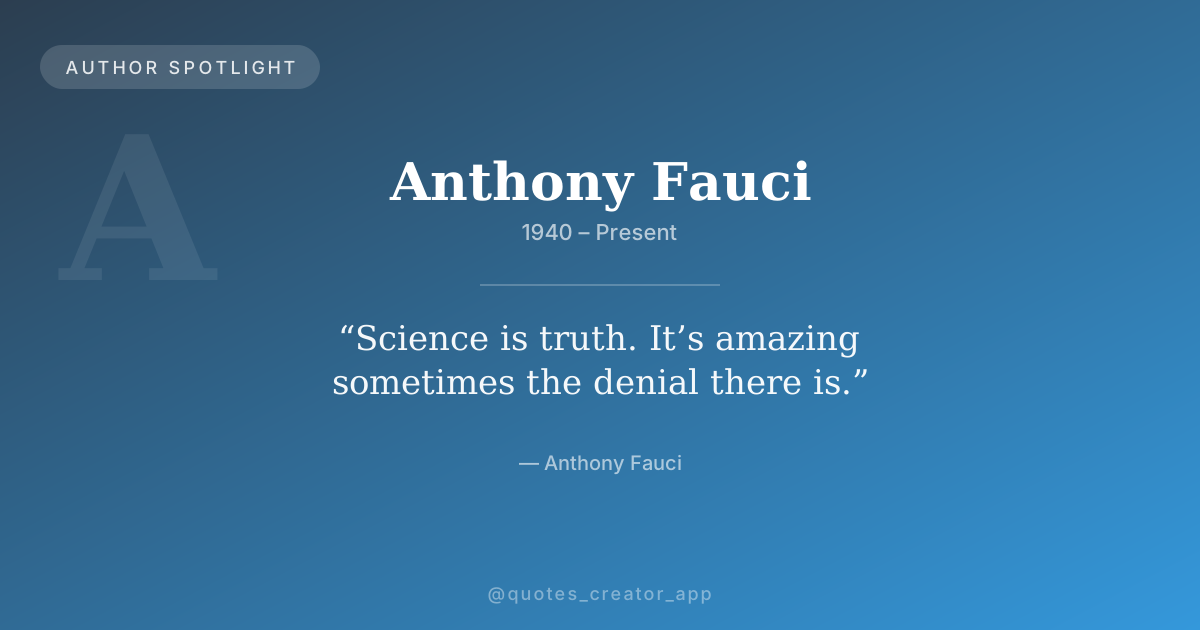
“One of the problems we face in the United States is that unfortunately, there is a combination of an anti-science bias that people are \u2014 for reasons that sometimes are, you know, inconceivable and not understandable \u2014 they just don’t believe science and they don’t believe authority. Science is truth. It’s amazing sometimes the denial there is.”
The meaning behind these words
This is the closest Fauci has ever come to public exasperation, and the pauses \u2014 the “you know” and the trailing hesitation \u2014 are the most revealing part of the quote. He is a practiced public speaker, and the unscripted quality of this sentence suggests genuine bewilderment: a scientist who has spent fifty years inside the machinery of evidence-based medicine, suddenly confronting a public that appears to have decided that evidence itself is optional. The phrase “science is truth” is simple to the point of being naive, and that is exactly why it is effective \u2014 it restates a premise that should not need to be restated.
The deeper tension in the quote is the relationship between science and authority. Fauci links the rejection of science with the rejection of authority as though they are the same problem, and in a sense they are: both require a baseline trust in institutions and expertise that had been eroding for years before COVID-19 arrived. What Fauci does not say, but what is clearly implied, is that the erosion is not organic \u2014 it is fed by media ecosystems, political incentives, and a deliberate effort to turn scientific consensus into just another opinion. Against that machinery, “science is truth” is both a plea and a prayer.
“Please, for your own safety, for that of your family, get your updated COVID-19 shot as soon as you’re eligible to protect yourself, your family, and your community.”
The meaning behind these words
Fauci delivered these words from the White House briefing room podium on November 22, 2022, knowing it would likely be his final appearance there. He introduced the sentence by calling it “my final message \u2014 maybe the final message I give you from this podium.” The phrasing is deliberate, careful, and entirely characteristic: no drama, no valediction, just the same public health guidance he had been offering for more than two years, delivered one last time. The word “please” does a lot of work here \u2014 it is the language of a physician asking a patient, not a bureaucrat issuing a mandate.
What makes the quote moving in retrospect is how it bookends a career. The boy who delivered prescriptions on his bicycle in Brooklyn, the young physician who stayed late in the NIH lab during the earliest days of the AIDS crisis, the septuagenarian who stood in the White House briefing room and corrected a president in real time \u2014 they all lead to this same sentence: please, for the people you love, do the thing that the science says will keep you safe. It is not a battle cry and it is not a victory lap. It is the quiet, persistent voice of a doctor who has said some version of this sentence ten thousand times, and who means it every time.
Anthony Fauci’s legacy
The institutional legacy is easier to measure than the personal one. Fauci’s laboratory work on HIV pathogenesis helped lay the foundation for the antiretroviral therapies that have saved millions of lives. PEPFAR, the AIDS relief program that he helped design, is widely regarded as the most successful global health initiative in American history. His stewardship of NIAID through thirty-eight years, seven presidents, and every major infectious disease outbreak since the mid-1980s represents a continuity of scientific leadership that is rare in any field and nearly unprecedented in American public health. He is, by any reasonable metric, one of the most consequential government scientists in the history of the United States.
The cultural legacy is more complicated. Fauci became, during the COVID-19 pandemic, a figure onto whom Americans projected their hopes, fears, and resentments about science, government, and each other. To some he was a hero \u2014 the calm, persistent voice of evidence in a storm of misinformation. To others he was a villain \u2014 the face of lockdowns, mandates, and a public health apparatus that seemed, to its critics, to have lost its sense of proportionality. The truth is that Fauci was neither of these things; he was a physician doing his job in public, under conditions that no amount of training can adequately prepare a person for. His real legacy may be simpler than either the celebration or the condemnation: he showed, for half a century, that it is possible to serve the public honestly, speak uncomfortable truths to powerful people, and survive the consequences.
Create graphics with Anthony Fauci’s quotes
Anthony Fauci’s words carry the weight of five decades in public health, and they remain strikingly relevant in any conversation about science, leadership, and the public good. Whether you are sharing on Instagram, creating a presentation, or looking for daily inspiration, Quotes Creator helps you transform these quotes into beautiful, shareable designs with custom fonts, gradients, and layouts.
Why we chose Anthony
We are publishing this spotlight in late July 2026, at a moment when public trust in science and institutions remains one of the defining tensions of American life. Fauci spent more than fifty years inside the machinery of government science, and the four quotes we selected trace a specific arc: the prescient warning, the quiet navigation of power, the baffled defense of truth itself, and the simple, repeated plea to do the thing that keeps people safe. He is a polarizing figure, and that is precisely why he is an important one. In an era when facts are treated as opinions, the career-long insistence that science is truth \u2014 however naive it may sound \u2014 is worth remembering.
— ThinkPeak Studio Editorial Team
Create your own quote graphic with this quote
Turn this line into a shareable graphic in seconds — free, no signup needed. For video quotes and 100+ templates, try the Android app.
Advertisement
Enjoyed this article? Get more like it in your inbox.