On this page
Author Spotlight: Barack Obama
From a skinny kid with a funny name growing up in Hawaii and Indonesia to the 44th President of the United States — a journey through the words, the convictions, and the legacy of a man who made hope a political strategy.
Who is Barack Obama?
Barack Hussein Obama II was born on August 4, 1961, in Honolulu, Hawaii, to Ann Dunham, a white anthropologist from Kansas, and Barack Obama Sr., a Black Kenyan economist studying at the University of Hawaii. His parents met in a Russian language class. They separated when Barack was two, divorced two years later, and his father returned to Kenya, visiting his son only once more before dying in a car accident in 1982. His mother remarried an Indonesian geologist, Lolo Soetoro, and moved the family to Jakarta when Barack was six, where he attended local Indonesian-language schools and woke at four in the morning for English correspondence lessons his mother administered at the kitchen table. At ten, he returned to Hawaii to live with his maternal grandparents, Stanley and Madelyn Dunham, in a modest two-bedroom apartment in Makiki. He attended Punahou School on scholarship, one of a handful of Black students in a predominantly white and Asian institution. It was during these years, navigating the dissonance between his absent African father, his white midwestern grandparents, and his Indonesian childhood, that he began the lifelong project of making sense of his own identity — a project that would become the subject of his first memoir, Dreams from My Father.
After two years at Occidental College in Los Angeles, Obama transferred to Columbia University in New York, where he graduated with a degree in political science in 1983. What followed was a decision that would define the moral architecture of his public life: instead of law school or Wall Street, he moved to Chicago in 1985 to work as a community organizer on the South Side. For three years, he worked with churches and community groups in the Roseland and Altgeld Gardens neighborhoods, helping residents organize around issues of job training, public safety, and asbestos removal from public housing. The work was grinding, the victories small, and the scale of the problems overwhelming. But it was there, in the basements of churches and the kitchens of working families, that Obama learned the lesson that would become the central thesis of his political career: change does not come from the top down but from the bottom up, and the distance between what is and what ought to be is crossed not by individuals but by organized communities. In 1988, he entered Harvard Law School, where in 1990 he was elected the first Black president of the Harvard Law Review — a moment that generated national headlines and caught the attention of a literary agent who offered him a book deal. That book became Dreams from My Father, a meditation on race, inheritance, and belonging that remains one of the finest memoirs ever written by an American politician.
Obama returned to Chicago after Harvard, practiced civil rights law, taught constitutional law at the University of Chicago Law School, and in 1996 was elected to the Illinois State Senate, representing the 13th district on Chicago’s South Side. His eight years in Springfield taught him the unglamorous craft of legislating: building coalitions, counting votes, accepting half-measures as the price of forward motion. In 2000, he ran for Congress and lost badly to incumbent Bobby Rush — a humbling defeat that taught him he had not yet earned the trust of the community he claimed to represent. He regrouped, won a U.S. Senate seat in 2004 with 70 percent of the vote, and then, in July of that year, delivered a keynote address at the Democratic National Convention in Boston that changed the trajectory of American politics. “There is not a liberal America and a conservative America,” he told the nation — “there is the United States of America.” Within four years, he had defeated Hillary Clinton in a grueling primary, weathered the Jeremiah Wright controversy with a speech on race in America that historians would later compare to Lincoln, and on November 4, 2008, was elected the 44th President of the United States, winning 365 electoral votes and a larger share of the popular vote than any Democrat since Lyndon Johnson.
His eight years in the White House were defined by a paradox: he governed as a pragmatic institutionalist while the nation demanded a transformative revolutionary. He passed the Affordable Care Act — the most significant expansion of the social safety net since Medicare — over unified Republican opposition and without a single GOP vote. He signed the Dodd-Frank Wall Street reform bill, rescued the American auto industry, and oversaw the operation that killed Osama bin Laden. He appointed two women to the Supreme Court, ended the military’s “Don’t Ask, Don’t Tell” policy, and became the first sitting president to endorse same-sex marriage. He negotiated the Paris Climate Agreement and the Iran nuclear deal. At the same time, his presidency exposed the hard limits of what even a gifted communicator can achieve against a political opposition whose explicit strategy was total obstruction. The hope that had defined his campaign collided repeatedly with the machinery of a broken Congress. Yet he left office in January 2017 with an approval rating of 59 percent, the highest for any departing president since Eisenhower. In the years since, he has remained an active public voice through the Obama Foundation, his memoir A Promised Land, and his ongoing work to train the next generation of leaders. At sixty-five, Barack Obama is no longer the young senator who promised hope and change. He is something rarer: a former president whose influence has only grown in his post-presidency, and whose words still carry the weight of a man who once believed — and still believes — that America can be better than it has been.
Barack Obama’s most memorable quotes
“There is not a liberal America and a conservative America — there is the United States of America. There is not a Black America and a white America and Latino America and Asian America; there’s the United States of America.”
The meaning behind these words
This sentence, delivered by a little-known Illinois state senator on a Tuesday night in Boston, did not just launch a political career — it articulated a vision of national identity that millions of Americans, exhausted by the bitter divisions of the post-9/11 era, had been waiting to hear. Obama was not denying the reality of political or racial divisions. He was making a more subtle and more radical claim: that those divisions are not the fundamental truth about who we are. The deeper identity, the one that matters most, is not conservative or liberal, Black or white or Latino; it is American. This is not naïveté. It is a moral assertion about what ought to take precedence when we think about ourselves as a people.
The rhetorical structure is deliberate and devastating in its simplicity. By listing the categories — liberal, conservative, Black, white, Latino, Asian — and then collapsing them all into a single term repeated like a refrain, Obama performed on stage what he was asking the country to do in its political life: acknowledge the differences and then transcend them. The sentence does not argue; it declares. And the declaration, coming from a biracial man with an African name who had just won a Senate primary in a state with a documented history of racial segregation, carried an authority that no white politician could have summoned. This was not a bromide about unity. It was a claim staked at the intersection of his own life and the nation’s oldest wound.
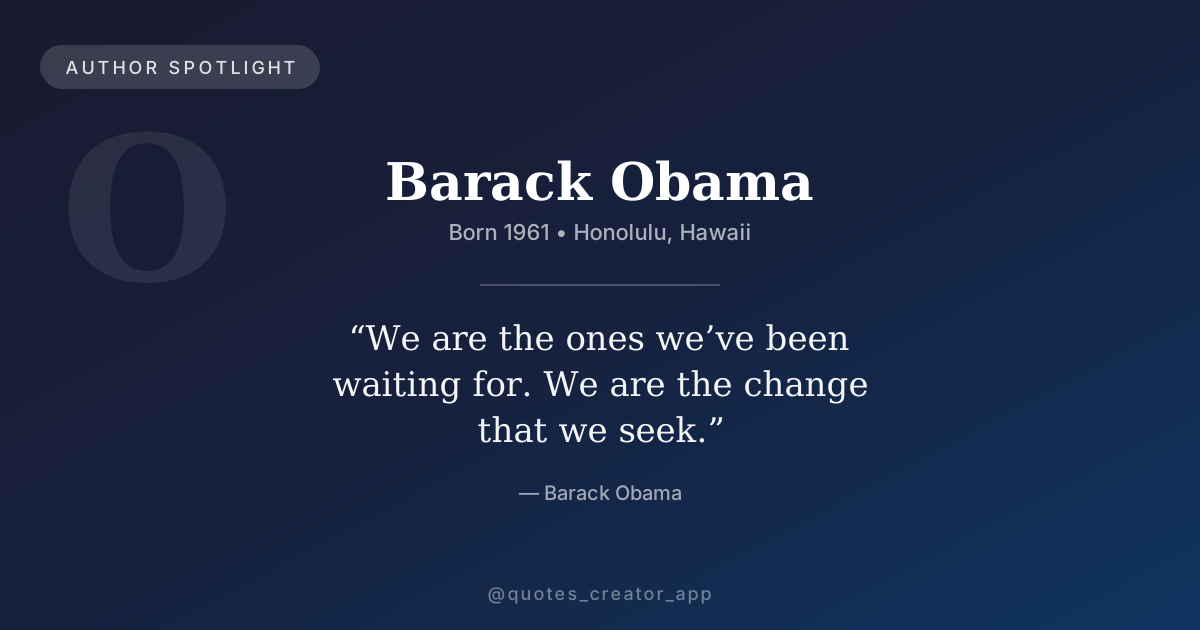
“Change will not come if we wait for some other person or if we wait for some other time. We are the ones we’ve been waiting for. We are the change that we seek.”
The meaning behind these words
These three sentences contain the core of Obama’s political philosophy and the secret of his movement’s emotional power. The first sentence names the temptation — waiting for a savior, deferring responsibility, hoping someone else will fix what is broken. It is the quiet voice that tells each of us that our action does not matter, that the problems are too large, that the moment is not right. Obama does not argue with that voice; he simply replaces it with another. He shifts the subject from the absent savior to the person standing in front of the mirror. You are what you have been waiting for. The change does not arrive from outside; it emerges from the choices you make.
What makes this quote endure is that it is not merely electoral rhetoric. It is a theory of citizenship. Democratic politics in the twenty-first century is dominated by a consumer mentality: voters treat politicians as service providers, and politicians treat voters as customers to be managed. Obama was offering a different model, one in which ordinary people are not consumers of change but its producers. This was the lesson he had learned on the South Side of Chicago in the 1980s, watching grandmothers and pastors and unemployed steelworkers organize themselves into a force capable of extracting concessions from City Hall. The quote is radical not because it is confrontational but because it is empowering. It takes the passivity that modern political culture cultivates and declares it unacceptable.
“The best way to not feel hopeless is to get up and do something. Don’t wait for good things to happen to you. If you go out and make some good things happen, you will fill the world with hope, you will fill yourself with hope.”
The meaning behind these words
Obama was often caricatured as a naïve idealist whose rhetoric of hope floated above the hard realities of politics. This quote is the rebuttal he offered again and again: hope is not a feeling you wait to receive but a byproduct of action. The person who sits at home and scrolls through the news will feel hopeless, because the news is a machine designed to produce despair. The person who goes out and knocks on doors, tutors a child, organizes a meeting, registers a voter — that person will feel hope, not because the circumstances have changed but because they themselves have become an agent of change. This is not a philosophical abstraction. It is a description of how human psychology actually works: action precedes motivation, not the other way around.
This insight is what separated Obama from the cynics who dismissed him and from the idealists who misunderstood him. He was not arguing that things would magically get better; he was arguing that the act of trying to make them better is itself the antidote to despair. The formulation is deliberately circular: you fill the world with hope by acting, and in doing so you fill yourself with hope too. The external and the internal are linked. This is a deeply pragmatic vision, one rooted in the community organizing tradition that treats hope not as an emotion but as a discipline — something you practice, not something you wait for. In an age of learned helplessness and doom-scrolling, it remains one of the most useful sentences a person can hear.
“We did not come to fear the future. We came here to shape it.”
The meaning behind these words
Delivered in the first weeks of his presidency, with the financial system in freefall, unemployment spiking past eight percent, and the country in the grip of the worst economic crisis since the Great Depression, this sentence was a declaration of intent disguised as a statement of fact. The nation was terrified. Every institution that Americans had trusted — the banks, the housing market, the auto industry — had failed. The natural human response was to retrench, to protect what remained, to look backward. Obama’s answer was to pivot the entire rhetorical frame from past to future, from fear to agency. “We did not come to fear the future” implies that our presence here — in this country, in this moment — is not an accident but a choice, and that choice carries responsibilities.
The sentence works because it is built on a premise that Americans of every political persuasion recognize: the American experiment is fundamentally forward-looking. The founders did not cross an ocean and fight a war to preserve what they had; they did it to build what did not yet exist. Obama was situating his presidency within that tradition, arguing that the appropriate response to crisis is not fear but construction. The word “shape” is important. It is not control or dominate. It acknowledges that the future is not entirely in our hands, but it insists that we are not entirely in its hands either. This is the balance that defined Obama’s entire approach to governing: clear-eyed about the limits of power, unwavering about the obligation to exercise it.
“In the unlikely story that is America, there has never been anything false about hope.”
The meaning behind these words
This sentence, delivered after his victory in the overwhelmingly white state of Iowa confirmed that a Black candidate with an African name could win, is perhaps the most compact expression of Obama’s worldview. Every word is doing work. “Unlikely story” acknowledges America’s contradictions — a nation founded on the proposition that all men are created equal by men who owned slaves, a nation that elected a Black president a century and a half after fighting a war over the right to enslave his ancestors. The word “false” is the pivot: his opponents said hope was a platitude, a marketing slogan, a con. Obama’s answer was to ground hope not in naïve optimism but in the historical record. America’s story is unlikely, improbable, and real — and therefore hope is not false. It is the most realistic response to a country whose entire existence is an argument against determinism.
The quote resonates beyond its electoral context because it makes hope an empirical claim rather than a sentimental one. You do not have to believe that everything will turn out well. You only have to look at what has already happened — the abolition of slavery, the enfranchisement of women, the civil rights movement, the improbable election of a man named Barack Hussein Obama — and acknowledge that the future is not foretold. The arc does not bend on its own; people bend it. Obama’s genius in this sentence was to collapse the distinction between his campaign and the American experiment itself, so that voting for him became, for millions of people, an act of participation in a story larger than any individual candidate. That is a rare feat in democratic politics, and it is why, nearly two decades later, the sentence still carries the voltage it did on that January night in Des Moines.
Barack Obama’s legacy
The historical ledger of Obama’s presidency is already taking its initial shape. The Affordable Care Act extended health coverage to over twenty million Americans and survived multiple Supreme Court challenges and congressional repeal attempts to become, against all odds, a permanent fixture of American life. The killing of Osama bin Laden closed the central wound of the 9/11 era. The Paris Agreement, the opening to Cuba, the Iran nuclear deal — each was controversial, and each represented a bet on diplomacy over conflict, on engagement over isolation. The American economy, which was losing eight hundred thousand jobs a month when Obama took office, went on to add jobs in every single month of his final seven years, the longest streak of consecutive job growth in American history. He appointed the first Latina to the Supreme Court. He commuted the sentences of more nonviolent drug offenders than any president before him. He did all of this without a major personal scandal, without an indictment of a senior staff member, and without a single day of self-pity leaking into public view. In the annals of the presidency, these are not small things.
But the deeper legacy is less easily measured. Barack Obama changed what an American president could look like, sound like, and be. He was a Black man with a white mother and a Kenyan name, raised in Hawaii and Indonesia, a constitutional law professor who could quote Scripture and the Stoics with equal fluency. He demonstrated, for eight years, that intellectual seriousness and emotional restraint need not be political liabilities. He wrote his own books, in sentences of genuine literary craft, something no president since Lincoln had done. His post-presidency has been an extension of that model: rather than descend into grievance or self-enrichment, he has built an institution — the Obama Foundation — devoted to training young leaders around the world, and has produced a memoir that sold more copies in its first twenty-four hours than any presidential memoir in American history. The ultimate judgment on his presidency will be rendered by historians not yet born. But the judgment on his character is already in: he was, and remains, a man who believed that politics could be a noble profession, and who conducted himself accordingly.
Create graphics with Barack Obama’s quotes
Barack Obama’s words carry the weight of a gifted orator and the precision of a constitutional lawyer — they are made for sharing. Whether you are posting on social media, preparing a presentation, or looking for daily inspiration, Quotes Creator helps you turn these quotes into beautiful, shareable designs with custom fonts, colors, and layouts.
Why we chose Barack Obama
August 4th is Barack Obama’s birthday, and twenty-two years after he first stepped onto the national stage at the 2004 Democratic Convention, his words remain among the most quotable in American public life. We chose Obama not because he was perfect — he would be the first to tell you he was not — but because he modeled a kind of public speech that is vanishingly rare: honest about the difficulty of the work, unwilling to traffic in cynicism, and grounded in the conviction that ordinary people, when organized and determined, can change their country. The five quotes we selected trace the arc of that conviction, from the young senator who declared there are no red states or blue states, to the president who insisted we came not to fear the future but to shape it, to the elder statesman who still believes the antidote to hopelessness is action. At sixty-five, Barack Obama remains what he has always been: a man who believes in the country he was elected to lead, and who has spent his life trying to make it worthy of that belief.
— ThinkPeak Studio Editorial Team
Create your own quote graphic with this quote
Turn this line into a shareable graphic in seconds — free, no signup needed. For video quotes and 100+ templates, try the Android app.
Advertisement
Enjoyed this article? Get more like it in your inbox.