On this page
Author Spotlight: Barbra Streisand
From a skinny Jewish girl in Brooklyn with a nose the industry wanted to fix, to the only artist with a number-one album in six consecutive decades — a look at the woman who refused to be anything but herself.
Who is Barbra Streisand?
Barbara Joan Streisand was born on April 24, 1942, in Brooklyn, New York, to Diana and Emanuel Streisand. Her father, a high school teacher, died when she was fifteen months old, and her mother struggled to raise Barbra and her older brother on a secretary’s salary. Streisand grew up in the Flatbush projects, a skinny kid with a prominent nose and a voice that stopped people mid-sentence. Her mother told her she wasn’t pretty enough to be a star, and when she was sent to a health camp at age six, the only thing that gave her any individuality was a burgundy sweater knit by a caregiver. She spent her adolescence watching old movies and singing on the stoop with neighborhood girls, always the one with the best voice and no father. By fourteen, she was taking acting classes; by sixteen, she had dropped the second “a” from her name — Barbra, not Barbara — because she wanted to be different, and she knew, even then, that different was the point.
Her career arc has no parallel. She began singing in Greenwich Village nightclubs in the early 1960s, signed with Columbia Records on the condition of full artistic control — an unprecedented demand for a young unknown — and won the Grammy for Album of the Year with her 1963 debut. She conquered Broadway with Funny Girl, then Hollywood with the film adaptation, winning the Academy Award for Best Actress in 1968 in a historic tie with Katharine Hepburn. Throughout the 1970s she was the biggest female box-office draw in the world, starring in The Way We Were, What’s Up, Doc?, and A Star Is Born, for which she became the first woman to win an Oscar for Best Original Song as a composer. In 1983, she wrote, produced, directed, and starred in Yentl — the first woman in history to hold all four roles on a major studio film — and won the Golden Globe for Best Director, an award no other woman would claim for another thirty-seven years. Her recording career is equally staggering: she is the only artist to have a number-one album on the Billboard 200 in six consecutive decades, from the 1960s to the 2010s, and with over 200 million records sold, she remains one of the best-selling recording artists of all time.
What drove her was not ambition in the conventional sense but a relentless commitment to her own instincts. She once described herself as “simple, complex, generous, selfish, unattractive, beautiful, lazy, and driven” — a contradiction she made no effort to resolve. She refused nose jobs when every agent told her she needed one. She demanded final cut and casting approval decades before any woman thought to ask. She left performing for years at a time and returned only when the material moved her. Streisand understood early that the industry would try to shape her into something it could sell, and her entire career became a sustained act of refusal. She was not difficult for the sake of being difficult; she was precise, and she trusted her own judgment more than she trusted the machinery around her. That singular quality — total confidence in her own creative compass — is what separates the great artists from the successful ones, and Streisand, across all her fields, was both.
Her personal life has been a quieter but equally steady force. She married the actor Elliott Gould in 1963, and they had a son, Jason, before divorcing in 1971. In 1998 she married the actor James Brolin, and the two have remained one of Hollywood’s most stable couples for nearly three decades. Beyond entertainment, she has been a vocal philanthropist and political activist, particularly on issues of women’s rights, LGBTQ+ equality, climate change, and heart disease research — she founded the Barbra Streisand Women’s Heart Center at Cedars-Sinai. In 2015, President Barack Obama awarded her the Presidential Medal of Freedom. Now in her eighties, she continues to speak, write, and occasionally perform, and remains one of the few figures whose mere name still commands the full attention of the culture she helped shape.
Barbra Streisand’s most memorable quotes
“I arrived in Hollywood without having my nose fixed, my teeth capped, or my name changed. That is very gratifying to me.”
The meaning behind these words
This is Streisand’s most autobiographical statement, and it contains her entire philosophy in a single sentence. When she arrived in Hollywood in the mid-1960s, the studio system expected female performers to be pliable products: change your name, fix your face, smile for the cameras, and don’t make trouble. Every agent she met told her to get a nose job. Every producer had an opinion about her hair, her clothes, her manner. Streisand looked at all of it and decided that the thing they wanted to erase — her difference — was precisely the thing she would build her career around. The word “gratifying” is key. She is not angry, not defensive, not trying to prove a point. She is simply satisfied. She won, on her own terms, and she knows it.
This quote also functions as a quiet manifesto for anyone who has ever been told they are not the right shape, size, or type. Streisand’s nose was not just a nose; it was a symbol of Jewish identity in an industry that had spent decades sanding down ethnic features. By refusing to change it, she made it impossible for the next generation of performers to be told that their faces needed fixing. In the decades since, countless actresses and singers — from Bette Midler to Lady Gaga — have cited Streisand’s refusal as the permission they needed to be themselves. The most radical thing you can do in a business that profits from insecurity is to declare that you like yourself exactly as you are.
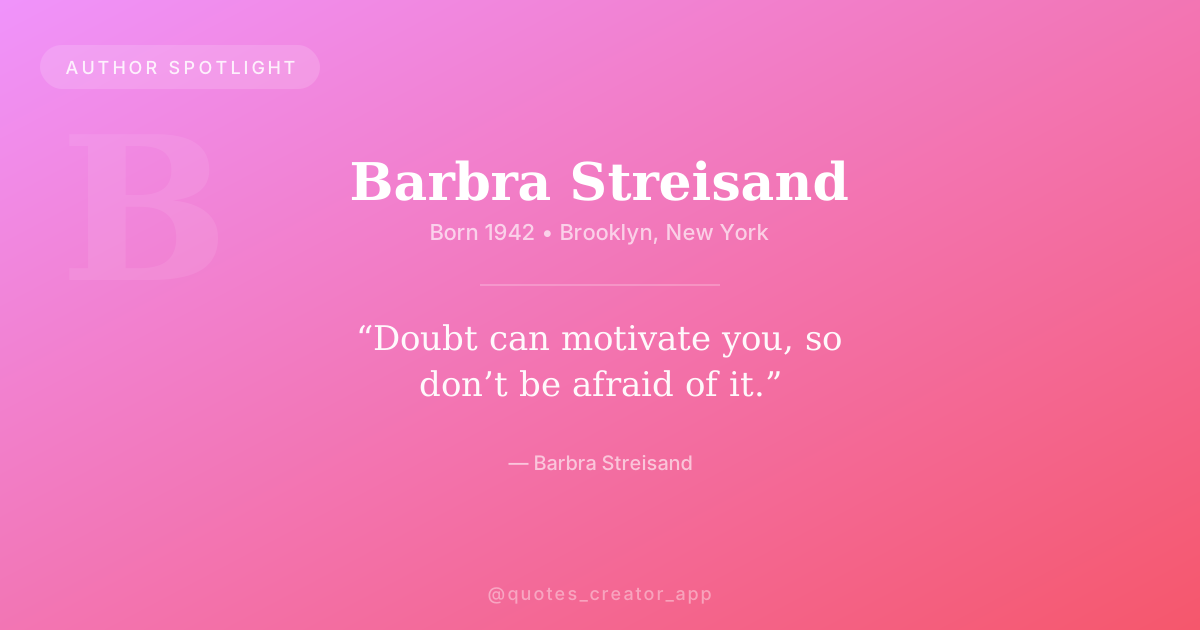
“Doubt can motivate you, so don’t be afraid of it. Confidence and doubt are at two ends of the scale, and you need both. They balance each other out.”
The meaning behind these words
This quote reveals a sophistication about the creative process that separates Streisand from the conventional self-help platitudes about “believing in yourself.” She is not advocating for blind confidence or the elimination of doubt. She is describing a dynamic equilibrium — confidence drives you forward, doubt keeps you honest. The person who has no doubt is a person who never questions their own judgment, and in Streisand’s world, that is the quickest path to mediocrity. Doubt is not the enemy of great work; it is the mechanism that forces you to make the work better.
This philosophy explains a great deal about her famously exacting standards in the recording studio and on film sets. Musicians who worked with her have described her as painstaking, detail-obsessed, unwilling to settle. Actors on her films have told stories about takes that went past fifty because she could hear a false note that no one else could detect. That level of precision does not come from arrogance; it comes from the voice in her head asking, over and over, “Is this good enough?” For Streisand, doubt is not a weakness to be overcome but a tool to be wielded — a built-in quality-control mechanism that has, for sixty years, kept her work at a level that few of her peers have sustained.
“To have ego means to believe in your own strength. And to also be open to other people’s views. It is to be open, not closed.”
The meaning behind these words
Streisand has been called “difficult” so often that the word has practically become part of her name. This quote is her rebuttal — not an apology, but a redefinition. She is reclaiming the word “ego” from its pejorative connotations and reframing it as a necessary condition for doing serious work. To believe in your own strength is not arrogance; it is the prerequisite for standing by your creative choices when everyone around you wants you to compromise. But she adds the crucial second clause: ego must be paired with openness. Strength without receptivity is tyranny; receptivity without strength is aimlessness. True ego, in Streisand’s definition, is the balance between the two.
This redefinition has particular resonance for women in male-dominated industries. Women who assert themselves are called difficult, bossy, egotistical. Men who do the same are called leaders. Streisand, who spent her entire career as a director, producer, and studio boss in an industry run almost exclusively by men, understood this double standard intimately. By redefining ego as a synthesis of confidence and openness, she created a framework that allowed her to be demanding without being closed off, to lead without apology, and to insist on her vision while still inviting collaboration. She made it possible to be powerful without being monstrous — a line that women in every profession continue to negotiate.
“I am simple, complex, generous, selfish, unattractive, beautiful, lazy, and driven.”
The meaning behind these words
This sentence is a work of art in itself — a self-portrait composed entirely of contradictions, and all the more honest for it. Most public figures present a curated version of themselves: humble, hardworking, grateful. Streisand presents the full messy spectrum. She is generous and selfish, beautiful and unattractive, lazy and driven, all at once, without attempting to resolve the tension between any of the pairs. The word “simple” opens the sentence, and “complex” follows immediately, because she understands that the simplest truth about any human being is that they are complicated.
The power of this quote lies in its refusal to separate the admirable from the unflattering. Streisand is not performing humility or fishing for compliments; she is describing herself with the detachment of a novelist sketching a character. It takes a rare degree of self-awareness to list your own worst qualities alongside your best and treat them as equally true, equally real, equally you. For an audience accustomed to celebrities who project flawless, airbrushed versions of themselves, this sentence lands like a declaration of independence from the entire machinery of public image. It suggests that the goal of self-knowledge is not to become a better person but to become a more accurate one.
“Nobody on this earth has the right to tell anyone that their love for another human being is morally wrong.”
The meaning behind these words
Streisand has been an outspoken advocate for LGBTQ+ rights for decades, long before it was politically safe for a mainstream entertainer to take that position. This quote distills the argument for marriage equality and LGBTQ+ dignity into a single, irreducible moral claim: love is not subject to external validation. No institution, no government, no religious authority has standing to adjudicate the moral worth of love between consenting adults. The word “nobody” is absolute. There are no exceptions, no carve-outs for tradition or scripture. It is the moral equivalent of a slammed door.
The simplicity of the statement is what makes it powerful. She does not hedge with qualifiers like “in my opinion” or “I believe.” She states it as a self-evident truth, the kind of sentence that does not invite debate because the person saying it has already decided where she stands. This is a defining characteristic of Streisand’s public voice: when she speaks about justice, she does not negotiate. She has applied the same clarity to women’s rights, to climate change, to gun control, and to every other cause she has championed. For a performer who spent the first half of her career being told to shut up and sing, the second half has been a sustained rebuttal: she will sing, and she will speak, and she will not apologize for either.
Barbra Streisand’s legacy
The arithmetic of Streisand’s career is staggering by any measure. Ten Grammy Awards. Five Emmy Awards. Two Academy Awards. Nine Golden Globes. A Tony. The Presidential Medal of Freedom. Over 200 million records sold. Thirty-one platinum albums. The only artist to top the Billboard 200 in six consecutive decades. The first woman to win an Oscar for Best Original Song as a composer. The first woman to write, produce, direct, and star in a major studio film. The first — and for thirty-seven years, the only — woman to win the Golden Globe for Best Director. Any one of these achievements would define a career. Together, they constitute a body of work that no performer in the history of American entertainment has matched in scope, longevity, or range.
But the numbers and firsts, impressive as they are, do not capture the deeper legacy. Streisand changed what it was possible for a woman to demand. When she signed with Columbia Records in 1962 and insisted on full artistic control, she was a teenager with no leverage and no precedent — and she got it anyway. Every female artist who has since negotiated creative autonomy, every actress who has refused to be retouched or resized, every director who has fought for final cut, owes something to the Brooklyn girl who looked at a system designed to contain her and decided, quietly and completely, that it would not. Her most important contribution is not any single song or film. It is the template she created for how to be a woman in charge of her own work, her own image, and her own life — without apology, without permission, and without ever being anything other than exactly what she is.
Create graphics with Barbra Streisand’s quotes
Barbra Streisand’s words carry a clarity and conviction that make them ideal for quote graphics. Whether you are sharing on social media, creating a vision board, or looking for daily motivation, Quotes Creator helps you transform these quotes into beautiful, shareable designs with custom fonts, gradients, and layouts.
Why we chose Barbra
In an era of manufactured celebrity and algorithmic fame, Barbra Streisand stands as a reminder of what genuine, hard-won artistry looks like. She did not go viral, trend on TikTok, or ride a wave of studio marketing to stardom. She walked into rooms full of men who told her to fix her face, change her name, and quiet her opinions — and she did none of it. The five quotes we selected trace the arc of a woman who defined talent on her own terms, redefined ego as a creative virtue, and used her platform to speak for those with quieter voices. At eighty-four, she remains what she has always been: a work in progress, and a master at the same time.
— ThinkPeak Studio Editorial Team
Create your own quote graphic with this quote
Turn this line into a shareable graphic in seconds — free, no signup needed. For video quotes and 100+ templates, try the Android app.
Advertisement
Enjoyed this article? Get more like it in your inbox.