On this page
Author Spotlight: Bill Withers
American soul and R&B singer-songwriter behind timeless classics ‘Lean on Me,’ ‘Ain’t No Sunshine,’ and ‘Lovely Day’
Who was Bill Withers?
William Harrison Withers Jr. was born on July 4, 1938, in the tiny coal mining town of Slab Fork, West Virginia. The youngest of six children, he grew up in nearby Beckley after his parents divorced when he was three. He developed a stutter as a child and struggled to fit in, finding solace in music. When he was 13, his father died, and the experience of growing up in poverty in Appalachia shaped the quiet resilience that would later define his songwriting. At 17, he enlisted in the United States Navy, where he served for nine years and first began to seriously explore singing and writing songs.
After leaving the Navy in 1965, Withers moved to Los Angeles in 1967 to pursue music while working as a mechanical assembler at Douglas Aircraft, IBM, and Ford. He recorded demo tapes with his own money, performed in clubs at night, and refused to quit his day job even after he finally caught his big break in 1971. When his debut album Just as I Am landed and “Ain’t No Sunshine” became a smash hit, Withers famously received two letters on the same day: one from his former employer offering his old mechanic job back at $3.50 an hour, and another from Johnny Carson’s The Tonight Show inviting him to perform. He chose music, but he never forgot where he came from.
Withers released a string of indelible hits in the early 1970s — “Lean on Me,” “Use Me,” “Grandma’s Hands” — before friction with record label executives led him to step away from the industry entirely in 1985. He called Columbia’s A&R executives “blaxperts” who tried to control his sound, and he refused to play their game. Unlike most artists who fade or burn out, Withers simply walked away at the height of his powers. He found fame at 32, a relatively mature age that gave him perspective; he had already been socialized to accept life as a regular middle-class American, so when the music business frustrated him, he had no trouble leaving it behind.
In the decades that followed, Withers’ songs only grew in stature. His work has been covered by artists across every genre, sampled by hip-hop giants like Tupac Shakur and Kendrick Lamar, and taught in schools as examples of masterful songwriting. He was inducted into the Songwriters Hall of Fame in 2005 and the Rock and Roll Hall of Fame in 2015, where Stevie Wonder presented the award. A seven-foot bronze statue of Withers was unveiled in his hometown of Beckley, West Virginia, in 2025. He died on March 30, 2020, at age 81, leaving behind a catalogue of songs that continue to comfort, inspire, and unite people around the world.
Bill Withers’s most memorable quotes
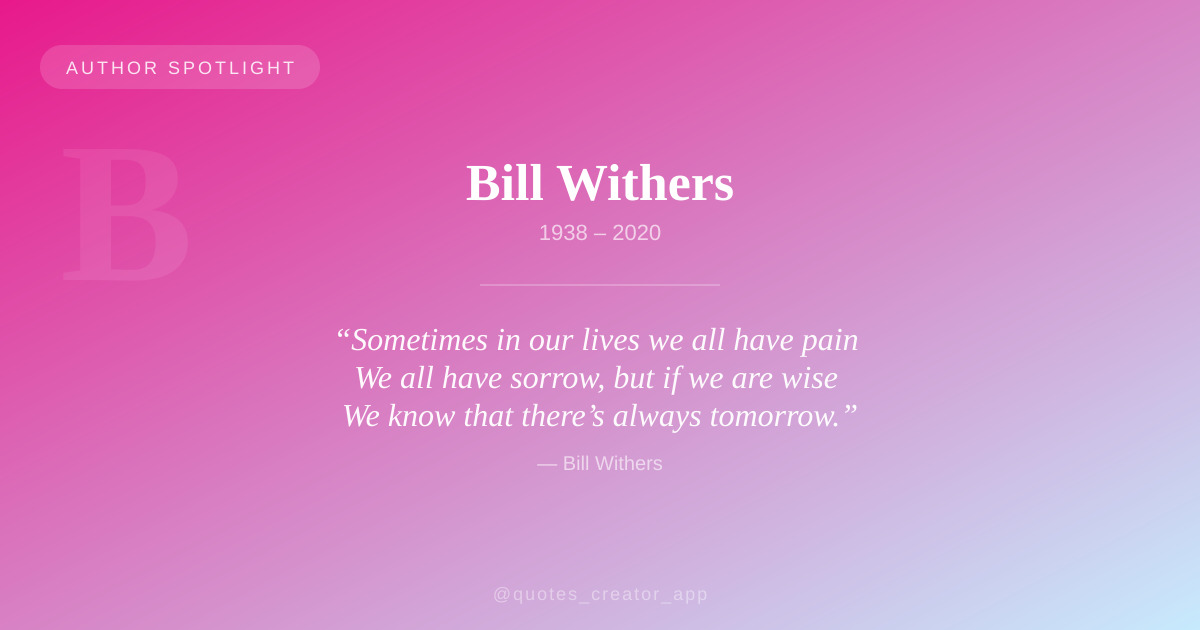
“Sometimes in our lives we all have pain
We all have sorrow
But if we are wise
We know that there’s always tomorrow.”
The meaning behind these words
These opening lines from “Lean on Me” are among the most recognizable in popular music, and for good reason. Withers distills a universal truth into four simple lines: pain and sorrow are inevitable parts of the human experience, but they are never permanent. The phrase “if we are wise” is crucial — it suggests that hope is not naive optimism but a conscious choice, a form of wisdom earned through living. In a world that often feels overwhelming, Withers offers not a promise that everything will be fine, but something more honest: the assurance that change always comes.
What makes these lines so powerful is their humility. Withers does not position himself above the listener; he includes himself in the collective “we.” He acknowledges the reality of suffering without dwelling on it, then gently redirects attention toward the horizon. This is the voice of someone who grew up in poverty, who stuttered as a child, who spent nine years in the Navy and worked on assembly lines — someone who had every reason to be bitter but chose instead to be wise.
“Ain’t no sunshine when she’s gone
It’s not warm when she’s away.”
The meaning behind these words
Withers wrote “Ain’t No Sunshine” after watching the film Days of Wine and Roses, a story about a couple destroyed by alcoholism. The song captures the disorienting emptiness of absence — how the world literally feels dimmer, colder, when someone essential is gone. It is a deceptively simple observation: sunshine and warmth are metaphors for emotional well-being, and their removal creates a void that no distraction can fill. The repetition of “I know” twenty-six times in the bridge mirrors the spiraling, obsessive quality of grief.
The song established Withers as a once-in-a-generation talent and won the Grammy for Best R&B Song in 1972. But its true genius lies in what it leaves unsaid. Withers never explains why she is gone or whether she will return. He simply sits in the feeling, trusting the listener to supply their own story. That restraint — the confidence to say less and mean more — became a hallmark of his writing and is why the song remains a touchstone for heartbreak over fifty years later.
“I’m not a virtuoso, but I was able to write songs that people could identify with. I don’t think I’ve done bad for a guy from Slab Fork, West Virginia.”
The meaning behind these words
Withers said this during his Rock and Roll Hall of Fame induction weekend in 2015, and it captures the disarmingly humble self-assessment that defined his entire career. He never pretended to be a technical marvel on any instrument, nor did he cultivate a larger-than-life persona. What he had was something rarer: an intuitive grasp of emotional truth and the ability to articulate it in language so plain it felt like conversation. He understood that people did not need to be impressed by his skill; they needed to feel understood by his songs.
The reference to Slab Fork is deliberate. Withers carried his Appalachian roots with him his whole life, and he never let fame convince him he was separate from the ordinary people he wrote for. That grounding gave his work an authenticity that no amount of studio polish could replicate. By refusing to inflate his own importance, he paradoxically made himself more valuable — a reminder that the most enduring art often comes not from ego, but from a clear-eyed view of one’s place in the world.
“My first goal was, I didn’t want to be a cook or a steward… I still had to prove to people that thought I was genetically inferior that I wasn’t too stupid to drain the oil out of an airplane.”
The meaning behind these words
This quote offers a rare window into the prejudice Withers faced as a young Black man from rural West Virginia. His wry humor — “prove to people that thought I was genetically inferior that I wasn’t too stupid to drain the oil out of an airplane” — barely conceals the indignity of having to demonstrate basic competence to a society that expected less of him because of his race. He chose aircraft-mechanic school deliberately, as a route to dignity and independence, and the pride in that achievement never left him.
The quote also reveals a pattern that would repeat throughout his life: when confronted with low expectations, Withers did not argue or complain. He proved them wrong through action, then moved on. He approached the music industry the same way — when executives tried to dictate his sound, he left. When critics underestimated his songwriting, he let the songs speak for themselves. It was not passivity but a quiet, steel-spined confidence that his work would outlast any dismissal.
“I grew up in the age of Barbra Streisand, Aretha Franklin, Nancy Wilson… It was a time where a fat, ugly broad that could sing had value. Now everything is about image. It’s not poetry. This just isn’t my time.”
The meaning behind these words
In this characteristically blunt assessment, Withers draws a line between two eras of popular music: one that valued vocal ability above all else, and one that prioritized visual presentation. His phrase “it’s not poetry” cuts to the heart of his artistic philosophy. For Withers, a song was a poem set to music — a vessel for meaning, not a vehicle for branding. He watched the industry shift toward image-driven pop and felt, without bitterness or nostalgia, that the world had simply moved in a direction that no longer made room for someone like him.
That clarity — the ability to recognize when a situation no longer serves you and the courage to walk away — is what makes Withers such a compelling figure. He did not rail against the changing times or attempt to adapt to trends. He simply decided that his time was done, and he went home. It is a decision that cost him millions of dollars in potential earnings but earned him something more valuable: a life lived on his own terms, and a legacy that has only grown in the decades since he stopped recording.
Bill Withers’s legacy
Bill Withers left the music industry in 1985, but his music never left the culture. “Lean on Me” has been recorded by dozens of artists across every genre and remains a staple of graduations, funerals, benefit concerts, and moments of collective grief. “Ain’t No Sunshine” is one of the most-streamed songs from the 1970s, discovered anew by each generation. “Lovely Day” holds the record for the longest sustained note on an American chart hit (18 seconds on a high E). “Just the Two of Us” continues to soundtrack weddings and family moments. His songs have been sampled by Tupac, Kendrick Lamar, Blackstreet, and Aaliyah, woven into the fabric of hip-hop and pop music.
What makes Withers’ legacy extraordinary is not just the quality of his work but the manner of his departure. He is one of the few artists in popular music who walked away from fame at its peak and never looked back, never attempted a comeback, never expressed regret. He proved that artistic integrity and commercial success could coexist — and that the former mattered more. In an era of relentless self-promotion, his quiet confidence and refusal to compromise stand as a powerful example. A seven-foot bronze statue in Beckley, West Virginia, now ensures that new generations will ask who he was, discover his music, and find in it the same comfort and wisdom that millions have before them.
Why we chose Bill
Today, July 4, marks what would have been Bill Withers’ 88th birthday — fitting for a man born on Independence Day who spent his career writing anthems of interdependence. We are also deep in the 2026 FIFA World Cup, a time when the world comes together, and no song captures the spirit of mutual reliance better than “Lean on Me.” Withers lived a life that defied easy categorization: he was a mechanic and a Rock and Roll Hall of Famer, a man who stuttered and a singer who moved millions, an artist who quit the business at the top of his game and never regretted it. In a culture obsessed with fame, his story is a quiet revolution.
— ThinkPeak Studio Editorial Team
Create graphics with Bill’s quotes
Bill Withers’ words have a timeless quality that makes them perfect for quote graphics. Whether you are sharing on Instagram, creating a vision board, or looking for daily inspiration, Quotes Creator helps you transform these quotes into beautiful, shareable designs with custom fonts, gradients, and layouts.
Create your own quote graphic with this quote
Turn this line into a shareable graphic in seconds — free, no signup needed. For video quotes and 100+ templates, try the Android app.
Advertisement
Enjoyed this article? Get more like it in your inbox.