On this page
Author Spotlight: Bonnie Tyler
The Welsh rock icon whose husky voice defined a generation and whose wisdom on authenticity and hard work transcends music.
Who was Bonnie Tyler?
Born Gaynor Hopkins on 8 June 1951 in the tiny Welsh village of Skewen, Bonnie Tyler came from nothing and built a career that spanned five decades, sold over 100 million records, and produced some of the most instantly recognisable songs in popular music. Her father was a coal miner and Second World War veteran; her mother raised six children in a four-bedroom council house. The family was deeply Protestant, and Tyler’s first public performance came in a chapel, where she sang the hymn “All Things Bright and Beautiful” as a child. She left school at sixteen with no qualifications and took a job in a grocery shop, handing her wages to her parents each week while saving five shillings for herself. It was a working-class beginning that shaped everything she became, and she never let anyone forget it.
Tyler’s singing career began in the pubs and clubs of South Wales, where she spent seven years grafting before landing her first record deal with RCA at twenty-six. Her debut single “Lost in France” became a hit across Europe, and “It’s a Heartache” catapulted her onto the US Billboard charts in 1977. But the turning point came in the early 1980s when she underwent surgery to remove vocal cord nodules and awoke to find her voice transformed — rougher, huskier, unmistakable. That voice caught the attention of songwriter Jim Steinman, who was looking for someone who could deliver the same operatic intensity he had brought to Meat Loaf. The result was “Total Eclipse of the Heart,” a song that sold thirteen million copies, topped charts around the world, and became one of the defining power ballads of the twentieth century. Steinman later said he wrote it specifically for Tyler’s voice, and listening to those opening piano chords, it’s impossible to imagine anyone else singing it.
What set Bonnie Tyler apart was not merely her vocal power but her philosophy. She never courted celebrity, never built an entourage, and never chased trends. “I have never gone out of fashion,” she once said, “because I never sought it.” She approached music with the discipline of the working-class girl she always considered herself to be — showing up, doing the work, honouring the gift. Even after achieving global fame, she continued performing in countries large and small, learning which songs resonated where, tailoring her sets to every audience. She recorded French-language duets, German-produced albums, and eventually represented the United Kingdom at Eurovision in 2013 — not as a nostalgic relic but as an active artist still releasing new material. Her last two albums, Between the Earth and the Stars (2019) and The Best Is Yet to Come (2021), arrived in her late sixties and early seventies, proof that she never stopped singing, never stopped creating, never stopped believing there was more to give.
On 8 July 2026, exactly one month after her seventy-fifth birthday, Bonnie Tyler died in Faro, Portugal, following complications from emergency surgery. She had lived in the Algarve with her husband Robert Sullivan — a former Olympic judo competitor she married in 1973 — for nearly four decades. Tributes poured in from across the world: Sir Cliff Richard called her “another wonderful friend gone too soon,” Catherine Zeta-Jones said she was heartbroken, and Prime Minister Keir Starmer described her as “one of Britain’s greatest recording artists.” But perhaps the most fitting tribute came from Carol Vorderman, who said Tyler’s music represented “fighting and power and living life without apology.” That is the Bonnie Tyler legacy — not just a voice, but a way of being in the world.
Bonnie Tyler’s most memorable quotes
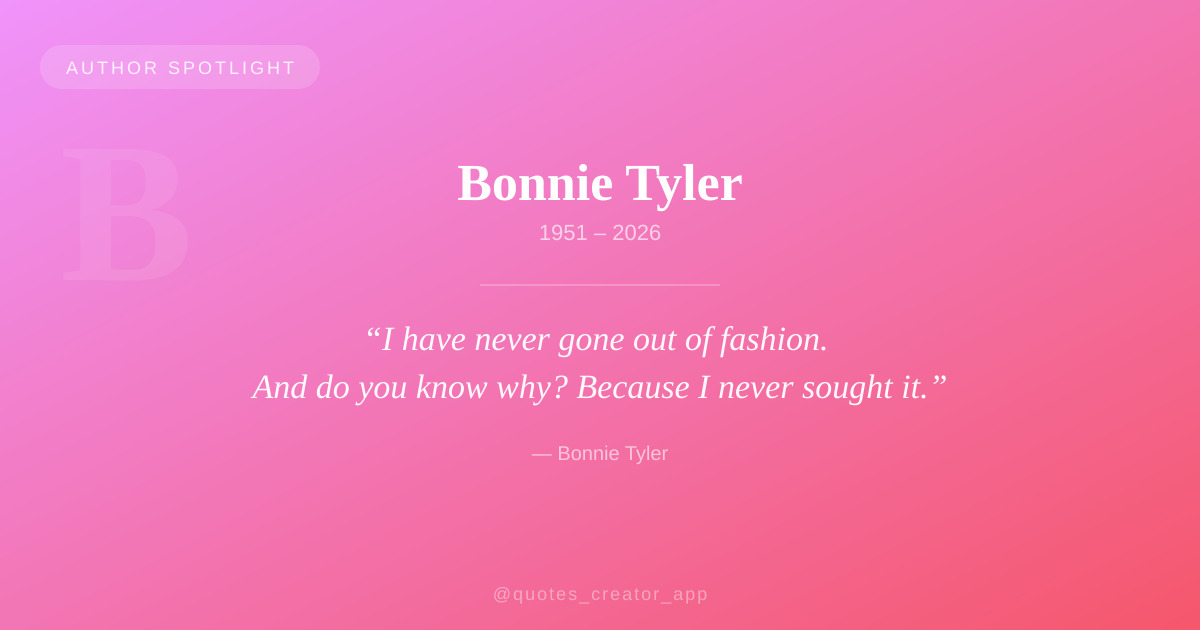
“I have never gone out of fashion. And do you know why? Because I never sought it. When you don’t seek it, it’s always with you.”
The meaning behind these words
This quote captures the central paradox of Bonnie Tyler’s entire career. In an industry built on image, reinvention, and the relentless pursuit of relevance, she simply refused to participate. While pop stars cycled through stylists and concepts, Tyler wore what she liked, sang what she believed, and let the music speak for itself. She understood something that escapes many public figures: desperation is visible. The harder you chase approval, the further it recedes. By anchoring herself in her working-class identity and her genuine love of singing, she became timeless without trying. There is a profound lesson here for anyone creating art, building a career, or simply navigating the pressures of social visibility in the modern world.
What makes the observation especially sharp is the distinction between being fashionable and seeking fashion. Fashion, by definition, changes. To seek it is to commit to constant reinvention, which Tyler rightly identifies as a form of dependence. But authentic expression — the thing you do because it is genuinely yours — does not age the same way. It becomes classic rather than dated, iconic rather than obsolete. Tyler’s music still fills dance floors and karaoke bars decades after its release because it was never designed for a particular moment. It was simply real, and nothing ages better than the real thing.
“I’ve been singing since I was 16 because I love it — I wanted to be a singer, not a star. There’s a difference between wanting to be famous and wanting to sing well.”
The meaning behind these words
In an era when social media metrics, follower counts, and viral moments often seem to matter more than the craft itself, Tyler’s distinction between fame and artistry is bracingly clear. She started singing at sixteen because something inside her needed to come out — not because she wanted to be recognised in supermarkets. Those seven years spent in pubs and clubs before landing a record deal were not a waiting room for stardom. They were the real thing: music for its own sake, performed for whoever happened to be listening. The joy she found in those early years carried her through every phase of her career, from global stadiums to small European television studios, and it protected her from the bitterness that so often afflicts artists when the spotlight moves on.
This philosophy also explains why Tyler never retired, never stopped recording, and never became a nostalgia act out of obligation rather than desire. She kept singing because she loved to sing. The distinction is not just semantic; it is a framework for building a sustainable creative life. Ambition to improve at your craft is generative and renewable. Ambition to be known is extractive and perishable. Tyler lived the former, which is why, at seventy-three, she was still releasing new albums and touring while many of her contemporaries had long since burned out or given up. She was there for the music, not the marquee, and the music repaid her with a lifetime of relevance.
“I suppose I don’t have to work but I do love working. I class myself as a working-class girl and I’ve never stopped working. When I’m offered shows here, there and the other, I do an awful lot because I feel other people would love to be offered what I’m offered; who am I to say no?”
The meaning behind these words
There is a humility in these words that is rare among people who have sold over six million copies of a single song. Tyler never forgot where she came from, and she never allowed success to create distance between herself and the people who made her. She spoke often of her parents, of her mother Elsie who raised seven children on a coal miner’s wage, of the house that felt “a bit like a scene from The Good Life.” That working-class identity was not a biographical footnote she outgrew; it was the lens through which she understood her good fortune. When she says “who am I to say no?” she is not performing humility. She genuinely believed that turning down opportunities would be an act of ingratitude to a life that had already given her more than she ever expected.
This ethic also explains Tyler’s remarkable durability. While many artists become selective to the point of retreat, Tyler kept working — in Germany, in France, in Poland, in New Zealand, wherever people wanted to hear her. She changed her setlists by country because she had different hits in different markets, and she treated every audience with the same respect. That willingness to show up, to do the work, to say yes, was not driven by financial necessity but by a deep-seated belief that work itself is dignifying. It is a thoroughly working-class philosophy, and it is one of the reasons she remained so beloved: people sensed that she never considered herself above them.
“I do believe that God blessed me in life with a wonderful family, a successful career, and a loving marriage, and remain thankful for that blessing.”
The meaning behind these words
Faith was a consistent thread throughout Tyler’s life, though she wore it lightly. Raised in a Protestant household where she attended church three times on a Sunday, she carried that sense of gratitude and groundedness into adulthood without ever becoming preachy or dogmatic. What is striking about this quote is not the belief itself but the simplicity of its expression. Tyler does not theologise or philosophise. She simply lists what she is thankful for — family, career, marriage — and attributes it to a force larger than herself. That kind of gratitude is rare in an industry that often rewards narcissism, and it was part of what kept her steady through the ups and downs of a long career.
The marriage she mentions deserves particular attention. Tyler met Robert Sullivan in 1972 and married him a year later. They were together for fifty-three years, until her death. In an industry where relationships are famously fragile, their partnership was a quiet anchor. Sullivan, an Olympic judo competitor turned property developer, was not part of the music world, and that may have been precisely the point. Together they built a life beyond the stage — homes in Wales and Portugal, a dairy farm in New Zealand, a quarry, dozens of properties. Tyler’s gratitude was not abstract. It was rooted in a life she had built with intention alongside someone who saw her as Gaynor, not as the woman who sang “Total Eclipse of the Heart.”
“It’s no good singing if you just want to be a pop star; you’ve got to work at it and do it for the love for it, not because you think it will make you famous.”
The meaning behind these words
This quote distils Tyler’s entire philosophy into a single sentence, and it reads almost like a challenge to the aspiring artist. She is not saying that ambition is wrong, or that recognition does not feel good when it comes. She is drawing a line between primary and secondary motivations. If your reason for singing is fame, you will quit when fame proves elusive or fleeting. If your reason is the singing itself, then every stage, no matter how small, is a gift. Tyler advised young artists to form bands, practise in garages, play charity shows and open mic nights — not as stepping stones to something better but as the work itself. The craft is the point. Everything else is incidental.
Her advice also carries a quiet warning about the psychology of fame. Pursuing recognition as an end in itself creates a fragile foundation: success, when it comes, never feels like enough, and failure, when it comes, feels like annihilation. But pursuing the love of an activity creates resilience. Tyler experienced the full arc of a music career — dizzying highs, quiet periods, reinvention, and late-career renaissance — and she navigated all of it with equanimity because the work was never a means to an end. It was the end. For anyone building a creative life, that distinction is worth tattooing on the inside of your eyelids.
Bonnie Tyler’s legacy
Bonnie Tyler leaves behind a catalogue of songs that have become cultural shorthand. “Total Eclipse of the Heart” alone has been covered, parodied, remixed, and lip-synced in countless films, television shows, and viral videos. The song’s recent use during an actual solar eclipse in 2024 renewed its popularity for yet another generation, proving Tyler’s own maxim correct: the things we do authentically never really go out of fashion. But her legacy extends far beyond any single track. She was one of the first Welsh artists to achieve sustained global success in the rock genre, paving the way for future generations of Welsh musicians. Her 2022 MBE, awarded in the Queen’s Birthday Honours for services to music, was a formal recognition of something her fans had known for decades: Bonnie Tyler was a national treasure.
Perhaps her most enduring gift, however, was the example she set. In a world increasingly obsessed with image curation and personal branding, Tyler demonstrated that you could build a fifty-year career on the strength of a unique voice and an uncompromising commitment to being yourself. She never pretended to be anything she was not, never abandoned her accent or her roots, and never allowed the machinery of fame to grind away the person underneath. She was Gaynor Hopkins from Skewen who happened to have a voice that could fill a stadium. And in the end, on the day she died, what people remembered was not just the songs but the spirit behind them — fierce, grateful, unpretentious, and utterly singular.
Create graphics with Bonnie’s quotes
Bonnie Tyler’s words have a timeless quality that makes them perfect for quote graphics. Whether you are sharing on Instagram, creating a vision board, or looking for daily inspiration, Quotes Creator helps you transform these quotes into beautiful, shareable designs with custom fonts, gradients, and layouts.
Why we chose Bonnie
Bonnie Tyler passed away just two days before this spotlight was written, and the outpouring of tributes from across the world confirmed what her fans have always known: she was far more than the voice behind a handful of eighties hits. She was a working-class Welsh woman who never asked for permission, never apologised for her ambition, and never stopped doing the thing she loved. Her quotes reveal a philosophy of life that is startlingly consistent — rooted in gratitude, grounded in hard work, and animated by an almost childlike love of singing. In a world that often rewards artifice, Bonnie Tyler reminds us that authenticity is not just noble but effective. It built a fifty-year career, earned the affection of millions, and left behind a body of work that will be played at weddings, karaoke bars, and late-night drives for as long as people have hearts that need eclipsing.
— ThinkPeak Studio Editorial Team
Create your own quote graphic with this quote
Turn this line into a shareable graphic in seconds — free, no signup needed. For video quotes and 100+ templates, try the Android app.
Advertisement
Enjoyed this article? Get more like it in your inbox.