On this page
Author Spotlight: Christopher Nolan
British-American filmmaker, knighted for services to film, known for complex narratives in blockbusters from Memento to Oppenheimer
Who was Christopher Nolan?
Sir Christopher Edward Nolan was born on 30 July 1970 in London, England, to an English father who worked in advertising and an American mother who was a flight attendant. Growing up between London and Chicago during his summers, Nolan was exposed to two cultures from an early age—an experience that would later inform his dual British-American citizenship and the transatlantic sensibility of his films. He began making short films at age seven using his father’s Super 8 camera, enlisting his action-figure toys as actors. By his teenage years, he was already experimenting with narrative structure and editing, showing an early fascination with the mechanical and philosophical possibilities of cinema that would define his entire career.
After studying English literature at University College London, where he chose the program specifically because it gave him access to filmmaking equipment, Nolan made his feature debut with Following (1998), a noir thriller shot on weekends for just £6,000. His breakout came with Memento (2000), a reverse-chronological mystery that earned two Academy Award nominations and established his signature approach: intellectually demanding narratives wrapped inside commercially viable genre frameworks. The Dark Knight trilogy (2005–2012) redefined the superhero genre and proved that blockbusters could carry philosophical weight, while Inception (2010), Interstellar (2014), and Dunkirk (2017) cemented his reputation as Hollywood’s most ambitious original storyteller. In 2023, Oppenheimer won seven Academy Awards including Best Picture and Best Director, earning Nolan his first Oscars after years of being the industry’s most celebrated director without one. He was appointed a Commander of the British Empire in 2019 and knighted in 2024 for his contributions to film.
At the core of Nolan’s worldview is a profound belief that audiences are smarter than studios assume. He treats filmmaking as a philosophical enterprise, threading questions about memory, identity, time, and human limitation through even his most spectacular set pieces. He insists on shooting on celluloid film, champions practical effects over CGI wherever possible, and refuses to own a smartphone—convictions that position him as both a defender of cinema’s analog heritage and one of its most forward-thinking practitioners. His films do not merely entertain; they invite audiences to work through puzzles of epistemology and ethics, rewarding repeated viewing in an era that increasingly favors passive consumption. “I think audiences get too much credit,” he has said, “they are extremely ruthless in their demand for newness, novelty and freshness.”
Nolan’s legacy is already being written in real time. With The Odyssey, his 2026 adaptation of Homer’s epic, he continues to push the boundaries of large-format filmmaking while drawing deeply from classical literature. He stands as the rare filmmaker who commands both massive global audiences and unwavering critical respect—the kind of auteur the industry once feared was vanishing. His influence extends beyond cinema: his commitment to analog craft in a digital world, his insistence that complexity can be commercial, and his demonstration that intellectual ambition and mass appeal are not mutually exclusive have made him a cultural figure as much as a cinematic one.
Christopher Nolan’s most memorable quotes
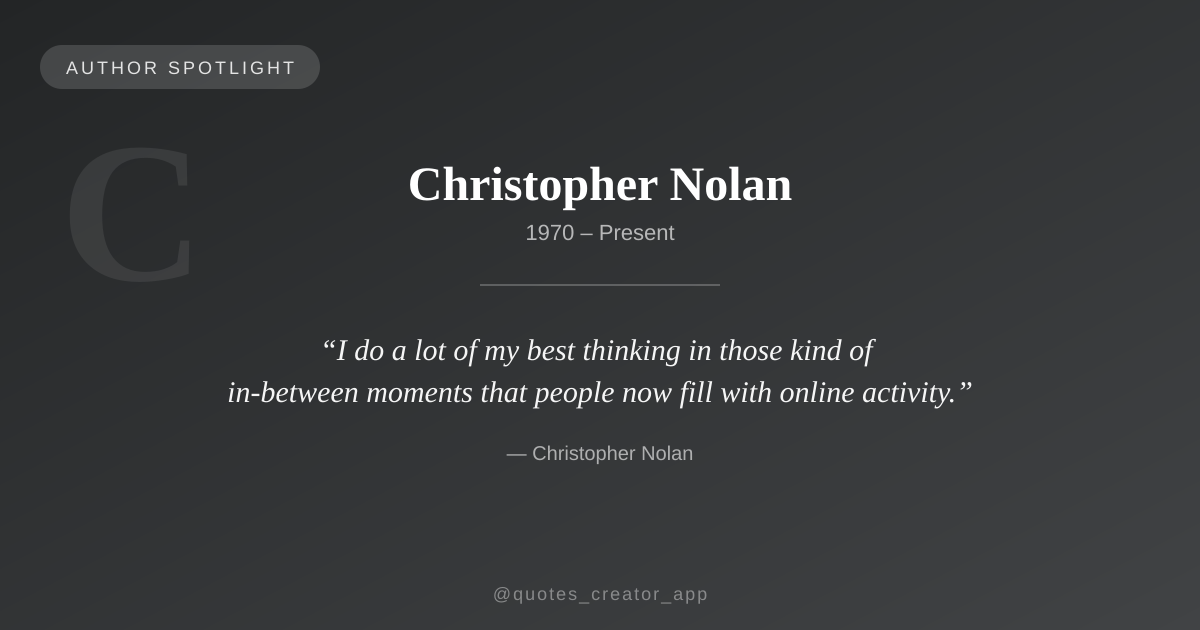
“I do a lot of my best thinking in those kind of in-between moments that people now fill with online activity.”
The meaning behind these words
In an age where the average person checks their phone over a hundred times a day, Nolan’s observation lands with uncomfortable precision. He is describing something most of us have lost: the generative power of boredom, the creative potential of the idle mind. Neuroscientists refer to this as the default mode network—the brain state activated during daydreaming, when we are not focused on any external task—and it is precisely this state that smartphones have colonized. Nolan, by deliberately opting out, preserves a sanctuary of unstructured mental time that he credits as essential to his creative output.
What makes this quote especially resonant is that it comes from someone whose work depends on intricate planning, meticulous structure, and enormous technical coordination. He is not romanticizing aimless thought as a replacement for discipline but identifying it as the soil in which discipline grows. The “in-between moments” he describes are not wasted time; they are the intervals where disparate ideas connect, where story problems resolve themselves subconsciously, and where the oversized ambition of films like Inception and Interstellar first took root. The quote is a quiet manifesto for reclaiming attention in an attention economy.
“The audience is extremely ruthless in its demand for newness, novelty and freshness.”
The meaning behind these words
Nolan made this remark while discussing the challenge of crafting a sequel to Batman Begins, but its implications reach far beyond franchise filmmaking. He is articulating a truth that every artist, writer, entrepreneur, and creator confronts: audiences have an almost primal hunger for the new, and they will punish repetition with indifference. This is not cynicism on Nolan’s part; it is a statement of respect. He views the audience not as passive consumers to be fed familiar comfort food but as active participants whose expectations must be honored—and surpassed.
This philosophy explains why Nolan has never made a conventional sequel, why The Dark Knight feels nothing like Batman Begins, and why he has resisted the gravitational pull of franchise filmmaking even after proving he could dominate it. Each of his films represents a deliberate break from the last: the non-linear amnesia thriller gives way to the magic-period drama, which yields to the space epic, which transforms into the war film. The “ruthless demand” he identifies is not a burden but a creative engine—the force that keeps him from resting on proven formulas and pushes his work into unfamiliar territory.
“You take an objective approach at times to get you through things, and you take a subjective approach at other times, and that allows you to find an emotional experience for the audience.”
The meaning behind these words
This quote reveals the dual consciousness at the heart of Nolan’s creative method. On one hand, he is the structural engineer—the writer who diagrams timelines on whiteboards, who reverse-engineers plot mechanisms, who approaches narrative as a mathematical puzzle to be solved. On the other hand, he is the empathetic artist who must inhabit characters emotionally, who must feel his way through scenes to earn genuine audience investment. The balance between these two modes, he suggests, is what produces work that is both intellectually rigorous and emotionally resonant.
The insight has applications far beyond screenwriting. It describes the rhythm of any complex creative endeavor: the oscillation between analytical distance and immersive feeling, between planning and instinct, between architecture and improvisation. Nolan’s films are so often described as “cold” or “cerebral,” yet the moments audiences remember most—Cooper watching decades of messages from his children in Interstellar, the final spinning top in Inception—are deeply emotional. He achieves this not despite his structural obsessions but because he knows when to set them aside and let subjectivity take over.
“With the great, whether it is Stanley Kubrick, Terrence Malick or Hitchcock what you’re seeing is inseparable, a vital relationship between the images and the story he’s telling.”
The meaning behind these words
Nolan is identifying what separates master filmmakers from competent ones: the inability to separate what a film looks like from what it means. In the work of the directors he cites, form and content are not two separate decisions made in sequence; they emerge together, each shaping the other from conception. A Kubrick tracking shot is not decoration applied to a scene—it is the meaning of the scene made visible. A Malick sequence of light through trees is not aesthetic indulgence; it is the philosophical argument of the film rendered in images rather than words.
This conviction runs through Nolan’s own filmography with remarkable consistency. The folding cityscapes of Inception are not merely spectacle; they are a physical metaphor for the nested, malleable architecture of dreams. The intersecting timelines of Dunkirk—land, sea, and air operating on different temporal scales—are not structural gimmicks; they embody the film’s thesis about the subjective experience of survival. Nolan aspires to the tradition he describes, where the visual language and the story it carries cannot be pried apart, and where every frame earns its place not just aesthetically but narratively and thematically.
“But remember, I spent ten years dealing with Batman.”
The meaning behind these words
This deceptively simple remark, offered during the promotional campaign for The Odyssey in 2026, contains an entire philosophy of creative resilience. When Nolan faced criticism for unconventional casting decisions in his Homeric adaptation, he responded not with defensiveness or detailed justification but with a single, quietly devastating sentence. He was reminding the world—and perhaps himself—that he had survived the most intense fan scrutiny imaginable: the casting of Heath Ledger as the Joker, a decision initially met with widespread ridicule that ultimately produced one of cinema’s most celebrated performances.
The quote doubles as a statement about earned confidence. Nolan has repeatedly made choices that looked wrong on paper and proved visionary in execution: casting a rom-com actor as a comic-book villain, building a World War II epic without a central protagonist in the traditional sense, making a three-hour talk-heavy biopic about a physicist that grossed nearly a billion dollars. “I spent ten years dealing with Batman” is shorthand for: I have been here before, I have been doubted before, and I have learned that the only response to skepticism is the work itself. It is a lesson in creative stamina delivered in nine words.
Christopher Nolan’s legacy
Christopher Nolan has done something that seemed impossible at the turn of the millennium: he has built a career making original, intellectually demanding blockbusters outside the franchise machinery that now dominates Hollywood. At a time when studios increasingly rely on established intellectual property to mitigate risk, Nolan has repeatedly convinced them to bet hundreds of millions of dollars on ideas that had no precedent—a film about shared dreaming, a space epic grounded in theoretical physics, a nonlinear war film told from three perspectives, a biopic about the father of the atomic bomb. Each of these was, in conventional studio logic, an absurd proposition. Each succeeded both commercially and critically.
His deeper legacy, however, may be philosophical rather than industrial. Nolan has reintroduced the idea that popular cinema can be a vehicle for genuine intellectual inquiry. His films ask audiences to think about the nature of time, the fallibility of memory, the ethics of power, and the limits of human understanding—and they do so not in the margins of niche art-house cinema but at the center of global popular culture. In an entertainment landscape that increasingly treats viewers as data points to be algorithmically satisfied, Nolan treats them as minds to be engaged. That alone may be his most radical and enduring contribution.
Create graphics with Christopher’s quotes
Christopher Nolan’s words have a precision and depth that make them perfect for quote graphics. Whether you are sharing on Instagram, creating a vision board, or looking for daily inspiration, Quotes Creator helps you transform these quotes into beautiful, shareable designs with custom fonts, gradients, and layouts.
Why we chose Christopher
Christopher Nolan is trending worldwide as The Odyssey dominates cultural conversation during the 2026 FIFA World Cup season—a rare convergence of classical storytelling, modern blockbuster cinema, and global sporting spectacle. Beyond the headlines, Nolan represents something increasingly rare: a filmmaker whose words about creativity, focus, and artistic integrity carry as much weight as the images he puts on screen. His deliberate rejection of smartphones, his defense of analog craft, and his insistence that audiences deserve intellectual respect make him a uniquely compelling figure for an Author Spotlight at this moment.
— ThinkPeak Studio Editorial Team
Create your own quote graphic with this quote
Turn this line into a shareable graphic in seconds — free, no signup needed. For video quotes and 100+ templates, try the Android app.
Advertisement
Enjoyed this article? Get more like it in your inbox.