On this page
Author Spotlight: Cristiano Ronaldo
Portuguese footballer, five-time Ballon d’Or winner, all-time leading goalscorer, and one of the greatest athletes in history
Who is Cristiano Ronaldo?
Cristiano Ronaldo dos Santos Aveiro was born on February 5, 1985, in Funchal, the capital of the Portuguese island of Madeira, to a working-class family. His father, José Dinis Aveiro, worked as a gardener and part-time kit man at the local football club Andorinha, while his mother, Maria Dolores, was a cook who held the family together through financial hardship. Ronaldo grew up in a small home with a tin roof, sharing a cramped room with his older brother and two sisters. From the concrete streets of Madeira, football became his escape and his obsession. At age 12, he left his family to join Sporting CP’s academy in continental Portugal — a tearful departure that saw him cry on the phone to his mother every night but refuse to come home, because even as a child he understood that the dream had a price. At 14, a racing heart during training revealed tachycardia, a condition that could have ended his career before it began. He underwent surgery and was back on the pitch within days, the same stubborn resolve already visible.
Manchester United manager Sir Alex Ferguson signed Ronaldo in 2003 after being convinced by a single preseason friendly against Sporting — United’s players reportedly begged Ferguson to buy the 18-year-old at halftime. Handed the iconic number 7 shirt, Ronaldo spent six years at Old Trafford winning three Premier League titles, the 2008 Champions League, and his first Ballon d’Or at age 23. In 2009, he moved to Real Madrid for a then-world-record €94 million, a transfer that would reshape modern football. Over nine seasons at Madrid, he won four Champions League titles, including the historic La Décima in 2014, scored 450 goals in 438 appearances, and collected four more Ballon d’Or awards. Subsequent stints at Juventus, a turbulent return to Manchester United, and his current leadership role at Al-Nassr in Saudi Arabia have only added to a legend that now includes over 970 senior career goals, making him the highest scorer in the history of professional football.
What truly distinguishes Ronaldo from even his greatest peers is an almost inhuman commitment to self-improvement. He follows a body-fat regimen so precise that teammates describe it as monastic, sleeps in five 90-minute cycles a day, eats six small meals, and trains with forensic attention to every muscle group. This discipline is not a recent adaptation but a lifelong philosophy: he believes that talent alone is a starting point, and that greatness must be constructed through daily, grinding effort. His confidence — often mistaken for arrogance by critics — is better understood as the product of an unshakable internal standard. He measures himself against no one but the ceiling of his own potential, and he has spent more than two decades proving that the ceiling keeps rising. “Hard work,” he once said, “is the only thing that can’t be given to you.”
At 41, Ronaldo is still competing at the highest level. In the 2026 FIFA World Cup, he became the first male player to score in six different World Cup tournaments. In 2025, he surpassed one billion total social media followers — the first human to reach that milestone. In 2026, he appeared on the Forbes World’s Billionaires list for the first time, with a net worth of $1.2 billion. These numbers are staggering, but they only hint at the deeper legacy: Ronaldo created a model of modern athleticism — a fusion of talent, science, and psychology — that has inspired an entire generation of young players who grew up wanting to be CR7. His influence extends beyond football into fashion, fitness culture, philanthropy, and the very idea of what an athlete can build beyond the field.
Cristiano Ronaldo’s most memorable quotes
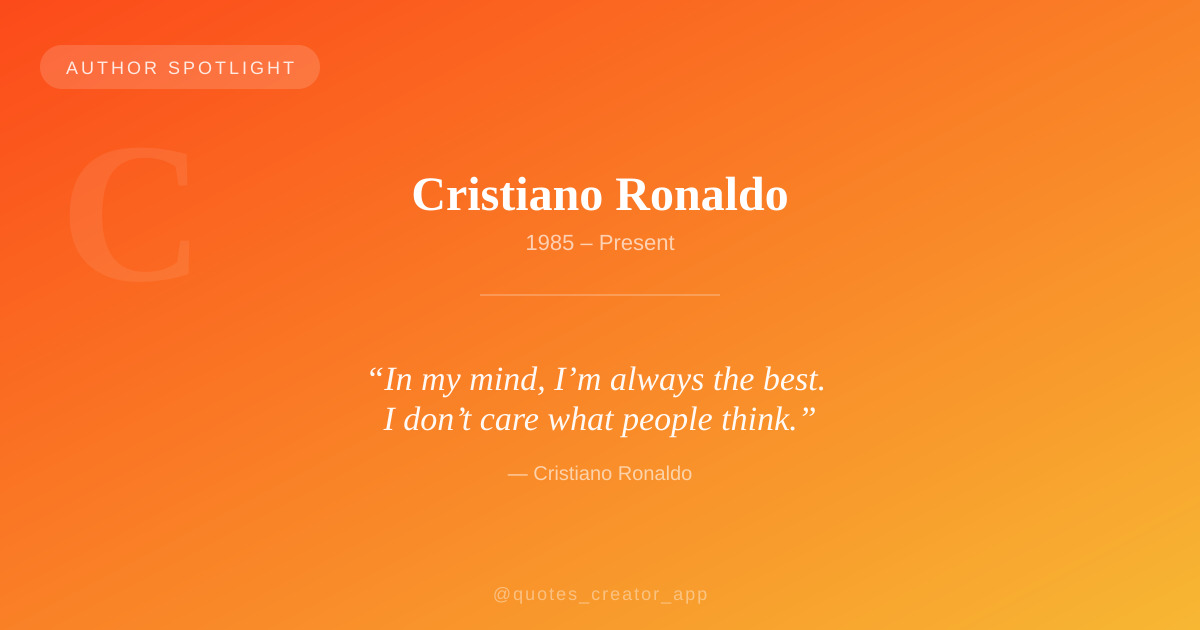
“In my mind, I’m always the best. I don’t care what people think, what they say. In my mind, not just this year but always, I’m always the best.”
The meaning behind these words
This quote, given to the BBC ahead of the release of his self-titled documentary Ronaldo, is a masterclass in the psychology of sustained excellence. Ronaldo does not say he hopes to be the best or that he is trying to be the best — he declares that in his mind, he already is. The qualification “in my mind” is critical: he is not making an empirical claim that requires universal agreement. He is describing the internal architecture of his confidence, the mental framework that allows him to walk onto any pitch, at any age, against any opponent, believing he will prevail. Psychologists call this a “performance mindset” — the ability to separate external criticism from internal self-assessment. Ronaldo has honed this separation into a superpower.
The wider context matters too. In 2015, Ronaldo was 30 years old, an age when many footballers enter decline. Lionel Messi had just won the 2015 Ballon d’Or, and critics were beginning to ask whether Ronaldo’s peak had passed. His answer was not an argument but a statement of fact from his own reality: he had already decided that he was the best, and that decision was not up for debate. He would go on to win three more Champions Leagues, two more Ballon d’Or awards, and the 2016 European Championship with Portugal. The quote reads differently now than it did in 2015 — what sounded like bravado then reads like prophecy today. It is a reminder that confidence, when backed by relentless work, is not arrogance but clarity.
“Your love makes me strong, your hate makes me unstoppable.”
The meaning behind these words
Few athletes in history have been as polarizing as Ronaldo, and even fewer have turned that polarization into fuel. This quote, shared across his social media platforms and echoed by millions of fans worldwide, captures a paradoxical truth about life in the public eye: both adoration and criticism can serve the same purpose if you refuse to let either define you. Ronaldo takes the energy of his detractors — the whistles from opposing fans, the doubters who call him past his prime, the media narratives that compare him unfavorably to Messi — and converts it into motivation. The distinction between “strong” and “unstoppable” is finely calibrated: love fortifies him, but hate removes his limits entirely.
This mindset did not develop overnight. Early in his career, Ronaldo was notorious for his temper on the pitch — the frustrated gestures, the petulant reactions to being tackled. Over time, he learned to channel that emotional intensity into performance rather than complaint. The transformation from a talented but volatile teenager into the cold-eyed competitor who thrives under the highest pressure is one of the great untold stories of his career. This quote is the mature distillation of that evolution: he no longer fights the noise. He uses it. For anyone facing criticism in their own life — at work, in relationships, in pursuit of a difficult goal — the principle is transformative. Let the doubters become data points in your engine, not obstacles in your path.
“I don’t see anyone better than me. No player does things that I cannot do myself, but I see things others can’t do. There’s no more complete player than me. I’m the best player in history — in the good and the bad moments.”
The meaning behind these words
This quote from the 2017 Ballon d’Or ceremony is Ronaldo’s most complete articulation of his self-belief. He moves beyond the usual athlete platitudes — putting the team first, staying humble, respecting opponents — and makes an unapologetic case for his own supremacy. The phrase “in the good and the bad moments” is particularly revealing. Ronaldo is not claiming to be perfect every single match. He is claiming that even on his worst days, even when the goals are not coming and the team is losing, his baseline remains higher than anyone else’s peak. It is a staggering assertion, yet one that the numbers support: his longevity, his consistency across four different domestic leagues, and his ability to deliver in knockout football are unmatched.
The deeper point here is about completeness. Ronaldo has spent his career eliminating weaknesses from his game. He arrived at Manchester United as a tricky winger with stepovers and no left foot; he leaves the game as a complete forward who can score with either foot, from distance, with his head, from set pieces, and under any tactical system. The claim to be “the most complete player” is not vanity but a challenge to anyone watching: name a skill required of a modern forward, and he has it. This quote should be read not as a dismissal of other greats but as an invitation to measure what “greatest” means. For Ronaldo, it means having no holes in your game — an ideal that applies far beyond football to any field where mastery is the goal.
“I think that because I am rich, handsome and a great player people are envious of me. I don’t have any other explanation.”
The meaning behind these words
This is Ronaldo at his most disarmingly direct. Asked about the hostile reception he received from Dinamo Zagreb fans who chanted Lionel Messi’s name during a Champions League match, he responded with a self-assessment so blunt it borders on satire. The quote became instant headline fodder, seized upon by those who saw it as proof of an inflated ego. But read more carefully, it reveals something deeper: Ronaldo has constructed a psychological firewall so robust that external hostility cannot penetrate it. Rather than internalizing criticism or searching for flaws in himself, he attributes it to the simplest possible explanation — envy. This is not naivety but a survival mechanism that has allowed him to endure 20 years of relentless public scrutiny without breaking.
The humor in the quote — the deadpan delivery of “rich, handsome and a great player” as if reading off a shopping list — is also significant. Ronaldo has always understood that he operates in a world of spectacle, and he knows how to play the role that has been assigned to him. The quote works because it has the ring of truth: he is rich, he is famously image-conscious, and he is undeniably a great player. By owning the perception rather than fighting it, he disarms his critics more effectively than any defensive statement could. It is the remark of someone who has long since stopped caring whether you like him, which is precisely the kind of freedom that allows greatness to flourish.
Cristiano’s legacy
Cristiano Ronaldo’s legacy is still being written. At 41, he is the oldest outfield player in World Cup history, the all-time leading goalscorer in men’s football, the first player to score in six World Cups, and the most-capped male international player of all time. He has won league titles in England, Spain, Italy, and Saudi Arabia — the only player to achieve that particular quadruple. He was named in the Ballon d’Or Dream Team in 2020, received a FIFA Outstanding Career Achievement award in 2021, and entered the Forbes Billionaires list in 2026. These are not merely statistics; they are the residue of a two-decade campaign against the limits of human performance. He has redefined what longevity means in elite sport, proving that the combination of genetic fortune and obsessive discipline can push back the clock further than anyone thought possible.
But Ronaldo’s most profound legacy may be cultural. He became the first person in history to amass one billion social media followers, a testament to a global brand that transcends football and language. He has inspired a generation of athletes to treat their bodies as laboratories and their careers as businesses. He has shown that confidence, even when it looks like arrogance, can be a legitimate strategy for survival at the highest level. And he has done it all while remaining, in many ways, the same boy from Madeira — fiercely loyal to his family, deeply connected to his Portuguese roots, and driven by a hunger that fame and fortune have never quite satisfied. Whether you admire him or not, you cannot deny the scale of what he has built. He is not just a footballer. He is a category of one.
Create graphics with Cristiano’s quotes
Cristiano Ronaldo’s words have a timeless quality that makes them perfect for quote graphics. Whether you are sharing on Instagram, creating a vision board, or looking for daily inspiration, Quotes Creator helps you transform these quotes into beautiful, shareable designs with custom fonts, gradients, and layouts.
Why we chose Cristiano
As the 2026 FIFA World Cup knockout stage unfolds, Cristiano Ronaldo is playing in what is almost certainly his final World Cup at age 41. He has already made history by scoring in six editions of the tournament, and every match could be his last on the global stage. It felt like the right moment to step back from the goals and the headlines and examine the man behind the legend — the boy from Madeira who refused to stay small, who turned love and hate into equal fuel, and who redefined what it means to compete. In a world that often rewards talent over effort, Ronaldo’s story remains the most powerful argument for the supremacy of hard work.
— ThinkPeak Studio Editorial Team
Create your own quote graphic with this quote
Turn this line into a shareable graphic in seconds — free, no signup needed. For video quotes and 100+ templates, try the Android app.
Advertisement
Enjoyed this article? Get more like it in your inbox.