On this page
Author Spotlight: Dakota Johnson
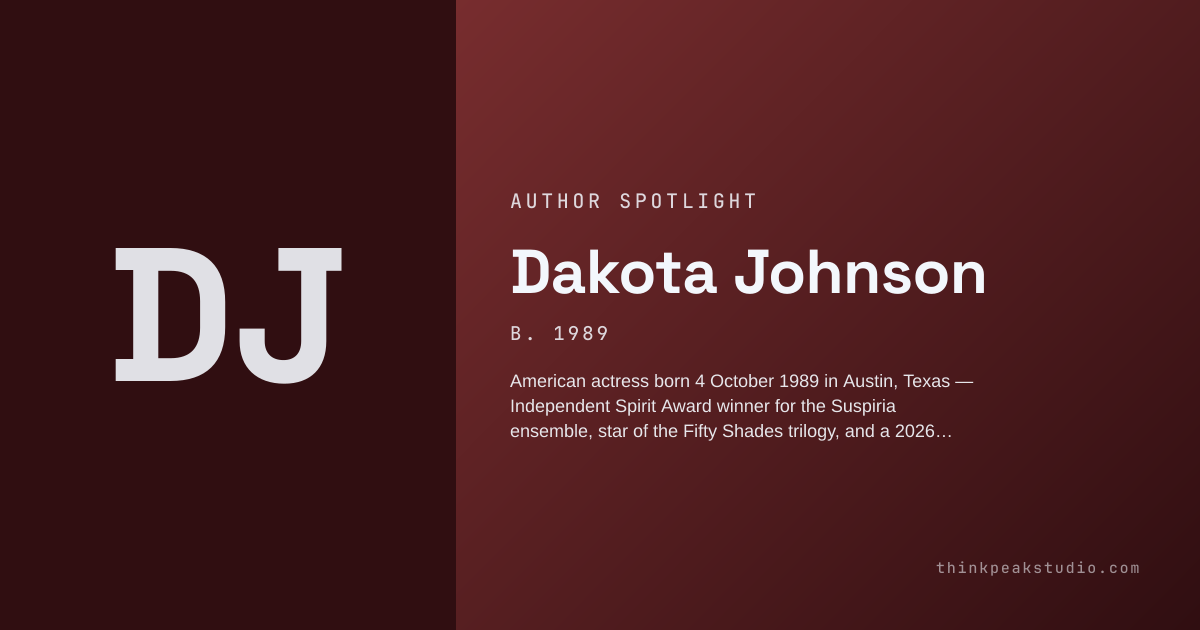
She was born into Hollywood’s first family of complicated fame, raised on the move and in the wings, and turned the disorientation of that childhood into a working method: say exactly what you see. Dakota Mayi Johnson was born on October 4, 1989, in Austin, Texas, the daughter of Don Johnson and Melanie Griffith and the granddaughter of Tippi Hedren, and she made her film debut at ten in Crazy in Alabama, playing a daughter to her real mother. The world met her properly as Anastasia Steele, in a trilogy that grossed more than $1.3 billion; it has kept watching her since for a run of choices that are almost deliberately unglamorous — the horror of Suspiria, the quiet ache of The Lost Daughter, the ambivalence of Materialists. Along the way she became something harder to manufacture than a movie star: a person whose interviews are worth reading on their own. She turned thirty-seven on October 4. This is her life — and the words she lives by.
Who is Dakota Johnson?
Dakota Mayi Johnson was born on October 4, 1989, in Austin, Texas, where her father, the actor Don Johnson, was shooting the film The Hot Spot. Her mother is the actor Melanie Griffith; her maternal grandmother is Tippi Hedren, the star of Hitchcock’s The Birds; her former stepfather is Antonio Banderas. It is a family with six half-siblings across three parents and three marriages, and Johnson has been candid about what it felt like to grow up inside it. “I was so consistently unmoored and discombobulated, I didn’t have an anchor anywhere,” she has said. Her childhood was spent trailing her parents to film sets and premieres, with long stretches in Aspen and Woody Creek, Colorado, where she worked summers at the local market, spent time near the writer Hunter S. Thompson, and attended the Aspen Community School for a period. She moved through the Santa Catalina School in Monterey and the New Roads School in Santa Monica, and she has described a long struggle with depression that began in her early teens. She made her screen debut at ten in Crazy in Alabama (1999), directed by Banderas and starring her mother, in which she and her half-sister Stella Banderas played Griffith’s daughters. In 2006 she was chosen as Miss Golden Globe — the first second-generation Miss Golden Globe in the ceremony’s history — and signed with IMG Models. After high school she auditioned for Juilliard and was not accepted, so she took acting classes and began the slow, ordinary work of getting cast.
The breakthrough took time and then arrived all at once. A small role as a one-night stand in David Fincher’s The Social Network (2010) was followed by the short-lived Fox sitcom Ben and Kate (2012–2013) and a cameo in the series finale of The Office. Then, in 2015, she was cast as Anastasia Steele in the adaptation of E. L. James’s Fifty Shades of Grey, a role she won over a field that reportedly included Felicity Jones, Elizabeth Olsen and Shailene Woodley. The film was savaged by critics and the trilogy was rewarded with two Golden Raspberry Awards — Worst Actress and Worst Screen Combo, the latter shared with Jamie Dornan — but it also made her internationally famous, earned her a People’s Choice Award for Favorite Dramatic Movie Actress, and grossed more than $1.3 billion worldwide across its three instalments. Johnson was nominated for the BAFTA Rising Star Award in 2016 and named to the Forbes 30 Under 30 list the same year. Rather than consolidate around the franchise, she went the other way, taking a supporting role in Luca Guadagnino’s A Bigger Splash (2015) and then the lead in his Suspiria (2018), a remake in which her performance won her the Robert Altman Award as part of the film’s ensemble at the 2019 Independent Spirit Awards.
What followed is one of the more deliberately unsettled filmographies of her generation. She starred in Drew Goddard’s Bad Times at the El Royale (2018), then in the independent adventure The Peanut Butter Falcon (2019), which became the highest-grossing independent film of its year, and in Our Friend (2019), Maggie Gyllenhaal’s The Lost Daughter (2021), and the Netflix adaptation of Jane Austen’s Persuasion (2022). She co-produced and starred in Cha Cha Real Smooth (2022) and Am I OK? (2022), and played the passenger opposite Sean Penn in Daddio (2024). In 2024 she took the title role in Sony’s Madame Web, a superhero film she has since described as a script that changed under her while she was making it; it was a critical and commercial failure and won her a second Razzie for Worst Actress, and her refusal to pretend otherwise became the story. She followed it with Materialists (2025), Celine Song’s romance with Chris Evans and Pedro Pascal, and the comedy Splitsville (2025), which she also produced. On October 2, 2026, she appeared alongside Anne Hathaway and Josh Hartnett in Verity, the film adaptation of Colleen Hoover’s thriller, and the next night she hosted Saturday Night Live for the third time. She is preparing her feature directorial debut, A Tree is Blue, and in April 2026 was named to the TIME100 list of the world’s most influential people, with the tribute written by her friend Taylor Swift.
What sets Johnson apart from most stars of her scale is not the résumé but the register in which she discusses it. She has been building her own production company, TeaTime Pictures, since 2020, the same year she became an investor and co-creative director of the sexual-wellness brand Maude. She joined three hundred women in founding the Time’s Up initiative in 2018, serves as a brand ambassador for Gucci, launched a book club in March 2024, and is a well-documented tattoo enthusiast. Privately, she was with the Coldplay singer Chris Martin for roughly eight years until 2025, and briefly dated the singer Role Model in 2026. But the through-line the public knows her for is a kind of radical unvarnishedness: the viral interview clips, the willingness to say “I don’t know” and “that’s not true” on camera, the way she treats a press junket as an opportunity for honesty rather than advertisement. She has called the fixation on her famous family — the “nepo baby” debate — “incredibly annoying and boring,” while acknowledging the privilege she was born into. In an age of media training, she is the opposite of it, and the audience has repaid the difference with attention.
Dakota Johnson’s most memorable quotes
“I was so consistently unmoored and discombobulated, I didn’t have an anchor anywhere.”
The meaning behind these words
This is the sentence that explains everything else Johnson says about herself, and it is remarkable for how precisely it diagnoses a privileged and painful childhood at the same time. She was not neglected; she was unmoored. Her parents were famous, working, and everywhere, and the family moved with the work — film sets, premieres, Aspen summers, new schools. For a child, that is not adventure but weather: a life with no fixed point to measure yourself against. The word “discombobulated” is deliberately homely, almost comic, and that is the honesty of it. She is not asking for sympathy. She is describing a specific kind of rootlessness that money and fame cannot fix and can, in fact, make worse, because it comes disguised as opportunity.
The line also quietly explains the career that followed. A person who never had an anchor learns to make one out of what is reliable and immediate — in Johnson’s case, the truth of the moment in front of her. It is why she has gravitated toward characters who are themselves unmoored — the fractured dancer in Suspiria, the drifting mother in Cha Cha Real Smooth, the young woman without a fixed identity in Am I OK? — and why she has spoken so openly about depression that began when she was young. Read next to her later comments about growing up around fame (“if you accept that as normal as a little kid, it can lead to a lot of complexes”), the sentence becomes the opening chapter of a story she has been telling in public for years: that the most important thing a peripatetic childhood teaches you is how to recognise, and then build, a place to stand.
“Actually, no, that’s not the truth, Ellen. You were invited.”
The meaning behind these words
Eight words, delivered with a flat calm, became one of the most quoted celebrity sentences of the modern era, and the reason is structural rather than dramatic. Ellen DeGeneres opened the interview by claiming she had not been invited to Johnson’s thirtieth birthday party. Johnson did not laugh it off, deflect, or perform gracious confusion. She simply corrected the record, on camera, and then supplied witnesses. It was not anger and it was not even a rebuke; it was a refusal to participate in a small lie being told at her expense. The sentence endures because almost everyone has been in that position — the moment when the socially convenient thing to do is to let an untruth stand, and the honest thing costs something. Johnson chose honest, and the clip became a fixture of the internet’s vocabulary.
What made the line land so hard is that it fit a pattern the audience had already noticed. She had been wary of DeGeneres’s show before, and the exchange came at a moment when the host’s public persona was under scrutiny, which is exactly why the internet adopted it: here was a guest refusing to cosign a comfortable fiction. But the deeper significance is what it revealed about Johnson’s default setting. She treats an interview as a conversation rather than a transaction, which is why her clips keep going viral and why writers keep describing her as “refreshing” in a media-trained age. Taylor Swift put it best in her 2026 TIME tribute: the actress’s name has become “synonymous with refreshing honesty,” as if, Swift joked, “this girl just… can’t lie.” The Ellen sentence is that reputation in miniature.
“Everyone who makes decisions is afraid. They want to do the safe thing and the safe thing is really boring.”
The meaning behind these words
This is Johnson’s clearest statement of an artistic position, and it is more radical than it sounds. She is not saying that safe choices are merely dull; she is saying that the people who greenlight films are themselves acting out of fear. The safe thing, in her diagnosis, is not a considered strategy but a symptom — the product of decision-makers who are frightened, so they repeat what has already worked and sand off what has not. In the same interview she argued that “art does not do well when it’s made by committee” and that “you cannot make art based on numbers and algorithms,” a line that reads today like a premonition of the algorithm-shaped entertainment landscape she works inside. The sentence matters because it refuses the usual euphemisms of the industry and names the root cause: fear.
It is also a coherent description of the way she has run her own career. Having been handed the safest possible franchise in Fifty Shades, she spent the next decade choosing the opposite — a horror remake with a notorious production, a Ferrante adaptation, a tiny film about an autistic child, a two-hander set entirely inside a taxi. When she finally did the biggest, safest thing available again, Madame Web, it failed, and she took the lesson in public rather than spinning it. The quote explains why: she would rather be interesting and wrong than safe and boring. For an audience that has grown weary of films assembled by frightened consensus, the remark is less a complaint than a manifesto — and, given that it was a working actor saying it on the record, an unusually brave one.
“What am I going to do, f***ing cry about Madame Web? No. I’m gonna laugh about it.”
The meaning behind these words
This is Johnson’s philosophy of failure in a single exhale, and it is the quote that turned a commercial disaster into a character study. Madame Web was panned and lost money; she won a Razzie for it; the internet memed the film and her. The expected response — a defensive interview, a blaming of the studio, a conspicuously timed rediscovery of enthusiasm — never came. Instead she described, without self-pity, what it is like to hand your body, mind and emotions to a project that becomes something else in the editing: “It’s just being taken and f***ed with, but you can’t do anything about it.” Then she reached the laugh. The sentence is not denial and it is not a performance of toughness. It is a decision about where to put the weight of an experience you cannot undo.
The line works because it is so specifically hers. She has said she probably will never make a film like that again — “I don’t make sense in that world” — and she has compared Hollywood’s remake culture to decisions made by “people who don’t even really watch movies.” But she has also refused to let the failure define her, famously telling an interviewer that not watching her own movies is “self-care.” The laugh is therefore not evasion; it is proportion. It is the sound of an artist who understands that a bad film is a season, not a verdict, and who would rather keep the ability to be amused than spend her authority defending something she knows was broken. In a culture that demands either apology or triumph, the choice to laugh is its own quiet integrity.
“If you accept that as normal as a little kid, it can lead to a lot of complexes.”
The meaning behind these words
This is the other side of the unmoored-childhood quote, and it is the most quietly unsettling thing Johnson has said about her own life. She was describing what it was like to grow up with two famous parents and a public that felt entitled to them: the times, she told Vogue Germany, when it was “really quite scary” and people “would aggressively and physically try to get to my mom when we were just going to the supermarket.” The sentence is about the danger of normalising that. A child has no other reference point; if the frightening thing is simply what daily life looks like, the fear does not register as fear. It registers as reality, and it shapes you before you have the vocabulary to question it. That, she suggests, is where complexes come from: not from a single trauma but from an environment a child had no power to name as abnormal.
The quote is also the most direct answer she has given to the “nepo baby” debate that has followed her career. She does not deny the advantages of her surname; she has said plainly that she benefited from privilege and that her father cut her off financially the moment she chose acting over college. But she resists the idea that fame is simply inherited good fortune. Her point is that being born into the public eye carries a cost that is rarely counted, and that the discourse around famous children tends to be, in her word, “boring” precisely because it prefers a verdict to a life. The sentence is the closest thing she has given to a rebuttal: yes, the door was open, and also, the house was strange, and the strangeness stayed. It is not a complaint. It is an accounting.
Dakota Johnson’s legacy
It is odd to use the word “legacy” about a thirty-seven-year-old who has just hosted Saturday Night Live and is preparing her first feature as a director, and Johnson would likely find the word funny. But a legacy is not only what survives a career; it is what a career has already changed, and Johnson has changed two things at once. On screen, she has produced a body of work that refuses the shape of a typical star trajectory. She took the most commercially explosive debut of her generation and then spent a decade walking away from its logic, building a filmography full of small, strange, intimate films — Suspiria, The Lost Daughter, Cha Cha Real Smooth, Daddio, Materialists — and repeatedly choosing directors with a point of view over paydays with a built-in audience. She has an Independent Spirit Award as part of the Suspiria ensemble, a BAFTA Rising Star nomination, a Forbes 30 Under 30 listing, and a 2026 TIME100 place. The range is the achievement: she is one of the few actors of her era who has been a blockbuster lead, an art-house lead, and a supporting player in someone else’s ensemble, without treating those as different careers.
Off screen, her legacy may be stranger and more durable. Johnson is the first movie star of her cohort whose interviews are consumed as a genre of their own. The Ellen exchange became a permanent part of the internet’s grammar; her Madame Web press tour became a widely studied case of a celebrity going off script; her deadpan candour has been analysed by the BBC, The New York Times, Glamour and Texas Monthly, all of whom arrived at the same conclusion: in an industry built on careful self-presentation, she is a genuinely unpredictable person. That quality is not merely entertaining. It has quietly rebuilt what audiences expect from the people who sell them films. Taylor Swift’s tribute — that Johnson is “synonymous with refreshing honesty,” endlessly curious, unable to stop taking risks — is a description of a public persona that did not exist before her and now feels almost normal.
There is also a legacy in the way she has handled the parts of fame that go badly, which may be the most transferable lesson she offers. She lost the biggest gamble of her career, took the Razzie, and laughed. She grew up inside a machine that makes privacy impossible and has spent her adulthood insisting on keeping some anyway, from the book club to the quiet relationships she declines to narrate for the press. She has been open about depression and about the complexes of a public childhood without turning either into a brand. And she keeps making things — producing through TeaTime Pictures, investing in the businesses she believes in, preparing to direct. The through-line of Dakota Johnson’s life so far is not a single performance but a method: pay attention, say what is true, and refuse to let fear — the industry’s or your own — choose on your behalf. On October 4 she turned thirty-seven. The work, and the honesty, continue.
Create graphics with Dakota Johnson’s quotes
Johnson’s words have the rare quality of sounding like a person thinking rather than a publicist arranging — exact enough to trust, dry enough to remember. Whether it is the admission of growing up unmoored, the flat correction that became a generation’s shorthand for refusing a small lie, the argument that the safe choice is the boring one, or the decision to laugh at a disaster rather than defend it, Quotes Creator helps you turn these quotes into beautiful, shareable designs with custom fonts, gradients, and layouts.
Why we chose Dakota Johnson
Dakota Johnson enters this spotlight on a measurable surge of public attention. On October 3, 2026, she hosted the second episode of Saturday Night Live’s fifty-second season — her third time hosting the show — one day after the release of Verity, her film with Anne Hathaway and Josh Hartnett. The next day, her birthday, her English Wikipedia biography was read 287,360 times, up from 52,788 the day before and roughly 21,000 in late September: a more than five-fold spike, and one of the largest single-day audiences any living actor drew that week. She has never appeared in this series before. But the substance is what earns a deep read. Johnson is that unusual figure who is both a genuine movie star and a genuine truth-teller, a woman whose off-screen candour has become as discussed as her films — and whose willingness to correct the record, admit a flop, and name the fear inside her own industry has made her a rare thing in modern celebrity: credible.
The five quotes we have selected trace the arc of that credibility rather than the arc of her box office. They begin with the rootless childhood that made her, in her own word, discombobulated — and the artistic method she built in place of an anchor. They move to the Ellen moment, the eight words that turned honesty into her signature. They reach the diagnosis at the centre of her thinking about film: that the safe choice is a symptom of fear, and boredom is the price of playing it safe. They land on the laugh that answered Madame Web, a working definition of resilience that asks for neither apology nor triumph. And they close on the cost of growing up famous, the complex inheritance she refuses either to deny or to let define her. These are not the words of an actress performing candour for a press tour. They are the words of a woman raised in the strangest possible normal, who learned early that the truth travels further than the spin — and who has been saying it out loud, on the record, ever since. On October 4 she turned thirty-seven; the work, and the honesty, continue.
— ThinkPeak Studio Editorial Team
Create your own quote graphic with this quote
Turn this line into a shareable graphic in seconds — free, no signup needed. For video quotes and 100+ templates, try the Android app.
Advertisement
Enjoyed this article? Get more like it in your inbox.


