On this page
Author Spotlight: Diego Maradona
Argentine footballer and manager, 1986 World Cup champion, FIFA Player of the Century, and one of the greatest players in football history
Who was Diego Maradona?
Diego Armando Maradona was born on October 30, 1960, in Lanús, Buenos Aires Province, and raised in Villa Fiorito, a shantytown on the southern outskirts of the Argentine capital. The first son after four daughters in a poor family that had migrated from Corrientes Province, he received his first football as a gift at age three and never really let go of it. At eight, a talent scout spotted him playing for his local club Estrella Roja; by twelve, he was a ball boy amusing crowds with his juggling at halftime of Argentinos Juniors matches. With Los Cebollitas (The Little Onions), the club’s junior side, he strung together an astonishing 141-game unbeaten run — the prelude to a first-division debut at fifteen and an Argentina debut at sixteen, the youngest in the national team’s history at the time.
Nicknamed El Pibe de Oro — “The Golden Boy” — Maradona became the first player ever to break the world transfer record twice, moving to Barcelona in 1982 for £5 million and to Napoli in 1984 for £6.9 million. It was in Naples that legend hardened into religion: he dragged an unfashionable southern club to its first-ever Serie A title in 1987 and a second in 1990, and the city has never stopped worshipping him. For Argentina he won 91 caps, scored 34 goals, and played in four World Cups. In Mexico in 1986 he produced the most famous tournament any individual has ever had — captaining Argentina to the title, winning the Golden Ball, and scoring both goals in the quarter-final against England: the infamous “Hand of God” followed four minutes later by a 60-meter slalom past five players that FIFA voters would later crown the “Goal of the Century.”
Maradona’s genius came wrapped in turbulence. His vision, ball control, and low center of gravity made him nearly impossible to dispossess, but the pressure of being the world’s most scrutinized athlete exacted a brutal price. A cocaine addiction that began in his Barcelona years ended his Napoli era in a ban, and his life off the pitch — the tax troubles, the health crises, the compressed-air rifle fired at intruding reporters — became a show he could never fully close. Yet he never hid from any of it. He spoke about his flaws with the same disarming directness he brought to everything else, and Argentines loved him not despite his wounds but partly because of them: he was proof that greatness could come from the mud of Villa Fiorito and remain, defiantly, of the mud.
He later managed Argentina at the 2010 World Cup and coached clubs across the UAE, Belarus, Mexico, and Argentina, still magnetic wherever he went. In 2000 he was voted FIFA Player of the Century, sharing the award with Pelé. When he died of a heart attack on November 25, 2020, at age sixty, Argentina declared three days of national mourning and tens of thousands filed past his coffin at the presidential palace. Naples renamed its stadium the Stadio Diego Armando Maradona within weeks. Few athletes in any sport have ever meant so much, to so many, so viscerally.
Diego Maradona’s most memorable quotes
“I dream of being able to score another goal against England… this time with the right hand.”
The meaning behind these words
Spoken less than a month before he died, this is Maradona in miniature: mischievous, unrepentant, and completely aware of his own myth. Thirty-four years after the “Hand of God” — the first-half goal against England at the 1986 World Cup that he punched in with his left fist and famously attributed to divine intervention — he was not asking for forgiveness. He was asking for an encore. Where most public figures spend their later years sanding down the controversial edges of their story, Maradona sharpened his. The joke lands precisely because he refuses the script of the repentant aging star; he would rather be the trickster forever than the saint for a day.
There is also something poignant underneath the humor. The quote is a dream — an old man imagining one more moment on the pitch, one more roar, one more scandal even. It captures how completely football and identity had fused in him: at sixty, ravaged by health problems, what he dreamed of was not rest but another goal. For readers far from any stadium, the lesson cuts both ways. It shows the life-giving power of loving what you do so much that you never stop dreaming about it, and it hints at the cost of an identity with no exit. Maradona chose the myth, eyes open, all the way to the end.
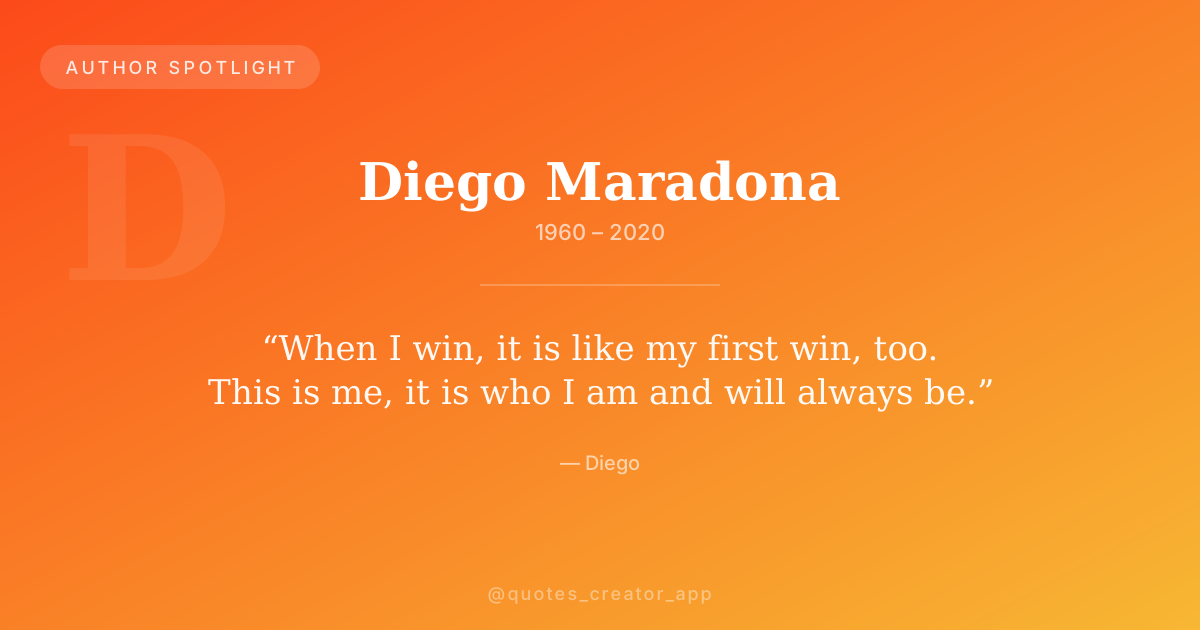
“Even now as a manager, when I suffer a loss it still feels like a first loss, the first I suffered as a player. And when I win, it is like my first win, too. This is me, this is my personality, it is who I am and will always be.”
The meaning behind these words
By 2012, Maradona had won and lost more than almost anyone in the history of sport — a World Cup, two Serie A titles, a doping ban, a near-fatal health collapse, a World Cup quarter-final exit as a manager. A rational veteran of such extremes might develop calluses, a professional detachment that keeps each result at arm’s length. Maradona confesses the opposite: every defeat still lands like the very first one, and every victory still tastes brand new. It is an extraordinary admission of emotional rawness from a man in his fifties, and he offers it not as a weakness but as a definition: this is me, it is who I am and will always be.
The quote explains both his greatness and his chaos better than any biographer could. The inability to insulate himself from feeling is exactly what made him play every match — a friendly, a relegation scrap, a World Cup final — as if the world depended on it, and exactly what made the quiet stretches of life unbearable. There is a genuine insight here for anyone who has been told to be less emotional about their work: sensitivity and stakes are not flaws to be managed out of you. The people who feel each loss like the first are often the same people who bring first-day passion to their ten-thousandth day. Maradona never learned to care less, and it is doubtful he ever wanted to.
“There is no secret here. I will give my all, as I always have. This way I prove to the people who hired me, and those who support me, how much it means.”
The meaning behind these words
Maradona said this while managing Al Wasl in Dubai — a mid-table club in the UAE Pro-League, about as far from the San Paolo’s eighty-thousand-strong delirium as football gets. That context is what makes the quote remarkable. This was not a man auditioning for the biggest job in the world; it was a fading icon explaining why he would pour everything into a modest one. His answer strips ambition down to its simplest honest form: there is no trick, no method, no branding — only the promise of total effort as a form of respect toward the people who believed in you enough to hire you and cheer for you.
Coming from someone who had every excuse to coast on his name, the words carry an integrity that transcends sport. Maradona frames effort as proof — not of skill, but of how much the opportunity means. That inversion is worth sitting with: we usually treat effort as the price of success, but he treats it as the currency of gratitude. Whether you are leading a legendary institution or a team nobody is watching, the standard is identical because the debt is identical. It is one of the least flashy things Maradona ever said, and one of the most quietly instructive — a work ethic articulated by a man more famous for magic than for discipline.
“The unconventional and uninhibited way of living was a part of my life. I won’t be like that now.”
The meaning behind these words
No account of Maradona is honest without the shadows: the cocaine addiction that took root in Barcelona and ended his Napoli years in a fifteen-month ban, the ephedrine expulsion from the 1994 World Cup, the health crises that repeatedly brought him to the edge. What is striking about this quote is its bookkeeping honesty. He does not deny the chaos, romanticize it, or blame anyone else for it. He files it, plainly, as “a part of my life” — a fact in the ledger — and then states an intention: I won’t be like that now. For a man so often painted as incapable of self-control, it is a startlingly sober sentence.
The quote also captures something universal about reinvention. Most of us narrate our past mistakes in one of two dishonest ways — we either disown them entirely (“that wasn’t really me”) or surrender to them (“that’s just who I am”). Maradona threads the harder, truer needle: it was me, and I am choosing differently now. His later relapses do not cancel the value of the aspiration; if anything, they underline how difficult that sentence is to live up to, and how much courage it takes to keep saying it. Anyone who has fought a habit, an addiction, or simply an old version of themselves will recognize the terrain. The first act of change is owning the past without being owned by it.
Diego’s legacy
Maradona’s footballing legacy is secure in the record books — FIFA Player of the Century alongside Pelé, the 1986 World Cup won almost single-handedly, two Serie A titles that turned Naples from a punchline into a champion, the “Goal of the Century” that still tops highlight polls four decades on. But statistics have never explained him. In Argentina, his image hangs in taxis and tattoo parlors beside actual saints; in Naples, murals of his face watch over entire neighborhoods and the city’s stadium now bears his name. There is even an Iglesia Maradoniana — a tongue-in-cheek church founded by fans — whose members number in the hundreds of thousands. No other athlete has inspired quite that register of devotion, because no other athlete so completely embodied the people who loved him: brilliant and flawed, generous and reckless, a poor kid who beat the world without ever becoming polished for it.
His words continue to matter for the same reason his dribbling did: they were impossible to fake. This week — as the 2026 World Cup final approaches and Wikipedia traffic surges around Lionel Messi, Argentina, and Maradona himself — his presence hovers over the tournament he defined in 1986. Every Argentine number 10, Messi above all, has played in a shirt Maradona made mythical. His quotes endure because they document, in his own unguarded voice, what it costs and what it means to feel everything: every win like the first, every loss like the first, every mistake owned out loud, every dream chased to the final month of life. Genius, he showed us, is not tidy — and honesty about the mess is its own kind of greatness.
Create graphics with Diego’s quotes
Diego Maradona’s words have a raw, defiant quality that makes them perfect for quote graphics. Whether you are sharing on Instagram, creating a vision board, or looking for daily inspiration, Quotes Creator helps you transform these quotes into beautiful, shareable designs with custom fonts, gradients, and layouts.
Why we chose Diego
With the 2026 World Cup final days away and Argentina chasing back-to-back titles, the football world keeps reaching for one name to measure everything against: Maradona. His Wikipedia page drew over one hundred fifteen thousand views yesterday alone — remarkable for a man gone nearly six years — as a new generation asks what made him different. We chose Diego because his story is the purest distillation of what this series is about: words that could only have come from one life. He was never careful, never packaged, never anyone but himself — and in an age of media-trained athletes, his unfiltered voice feels more valuable than ever.
— ThinkPeak Studio Editorial Team
Create your own quote graphic with this quote
Turn this line into a shareable graphic in seconds — free, no signup needed. For video quotes and 100+ templates, try the Android app.
Advertisement
Enjoyed this article? Get more like it in your inbox.