On this page
Author Spotlight: Dua Lipa
From a London teenager with a dream to a multi-Grammy-winning global superstar — a look at the singer, the songwriter, and the voice of a generation that refuses to be anything less than unapologetically itself.
Who is Dua Lipa?
Dua Lipa was born on August 22, 1995, in London, England, to Albanian Kosovo parents Dukagjin and Anesa Lipa. Her father, a former lead singer in a Kosovar rock band, nurtured her musical curiosity from a young age, while her mother encouraged the discipline that would eventually carry a teenager back and forth between London clubs and the recording studio. Lipa grew up bilingual, moving between Kosovo and London, and has spoken openly about how the experience of navigating two cultures shaped her fierce independence — a trait that would become the emotional engine of her music.
She released her self-titled debut album Dua Lipa in 2017, which debuted at number five on the UK Albums Chart and yielded the global smash “New Rules” — a track that became an anthem for self-respect and reached number one in eighteen countries. Her second album, Future Nostalgia (2020), was a decisive pivot to retro-disco and synth-pop, earning her the Grammy for Best Pop Vocal Album and spawning the era-defining hits “Don’t Start Now” and “Levitating,” the latter becoming the most-streamed song of 2021. Her third album, Radical Optimism (2024), marked another reinvention, blending electronic music with introspective lyrics about resilience and renewal, and debuted at number one in the UK. She has won multiple Grammy Awards, several BRIT Awards — including British Female Solo Artist — and was named one of the most influential people in the world by Time magazine.
What separates Lipa from many of her contemporaries is the clarity with which she has articulated a personal philosophy through pop music. Her songs are not just dance tracks; they are instructions. “New Rules” is a manual for walking away from toxic relationships. “Don’t Start Now” is a declaration of emotional self-sufficiency. “Physical” is a call to reclaim the body. Across three albums, she has built a body of work that insists pop music can be both escapist and substantive — that you can dance and think at the same time. Her live shows, particularly the 2022–2023 Future Nostalgia Tour, were praised for their precision and energy, confirming her reputation as one of the finest performers of her generation.
Lipa has also become a fashion icon and cultural tastemaker, founding her own podcast Service95 and curating a creative universe that extends well beyond the recording studio. She has stated that her Albanian heritage is central to her identity, and she has used her platform to advocate for the Kosovar community and for causes ranging from LGBTQ+ rights to refugee support. In an industry that often rewards passivity, Lipa has made a career out of refusing to be still.
Dua Lipa’s most memorable quotes
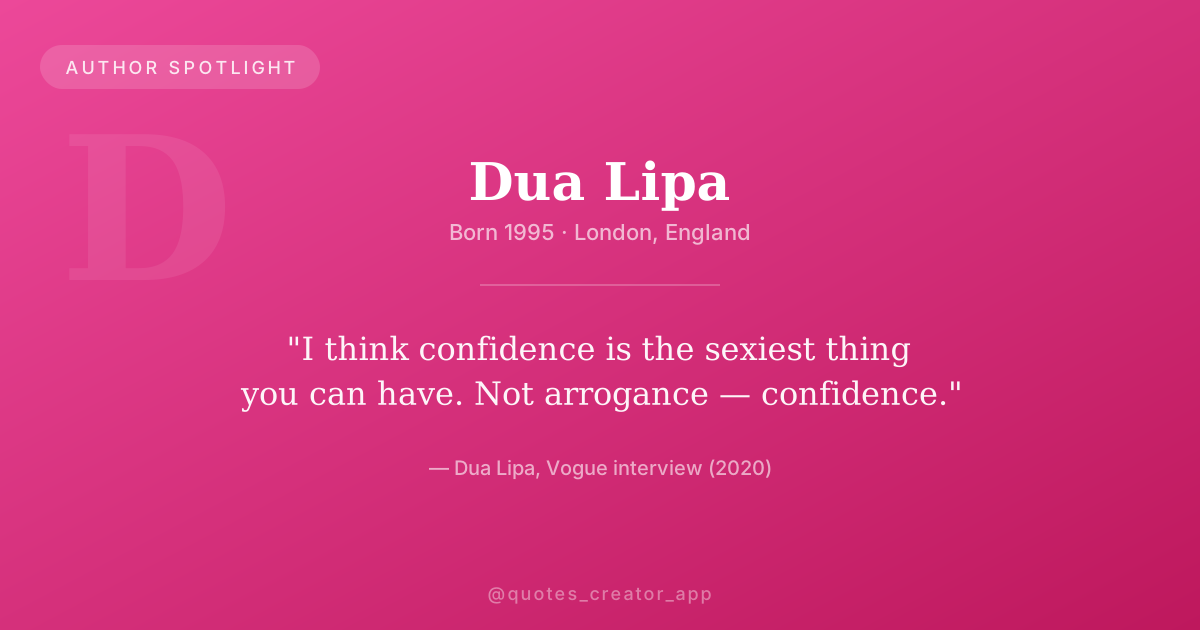
“I think confidence is the sexiest thing you can have. Not arrogance — confidence. When you walk into a room and you’re comfortable in your own skin, that’s magnetic.”
The meaning behind these words
Lipa draws a careful distinction here that is easy to miss. By separating confidence from arrogance, she is rejecting the false choice that many women in the public face: you are either modest and palatable, or you are “too much.” Her version of confidence is quieter than arrogance and more deliberate — it is not about believing you are better than everyone else, it is about being so at home in yourself that the need to perform superiority disappears. The word “magnetic” is telling: she is describing something that draws people in rather than something that pushes them away.
This quote is a distillation of the philosophy that runs through her entire catalogue. The woman who sets “New Rules” is not angry or bitter; she is simply confident enough in her own worth to walk away from what does not serve her. The woman who tells someone not to start a relationship in “Don’t Start Now” is not playing hard to get; she is being honest about what she needs. Confidence, in Lipa’s framework, is not a performance. It is a prerequisite.
“I always say be true to yourself, because if you can’t be true to yourself, how can you be true to anyone else?”
The meaning behind these words
This is a simple philosophical statement that doubles as a creative manifesto. Lipa has spoken extensively about the pressure she felt early in her career to sound like other artists — to smooth her voice, to adopt safer production choices, to fit into a pre-existing pop mold. The decision to make Future Nostalgia a retro-disco record was, in part, a refusal to do that. She chose a sound that felt personal and authentic to her influences, even when the industry was moving in a different direction.
The quote also speaks to the emotional core of her songwriting. Her lyrics are rarely abstract; they are direct, specific, and rooted in experiences she has actually lived. “IDGAF” is not a generic empowerment track — it is a song about a particular kind of heartbreak where you decide that your dignity matters more than the relationship. By insisting on being true to herself in her music, Lipa has built a catalog that resonates because it does not sound like it was written by committee. The authenticity is audible.
“I don’t want to be told what to do. I’ve always been that way. I think it’s important to stand up for yourself, because if you don’t, no one else will.”
The meaning behind these words
This quote arrives with a directness that is pure Lipa. She does not hedge or soften the statement; she does not say “I try not to be told what to do” or “I think it’s sometimes important.” The assertion is total and unqualified. The phrase “I’ve always been that way” roots it in her biography — the teenager who moved between Kosovo and London, who left home at fifteen to pursue music against her family’s initial reservations, who refused to let the industry dictate the shape of her career.
The second half of the quote — “if you don’t, no one else will” — is the part that has resonated most widely, particularly with young women. It is a statement about self-advocacy that refuses the comforting fiction that someone else will come to your rescue. In Lipa’s worldview, agency is not given; it is claimed. This is the same energy that powers “New Rules,” a song that functions as a self-rescue manual. The message is consistent across her music and her public statements: the person who is going to fight for you is you.
“I want to make people feel something. I want my music to make people feel confident, like they can take on the world.”
The meaning behind these words
This is perhaps the most revealing thing Lipa has ever said about her creative intentions. The word “feel” appears twice — she is not interested in making people think, or making people agree with her, or making people dance (though she does all three). She is interested in the feeling. And the feeling she wants to create is confidence: the sensation of being equal to whatever the world puts in front of you. This is a more modest and more honest ambition than “changing the world” or “breaking boundaries,” and it is precisely because it is modest that it rings true.
The quote also illuminates the relationship between Lipa’s music and her audience. Her concerts are not passive listening experiences; they are communal acts of self-affirmation. When thousands of people sing “New Rules” together, they are not just singing a pop song — they are rehearsing a set of principles for how to treat themselves with respect. Lipa has built a career on the understanding that pop music at its best is functional: it does something to the listener, and what it does is make them feel more capable of being who they already are.
Dua Lipa’s legacy
The most immediate measure of Lipa’s legacy is her commercial and critical success. She is one of the most-streamed artists in Spotify history, with billions of streams across her catalogue. Future Nostalgia is one of the best-selling albums of the 2020s, and “Levitating” spent more weeks on the Billboard Hot 100 than almost any other song in the chart’s history. She has won Grammy Awards, BRIT Awards, and MTV Video Music Awards, and has headlined some of the world’s largest festivals and venues. Her Future Nostalgia Tour was one of the highest-grossing tours of 2023, cementing her status as a live performer of the first rank.
The deeper legacy is cultural. Lipa has been instrumental in the resurgence of disco and retro-pop sounds that dominated the early 2020s, proving that nostalgia and innovation are not opposites. More importantly, she has created a template for what pop empowerment can sound like in an era of ironic detachment. Her songs do not wink; they do not hedge their emotional bets. They are sincere, direct, and unapologetically aimed at making the listener feel strong. For a generation of young women navigating a world that constantly asks them to be smaller, quieter, and more accommodating, Dua Lipa’s music offers a different instruction: take up space, trust yourself, and never apologize for it. That is a legacy that will outlast any chart position.
Create graphics with Dua Lipa’s quotes
Dua Lipa’s words have a direct, empowering quality that makes them perfect for quote graphics. Whether you are sharing on Instagram, creating a vision board, or looking for daily inspiration, Quotes Creator helps you transform these quotes into beautiful, shareable designs with custom fonts, gradients, and layouts.
Why we chose Dua
We are publishing this spotlight in mid-July 2026, as Dua Lipa continues to tour globally following the success of Radical Optimism and the cultural dominance of her earlier work. It felt like the right moment to look past the streaming numbers and the fashion campaigns and remember that everything she has built started with the same thing: a clear, unapologetic voice telling people to trust themselves. The four quotes we picked are not the four most famous things she has ever said; they are the four that most clearly trace the arc from a London teenager with a dream to the voice of a generation that refuses to be diminished.
— ThinkPeak Studio Editorial Team
Create your own quote graphic with this quote
Turn this line into a shareable graphic in seconds — free, no signup needed. For video quotes and 100+ templates, try the Android app.
Advertisement
Enjoyed this article? Get more like it in your inbox.