On this page
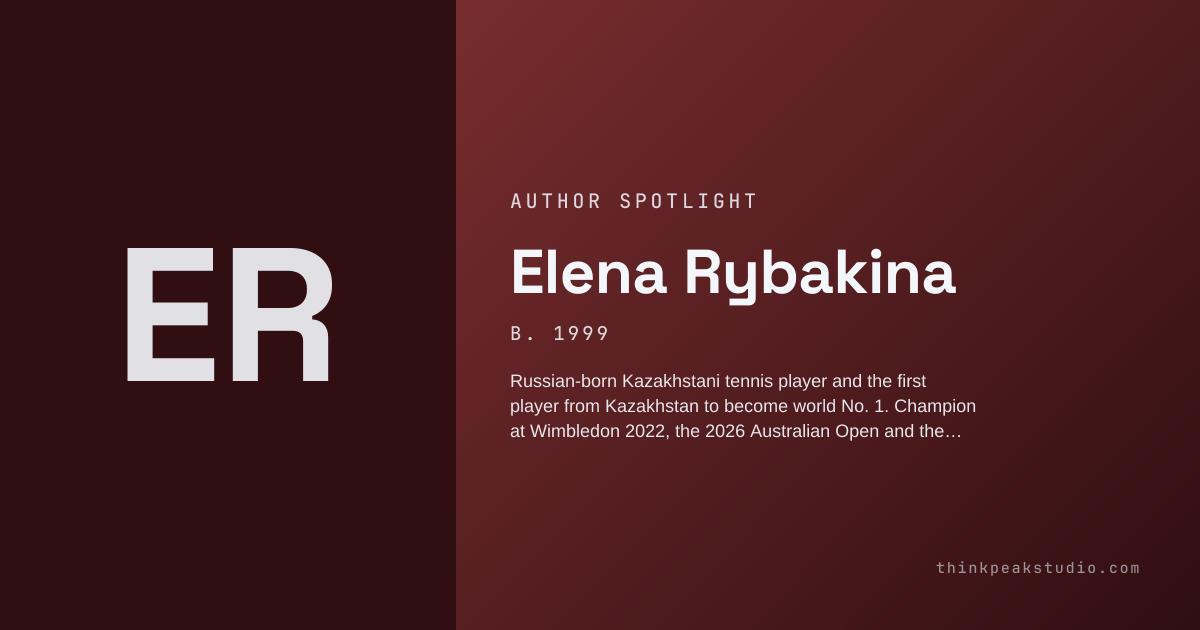
Author Spotlight: Elena Rybakina
She was too tall for gymnastics and too tall for ice skating, so she tried tennis. She was ranked 23rd in the world when she won Wimbledon. A week before the US Open she would go on to win, she could barely walk without pain. Elena Rybakina has spent her career arriving quietly and leaving with the trophy. This is the story of a world No. 1 built out of patience — told through five of her own lines.
Who is Elena Rybakina?
Elena Andreyevna Rybakina was born on 17 June 1999 in Moscow. She was introduced to sport young, alongside her older sister Anna: the girls tried gymnastics and ice skating before coaches told the family that Rybakina was already too tall to pursue either professionally. Her father, who had played tennis informally in his twenties, steered her toward the court instead, and she began playing at six years old. She was not raised inside a high-performance academy. Through her teens she trained in group sessions in Moscow — by her own account roughly two hours of tennis and three hours of fitness a day — while attending an ordinary school, and she only began working with a private coach at 18. She nonetheless rose to junior world No. 3 and won the 2017 Trofeo Bonfiglio, a Grade-A junior title, beating Iga Świątek in the final.
By the time she finished school, the professional path was in doubt. The Russian Tennis Federation had not funded her career, and her family could not afford the travel and coaching a young professional needs; her father pushed her toward a college scholarship instead, and she had around 15 offers from American universities. Then the Kazakhstan Tennis Federation made an offer of its own. Rybakina’s father was originally from Kazakhstan, and in 2018, at 19, she acquired Kazakhstani citizenship and switched federations. She has always described the decision as a piece of luck that ran both ways. “They believed in me,” she said. “We just find each other.” The support changed everything. She won her first WTA title at the 2019 Bucharest Open, and in 2020 she reached five finals — more than any other player on tour — becoming the first Kazakhstani player to break into the top 20.
Her major breakthrough came at the 2022 Wimbledon Championships, where, ranked 23rd in the world, she beat Ons Jabeur 3-6, 6-2, 6-2 in the final. It made her the first player representing Kazakhstan — man or woman — to win a Grand Slam singles title, and the youngest Wimbledon women’s champion since Petra Kvitová in 2011. A year later she reached the Australian Open final, made her top-10 debut, and claimed her first two WTA 1000 titles at Indian Wells and Rome. A 2024 season of three WTA 500 titles and a Wimbledon semifinal followed. Then came the result that reset her career: at the 2025 WTA Finals in Riyadh, she went undefeated, beat Aryna Sabalenka in the final, and collected $5.235 million — the largest prize-money payout in the history of women’s sport.
In 2026 she completed her climb. She won the Australian Open, again beating Sabalenka and again coming from behind — this time from 3-0 down in the deciding set. Then came New York. Three weeks before the US Open she had retired from a Cincinnati quarterfinal with an ankle injury; she arrived unable to train, spent a week off court, and was unsure she would be able to play. She played. In the final she beat the two-time defending champion Sabalenka 6-4, 5-7, 6-2, ending a 19-match US Open winning streak. The run had already sealed her rise to world No. 1 — confirmed on 14 September 2026, making her the 30th woman to hold the top ranking, the first from Kazakhstan, and the second-oldest first-time No. 1 in WTA history. She has now won both hard-court majors in the same year and needs only the French Open for a career Grand Slam. Off court, she has funded grants for 14 young female players in Kazakhstan, supported an animal-welfare movement, and directed most of a federation bonus after Wimbledon toward juniors and an animal shelter. The tour calls her the “Ice Queen” for the calm she keeps between the lines.
Elena Rybakina’s most memorable quotes
“Maybe I proved that not always you have to have great team from the young age, because I didn’t ‘til the age of 17, 18. So I think this is the most important thing, that everybody, no matter their financial situation, no matter who they are, they can play and achieve many great results.”
The meaning behind these words
This was Rybakina’s answer to a simple question at the press conference after winning her first major: what had the victory proved? She could easily have spoken about belief, or about the quality of her serve. Instead she reached for the least glamorous fact of her own biography. She had not been groomed for this. She had no elite academy and no private coach until she was 18, no long-running high-performance team behind her from childhood. The line is not false modesty; it is a precise accounting of what she was missing, offered in the same calm register she uses for everything else. At 23, ranked 23rd, she had just won the biggest tournament in tennis without the infrastructure that is supposed to be necessary for it.
What makes the sentence endure is where she points its meaning. She does not say that anyone could win Wimbledon if they simply want it enough — a claim that would be both untrue and unkind. She says that financial situation and background should not decide who gets the chance. That is a smaller, sharper, more defensible idea: the barrier she names is access, not desire. It is also the thesis she has since acted on, funding grants for young female players in Kazakhstan a year after this speech. The quote matters because it reframes her whole career. She is not the exception who proves the rule. She is the argument for changing the rule.
“It was very good timing because they were looking for the player. I was looking for some help. They believed in me. So I think it was very good combination. We just find each other.”
The meaning behind these words
Rybakina was asked, on the eve of the Wimbledon semifinal that would change her life, how she feels about representing Kazakhstan when she was born in Russia. The question was freighted — nationality switches in sport are usually discussed as transactions, or worse, as betrayals — and she answered it without defensiveness or grievance. She described it plainly as a match: a federation that needed a player and a player who needed a chance. “They believed in me.” No one is cast as villain; no one is owed a debt. The warmth is in the brevity. The line is generous to the country that funded her and honest about why she needed funding.
”We just find each other” is the part people remember, because it turns a bureaucratic event into something closer to fate. But read carefully, the sentence is also an act of gratitude with a work ethic built in: the way she repays being believed in is by delivering results, and she says as much elsewhere, noting that her wins are good for the sport in Kazakhstan. This is the quote that explains the rest of her career’s moral logic. When she later gave away a Wimbledon bonus and funded 14 junior players, she was not performing charity. She was completing the exchange she describes here — someone saw her when she was unproven, so she will see the next ones.
“Maybe one day you will see huge reaction from me, but unfortunately not today. I didn’t know what to do, it was shocking. It’s too many emotions. I was just trying to keep myself calm. Maybe later when I’m alone in the room, I’m going to cry nonstop.”
The meaning behind these words
When Rybakina won Wimbledon, she raised one arm and walked to the net. That was the entire celebration — no collapse, no scream, no tears. Ons Jabeur joked afterward that she would have to teach the new champion “how to celebrate properly,” and the press, sensing the contrast with the era’s elaborate displays, reached for a nickname: the Ice Queen. But Rybakina’s own explanation, given minutes later, refuses the label even as it seems to confirm it. She is not cold. She says she was so overwhelmed that she did not know what to do, that when she gave her on-court speech she was thinking she might cry and somehow held it. The stillness on the outside was an effort, not an absence.
The second half of the quote is where the real information sits: “Maybe later when I’m alone in the room, I’m going to cry nonstop.” She is telling us exactly where the emotion went — inward, private, delayed until the cameras left. That is a different thing from having none. It reframes the “Ice Queen” idea as a misreading of composure: what looks like indifference is often feeling that has been disciplined for a moment, because the moment demanded it. And she does eventually let it out; later in that same press conference she wells up when asked whether her parents would be proud, then laughs: “You wanted to see emotion!” The coolness she is known for is not the whole of her. It is the part she chooses to show while the work is unfinished.
“In the beginning, when it’s the first final and you go so far in a tournament, of course you are more emotional. Now I feel like I’m just doing my job, trying to improve each day. So it’s kind of another day, another match.”
The meaning behind these words
Rybakina had just beaten the world No. 2, Iga Świątek, 7-5, 6-1 to reach the Australian Open semifinals. Asked to compare the player she is now with the one who had reached only one Grand Slam final before, she described a change in psychology rather than technique. Early in her career, going deep meant emotion: the occasion was loud and her nerves answered it. Now, in her mid-twenties, she has flattened the occasion. “Just doing my job” is easy to misread as boredom or false humility. It is neither. It is the language of a professional who has learned that the biggest matches are won by treating them like ordinary ones.
There is a paradox worth naming here, because it runs straight through her 2026 season. The more she insisted a Grand Slam quarterfinal was “another day, another match,” the better she played — she won the Australian Open, then the US Open, both times against the same rival. Detachment became a competitive weapon. And the quote has a second half that is easy to overlook: “trying to improve each day.” “Another day” is not an invitation to coast; it is a day of work. The sentence pairs acceptance with ambition — stop treating the moment as life-or-death, and you free yourself to actually get better. It is the most practical thing she has ever said about winning.
“It’s tough to find words right now, honestly. I didn’t expect anything like this coming into this tournament. I’d been dealing a little bit with an injury, but somehow everything aligned on my side.”
The meaning behind these words
This was Rybakina’s first sentence as a US Open champion and world No. 1. The context is what gives it weight: three weeks earlier she had retired from a Cincinnati quarterfinal with an ankle injury, was told by doctors that the scans did not look good, and spent a week moving only between her hotel room and the gym. She did not practise for seven days. She said walking itself had been painful. So when she says she “didn’t expect anything like this coming into this tournament,” she is not using a figure of speech. She genuinely did not know she would compete until shortly before it began. The wonder in the line is earned.
”Somehow everything aligned on my side” is a quietly remarkable way to describe the finest fortnight of a player’s career. She does not say she dominated, or that she had been building to this, or that she deserved it. She credits alignment — the word people use for luck. That is partly the “Ice Queen” temperament again, deflecting rather than declaring, but it is also a real belief: she had done the work, and she had also been healthy enough, on the right days, for the work to count. The quote holds those two things together. It respects effort without pretending effort is ever fully in control of the outcome — which is exactly the humility of someone who could have been home in three weeks, and instead ended the fortnight holding the trophy.
Elena’s legacy
Rybakina’s legacy is not yet about a finished record; at 27, she is still writing it, and the sport can already see the shape. She is the player who proved that the pipeline is not destiny. She came to professional tennis from outside the systems that are supposed to produce champions — no funded academy, no private coach until 18, a career that at one point hinged on whether a federation would offer support. What followed was not a fairytale sprint but a slow accumulation: a first title at 20, five finals at 21, a maiden major at 23, a WTA Finals crown at 26, and then, in a single 2026 season, both hard-court Slams and the No. 1 ranking. That arc matters because it is the opposite of a prodigy’s story. She got better later, and kept getting better.
The deeper legacy may be the example she sets about what composure is for. The “Ice Queen” nickname is usually thrown at her as a curiosity, but in a sports culture that increasingly rewards visible emotion and self-promotion, Rybakina has made a quieter style work on her own terms — never chasing the crowd, answering questions plainly, and letting the scoreboard argue for her. She also turned gratitude into structure: funding grants for young female players in Kazakhstan and directing a Wimbledon bonus toward juniors and an animal shelter, in explicit repayment of the belief that once carried her. Whether she completes the career Grand Slam at Roland Garros or not, the through-line is already clear. Talent is common; a system that says yes to the unproven is rare; and the best response to being given a chance is to make sure someone else gets one.
Create graphics with Elena Rybakina’s quotes
Elena Rybakina’s words carry the discipline of a competitor who earned every room she enters: honest about the unglamorous beginnings, unsentimental about pressure, and quietly insistent that the work matters more than the noise around it. Whether you want a reminder that your starting point does not have to be your ceiling, or a line about treating a big day like any other, Quotes Creator lets you turn these quotes into elegant, shareable designs with custom fonts, gradients, and layouts.
Why we chose Elena Rybakina
Elena Rybakina enters this spotlight at the summit of her sport. She ranked 38th among all English Wikipedia articles for September 2026, with more than 1.51 million views — a surge driven by her US Open title, her rise to world No. 1, and a season in which she won both hard-court majors. But the timing is only the occasion. We chose her because her career is one of the most instructive in modern tennis: the player no academy built, who waited a decade for the support she needed, who won her first major at 23 and her first No. 1 ranking at 27, and who answered every question about it with the same disarming calm.
The five quotes we have selected trace that arc from the outside in. There is the underdog’s precise accounting of what she lacked and what it proved; the quiet gratitude of a nationality switch that ran both ways; the composure that the world misread as coldness and that she explained, honestly, as a feeling held back; the professional’s discovery that a Grand Slam quarterfinal can be treated as another day of work; and the humility of a champion who, at the height of her career, credited alignment rather than domination. Taken together they describe a person who learned to be at peace with the long way round. In an age that rewards the instant breakthrough and the loud self-announcement, Elena Rybakina stands for something older and sturdier — that persistence is a strategy, composure is a skill, and the right time to peak is whenever you are finally believed in.
— ThinkPeak Studio Editorial Team
Create your own quote graphic with this quote
Turn this line into a shareable graphic in seconds — free, no signup needed. For video quotes and 100+ templates, try the Android app.
Advertisement
Enjoyed this article? Get more like it in your inbox.


