On this page
Author Spotlight: Ethel Cain
Born Hayden Silas Anhedönia in a Southern Baptist household in Perry, Florida, and reborn as Ethel Cain — a name borrowed, in part, from the Bible’s first exile — she has spent her short career insisting on one thing above all others: that the stories a culture would rather bury are the ones most worth singing. Preacher’s daughter, prodigal, model, producer, and self-made architect of a sound that critics keep straining to name, she turned a concept album about a girl called Ethel into the most talked-about debut of her generation. What follows is not an attempt to fix her in place — she has spent her whole life refusing to be fixed — but to sit, as she once put it, with what she has made.
Who is Ethel Cain?
Hayden Silas Anhedönia was born on 24 March 1998 in Tallahassee, Florida, and raised in Perry, a small, deeply rural town in the state’s northern Big Bend, as the eldest of four children in a Southern Baptist family. Her father was a deacon; her mother, like her, sang in the church choir. The church was, by her own account, her first exposure to music — “My whole life was always singing, always, always music all the time,” she has said — and it left a mark that no amount of distance has erased. She began studying classical piano at eight, and by adolescence was writing her first album, steeped in the Christian music that filled the house and in the voice of Florence Welch, the teen idol she credits with showing her what a woman’s intensity could sound like. She was homeschooled, which meant the boundaries between the world and the family, between the sacred and the everyday, were always thinner for her than for most. At sixteen she left the church. She did not, it turned out, ever quite leave the feeling of it.
The second rupture was the one that made her name. Anhedönia came out as gay to her family at twelve, and on her twentieth birthday she came out publicly as a trans woman. The language she has used to describe it is unsparing: “It was made clear to everyone that I was not like other people,” she recalled. “Whenever I started to develop, I started to come into my own as a trans woman. We were a house divided — it was me versus my whole town.” Out of that alienation she built a persona. Around 2017 she began releasing music under shifting monikers — first as White Silas, publishing Gregorian-chant-inspired pieces to SoundCloud and Tumblr — before settling, in 2019, on Ethel Cain. The name was deliberate: she wanted something “womanly, matronly, old American,” and she borrowed “Cain” from the biblical figure — the firstborn marked by God, the farmer, the exile. A series of self-released EPs followed — Carpet Bed and Golden Age in 2019, then the critically noticed Inbred in 2021 — and a publishing deal with Prescription Songs, after the rapper Lil Aaron spotted her at a Los Angeles show.
The breakthrough was Preacher’s Daughter, released on her own Daughters of Cain label in May 2022. It is a concept album in the truest sense: a single narrative, spanning decades and multiple genres, following a girl named Ethel Cain through the American South — through faith, abuse, drugs, sex work, and murder — and ending, in the closing track, with the narrator’s death and her body being consumed. That a record so unflinching became a cult phenomenon is one of the more telling facts of the past few years. Critics placed it on best-of-the-year lists; the single “American Teenager,” a song about gun culture, war, and religious disillusionment dressed up as stadium pop, wound up on Barack Obama’s list of his favourite songs of 2022 — a development Cain met with bemusement, calling it her “anti-war, anti-patriotism fake pop song.” She toured relentlessly, opened for Florence and the Machine, Boygenius, and Mitski, played Coachella, and landed on the Forbes 30 Under 30 list in 2024.
What she did next is what separates an artist from a moment. In January 2025 she released Perverts, an experimental drone record that abandoned the melodies that had made her famous, simply, she said, because she loved the genre and wanted to make it herself. That August came her second studio album, Willoughby Tucker, I’ll Always Love You, a lyrical prequel to Preacher’s Daughter that filled in the story’s beginning. And in April 2025, when Preacher’s Daughter finally received a vinyl pressing three years after its digital release, it debuted at number ten on the Billboard 200 — making Cain the first openly transgender artist ever to reach the top ten. Alongside the music she became a model, fronting campaigns for Givenchy, Miu Miu, and Marc Jacobs and signing with IMG Models, and a figure of relentless, sometimes prickly candour about politics, faith, and her own past. She is, at twenty-eight, an artist who has made a career out of refusing every category she has been offered — and out of turning that refusal into songs.
Ethel Cain’s most memorable quotes
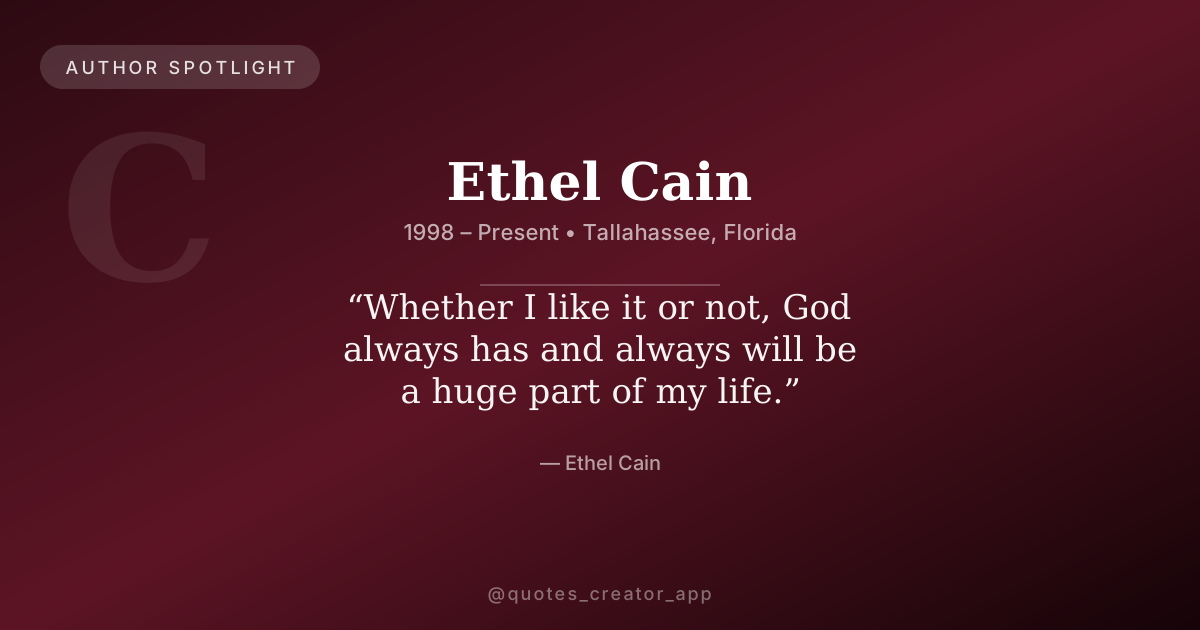
“Whether I like it or not, God always has and always will be a huge part of my life. Whether he’s being used as a comforting figure or a threat, I’ve always been surrounded by it. It’s not really something you can walk away from. And I’d rather just sit with it than be like ‘Fuck the church!’”
The meaning behind these words
This is the clearest statement Ethel Cain has ever given of her relationship to the faith she was raised in, and it is remarkable for what it refuses to do. The instinct, for almost anyone who leaves a strict religious household, is to swing to the opposite pole — to denounce, to mock, to burn the whole thing down. Cain will not do it. “Whether I like it or not” is the key phrase, because it concedes something most people spend their lives resisting: that we do not choose what shapes us, and that the attempt to renounce a formative force is, in its own way, a form of captivity to it. God, she is saying, is not a belief she holds but an environment she grew up inside — “a comforting figure or a threat,” tenderness and terror bound together, and you do not get to keep one without the other. “It’s not really something you can walk away from” is not defeatism. It is honesty about the difference between leaving a place and leaving what the place did to you.
The sentence that follows is the one that has defined her. “I’d rather just sit with it than be like ‘Fuck the church!’” To sit with a thing, rather than rage against it or embrace it, is a precise description of her entire artistic method. It is why an atheist listener can find Preacher’s Daughter unbearably moving, and why a believer can find it harrowing: the record does not take a position, it simply inhabits the full, contradictory weight of the sacred. This refusal of easy apostasy is, in its quiet way, more radical than rebellion — it treats the church as something too large and too intimate to be dismissed, a presence that survives even the people who walk away from it. In an age that rewards the loudest possible renunciations, Cain chose the harder thing: to live inside the tension, and to make art from it. Her later clarification — that she is not a Christian, but that she still abides by the values she was raised on, “kindness, graciousness, loving her neighbor” — is the same idea, stated more gently. You can leave the theology and keep the shape it gave your soul.
“It was made clear to everyone that I was not like other people. Whenever I started to develop, I started to come into my own as a trans woman. We were a house divided — it was me versus my whole town.”
The meaning behind these words
Here, in three sentences, is the founding wound of everything she would go on to make. “It was made clear to everyone that I was not like other people” is written in the passive voice for a reason: the knowledge of her difference arrived not as a private discovery but as a public verdict, something made clear by the town around her before she had language to claim it for herself. The word “everyone” is doing heavy work — the shame was not hidden, it was communal, a thing she carried under the gaze of an entire small town. Then the sentence pivots, and the agency shifts back to her: “I started to come into my own.” The transformation, when it comes, is not a rejection of that difference but a taking of ownership of it. And then the verdict, delivered with biblical economy: “We were a house divided — it was me versus my whole town.” A house divided against itself cannot stand, the scripture says; she is invoking the language of the very world that rejected her in order to describe her own rupture from it.
What is most striking, in retrospect, is that she did not turn this wound into escape. Her music is full of the town, the church, the heat, the highways — the entire southern American landscape that made her feel like a foreigner in her own home. Most artists who feel this kind of alienation leave, and never look back; Cain made the leaving and the place itself her subject. There is no resentment-as-aesthetic here, only a kind of forensic tenderness, the gaze of someone who can describe a world precisely because she was never fully allowed inside it. And there is, buried in the phrase “my whole town,” a strange, reluctant loyalty — she does not say “the town” but “my whole town,” claiming it even as it turned against her. That possessive is the whole of her art in miniature: she refuses to cede the place that hurt her, insists on it being hers, and sings it back into existence on her own terms. The exile does not forget the house. The exile writes the house’s story.
“I’m autistic, and so that definitely heightens sensory everything… When I’m producing music, I literally feel sometimes I can see it. I have to close my eyes, and I imagine the bass is the earth. I imagine the synths are rising up next to you, and I imagine the vocals are high in the sky, right in the center. I close my eyes and picture the sound around me — that’s how I mix.”
The meaning behind these words
This is Ethel Cain explaining, with startling lucidity, what it is actually like inside her head when she makes a record — and it is the closest she has come to describing the engine of her sound. She does not mix music the way a technician might, by levels and frequencies; she mixes it the way a painter might, or a geographer, by seeing it. “The bass is the earth. The synths are rising up next to you. The vocals are high in the sky.” Sound, for her, has mass and position and altitude; a song is a place you stand inside, not a thing you listen to. The diagnosis of autism, sought in adulthood, reframes what might otherwise look like mere metaphor. For Cain it is literal — “that definitely heightens sensory everything” — a way of perceiving in which the boundaries between the senses do not hold, in which “music is not just something you listen to” and “film is not just something you watch.” She is describing a mind that experiences the world as a single, overwhelming, layered field, and then has the discipline to translate that field into song.
The importance of this quote goes beyond craft, because it names the source of what critics keep praising as the “cinematic” quality of her work. She builds songs as scenes, albums as landscapes, characters as people who breathe. Preacher’s Daughter does not feel like a collection of tracks; it feels like a place — the South, yes, but also an interior geography of fear and desire and faith. When she says “I close my eyes and picture the sound around me,” she is describing an imagination that is spatial and synesthetic and, crucially, not ashamed of its own intensity. In a culture that treats neurodivergence as a thing to be managed or apologized for, she treats it as the very source of her gift — not a deficit but a “heightening,” a word she chooses deliberately. It is a quietly revolutionary reframing: the thing that made her feel different, that marked her as not-like-other-people, is the same thing that lets her make worlds. She did not overcome her difference. She tuned it, and played it back to the rest of us.
“Once you make pop music, your other genres won’t be taken as seriously.”
The meaning behind these words
On its face this is a sentence about the music industry’s genre politics, and it is accurate about that — there is a long, ugly tradition of treating pop as unserious, as disposable, as beneath the dignity of “real” art. That gatekeeping has never been gender-neutral, and it has never been neutral about trans artists, who are forever being asked to prove their seriousness in ways their cisgender peers are not. Cain was speaking in the aftermath of “Crush,” the most conventionally pop thing she had ever made, and the fear she names is specific and real: the fear that one catchy song would reclassify her, in the industry’s eyes and the public’s, from “serious artist” to “pop act,” and that the ambient folk and slowcore and Southern Gothic she had spent years building would suddenly count for less. It is a sentence about the fragility of credibility, and about how quickly a woman’s art can be reduced to a genre label the moment it becomes accessible.
But what the quote means in the long arc of her career is something more interesting, because she answered her own fear not by avoiding pop but by walking straight through it. She made “American Teenager,” a song that sounds like the most triumphant pop anthem of the decade and is secretly a lament about war and gun violence and the hollow promise of the American dream — a pop song that smuggles a eulogy inside a chorus. And then, having proven she could do it, she turned around and made Perverts, a ninety-minute drone record with almost no hooks at all, an album that exists partly to demonstrate that the same artist can hold both registers at once. The quote, read now, is a prophecy she refused to be governed by. She did not let the fear of being taken less seriously keep her from the pop, and she did not let the pop define her. The resolution was not to choose a genre but to make the boundaries between them irrelevant — to become an artist for whom “serious” is a word the audience has to retire, because the work refuses to stay in any one category long enough to be judged.
Ethel Cain’s legacy
It is too early, by any honest measure, to write a final legacy for an artist who is twenty-eight years old. But the shape of the thing is already visible, and it is unusual. Ethel Cain did something that a single generation rarely does twice: she took a genre that belonged to the past — the Southern Gothic, the country lament, the hymn — and made it feel not retro but inevitable, the only possible vessel for the thing she needed to say. Her music gave the American South back to itself in a new way, insisting that the region’s violence and its tenderness, its faith and its hypocrisy, could not be untangled, and that the truest stories are told by the people the region tried to write out of its own mythology — the trans girl in the rural town, the preacher’s daughter who left the church and kept the cross. The cult following Preacher’s Daughter earned was not the idle fandom of a viral moment; it was the recognition, felt with unusual intensity by a generation raised on the internet and starved for sincerity, that someone was finally telling the truth about home, and God, and being trapped inside a place you love that does not love you back.
The rest of the legacy is the woman herself, and the way she has carried the burden of being a first. As the first openly transgender artist to crack the Billboard 200 top ten, she is now a symbol whether she asked to be or not — and she has met that burden with a refusal to be flattened, remaining unapologetically strange, unapologetically opinionated, and unapologetically herself. Her political candour — the anti-war fury of “American Teenager,” the pro-Palestinian prayer she released as “من النهر,” her contempt for the current president — has made her a lightning rod in a way few artists of her generation are willing to be. And she has not been without real, public falls: the resurfacing, in the summer of 2025, of offensive posts from her own teenage years forced a reckoning she answered with a long written statement and a hard look at who she used to be. That, too, is part of the legacy — the willingness to sit with the ugliest parts of a past, her own as well as her country’s, rather than look away. She built an entire artistic identity on that exact discipline. The preacher’s daughter who could not walk away from God did not walk away from herself, either, and that refusal — to sand down, to soften, to be more palatable — is likely to be what endures long after the charts have moved on.
Create graphics with Ethel Cain’s quotes
Ethel Cain’s words carry the same gravity as her music: unflinching, atmospheric, and built on the belief that the hardest truths are the ones worth saying beautifully. Whether you are looking for a line about faith that refuses to be simple, or a reminder that your difference is a heightening rather than a flaw, Quotes Creator helps you turn these quotes into shareable designs with custom fonts, colors, and layouts.
Why we chose Ethel Cain
Ethel Cain enters this spotlight at a moment when her name is surging through the cultural conversation once again. In August 2026, her Wikipedia pageviews sat comfortably in the tens of thousands a day — a figure driven by the afterglow of a landmark year in which she released two records, became the first openly transgender artist to reach the Billboard 200 top ten, and found herself, as she so often does, at the center of the discourse. But the timing, as always, is secondary to the substance. We chose Ethel Cain because, in an age of artists who are carefully packaged and endlessly smoothed, she remains what she has always been: someone who refuses to be made smaller or easier, and who has turned that refusal into the most distinctive American sound of her generation.
The four quotes we have selected trace the spine of a life and a mind: the God she could not walk away from, the town that made her a stranger, the synesthetic imagination that lets her see the music she makes, and the fear of pop music she answered by walking straight through it. These are not the tidy maxims of a comfortable life. They are the operating principles of someone who has made an art form out of sitting with what is difficult — faith without belief, home without belonging, difference without apology. In an era that increasingly rewards the loudest renunciation and the smoothest surface, Ethel Cain stands as a monument to the opposite proposition: that the truest thing you can do is not to flee what shaped you, but to turn around and sing it, in all its beauty and its horror, back into the light. The sound is hers alone. The truth of it is for everyone.
— ThinkPeak Studio Editorial Team
Create your own quote graphic with this quote
Turn this line into a shareable graphic in seconds — free, no signup needed. For video quotes and 100+ templates, try the Android app.
Advertisement
Enjoyed this article? Get more like it in your inbox.