On this page
Author Spotlight: George Orwell
From the opium-stained bungalows of colonial Motihari, where he was born the son of an imperial functionary at the fag end of the Raj, to a cold, damp farmhouse on the Hebridean island of Jura, where he typed the final pages of Nineteen Eighty-Four as his lungs haemorrhaged and the fog rolled in from the Atlantic — the life and words of Eric Arthur Blair, a man who invented the language we use to describe political nightmares and who proved, at the cost of his own health and ultimately his life, that writing could be a form of moral action.
Who is George Orwell?
Eric Arthur Blair was born on 25 June 1903 in Motihari, a small town in the Bengal Presidency of British India, where his father, Richard Walmesley Blair, worked as a sub-deputy opium agent in the Indian Civil Service — a detail that would supply the young writer with an early, intimate view of the bureaucratic machinery of empire. His mother, Ida Mabel Limouzin, was the daughter of a French teak merchant and an Englishwoman, and possessed the kind of restless, impractical gentility that characterised what Orwell later described, with characteristic precision, as the “lower-upper-middle class.” When Eric was one year old, Ida took him and his older sister Marjorie back to England, settling in Henley-on-Thames, Oxfordshire. His father would remain in India for the better part of a decade. The boy grew up surrounded by women — his mother, his sisters, the French Ursuline nuns at the convent school he attended from age five — acutely aware of his family’s strained finances and the peculiar limbo of a class position that granted him access to the institutions of the elite without the money to inhabit them comfortably. He was poor among the rich, a scholarship boy at St Cyprian’s, the Eastbourne preparatory school he later immortalised with acid precision in the essay “Such, Such Were the Joys.” At St Cyprian’s he met Cyril Connolly, the future editor of Horizon, and learned the twin arts of social observation and concealed resentment. His exam results earned him a King’s Scholarship to Eton, where he was taught French by Aldous Huxley and where, by his own later account, he did very little work. He left at eighteen, bypassing university, and instead of living the literary dream he had shared with his adolescent sweetheart Jacintha Buddicom — with whom he had read poetry and stood on his head in fields — he signed up for the Indian Imperial Police in Burma.
The five years Blair spent as a colonial policeman in Burma, from 1922 to 1927, were the crucible in which his political conscience was forged. Stationed in remote outposts across the Irrawaddy Delta, he oversaw a system he increasingly detested: the casual violence, the racial hierarchy, the fundamental lie at the heart of a foreign occupation that called itself civilisation. In the essay “Shooting an Elephant,” one of the most perfectly constructed pieces of short nonfiction in the language, he described being forced by the expectations of a jeering Burmese crowd to shoot a rampaging elephant he knew did not need to die — a parable about the ways in which imperialism corrupts and constrains the oppressor as surely as the oppressed. In another essay, “A Hanging,” he watched a condemned man step aside to avoid a puddle on the path to the gallows, and recorded the moment with a clarity that makes physical the mystery of extinguishing a life: “His nails would still be growing when he stood on the drop.” When Blair returned to England on leave in 1927, he resigned from the Imperial Police and announced to his astonished family that he intended to become a writer. He was twenty-four years old and possessed nothing but a classically trained prose style, an intimate knowledge of the machinery of oppression, and a conviction, which would never leave him, that the most important work a person could do was to describe things as they actually were. To research the lives of the poor, he dressed in ragged clothes and lived in the slums of Paris and the doss-houses of London — cooking dishes in the rat-infested basements of Parisian hotels, sleeping on the Thames Embankment, deliberately subjecting himself to the degradations of poverty so he could report on them with authority. The result was Down and Out in Paris and London (1933), published under a name chosen from a shortlist he sent to his agent: George Orwell.
The mid-1930s transformed Orwell from an observer of suffering into a participant in the political struggles of his age. Commissioned by the left-wing publisher Victor Gollancz to investigate conditions in the industrial north of England, Orwell travelled to Wigan, Barnsley, and Sheffield in 1936, descending into coal mines, lodging in workers’ houses overrun with black beetles, documenting the malnutrition, the slums, the dignity of people ground down by an economic system that had no use for them. The Road to Wigan Pier (1937) is both a devastating work of social reportage and a furious polemic about the failures of the British socialist movement, which Orwell had come to see as dominated by “cranks” and middle-class poseurs who had no genuine connection to the working class they claimed to represent. But it was Spain that marked the great watershed of his life. In December 1936, six months after the outbreak of the Spanish Civil War, Orwell arrived in Barcelona and enlisted in the POUM militia — a revolutionary Marxist faction at war with both Franco’s fascists and Stalin’s Communists. He was sent to the front in Aragon, where the trenches were so quiet, so absurdly ill-equipped, that he described the war as a “blood-stained pantomime.” Then, in May 1937, a bullet from a sniper’s rifle passed through his throat, missing his carotid artery by millimetres. While he was recovering in Barcelona, the Communist-backed government began purging the POUM as “fascist traitors.” Orwell and his wife Eileen fled across the French border with the secret police on their heels. The experience crystallised in him a lifelong conviction: that the Soviet Union was not a socialist utopia but a totalitarian nightmare, and that the willingness of Western intellectuals to apologise for Stalin was not merely a political error but a moral betrayal. Homage to Catalonia (1938), his account of the war, sold poorly in its own time but has since been recognised as one of the essential books of the twentieth century.
The Second World War and its aftermath produced the two novels for which Orwell is most widely remembered, and they were written in circumstances of extraordinary physical hardship. Declared unfit for military service because of his damaged lungs, Orwell worked for the BBC’s Eastern Service, producing propaganda broadcasts to India that he found so ludicrous he described the atmosphere as “something halfway between a girls’ school and a lunatic asylum.” He joined the Home Guard, wrote the “As I Please” column for Tribune, and began crafting a short allegorical fable about a revolution betrayed. Animal Farm, completed in 1944, was almost never published. T.S. Eliot, then an editor at Faber & Faber, rejected the manuscript with the extraordinary observation that the pigs were the most intelligent characters and that the book therefore risked being read as pro-Trotskyist. Other publishers balked at offending Stalin, Britain’s wartime ally. When it finally appeared in August 1945, three months after VE Day, it was an immediate sensation, translated into dozens of languages and establishing Orwell as a writer of global consequence. By then his wife Eileen had died during a routine hysterectomy, leaving him to raise their adopted infant son, Richard, alone. He retreated to Barnhill, a remote, unheated farmhouse on the Hebridean island of Jura, accessible only by a five-mile track through peat bog. There, with his tuberculosis worsening and the Scottish damp seeping through the walls, he set about writing the novel that would give the world the vocabulary of dystopia. He typed the manuscript of Nineteen Eighty-Four largely in bed, chain-smoking roll-ups, his fingers so weakened by illness that it was a physical labour to strike the keys. In September 1949, he entered University College Hospital in London. Three months later, on 13 October 1949, he married Sonia Brownell from his hospital bed. On 21 January 1950, aged forty-six, an artery in his lung burst and George Orwell died. He was buried in the churchyard of All Saints’ in Sutton Courtenay, Oxfordshire, under his real name: Eric Arthur Blair.
George Orwell’s most memorable quotes
“Who controls the past controls the future: who controls the present controls the past.”
The meaning behind these words
This sentence is one of the most compressed statements of political epistemology ever written, and it operates with the efficiency of a mathematical theorem. The first clause — “who controls the past controls the future” — is a claim about how legitimacy is manufactured. If you can dictate what people believe happened yesterday, you can dictate what they believe is possible tomorrow. Every political movement understands this intuitively. Regimes rewrite history textbooks. Revolutions tear down statues. The victors of a war get to tell its story, and the story determines what kind of future the next generation can imagine. Orwell, who had watched the Stalinist purges of his Spanish comrades rewritten in real time as the suppression of “fascist traitors,” knew that the control of historical memory was not an abstract philosophical problem but a practical technique of power, as real and as lethal as a bullet through the throat.
The second clause is the one that makes the sentence truly dangerous: “who controls the present controls the past.” This is the mechanism by which the first claim operates. The past is not fixed. It is constantly being re-narrated by the people who hold power in the present moment. Orwell saw this happening in the press, in the ministries, in the speeches of politicians who denounced as “Trotskyites” the same revolutionaries they had embraced a year earlier. In Nineteen Eighty-Four, the protagonist Winston Smith works in the Ministry of Truth, where his job is to alter newspaper archives so that the Party’s predictions always appear to have been correct. This was not a science-fiction fantasy. It was a barely exaggerated version of what Orwell had witnessed in the Communist press, where the Soviet Union’s shifting alliances — first with Hitler, then against him — were presented not as reversals but as continuities. The sentence is a warning: if you let someone control how history is told, you have surrendered not only your understanding of the past but your capacity to shape the future. The two are the same thing.
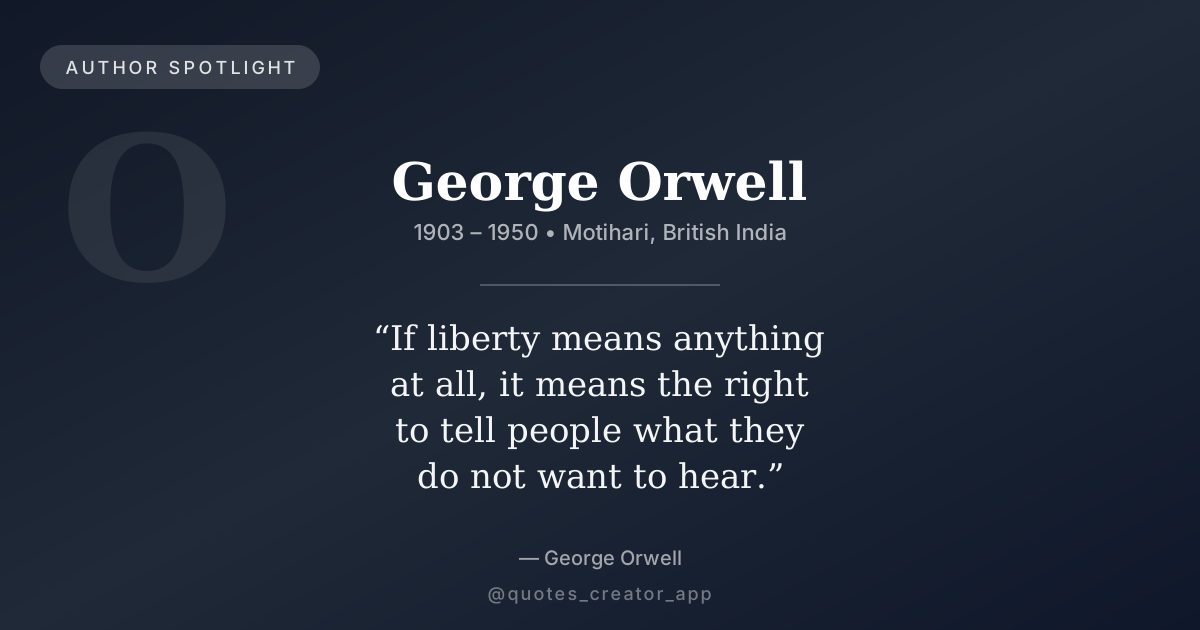
“If liberty means anything at all, it means the right to tell people what they do not want to hear.”
The meaning behind these words
This sentence was written in a moment of acute frustration. Orwell had drafted a preface to Animal Farm that was suppressed by his publisher and not printed until decades after his death. The preface was a sustained attack on the self-censorship of the British literary establishment, which he accused of refusing to publish anything that criticised the Soviet Union because the USSR was Britain’s wartime ally. In the essay he called this phenomenon “the freedom of the press” in scare quotes, noting that while Britain had no formal censorship, it had something equally effective: a consensus among publishers, editors, and reviewers about what was permissible to say. The freedom to speak, he argued, was meaningless if the only speech permitted was speech that reinforced the opinions people already held. Liberty was defined not by the right to agree but by the right to disagree — and specifically by the right to say things that the powerful, the respectable, and the comfortably opinionated would prefer to ignore.
The sentence has outlived its immediate context and become a kind of constitutional clause of intellectual freedom. It has been quoted by dissidents on every continent, by journalists in authoritarian states, by whistle-blowers who sacrificed their careers to expose wrongdoing. What makes it so powerful is its construction as a definitional move: “if liberty means anything at all.” Orwell is not offering one possible definition among many. He is drawing a line in the sand and saying, essentially: this is the definition, or the word is empty. Everything else that calls itself liberty — the liberty to shop, the liberty to choose between two identical political parties, the liberty to say nothing that disturbs the powerful — is window dressing. The real thing, the irreducible thing, is the right to be unpopular, inconvenient, and offensive to the prevailing consensus. Orwell, who spent his career being all three, was not being rhetorical. He was stating the organising principle of his life.
“Political language … is designed to make lies sound truthful and murder respectable, and to give an appearance of solidity to pure wind.”
The meaning behind these words
“Politics and the English Language” is the most widely taught essay in the Orwell canon, a staple of writing courses across the English-speaking world, and it is almost always misrepresented. Most people remember it for its six rules of good writing — never use a metaphor you are used to seeing in print, never use a long word where a short one will do, break any of these rules sooner than say anything outright barbarous. These rules are sensible, but they are not the point of the essay. The point is the sentence quoted above, which is not about style at all. It is about the relationship between language and power. Orwell’s argument is that dishonest political systems produce dishonest language not as a side effect but as a deliberate strategy. When a government bombs a village and calls it “pacification,” when a regime executes its opponents and calls it “the elimination of unreliable elements,” when a corporation fires thousands of workers and calls it “right-sizing,” language is not merely failing to communicate — it is actively obscuring reality. The phrase “pure wind” is a marvel of deflationary contempt. Orwell takes the pompous Latinisms of political speech and reveals them as vapour.
The deeper argument of the essay, which tends to get lost in the writing advice, is that linguistic decay and political decay are the same process seen from different angles. Sloppy language makes sloppy thought possible, and sloppy thought makes tyranny possible, because a population that cannot think clearly cannot resist the manipulation of people who can. This is why Orwell devoted so much of his career to what might seem like a minor preoccupation — the correct use of English prose. He believed, with a seriousness that bordered on the religious, that clarity was a moral obligation. A writer who used a dead metaphor was not merely being lazy but was actively collaborating in the degradation of public discourse. His six rules were not stylistic tips. They were ethical injunctions. And the sentence at the centre of the essay — that political language is “designed to make lies sound truthful and murder respectable” — is the diagnosis that makes the cure necessary. If language can be used to disguise atrocity, then the defence of language is the defence of the victims of atrocity. The two projects cannot be separated.
“We have now sunk to a depth at which the restatement of the obvious is the first duty of intelligent men.”
The meaning behind these words
Orwell wrote this sentence in January 1939, in a review of Bertrand Russell’s book Power for The Adelphi. The timing matters. Hitler had annexed Austria and the Sudetenland. The Spanish Republic was collapsing. Stalin’s purges were at their peak. Across Europe, things that had seemed impossible — the return of mass torture as a technique of government, the open celebration of militarism, the casual liquidation of truth by propaganda — had become routine. In such a context, Orwell argued, the most urgently needed intellectual work was not theoretical innovation or ideological refinement. It was the simple, stubborn insistence that a machine-gun was still a machine-gun even when a “good” man was pulling the trigger. The sentence is a rebuke to sophistication, to the intellectual habit of overcomplicating what is straightforward, to the instinct that says the clever thing is always the nuanced thing and never the obvious thing. Sometimes, Orwell believed, the obvious thing is exactly what needs to be said, precisely because it has been so thoroughly obscured by ideological fog.
The line has become a touchstone for writers and thinkers working in periods of political crisis, and its relevance has only grown in an era of algorithmic misinformation and institutional gaslighting. It functions as a kind of permission — permission to say, in plain terms, what everyone knows but no one of consequence is willing to state publicly. That the war is unwinnable. That the policy is failing. That the numbers do not add up. That the emperor is naked. Orwell understood that the people who restate the obvious are rarely rewarded for it. They are mocked as simplistic, derided as unsophisticated, condemned as lacking the kind of complexity that qualifies one for serious consideration. But the restatement of the obvious is not a sign of intellectual poverty. It is the work of clearing away the debris of euphemism, the accumulated sediment of years of deliberate obfuscation, so that people can see what is actually in front of them. In an age when the machinery of disinformation has become more powerful than Orwell could have imagined, the first duty of intelligent men and women remains what it was in 1939: to say clearly what is true, however uncomfortable, however unwelcome, however obvious it ought to be.
“The choice before human beings, is not, as a rule, between good and evil but between two evils.”
The meaning behind these words
This sentence, written in the dark middle of the Second World War, is perhaps the bleakest thing Orwell ever published — and the most morally honest. He was responding to pacifists who argued that Britain should not fight Hitler because war itself was an absolute evil. Orwell, who had seen war up close, who had a sniper’s bullet pass through his throat and who had watched his comrades in the POUM murdered not by fascists but by their supposed allies on the left, did not disagree that war was evil. He simply insisted that the alternative — letting the Nazis win — was a greater evil. The choice was not, he argued, between good and evil, but between one evil and another, and the moral duty of the serious person was to choose the lesser evil without pretending, for a moment, that it was anything other than evil. This is an unbearable position to hold, and Orwell held it without flinching. He refused the comfort of moral purity, the seductive fantasy that there existed somewhere a course of action that would leave the chooser with clean hands. There was no such course. There never is.
The sentence has a broader application that extends well beyond the question of war. Most of the moral dilemmas that face ordinary people in ordinary times are not contests between righteousness and villainy. They are contests between competing claims, each of which has some legitimacy and each of which carries some cost. The parent who must choose between career and children. The citizen who must choose between two flawed political candidates. The employee who must choose between loyalty to a colleague and reporting misconduct. Orwell’s insight is that the moral life consists largely of making imperfect choices between imperfect options, and that the mark of an honest person is the willingness to acknowledge the imperfection of the choice. The person who insists, in every situation, that his side is wholly good and the other side wholly evil is not a moral exemplar. He is a fanatic, or a fool, or both. Orwell, who spent his life attacking the self-righteousness of intellectuals who could not tolerate the idea that their ideological commitments might involve moral compromise, understood that the refusal to accept the reality of lesser evils was itself a kind of evil — the evil of preferring one’s own comfort to the uncomfortable truth of a world in which no clean choice is available.
George Orwell’s legacy
The scale of Orwell’s posthumous influence is unmatched by any English-language writer of the twentieth century except perhaps Shakespeare. The adjective “Orwellian” has entered the vocabulary of every major language on earth, describing not merely the specific horrors of Nineteen Eighty-Four — the telescreens, the Thought Police, Room 101 — but the entire apparatus of modern state surveillance, propaganda, and the manipulation of language for political ends. His neologisms — “Big Brother,” “doublethink,” “Newspeak,” “thoughtcrime,” “memory hole,” “cold war” — are not literary curiosities. They are the words that journalists, activists, and ordinary citizens reach for when they need to describe the workings of authoritarian power, because no one has provided better ones. Every time a government uses the phrase “enhanced interrogation” to mean torture, every time a corporation describes mass layoffs as “streamlining,” every time a politician says “collateral damage” to mean dead children, the ghost of Orwell is standing in the room, and his essay on political language is being vindicated all over again. In 2008, The Times ranked Orwell the second-greatest British writer since 1945. Animal Farm and Nineteen Eighty-Four have together sold more than fifty million copies. They are taught in schools from Birmingham to Beijing, adapted into films, plays, operas, and graphic novels, their imagery reproduced on protest signs from Tahrir Square to Tiananmen.
But the deeper legacy is not the books themselves, however indispensable they remain. It is the example of the life. Orwell was not, by any conventional measure, a successful man. At the time of his death, he had lived for years in poverty and physical pain. Many of his books had been commercial failures. The two novels that made him immortal were received with hostility by large portions of the literary establishment. He was denounced by Communists as a reactionary and by conservatives as a socialist. He belonged to no school, founded no movement, and left behind no disciples. What he left behind was a model of intellectual conduct. He demonstrated that it was possible to be a socialist without apologising for Stalin, a patriot without endorsing empire, a critic of capitalism without romanticising collectivism, a defender of truth without claiming infallibility. He was willing to change his mind, to admit error, to be corrected by facts. He wrote with a clarity that was not a gift but a discipline, the product of an almost physical struggle against the forces of vagueness and evasion. He once wrote: “So long as I remain alive and well I shall continue to feel strongly about prose style, to love the surface of the Earth, and to take pleasure in solid objects and scraps of useless information.” The sentence is characteristically precise. It names the things that made Orwell who he was: the love of language as a craft, the love of the physical world as a source of irreducible joy, and the conviction that even scraps of useless information were worth attending to, because attention itself — the act of looking carefully at what is actually there — was the foundation of everything he believed. That is his legacy. Not a set of opinions, but a way of being in the world: clear-eyed, unconsoled, and unwilling to look away.
Create graphics with George Orwell’s quotes
George Orwell’s words are built for a world that needs them — precise, fearless, and as urgent today as the day they were written. Whether you are looking for a call to intellectual honesty, a defence of free expression, or a reminder that language matters, Quotes Creator helps you turn these quotes into beautiful, shareable designs with custom fonts, colors, and layouts.
Why we chose George Orwell
August 2026 marks seventy-six years since Orwell’s death, but the anniversary is incidental to the choice. Orwell is chosen not because of a date on the calendar but because his work is, at this moment and perhaps at every moment, unignorable. We live in an era where the concept of objective truth is under sustained assault — from algorithmic echo chambers, from state-sponsored disinformation, from the accelerating compression of political discourse into slogans and memes. Orwell spent his career defending a simple proposition: that facts exist, that language can describe them, and that the refusal to do so honestly is a form of moral abdication. The five quotes we selected track the arc of that defence. They move from the mechanics of historical manipulation (“who controls the past controls the future”) through the irreducible definition of liberty (“the right to tell people what they do not want to hear”) to the anatomy of political language and the ethics of imperfect choice. Taken together, they form a kind of manual for intellectual survival in a dishonest age. Orwell was frequently wrong about specific predictions. He was wrong about the durability of Stalinist totalitarianism, wrong about the inevitability of nuclear stalemate, wrong about the direction of British socialism. But he was right about the things that mattered most: that power would always seek to control language, that truth would always be inconvenient to the powerful, and that the task of the writer was not to be right in every particular but to be honest in every sentence. At a time when public discourse is saturated with what he called “pure wind,” the restatement of the obvious — that facts are real, that language should mean what it says, that liberty requires the right to dissent — remains, as it was in 1939, the first duty of intelligent men and women. George Orwell did not live to see the world he warned against. But he left us the words to describe it, and the courage to resist it.
— ThinkPeak Studio Editorial Team
Create your own quote graphic with this quote
Turn this line into a shareable graphic in seconds — free, no signup needed. For video quotes and 100+ templates, try the Android app.
Advertisement
Enjoyed this article? Get more like it in your inbox.