On this page
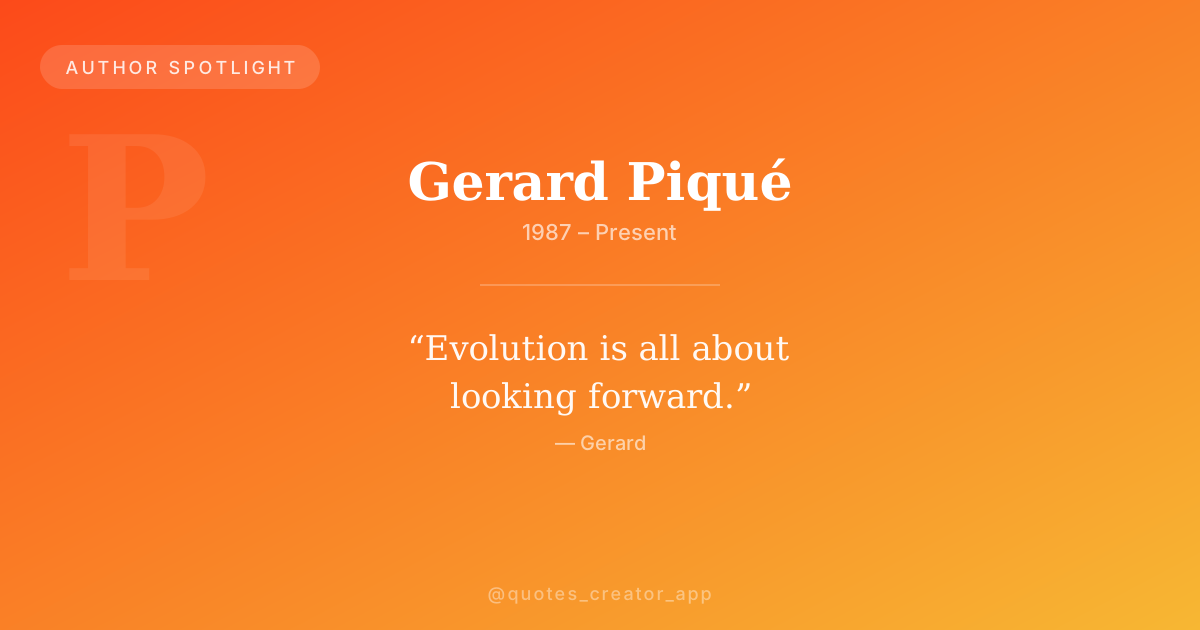
Author Spotlight: Gerard Piqué
Spanish World Cup winner, Barcelona legend, and entrepreneur who built a second career in business and media
Who was Gerard Piqué?
Gerard Piqué Bernabeu was born on February 2, 1987, in Barcelona, into a family that breathed football. His grandfather, Amador Bernabeu, was a former vice president of FC Barcelona, and Piqué was registered as a club member before he could walk. He joined Barcelona’s famed La Masia academy as a child, but at 17, he made the bold and unusual decision to leave his boyhood club for Manchester United. It was a gamble that few Spanish teenagers would have taken at the time, but one that would shape the rest of his life.
Under Sir Alex Ferguson, Piqué shared a dressing room with some of the greatest players of the era—Paul Scholes, Cristiano Ronaldo, Wayne Rooney, and Ryan Giggs. He described those years as “a master’s degree in development both as a player and a person.” Yet playing time was limited, and after a loan spell at Real Zaragoza, he returned to Barcelona in 2008. What followed was one of the most decorated careers in football history: nine La Liga titles, three Champions League trophies, a FIFA Club World Cup, and a historic sextuple in 2009. With Spain, he won the 2010 World Cup and Euro 2012, forming the defensive backbone of a golden generation that dominated world football.
Piqué was never just a footballer. He read widely, thought strategically, and treated his playing career as one chapter, not the whole book. While still an active player, he founded Kosmos, an investment group that went on to reshape the Davis Cup in tennis and acquire FC Andorra. After retiring in November 2022, he launched the Kings League, a seven-a-side football competition that blended traditional sport with digital entertainment and quickly amassed millions of viewers. His transition from elite athlete to entertainment entrepreneur was seamless, driven by an intellectual restlessness that set him apart from his peers.
But Piqué was also a figure of friction. He was outspoken on Catalan independence, clashed with referees, and never shied away from controversy. He was booed by some Spain fans, adored by Barcelona supporters, and respected by rivals who knew they were facing one of the most intelligent defenders of his generation. His 37 major trophies speak to his greatness on the pitch; his second career reveals a mind that was always thinking about what comes next.
Gerard Piqué’s most memorable quotes
“If you stop now and start to realise what you have achieved, then you start to relax, and you start to lose. I don’t think about everything I have achieved. I will do it when I retire because then I will have a lot of days to remember.”
The meaning behind these words
This quote captures the relentless psychology of a champion who understood that satisfaction is the enemy of success. Piqué articulated what many elite performers feel but rarely express: that reflection and gratitude, however important, must be deferred. During the peak of his career, he refused to dwell on trophies because he knew that doing so would dull the edge that made him great. The discipline of postponing self-congratulation is one of the hardest mental habits to cultivate, and it explains how a player with 37 major honours could keep competing at the highest level for over a decade.
The wisdom here extends far beyond football. In any field, the moment you believe you have arrived is the moment the decline begins. Piqué understood that achievement is not a destination but a moving target. By reserving reflection for retirement, he protected his competitive hunger and ensured that every new season began with the same urgency as his first. It is a philosophy that has served him well in business too—Kosmos and the Kings League were not born from a man resting on his laurels, but from someone still chasing the next frontier.
“Business is another kind of world that I don’t think is as passionate. It is not the pressure to perform as you have in football. It is more about strategy, skill, about how you deal with all the information you have. Some of the things from football I can bring to business, and some things from business I can bring to football.”
The meaning behind these words
Here Piqué reveals the analytical mind that distinguished him from most footballers. He does not romanticise business as a replacement for sport; instead, he draws a clear-eyed distinction between the emotional intensity of the pitch and the intellectual demands of the boardroom. This was not a retired athlete looking for a hobby—it was someone who had studied both worlds and understood what each demanded. His observation that skills flow in both directions—football teaching business and business teaching football—reflects a genuinely integrative thinker.
This dual perspective explains why Piqué succeeded where many athlete-entrepreneurs have failed. He approached Kosmos and the Kings League with the same strategic rigour he applied to reading a striker’s movement. Rather than treating business as a fallback, he treated it as a new arena that required different tools. His willingness to admit that business lacks the passion of football is also telling—it shows an honesty about his motivations and a clarity about what truly drives him, even as he excels in both domains.
“I can’t stand comparisons to the past. It doesn’t matter what we did in previous seasons.”
The meaning behind these words
This blunt declaration reveals Piqué’s allergy to nostalgia, a trait that defined both his playing career and his second act. At Barcelona, a club steeped in history and prone to comparing every new team to the Guardiola era, Piqué refused to let the past set the standard. He understood that reverence for former glories can become a prison, trapping a team in an impossible benchmark rather than freeing them to create something new. This forward-facing mindset protected him from the complacency that often afflicts dynasties.
The sentiment embodies a broader philosophy about life and achievement. Every season, every project, every phase exists on its own terms. By rejecting comparisons to the past, Piqué freed himself to judge each moment by what was possible now, not what had been achieved before. It is a principle that applies as much to the Kings League—which had no precedent—as it did to the Barcelona dressing room. Innovation requires the courage to stop measuring against what came before and start building what comes next.
“I consider that, in a democracy, everyone has the right to decide. If people don’t have the right to express what they feel, we would be going back to a bygone era.”
The meaning behind these words
Piqué was never a footballer who stayed in his lane, and this quote, spoken in the context of the Catalan independence debate, shows why. Where many public figures tiptoe around political issues, he articulated a principled defence of democratic expression with clarity and conviction. He did not tell people what to believe; he argued for their right to believe it. The phrase “going back to a bygone era” is a pointed reference to Spain’s Francoist past, a history that still echoes through Catalan politics.
Speaking out came at a cost. Piqué was booed by sections of Spain’s national team supporters and faced persistent online abuse. He never backed down. His willingness to accept the consequences of his views, rather than retreat into the comfortable silence that most athletes choose, revealed a depth of character that transcended sport. In a world that often demands athletes be apolitical entertainers, Piqué insisted on being a citizen first, and the jersey was never large enough to contain the full scope of who he was.
“I learned so much during my time at United. Sharing a dressing room with Paul Scholes, Cristiano Ronaldo, Wayne Rooney, Ruud van Nistelrooy, and Ryan Giggs at such a young age was an amazing experience. I didn’t play as much as I would have liked, but it was a master’s degree in development both as a player and a person.”
The meaning behind these words
This reflection on his Manchester United years reveals the humility beneath Piqué’s often brash exterior. He arrived in England as a teenager, far from home, and did not become an immediate star. Instead of resenting his limited playing time, he treated the experience as an education. The phrase “master’s degree” is not casual—it frames development as something systematic and intellectual, not merely physical. Piqué was studying greatness before he became great himself.
The quote also speaks to a broader truth about growth: sometimes the apprenticeship matters more than the early results. Piqué could have stayed at Barcelona’s academy, taken a safer path, and likely still had a fine career. But his willingness to be uncomfortable, to sit on the bench and absorb lessons from world-class teammates, accelerated his development in ways that only challenge can. It was a formative chapter that he never forgot, and the respect he still holds for that period speaks to the depth of character that underpinned his trophy-laden career.
Gerard’s legacy
Piqué retired with 37 major trophies, making him one of the most decorated footballers in history. His name sits alongside the immortals of the game: Xavi, Iniesta, Messi, Puyol. He started in World Cup and European Championship finals, scored in El Clásico, and captained the club he loved. In purely sporting terms, he belongs in any conversation about the greatest centre-backs of all time. But his legacy refuses to be confined to the pitch. The same restless intelligence that made him read the game better than almost anyone also drove him to build beyond it.
The Kings League, which now operates across multiple countries, is perhaps the most vivid expression of what makes Piqué different. It is not a retirement project or a vanity venture; it is a genuine innovation in how sport is packaged and consumed, blending the immediacy of streaming culture with the emotional pull of live competition. When La Liga president Javier Tebas predicted that Piqué would one day become a “great president of Barcelona,” he was acknowledging what many had long suspected: the student who left La Masia at 17 had always been preparing for something larger than football. Piqué’s real legacy may not be the trophies he lifted, but the systems he is building for a generation that consumes sport differently. He evolved, and he is still looking forward.
Create graphics with Gerard’s quotes
Gerard Piqué’s words have a sharp, forward-facing clarity that makes them perfect for quote graphics. Whether you are sharing on Instagram, creating a vision board, or looking for daily inspiration, Quotes Creator helps you transform these quotes into beautiful, shareable designs with custom fonts, gradients, and layouts.
Why we chose Gerard
Gerard Piqué is trending globally as Spain’s 2026 World Cup victory draws fresh attention to the nation’s footballing icons, past and present. But Piqué stands apart from the typical athlete story. His career arc—from La Masia prodigy to serial winner, from political lightning rod to media entrepreneur—is a study in reinvention. We chose him because his words reveal a mind that never stopped evolving, a competitor who refused to be defined by yesterday’s trophies, and a public figure who understood that speaking your truth matters more than being universally liked.
— ThinkPeak Studio Editorial Team
Create your own quote graphic with this quote
Turn this line into a shareable graphic in seconds — free, no signup needed. For video quotes and 100+ templates, try the Android app.
Advertisement
Enjoyed this article? Get more like it in your inbox.