On this page
Author Spotlight: Glen Hansard
From the cold flagstones of Grafton Street, where he first opened his guitar case at thirteen, to the stage of the Kodak Theatre, where an Oscar was placed in his hands for a song he wrote on a borrowed instrument in a friend’s flat, to the annual Christmas Eve busk outside the Gaiety Theatre that raised hundreds of thousands for Dublin’s homeless — the life and words of a man who believed that music was not a career but a calling, and that the only real failure was cynicism.
Who is Glen Hansard?
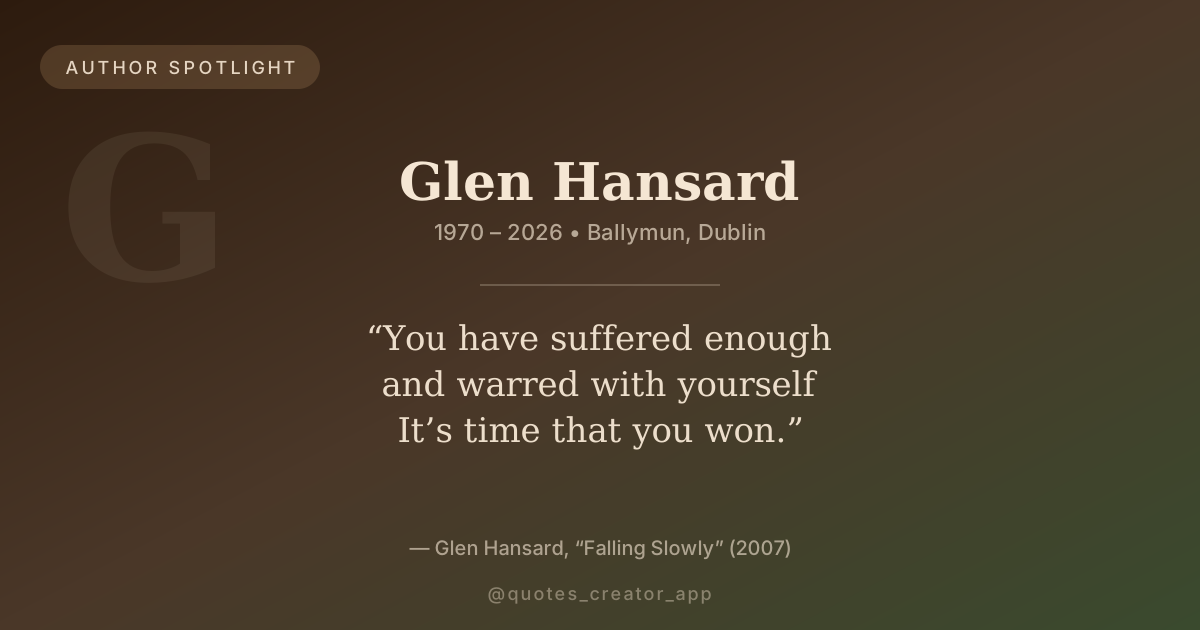
Glen James Angus Hansard was born on 21 April 1970 in Ballymun, a sprawling council estate on Dublin’s north side, the second of six children. His father James was a carpenter and a gifted fiddle player who had toured Ireland with showbands in the 1930s and 1940s — a man of music and silence in equal measure, given to heavy drinking and occasional violence. His mother Catherine held the household together with quiet resilience. Glen acquired his first guitar from an uncle who was in prison, taught himself Bob Dylan and Van Morrison songs by ear, and discovered early that music was not a hobby but a lifeline. He was a restless, intelligent boy who found school suffocating. At thirteen, still attending Ballymun Comprehensive, his headmaster told him something that would alter the trajectory of his life: while Glen might not become a rock star, if he stuck at it he would likely make a living from it. Hansard took the advice literally. He left school that year and went to Grafton Street with his guitar. He would later say that busking was the “great leveller” — an education in music, in people, and in the strange alchemy of holding a crowd with nothing but a voice and a handful of chords. “Everything I learned about singing, I learned from busking,” he said. “Everything I learned about songwriting, I learned from busking.” The pavement was his conservatoire.
In 1990, aged twenty, Hansard formed The Frames, a rock band built around the community of musicians he had befriended on the streets and in the pubs of Dublin. The band’s early years were lean. Their debut album Another Love Song (1991) peaked at No. 77 in the Irish charts, a commercial failure that saw Island Records drop them. But the same year brought an unexpected break: the director Alan Parker cast Hansard as the guitarist Outspan Foster in The Commitments, the film adaptation of Roddy Doyle’s novel about a group of unemployed Dubliners who start a soul band. Hansard, with his shock of curly red hair and a face that looked like it had been carved from Irish whetstone, had lived the role. The film was a hit. But Hansard was not built for the machinery of fame. He clashed with Parker over scheduling when filming conflicted with a Frames gig, and later admitted that the sudden attention “did a number on me.” He retreated into The Frames, and the band did what Irish bands do: they kept playing. Through dogged touring and residencies at Dublin venues like Whelan’s, they built a ferociously loyal following. Their fourth album For the Birds (2001) broke into the Irish top ten. Burn the Maps (2004) went to No. 1. By the mid-2000s, The Frames were one of Ireland’s most beloved bands, and Hansard’s reputation as a frontman of almost frightening emotional intensity — a man who sang as if each song was being torn from his chest — was firmly established.
Then came Once. In 2006, Hansard had begun collaborating with the Czech singer and pianist Markéta Irglová, whom he had met years earlier at a music festival organised by her parents in the Czech Republic. Their duo, The Swell Season, released a self-titled debut that year, and they were approached by John Carney — a former Frames bassist — to star in a low-budget film about two struggling musicians in Dublin who fall in love while making music together. Shot on a shoestring over seventeen days, Once was a film that should not have worked. It had no professional actors in the leads, no real script, no budget. What it had was chemistry and songs. At the centre of it was “Falling Slowly,” a song Hansard had written on a borrowed guitar in a friend’s flat — a fragile, ascending ballad about two people salvaging something beautiful from the wreckage of their separate lives. The film premiered at Sundance in January 2007 and won the World Cinema Audience Award. In February 2008, Hansard and Irglová stood on the stage of the Kodak Theatre in Los Angeles, and “Falling Slowly” won the Academy Award for Best Original Song. Irglová’s acceptance speech was famously cut off by the orchestra; the host Jon Stewart brought her back out to finish her words, one of the few moments of genuine grace in Oscar history. Hansard was thirty-seven. He had gone from a thirteen-year-old busker singing Dylan covers on Grafton Street to an Academy Award winner in twenty-four years, and he had done it without ever leaving the streets behind.
The decades that followed the Oscar were a quiet masterclass in how to handle success without being consumed by it. Hansard released five solo albums, beginning with Rhythm and Repose (2012) and culminating in All That Was East Is West of Me Now (2023). Didn’t He Ramble (2015) was nominated for a Grammy for Best Folk Album. He toured with Eddie Vedder, sang with Bruce Springsteen in Kilkenny, performed at Shane MacGowan’s funeral in a rendition of “Fairytale of New York” that reduced a cathedral of hard men to tears. But the work that mattered most to him happened on the streets. From 2010 until his death, Hansard led an annual Christmas Eve busk outside the Gaiety Theatre on South King Street — steps from where he had once sung for coins as a boy — raising money for the Dublin Simon Community, which serves the homeless. In 2016, he joined the Home Sweet Home coalition, which occupied Apollo House, a vacant government building in central Dublin, converting it into emergency accommodation for rough sleepers. The occupation was illegal; the coalition was taken to the High Court and ordered to vacate. Hansard did not care. He believed, with a conviction that his years on the streets had hammered into him, that music without solidarity was performance, not art. He married the Finnish poet Maire Saaritsa in 2022; they had a son, Christy, that same year. He divided his time between Celbridge in County Kildare and Helsinki, raised his child, planted vegetables, made tables, and continued to write songs. On the night of 28 July 2026, he played at a traditional music session at the Wren’s Nest pub in Chapelizod. In the early hours of 29 July, riding his motorcycle along the Strawberry Beds on the outskirts of Dublin, he was killed in a single-vehicle crash. He was fifty-six. His funeral at St Patrick’s Cathedral drew thousands. Eddie Vedder sang. Bono wept. The ceremony ended with a group rendition of Bob Dylan’s “Forever Young,” led by Liam Ó Maonlaí of Hothouse Flowers, sung by the friends and collaborators Hansard had gathered around him over a lifetime of refusing to let music become a solitary pursuit.
Glen Hansard’s most memorable quotes
“Take this sinking boat and point it home / We’ve still got time / Raise your hopeful voice, you have a choice / You’ve made it now.”
The meaning behind these words
These four lines — the climax of “Falling Slowly,” the song that defined Hansard’s career and introduced him to the world — are a work of extraordinary economy. The first image is a sinking boat, which is almost too obvious a metaphor for despair, and yet the genius of the line is in what it asks the singer to do: not to bail the water out, not to repair the hull, but to point it home. There is no promise of rescue. The boat is still sinking. But direction matters. Agency matters. The simple act of choosing a heading — of deciding that even a failing vessel can be aimed at something worth reaching — is the difference between surrender and survival. Hansard, who had spent his adolescence on the streets of Dublin asking strangers for money in exchange for songs, understood the difference between circumstances and what you do with them better than almost anyone. The sinking boat was not an abstraction to him. It was autobiography.
The second couplet shifts from metaphor to imperative, from the boat to the voice inside the singer’s throat. “Raise your hopeful voice” is not a suggestion; it is an instruction, and the word “hopeful” carries the whole weight of the song’s moral argument. Hope, in Hansard’s world, is not the same thing as optimism. Optimism is a prediction about outcomes. Hope is a decision about orientation — a commitment to singing even when the boat is sinking, even when the shore is invisible, even when you have no evidence that anyone is listening. The final line — “you’ve made it now” — is perhaps the most radical, because it locates the victory not in the destination but in the decision. The moment you raise your voice, you have already won. The arrival is incidental. The singing is the point. This is the theology of busking, translated into song. Grafton Street had taught Hansard that you do not wait for permission to make music. You open your case. You tune your guitar. You raise your voice. And whatever happens after that — coins in the case or indifference, fame or obscurity, an Oscar or an empty pub — is not the measure of the thing. The measure is the singing.
“The muse holds no appointments. You can never call on it. I don’t understand people who get up at 9 o’clock in the morning, put on the coffee and sit down to write.”
The meaning behind these words
This is Hansard at his most contrarian, and also at his most honest about the way creativity had always worked for him. The statement is a direct assault on one of the most durable myths of the writing life: the idea that inspiration can be scheduled, that art is a profession like accountancy, that if you simply show up at the same desk at the same hour every day, the muse will learn to find you there. Hansard rejected this outright. For him, creativity was not a discipline but a visitation. It arrived on its own terms, at its own hour, and the only thing the artist could do was stay available — keep the instrument nearby, keep the mind open, refuse to drown the receptive silence in the noise of modern life. This is not laziness dressed up as philosophy. It is a recognition that the deepest creative work happens below the level of conscious intention, in a part of the mind that cannot be commanded.
The remark also reveals something essential about Hansard’s artistic formation. He did not learn his craft in a classroom or a conservatoire. He learned it on the street, where you could not choose the moment the song would arrive — you simply had to be ready when it did. Busking is a form of radical availability. You stand in the open air, subject to weather and indifference and the unpredictable attention of strangers, and you sing. Sometimes the song lands. Sometimes it does not. But you cannot force it. Hansard’s philosophy of the muse is an extension of this experience: the artist is not a factory but a lightning rod. The work of the artist is not to produce on a schedule but to remain in a state of readiness good enough that when the lightning strikes, you are there to catch it. The coffee-and-desk routine that he dismisses is not wrong for everyone — many great writers have used it — but Hansard understood that his own gift was tied to spontaneity, to the unguarded moment, to the song that arrives unbidden while you are walking home from the pub or staring out a train window. He was suspicious of any method that replaced openness with discipline, because discipline, in his experience, was not how the best songs had come to him. The best songs had come when he was not trying.
“Sadness is very loud, and happiness is quiet.”
The meaning behind these words
This is a statement of such compressed wisdom that it seems almost too simple, and yet the more you sit with it the more it unfolds. The observation operates on multiple levels simultaneously. On the most literal level, it is a comment about musical aesthetics: sad songs announce themselves — a minor key, a slow tempo, a singer’s voice cracking with emotion — while happy songs, when they are truly successful, tend to feel effortless, transparent, as if they have always existed. But Hansard is not talking only about music. He is describing the architecture of human emotion. Sadness demands to be heard. It is a signal, an alarm, a broadcast. It evolved to summon help, to communicate need, to make itself impossible to ignore. Happiness, by contrast, is a condition of sufficiency. It does not need to announce itself because it is not asking for anything. A happy person does not need to be rescued. A happy person can sit in silence and be content with it.
The deeper insight, and the one that connects this quote to the rest of Hansard’s work, is that the loudness of sadness is not a design flaw. It is the starting point for art. Hansard’s own songwriting drew almost entirely from the well of difficult emotion — heartbreak, loss, exile, longing, the ambiguous grief of leaving a country and a faith and a version of yourself behind. He was not embarrassed by this. He did not apologise for writing sad songs. He understood that sadness is the emotion that most urgently requires expression, and that the expression of sadness — in a song, in a conversation, in a shared silence — is the mechanism by which it becomes bearable. Happiness, in his framework, is not the opposite of sadness but its aftermath. It is the quiet that follows the storm, the moment when the song ends and the room is full of something that does not need to be named. This is why Hansard’s music never felt maudlin, even at its saddest. It was not wallowing. It was processing. The sadness was loud because it had to be. The happiness that followed — the resolution, the final chord, the exhale — was quiet because it had been earned.
“I’ve always felt that if I ever got cynical, I would have to stop making music because I’d just be poisoning the air.”
The meaning behind these words
There are musicians who regard cynicism as a mode of sophistication — a sign that they are too intelligent to be taken in by sentiment, too worldly to believe in anything so naive as hope. Hansard was not one of them. This quote, delivered with characteristic bluntness, is a declaration of artistic ethics disguised as a throwaway remark. The key word is “poisoning.” Hansard is not arguing that cynicism is incorrect or unfashionable. He is arguing that it is toxic — that a cynical artist is not merely misguided but actively harmful, that the music produced by a cynical heart is a form of environmental damage. This is an unusual position in a culture that often equates cynicism with intelligence, but it was central to everything Hansard believed about the purpose of what he did. Music, for him, was not a product. It was an atmosphere. The person who makes it is responsible for the quality of the air that other people breathe.
The quote also explains Hansard’s remarkable consistency across four decades of making music. He never had a cynical period. He never made a cold album, a detached album, an album that seemed to have been assembled rather than felt. Even his weaker records — and he had them — were earnest. This is rarer than it sounds. Most artists who remain in the public eye for as long as Hansard did go through phases of irony, detachment, self-parody, burnout. Hansard did not, and the reason is contained in this sentence. He had drawn a line around cynicism and placed it outside the boundary of what he was permitted to feel if he wanted to keep making music. This was not an abstract prohibition. It was self-preservation. Hansard knew that his gift depended on a certain kind of openness — the same openness that had allowed him, as a thirteen-year-old, to stand on a street corner and sing to strangers without the armour of irony. Cynicism was armour. And armour, for a songwriter whose power came from vulnerability, was death. If he ever found himself putting it on, he would stop. He never did.
“A song is like a saddle: you ride it for a while, and if it’s the right kind of song you can sing it for the rest of your life.”
The meaning behind these words
This is perhaps the most elegant metaphor Hansard ever produced for his own relationship with music, and it is characteristic of him that the metaphor is drawn from the world of physical craft rather than the world of ideas. A saddle is a working object. It is made to be used, to bear weight, to travel. It is not decorative. It is not a monument. It exists in relationship to a living animal and a human rider and a journey. A song, in Hansard’s conception, is the same kind of thing. It is not a statement frozen in amber. It is not a finished work that belongs to its creator. It is a tool for movement — something you climb onto and ride through time. The emphasis on duration is crucial. The measure of a song, in this view, is not the chart position or the critical reception. It is whether the song can carry you for the rest of your life, whether it remains true and useful and bearable after decades of singing it. Hansard sang “Falling Slowly” thousands of times between 2007 and 2026, and by all accounts he never tired of it. That is what he means by “the right kind of song” — a song with enough structural integrity, enough emotional truth, to withstand repetition without becoming hollow.
There is also a quiet humility embedded in the image. The singer is not the creator of the song in any permanent sense. He is the rider. The song precedes him and outlasts him. His job is not to possess it but to travel with it for as long as it will carry him. This is a working-class philosophy of art, appropriate to a man who never went to university, who learned his craft on the street, who saw music not as self-expression in the therapeutic sense but as a trade — something you do because people need it and because you are capable of doing it well. Hansard was a carpenter’s son. He understood that a well-made object serves its user long after the maker has left the workshop. A chair, a saddle, a song — the principle is the same. You make it as well as you can. You trust that it will hold. And then you let others ride it into the years you will not see.
Glen Hansard’s legacy
Glen Hansard’s death on a Dublin roadside in the summer of 2026 produced an outpouring of grief whose scale surprised even those who had followed his career closely. More than eleven thousand people queued for hours to attend his public wake at the Irish Museum of Modern Art, a venue usually reserved for the work of painters and sculptors. The crowd spanned generations: middle-aged Frames fans who had followed the band through the lean years of the 1990s, young people who had discovered him through Once, homeless Dubliners who had been served by the charities he supported, musicians who credited him with inspiration in their own careers. The ceremony at St Patrick’s Cathedral featured performances by Eddie Vedder, Lisa O’Neill, and Markéta Irglová. Bono called him “the most musical and mischievous archangel of Ballymun.” Bruce Springsteen said, “Here on E Street, we are heartbroken.” Barack Obama posted a tribute. The Taoiseach called him a “significant contribution to Ireland’s cultural landscape.” These are the kinds of tributes that usually accompany the death of a statesman, not a singer-songwriter. That they felt proportionate rather than excessive is a measure of what Hansard meant to people.
But the deeper legacy will not be found in the tributes, the Grammy nomination, or even the Oscar sitting on a shelf somewhere. Hansard changed what it was possible for a musician to be in modern Ireland — and, by extension, in the wider world of folk and rock music. He was an international star who never stopped busking. He was an Academy Award winner who spent Christmas Eve raising money for rough sleepers. He was a man of intense, sometimes overwhelming emotion who refused cynicism as a matter of moral principle. He occupied the entire spectrum of human feeling in public — the grief, the rage, the tenderness, the ecstasy, the gratitude — without ever curating his personality for social media, without ever reducing himself to a brand. He treated music as a form of service, and the proof of that commitment is in the work: the songs that will be sung at funerals and weddings and in quiet kitchens long after everyone who knew him personally is gone. He once said that if you did not mark your successes, “the day your ship comes in could be just another day at the office, and there’s no poetry in that.” He marked his. Not with trophies or chart positions, but by returning, every year, to the street corner where he started, opening his guitar case, and singing. The poetry was in the return. The legacy is in the songs that remain.
Create graphics with Glen Hansard’s quotes
Glen Hansard’s words carry the rare combination of emotional honesty and hard-won wisdom — they speak to anyone who has ever felt broken, hopeful, doubtful, or defiant. Whether you are looking for lyrics that capture the ache of a departing love or the quiet strength of persevering against the odds, Quotes Creator helps you turn these quotes into beautiful, shareable designs with custom fonts, colors, and layouts.
Why we chose Glen Hansard
We write this on 9 August 2026, eleven days after Glen Hansard died in a motorcycle crash on the Strawberry Beds outside Dublin, an accident that sent a shockwave through the music world and brought millions of people to his Wikipedia page. He was fifty-six. The public grief has been extraordinary — an eleven-thousand-person wake, a cathedral funeral broadcast live across the world, tributes from Springsteen and Obama and Bono — but our reason for choosing Hansard goes beyond the immediate news cycle. Hansard represented a vanishing ideal in popular culture: the artist who achieves global fame without ever becoming a product. He won an Oscar and a Grammy nomination, made millions, toured the world, and yet his annual Christmas Eve busk for the homeless remained the fixed point on his calendar. He occupied a government building to protest Ireland’s housing crisis and faced a High Court injunction unblinking. He played at Shane MacGowan’s funeral and made a cathedral of hard men weep. He found Hare Krishna in his twenties and kept its disciplines quietly for the rest of his life. He married a Finnish poet and divided his time between County Kildare and Helsinki, raising a son, planting vegetables, making tables. He was the son of a carpenter who sometimes drank too much and a mother who endured too much, and he turned that inheritance not into resentment but into songs that made people feel less alone. The five quotes we selected trace the arc of his philosophy: the insistence on pointing the boat home even as it sinks, the conviction that true creativity cannot be summoned on a schedule, the recognition that sadness shouts while happiness whispers, the absolute refusal to let cynicism poison the well, and the humble understanding that a song, like a saddle, is something you ride for as long as it will carry you — and if it is built well, it will carry others long after you are gone. At his best, Glen Hansard was not making entertainment. He was making the air breathable. He still is.
— ThinkPeak Studio Editorial Team
Create your own quote graphic with this quote
Turn this line into a shareable graphic in seconds — free, no signup needed. For video quotes and 100+ templates, try the Android app.
Advertisement
Enjoyed this article? Get more like it in your inbox.