On this page
Author Spotlight: Hayden Panettiere
She was famous before she could talk, a working actress before she could read, and by the time she was old enough to understand what had happened to her, she had already spent a quarter of a century as someone else’s idea of who she should be. Hayden Panettiere was the indestructible cheerleader of Heroes, the wounded country star of Nashville, the voice of a generation’s childhood in A Bug’s Life and Kingdom Hearts — and, in the end, something far braver than any role she ever played: a woman who used the last years of her life to tell the unvarnished truth about being a child star, about postpartum depression, about abuse, and about the cost of choosing to get well. “It’s really scary, and it needs to be talked about,” she said of the illness that nearly broke her, and it became the thesis of her whole life. This is the story of an actress who spent her final act stepping out of every costume and simply telling the truth.
Who is Hayden Panettiere?
Hayden Lesley Panettiere was born on August 21, 1989, in Palisades, a hamlet in Rockland County, New York, the eldest child of Lesley R. Vogel, a former daytime soap actress, and Alan Lee “Skip” Panettiere, a captain in the New York City Fire Department. Her surname, Italian for “baker,” was inherited from a step-grandfather who adopted her father, and her ancestry was Italian, German, and English. She had one younger brother, Jansen, who became an actor and visual artist in his own right. The remarkable thing about her childhood is that it barely existed as a private matter at all: she appeared in her first commercial at eleven months old, in a 1990 advertisement for a Playskool toy train, and by her own later account she was being groomed for stardom before she had any say in the matter. Her full-time acting career began in 1994, when she was barely five, as Sarah Roberts on the ABC soap opera One Life to Live, followed by a four-year run as Lizzie Spaulding on Guiding Light, a role that saw her character battle leukemia and earned the real-life girl a Special Recognition Award from the Leukemia & Lymphoma Society for the awareness she raised. She was the voice of Princess Dot in Pixar’s A Bug’s Life at nine, a performance that made her the fifth-youngest Grammy nominee in history, and she spent her school years homeschooled through programs built around her filming schedule.
Stardom arrived in the form of a cheerleader with healing powers. In 2006, at sixteen, Panettiere was cast as Claire Bennet on the NBC superhero series Heroes, and the show’s famous tagline — “save the cheerleader, save the world” — made her face one of the most recognizable on television. The role won her a Saturn Award and two Teen Choice Awards and turned her into a fixture on the science-fiction convention circuit; it also, crucially, gave her the leverage to say what she actually believed. She used it quickly. In 2007 she paddled into the waters off Taiji, Japan, to confront a dolphin hunt alongside the Whaleman Foundation; in 2008 she delivered letters of protest to the Norwegian and Japanese ambassadors over whaling; she campaigned for Barack Obama, for D.C. statehood, and against teen pregnancy. A decade of defining work followed: she voiced Kairi across the Kingdom Hearts video-game series, portrayed Amanda Knox in a controversial 2011 film, and returned to the slasher genre as Kirby Reed in Scream 4 (2011) and, after a hiatus, Scream VI (2023). In 2012 she took the role that would define her adult career — Juliette Barnes, the scheming, fragile country singer on ABC and then CMT’s Nashville — earning two Golden Globe nominations for Best Supporting Actress and recording much of the show’s soundtrack herself.
The public career, however, concealed a private life that was slowly coming apart, and what makes Panettiere remarkable is that she refused to keep it hidden. In December 2014 she gave birth to a daughter, Kaya, with her on-and-off fiancé, the former heavyweight boxing champion Wladimir Klitschko, and in the months that followed she developed postpartum depression so severe that she checked into treatment. In September 2015 she went on Live with Kelly and Michael and said the illness was “scary and needs to be talked about,” one of the earliest and most prominent public reckonings with postpartum depression by a Hollywood star. The struggle deepened into addiction, and in 2018 she made the agonizing decision to relinquish full custody of her daughter to Klitschko so she could recover — a choice she called “a living nightmare” and “heartbreaking” but necessary. More pain followed: an on-and-off relationship with Brian Hickerson that ended in his arrest and eventual jailing for domestic violence charges involving her, which she addressed publicly in 2020 by urging other abuse victims to come forward; and, in February 2023, the sudden death of her brother Jansen at twenty-eight from an enlarged heart. Each blow, rather than silencing her, seemed to sharpen her conviction that her suffering could be turned into somebody else’s survival guide.
Her final years were, in that sense, her most courageous. In May 2026 she published a memoir, This Is Me: A Reckoning, in which she came out as bisexual, revealed that she had dated women, and described the experience of being “groomed” into child stardom with a candor that had become rare in an industry built on image management. “I was like a little soldier,” she told The Hollywood Reporter of her childhood, and the line landed with the force of a confession delivered to everyone who had ever watched her grow up on screen. Her final film, the psychological thriller Sleepwalker, was released in 2026 with Panettiere in the lead role and as an executive producer — a last assertion of control over her own image and story. On August 16, 2026, five days before her thirty-seventh birthday, she was found unresponsive at an apartment in Greenville, South Carolina, and pronounced dead at the scene. The coroner found no signs of trauma; her family, her fans, and the industry she had spent her whole life inside were left to reckon with a loss that felt, to many, like the end of a story that had only just begun to be told in her own words.
Hayden Panettiere’s most memorable quotes
“I was like a little soldier.”
The meaning behind these words
Six words, and yet they do the work of a thousand-page indictment of an entire industry. When Panettiere described her childhood as being like “a little soldier,” she was not reaching for a dramatic metaphor; she was reporting, with the flat precision of someone who has finally found the right word for an old wound, what child stardom actually demanded of her. A soldier follows orders, suppresses fear, and exists in service of a mission chosen by other people. A soldier is praised for obedience, not for asking why. Everything in Panettiere’s early biography — the commercial at eleven months, the soap operas at five, the Grammy nomination at nine, the homeschooling engineered around her filming schedule — was the record of a small child being marched through an adult’s ambition, and told all the while that she was lucky, that she was special, that she should be grateful. The word “soldier” collapses that whole comforting narrative. It insists that what looked like a fairy tale from the outside was, from the inside, something closer to a kind of service — performed without consent, without a clear exit, and without anyone asking the child whether she wanted to fight.
The timing of the sentence matters as much as its content. She said it in 2026, at thirty-six, in the promotion of a memoir whose very subtitle — A Reckoning — announced her intent to settle accounts with the version of her life that had always belonged to the public. To call yourself a soldier, rather than a star, is to refuse the industry’s preferred vocabulary; it is to translate glamour back into labor and, quietly, into exploitation. And there is a devastating implication buried in the past tense. I was a little soldier implies that at some point she stopped being one — that the woman writing the memoir had, at last, discharged herself from the army of childhood, laid down the performance, and begun speaking in her own voice. The line is a confession, an accusation, and a declaration of independence compressed into half a dozen words, and it is the sentence that unlocks everything else she would go on to say.
“The show put me in a place to speak for things that I’m passionate about.”
The meaning behind these words
Most people would have described what Heroes gave Panettiere in the language of career — fame, money, magazine covers, a seat at every awards show that mattered. What is striking about this sentence, spoken in 2008 at the very peak of her fame, is that she defined the show’s gift in entirely different terms: not as a payoff but as a responsibility, not as a spotlight but as a platform. The distinction is subtle and completely defining. A spotlight is pointed at you; a platform is something you stand on to speak. In choosing the second word, an eighteen-year-old was already articulating the philosophy she would live by for the rest of her life — that celebrity, if it was worth anything at all, was worth exactly as much as the causes it allowed you to serve. She said it while she was busy proving it, paddling out to confront the dolphin hunters of Taiji, hand-delivering protest letters to ambassadors, campaigning for D.C. statehood and against teen pregnancy, and refusing to be the passive, smiling face her industry expected her to be.
The line also reveals how early and how deliberately she understood the trade she was making. She had been a worker in Hollywood’s machine since infancy; by the time she became the most famous teenager in the country, she could have reasonably concluded that the machine owed her the right to disappear, to enjoy the spoils, to go quiet. Instead she ran the calculation in the opposite direction: the machine owed her a voice, and she intended to use it. There is something almost subversive in the sentence’s calm. It takes the most superficial currency in modern life — fame — and announces, with no apology and no fanfare, that its only real value is what it can do for other people. Years later, when she used that same platform to talk about postpartum depression and domestic violence, she was not changing direction. She was simply extending the same principle inward, discovering that the thing she was finally most passionate about speaking for was herself — and, through herself, the millions of people whose suffering had never once been on television.
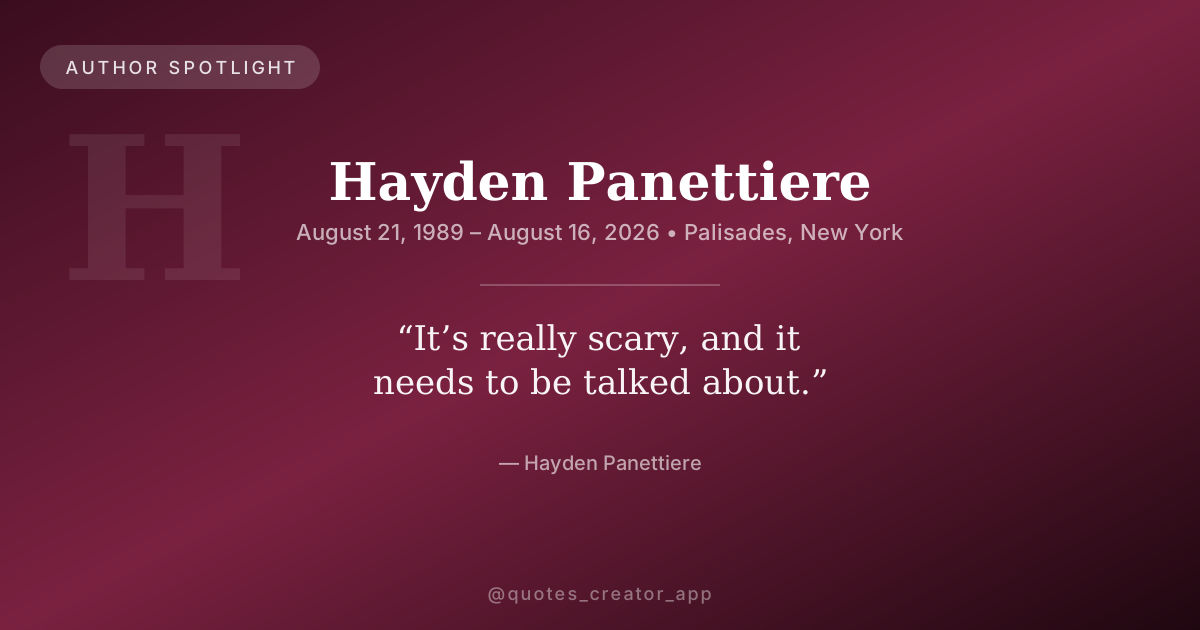
“It’s really scary, and it needs to be talked about.”
The meaning behind these words
In 2015, when Panettiere sat on a morning talk show and said this about postpartum depression, it was close to unthinkable for a Hollywood star to speak so plainly about maternal mental illness. The dominant script of celebrity motherhood was one of seamless joy — the glowing new mother, the effortless return to a red-carpet body, the silence about everything in between. Panettiere broke that script in a single sentence, and she did it not with clinical jargon but with two disarmingly simple observations: that the thing she was experiencing was terrifying, and that its very terror was the reason it had to be named aloud. The structure of the sentence is a small masterclass in advocacy. “It’s really scary” does the work of honesty, admitting the fear without embarrassment; “it needs to be talked about” does the work of purpose, converting that private fear into a public duty. She was not offering a cure or a slogan. She was offering permission — the most radical gift one suffering person can give another.
What made the statement historic is that she meant it, and kept meaning it for the rest of her life. This was not a one-off sound bite but the founding moment of a cause she would return to through treatment, relapse, and recovery, and eventually through the memoir she wrote eleven years later. Postpartum depression nearly destroyed her — it was the illness that, compounded by addiction, cost her the full custody of her daughter, a decision she later called the hardest of her life. And yet the woman who said “it needs to be talked about” never stopped talking about it, even when the talking grew painful, even when the story turned against her. That is what separates a memorable quote from a defining one. Plenty of celebrities have uttered a sentence about mental health and moved on; Panettiere spent a decade and a half proving, in the most vulnerable terms possible, that she believed her own words. In doing so, she helped pry open a national conversation about postpartum depression that has since saved — and continues to save — the lives of women who heard her voice and finally felt less alone.
“It was a living nightmare.”
The meaning behind these words
If “it needs to be talked about” is the principle of Panettiere’s life, “it was a living nightmare” is its cost, stated without any of the smoothing that celebrities are trained to apply. When she made the decision in 2018 to hand full custody of her young daughter to Klitschko so that she could pursue treatment for postpartum depression and addiction, she did not wrap it in the language of strength or self-care or any of the other euphemisms available to her. She called it what it was: a nightmare that she was awake for. The word “living” is the crucial one. A nightmare, in the ordinary sense, ends when you wake up. A living nightmare is one from which there is no waking — a horror that occupies the daylight, that you carry with you through every ordinary hour, and that no amount of good intentions or hard work can simply dissolve. By choosing the phrase, she refused to pretend that the right decision and the easy decision were ever the same thing, or that recovery is a clean, triumphant narrative.
And yet the sentence is not, ultimately, a surrender. To name the nightmare is the first act of surviving it, and the very fact that she said it publicly — years later, in interviews and, at last, in her memoir — is the proof that she had walked through it and come out the other side. There is a profound, almost defiant honesty in the admission, because it hands the public a version of motherhood that is neither the sanitized fairy tale nor the tabloid’s cruel caricature of the mother who “gave up” her child. It is the truth of a woman who loved her daughter enough to choose, temporarily, to be apart from her in order to become well enough to be a real mother to her. That is the quiet heroism the sentence protects: not the heroism of sacrifice alone, but the harder heroism of explaining it honestly, in a culture that punishes mothers either way. Panettiere lost a great deal, and she did not pretend otherwise. She simply refused to let the loss be meaningless.
Hayden Panettiere’s legacy
The most obvious measure of Hayden Panettiere’s legacy is the work itself, and it is considerable. For thirty-six years she was a near-constant presence in American entertainment — the fifth-youngest Grammy nominee in history for A Bug’s Life, the Saturn Award–winning and Teen Choice–winning star of Heroes, the twice Golden Globe–nominated lead of Nashville, the voice of Kairi for a generation of Kingdom Hearts players, the scream-queen favorite of the Scream franchise, and the model, singer, and designer whose face anchored campaigns for Neutrogena and Candie’s. She grew up on screen so completely that millions of people felt, when she died, as though they had lost someone they had known their whole lives — because, in a real sense, they had watched her their whole lives. That longevity, from an eleven-month-old in a toy-train commercial to a thirty-six-year-old executive producer of her final film, is itself a kind of achievement: she was one of the very few child stars who never fully left the frame, who kept working and kept evolving for a third of a century.
But the deeper legacy is the one she built with her mouth, not her filmography, and it will almost certainly outlast everything she ever made on screen. Hayden Panettiere talked about things that famous people, and especially famous women, and especially famous mothers, were not supposed to talk about. She talked about postpartum depression when the phrase was barely spoken in public, about addiction, about being abused by a partner, about the reality of being a child star groomed by an industry, and about the almost unbearable decision to give up custody of her child in order to get well. Each of these admissions cost her something — her privacy, her reputation, her comfort — and she paid the price anyway, because she had concluded early that the entire point of a platform was to stand on it and speak. The women who have since come forward about postpartum depression, the victims of domestic violence who dialed the hotline she shared to her millions of followers, the former child stars emboldened to tell their own stories — all of them stand, in some part, on the ground she broke.
There is a final legacy, too, that belongs entirely to the last act of her life, and it is the hardest one to hold. In This Is Me: A Reckoning, published just three months before her death, Panettiere finally seized control of her own narrative — coming out as bisexual, naming her abuse and her illness and her childhood with unflinching clarity, and asking, in effect, to be seen as a whole person rather than a collection of characters. The tragedy is that she died so soon after beginning to tell the story in her own words. The consolation, such as it is, is that she got to tell it at all, and that the words she left behind — it’s really scary, and it needs to be talked about — are already doing the work she intended them to do. The cheerleader who was supposed to save the world ended up doing something quieter and more radical: she spent her life telling the world what was wrong, so that the rest of us might finally learn to do the same.
Create graphics with Hayden Panettiere’s quotes
Hayden Panettiere’s words carry the same quality that made her one of the most beloved actresses of her generation — they are honest, fearless, and built to be shared. Whether you need a line about mental health, about speaking your truth, or about finding the courage to get well, Quotes Creator helps you turn these quotes into beautiful, shareable designs with custom fonts, colors, and layouts.
Why we chose Hayden Panettiere
Hayden Panettiere enters this spotlight at the most impossible moment of her story — and at the very peak of the world’s attention on it. She died on August 16, 2026, at thirty-six, and in the days that followed her Wikipedia page surged to more than ten million views in a single day as the public grappled with the loss of a woman who had been a constant presence in their lives for more than three decades. The timing, as it always is with these spotlights, is secondary to the substance. We chose Hayden Panettiere because her life is one of the rare ones in which the most famous thing about a person — the roles, the fame, the face on a thousand screens — is not the most important thing about them. Everyone knows the cheerleader. Far fewer understand the woman behind her: the eleven-month-old marched into a commercial before she could walk, the teenager who decided her fame was a platform and not a prize, the mother who nearly lost everything to postpartum depression and then made the agonizing choice to get well, the survivor who turned every wound into a warning that might save somebody else.
The four quotes we have selected trace the spine of that story. They begin with the child — “I was like a little soldier” — the six words in which she finally named what had been done to her, and refused the industry’s preferred vocabulary of glamour and gratitude. They move through the young activist’s creed, the confession that her show had given her not a spotlight but a place to speak, and that she intended to use it. They reach the sentence that defines her — “it’s really scary, and it needs to be talked about” — the moment she turned her own darkest private battle into a national conversation about postpartum depression that has saved lives she will never know about. And they end with the cost of it all, the “living nightmare” of a mother who chose recovery at the price of daily life with her child, and refused to pretend the choice was anything less than agony. These are not the tidy maxims of a comfortable life. They are the words of a woman who spent thirty-six years learning, at last, to tell the truth — and who gave the rest of us permission to do the same.
— ThinkPeak Studio Editorial Team
Create your own quote graphic with this quote
Turn this line into a shareable graphic in seconds — free, no signup needed. For video quotes and 100+ templates, try the Android app.
Advertisement
Enjoyed this article? Get more like it in your inbox.