On this page
Author Spotlight: Homer
Ancient Greek epic poet, traditionally credited as the author of the Iliad and the Odyssey, the foundational works of Western literature
Who was Homer?
Homer is the name attached to the two greatest epics of the ancient world—the Iliad and the Odyssey—yet almost everything about the man himself is shrouded in mystery. He is traditionally said to have lived around the 8th century BC in Ionia, a region along the western coast of present-day Turkey and the nearby Greek islands of Chios and Samos. Ancient biographical traditions consistently describe him as a blind bard, a wandering poet who performed at religious festivals and royal courts, composing verses that had been transmitted orally for generations. Seven different cities would later claim to be his birthplace—Smyrna, Chios, Colophon, Ithaca, Pylos, Argos, and Athens—but no single account ever achieved consensus. What is certain is that the poems bearing his name became the cornerstone of Greek education and culture, memorized by schoolchildren, quoted by philosophers, and performed at the great Panathenaic festivals of Athens for centuries.
The Iliad and the Odyssey together comprise nearly 28,000 lines of dactylic hexameter, composed in a literary dialect that blends Ionic and Aeolic Greek from different centuries. The Iliad focuses on a few weeks in the tenth year of the Trojan War, centering on the rage of Achilles after Agamemnon dishonors him—and the catastrophic consequences that follow. The Odyssey follows the hero Odysseus on his ten-year journey home from Troy to Ithaca, navigating monsters, gods, and the limits of human endurance. Together, they span the full range of human experience: war and peace, love and loss, honor and shame, loyalty and betrayal, mortality and the yearning for immortality. Plato would later declare that Homer “has educated Greece,” and indeed for centuries these poems served as both scripture and schoolbook, shaping Greek religion, ethics, and identity. Alexander the Great was said to sleep with a copy of the Iliad under his pillow.
Modern scholarship has complicated the picture considerably. The “Homeric Question”—whether a single poet named Homer actually existed, or whether the poems are the accumulated work of many oral bards over centuries—has been debated intensely since the 18th century. The theory of oral-formulaic composition, pioneered by Milman Parry and Albert Lord in the 20th century, demonstrated that the epics are the product of a long oral tradition in which bards composed spontaneously using a vast repertoire of formulaic phrases and narrative patterns. Many scholars now believe the poems were composed by different authors at different times, with the Iliad predating the Odyssey by perhaps a generation. Yet the name “Homer” endures not as a biographical certainty but as a symbol: the point at which oral tradition crystallized into literary art, the moment when spoken song became written text, and the birth of Western literature as we know it.
Whoever Homer was—one poet or many, a historical individual or a cultural construct—the power of the poems is undeniable. They have survived nearly three millennia, translated into every major language, adapted into countless works of art, literature, music, and film. They gave us Achilles and Hector, Odysseus and Penelope, Helen and Priam. They introduced the literary techniques—in medias res, epic simile, divine intervention, the hero’s journey—that would define narrative art for thousands of years. And they asked the questions that still define the human condition: What is a good life? What do we owe our community? How do we face death? How do we find our way home?
Homer’s most memorable quotes
Homer’s poetry is dense with lines that have echoed through the centuries—lines about courage, mortality, love, honor, and the bittersweet texture of human existence. These four passages, in particular, capture the range and depth of his vision.
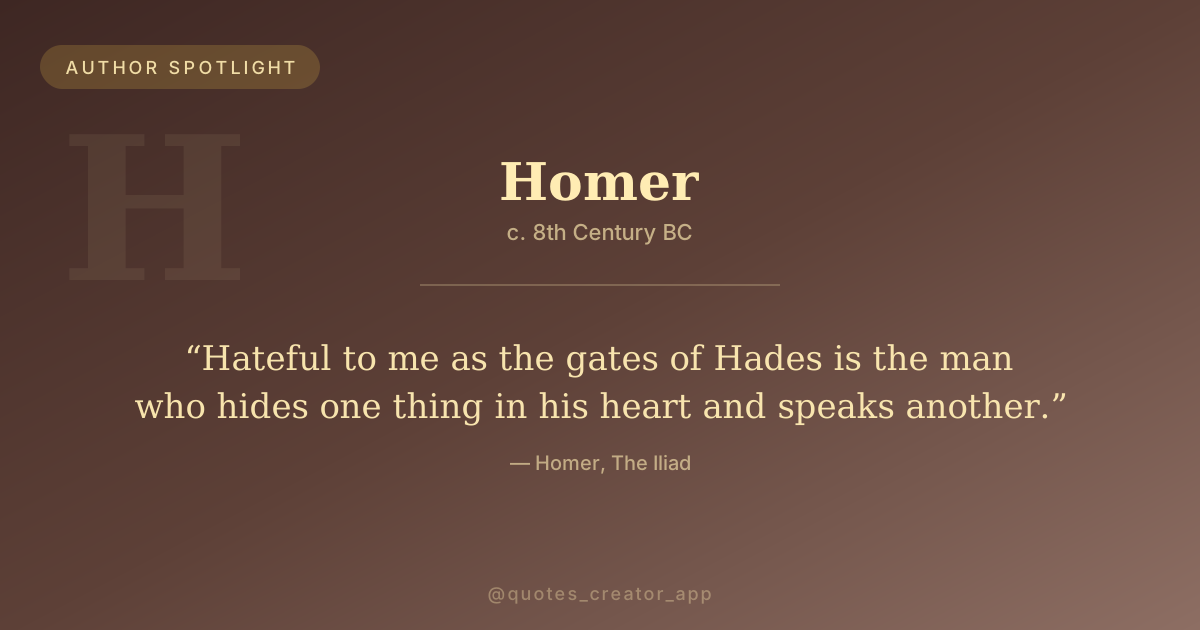
“Hateful to me as the gates of Hades is the man who hides one thing in his heart and speaks another.”
The meaning behind these words
Spoken by Achilles in the heat of his quarrel with Agamemnon’s embassy, this line articulates a moral principle that runs through both Homeric epics: the condemnation of duplicity. Achilles is the most fearsome warrior in the Greek army, but what he despises above all is not cowardice or weakness but dishonesty—the gap between inner conviction and outer speech. In a warrior culture that prized directness and transparency, the man who spoke one thing while thinking another was seen as fundamentally untrustworthy, a threat to the social bonds that held the community together. For Achilles, such a person is as hateful as death itself.
The line has resonated across millennia because it speaks to something universal. Every culture has wrestled with the tension between authenticity and diplomacy, between saying what one truly believes and saying what is socially expedient. Achilles’s position is extreme—he would rather have open hostility than concealed deceit—but it captures a longing for integrity that persists in every age. The comparison to “the gates of Hades” is especially striking: for the ancient Greeks, Hades was not merely death but a realm of shadows, a diminished existence. To equate dishonesty with that kind of half-life suggests that duplicity is itself a form of spiritual death, a negation of what makes life worth living.
“As is the generation of leaves, so is that of humanity. The wind scatters the leaves on the ground, but the live timber burgeons with leaves again in the season of spring returning. So one generation of men will grow while another dies.”
The meaning behind these words
This passage, spoken by the Lycian warrior Glaucus to the Greek Diomedes when they meet on the battlefield, is one of the most celebrated similes in all of literature. Its power lies in its double vision: it is at once deeply melancholic and strangely comforting. The comparison of human lives to leaves is devastating in its brevity—we are as fragile, as seasonal, as easily scattered by forces beyond our control. The wind that sweeps the leaves away is death, war, time itself, and no human effort can resist it. And yet the image does not end in despair. The “live timber” remains; new leaves return with spring. The individual passes, but life continues.
For Glaucus and Diomedes, who have just discovered that their grandfathers were guest-friends and are about to exchange armor rather than fight, the simile provides a philosophical frame for their encounter. It places their personal drama within the larger rhythm of nature, reminding them—and us—that the cycles of enmity and friendship, war and peace, are themselves as natural as the seasons. Alexander Pope’s translation captures the full emotional range: “Like leaves on trees the race of man is found, / Now green in youth, now withering on the ground.” The line has been borrowed and adapted by poets from Virgil to Simonides to modern writers, and its enduring appeal lies in its ability to acknowledge human mortality without yielding to nihilism. We are leaves, yes—but we are leaves on a tree that keeps growing.
“Even his griefs are a joy long after to one that remembers all that he wrought and endured.”
The meaning behind these words
This deeply human insight appears in a quiet moment of The Odyssey, spoken by the swineherd Eumaeus as he reflects on the long-absent Odysseus. It captures a psychological truth that Homer understood with uncanny precision: that suffering, once survived and integrated into the story of a life, can become a source of meaning rather than mere pain. The key word is “remembers.” Grief and hardship, viewed from within, are simply agony. But recollected from a distance—woven into the narrative of what someone “wrought and endured”—they become part of a larger whole, the raw material of identity and wisdom.
The line illuminates why the Odyssey itself is structured as a series of nested recollections. Odysseus’s most harrowing adventures—the Cyclops, Circe, the descent into the underworld—are told not as they happen but as memories he recounts to the Phaeacians. By the time we hear them, they have already been transformed from trauma into story, from suffering into significance. Homer seems to be suggesting that this is the fundamental human work: to convert the chaos of experience into a coherent narrative, to make meaning out of what we have endured. The “joy” Eumaeus describes is not pleasure in the ordinary sense; it is the satisfaction of seeing one’s life as a completed form, in which even the darkest chapters have their place. This is the consolation that art offers life—and Homer, as the first great artist of the Western tradition, understood it from the beginning.
“Be both a speaker of words and a doer of deeds.”
The meaning behind these words
This compact line, spoken by Phoenix as he attempts to persuade Achilles to rejoin the battle, distills the Greek ideal of the complete man. Phoenix was Achilles’s tutor, and he reminds his former pupil of the education he received: training not only in martial prowess but also in rhetoric and counsel. In the Homeric world, the hero is not merely the strongest fighter on the field; he must also be the most persuasive speaker in the assembly. The two capacities—speech and action—are not separate domains but twin expressions of excellence, and the truly great man masters both.
The ideal articulated here shaped Greek education for centuries. The concept of paideia—the comprehensive cultural education of the citizen—was built on the foundations Homer laid, combining physical training with instruction in poetry, music, and rhetoric. It influenced the Roman ideal of the orator-statesman, the Renaissance conception of the uomo universale, and the modern liberal arts tradition. But the line’s force is not merely historical; it is a practical challenge to anyone who would separate thought from action, words from deeds. Phoenix is telling Achilles—and every reader since—that eloquence without courage is hollow and that strength without wisdom is dangerous. The two must grow together, each tempering and completing the other. In a world that increasingly rewards specialization, Homer’s insistence on wholeness remains a quiet rebuke and a timeless aspiration.
Homer’s legacy
It is difficult to overstate Homer’s influence on Western civilization. The Iliad and the Odyssey are not merely the oldest works of European literature; they are the template upon which virtually all subsequent narrative art was built. Virgil’s Aeneid is a conscious fusion of both Homeric epics, designed to give Rome a founding myth equal to those of Greece. Dante places Homer in Limbo as “poet sovereign,” the king of all poets, even though Dante could not read Greek and knew Homer only through reputation. Shakespeare drew on Homeric archetypes throughout his plays; James Joyce structured Ulysses as a modern-day Odyssey; Derek Walcott’s Omeros transposed the Homeric world to the Caribbean. The list of writers, artists, and composers who have wrestled with Homer’s legacy includes virtually every major figure in the Western tradition.
But Homer’s deepest legacy may be something less obvious than literary influence: the idea that human life is a story worth telling. Before Homer, there were undoubtedly myths, legends, and songs. But the Iliad and the Odyssey were the first works to take individual human experience—the rage of a slighted warrior, the longing of a lost traveler to return home—and elevate it to the scale of cosmic drama. They insisted that the interior life of mortals mattered, that our griefs and joys were worthy of the gods’ attention, that the struggle to live with honor and return to what we love was not merely personal but universal. Every novel, every film, every story that treats ordinary human experience as the stuff of art owes something to the blind bard of Ionia who first showed what narrative could do. Nearly three thousand years later, we are still telling Homer’s story—and, in doing so, telling our own.
Create graphics with Homer’s quotes
Homer’s words carry a gravity and wisdom that have endured for nearly three millennia. Whether you’re looking for daily inspiration, creating a vision board, or sharing timeless insights on social media, Quotes Creator helps you transform these ancient lines into beautiful, shareable designs with custom fonts, gradients, and layouts.
Why we chose Homer
Homer is trending worldwide as Christopher Nolan’s The Odyssey (2026) dominates the cultural conversation, reintroducing the ancient poet to a massive global audience. The spike in Wikipedia pageviews reflects a rare moment when a figure from the 8th century BC becomes part of contemporary popular discourse. But Homer’s relevance extends far beyond a film adaptation. His poetry grapples with questions that define the human condition—mortality, honor, homecoming, integrity—and his lines remain among the most quoted in history. In an era of fleeting digital communication, Homer’s words remind us of the power of language that was made to be spoken aloud, to be remembered, to endure.
— ThinkPeak Studio Editorial Team
Create your own quote graphic with this quote
Turn this line into a shareable graphic in seconds — free, no signup needed. For video quotes and 100+ templates, try the Android app.
Advertisement
Enjoyed this article? Get more like it in your inbox.