On this page
Author Spotlight: J. Robert Oppenheimer
He was a boy who read Sanskrit and collected minerals on Riverside Drive, a young man who confessed he needed physics more than friends, and the director of the most consequential scientific undertaking in human history. J. Robert Oppenheimer gave the world the atomic bomb — and then gave the world the language with which to mourn it. When the first nuclear weapon detonated in the Jornada del Muerto desert on the morning of July 16, 1945, a test his own men had named Trinity, the man who had built it reached not for a technical phrase but for a sacred one, a line he had translated himself from the Bhagavad Gita: “Now I am become Death, the destroyer of worlds.” That sentence — archaic, reverent, terrified and triumphant all at once — is the key to the man. He was a physicist of the rarest brilliance and a humanist of the deepest unease, a genius who became the walking conscience of science, and a patriot who was, in 1954, stripped of his security clearance in a proceeding one observer called a “dry crucifixion.” This is the story of the man who changed the world, and who then spent the rest of his life trying to understand, and to warn against, what he had done.
Who is J. Robert Oppenheimer?
Julius Robert Oppenheimer was born on 22 April 1904 in New York City, into a family that had arrived at the American dream a single generation before he did. His father, Julius Seligmann Oppenheimer, had come to the United States from Hanau, Germany, in 1888 as a penniless teenager without money, higher education, or English, and had risen within a decade to become a wealthy textile importer. His mother, Ella, née Friedman, was a painter. The Oppenheimers were non-observant Jews who collected art — there were Picassos and Van Goghs on the walls of their apartment on Riverside Drive near West 88th Street — and who sent their precocious, solitary son to the Ethical Culture School, an institution founded on the motto “Deed before Creed” that prized independent thought above doctrine. The boy was a phenomenon: he read widely in English and French literature, collected minerals with a collector’s passion, and skipped grades as a matter of routine. A bout of colitis contracted while prospecting in Czechoslovakia delayed his entry to college by a year, a year he spent recovering in New Mexico, where he fell in love with the desert and the horseback riding that would stay with him all his life. He entered Harvard in 1922 at eighteen, took six courses a term instead of four, and graduated summa cum laude in 1925 after only three years — having been steered away from chemistry and toward physics by a single course in thermodynamics taught by Percy Bridgman.
What followed was the making of a physicist, and it was not a smooth one. At Cambridge, where he had gone to work under Ernest Rutherford and J. J. Thomson, Oppenheimer was miserable — a theoretical mind trapped in a laboratory where his clumsiness was exposed. “The lab work is a terrible bore,” he wrote to a friend, “and I am so bad at it that it is impossible to feel that I am learning anything.” He quarreled with his tutor, the future Nobel laureate Patrick Blackett, and fell into a depression so severe that, by his own later accounts, he once left a poisoned apple on Blackett’s desk — a story his grandson has since called unsubstantiated, but one that speaks to the turbulence of those years. He was a tall, thin chain smoker who neglected to eat for days during periods of intense concentration, and who told his brother Frank, with disarming honesty, “I need physics more than friends.” Salvation arrived in 1926 when he moved to Göttingen to study under Max Born, then the center of the theoretical universe. There he found his element: he published more than a dozen papers, co-authored the Born–Oppenheimer approximation that remains his most cited work, befriended Heisenberg, Pauli, Dirac, and Fermi, and earned his doctorate in 1927 at twenty-three. After his oral examination, the professor administering it reportedly sighed, “I’m glad that’s over. He was on the point of questioning me.”
He came home to California and built the finest school of theoretical physics in America. Joining Berkeley in 1929 — he became a full professor in 1936, splitting his time with Caltech — Oppenheimer attracted a generation of students who would go on to reshape the field, and in the 1930s he made contributions to quantum mechanics, quantum electrodynamics, cosmic ray showers, and the theory of neutron stars and black holes that still bear his name in textbooks. It was in these years, too, that he became something more than a scientist. He studied Sanskrit under Arthur Ryder, learning to read the Bhagavad Gita in the original and calling it “the most beautiful philosophical song existing in any known tongue.” He read poetry, wrote verse of his own, and threw himself into the left-wing politics of the Depression era — the Spanish Civil War, the unions, the causes of his many Communist friends and lovers — associations that were unremarkable in Berkeley in 1936 and would, two decades later, be used to destroy him. Then the war came. In 1942 he was recruited to the Manhattan Project, and in 1943, at thirty-nine, he was placed in charge of Los Alamos, a secret laboratory on a mesa in New Mexico where he would direct the most brilliant collection of scientists ever assembled toward a single, terrible goal. On 16 July 1945, at 5:29 in the morning, the Trinity test succeeded — and the world crossed a threshold from which it has never returned. Three weeks later, the bombs fell on Hiroshima and Nagasaki.
The second half of his life was a long reckoning with the first. Made famous overnight as the “father of the atomic bomb,” Oppenheimer became the most prominent scientific voice in America — and its most uneasy one. He lobbied for international control of atomic energy, warned that “the people of this world must unite or they will perish,” and opposed the development of the hydrogen bomb partly on ethical grounds, a stand that made him powerful enemies, chief among them the Atomic Energy Commission chairman Lewis Strauss. In 1947 he became director of the Institute for Advanced Study in Princeton, a post he held until 1966. And then, in 1954, his enemies closed in: a security hearing dredged up his pre-war left-wing associations and stripped him of his security clearance, publicly humiliating the man who had done more than anyone to win the war. He never fully recovered, though he continued to lecture, write, and work in physics until his death from throat cancer on 18 February 1967, in Princeton, at sixty-two. In 1963, in a gesture of partial rehabilitation, President Lyndon B. Johnson had presented him with the Enrico Fermi Award. The 1954 decision itself was not formally vacated until 2022, more than half a century after his death — a final, belated acknowledgment that the man who was once called a security risk had been, all along, what his friend Isidor Rabi insisted he was: “a real patriot.”
J. Robert Oppenheimer’s most memorable quotes
“I can’t think that it would be terrible of me to say — and it is occasionally true — that I need physics more than friends.”
The meaning behind these words
This is the young Oppenheimer, and it is the most honest thing he ever said about himself. Written to his younger brother Frank in the autumn of 1929, when Robert was twenty-five and already one of the most promising theoretical physicists of his generation, the sentence is a confession wrapped in an apology — the hedge “I can’t think that it would be terrible of me to say” doing the work of a man who knows how the remark will land, and the quieter “it is occasionally true” doing the work of a man who knows it is truer than he wants to admit. He is not boasting about his intellect. He is diagnosing his own loneliness. The friendships of ordinary life — the ease, the warmth, the give-and-take — were hard for him, and physics was where he went when they failed. It was a refuge that never disappointed, a companion that never demanded anything back.
The sentence reads differently with the whole of his life behind it, and that is what gives it its tragic weight. The man who needed physics more than friends would, sixteen years later, find himself needing friends more than physics — and would discover that the friends of his Berkeley years, the Communists and fellow travelers he had loved and drifted toward, had become the very instruments of his destruction. The isolation he had chosen in 1929 became the isolation imposed on him in 1954, when the hearing closed around him and much of the scientific establishment stood silent or turned away. And yet the line is also the key to his greatness. The same total absorption that made intimacy hard is what made Los Alamos possible — the capacity to pour every hour of himself into a problem until it yielded. Genius, the sentence quietly suggests, is not always a gift. Sometimes it is a necessity, and sometimes it is a kind of loneliness that no number of colleagues can fill.
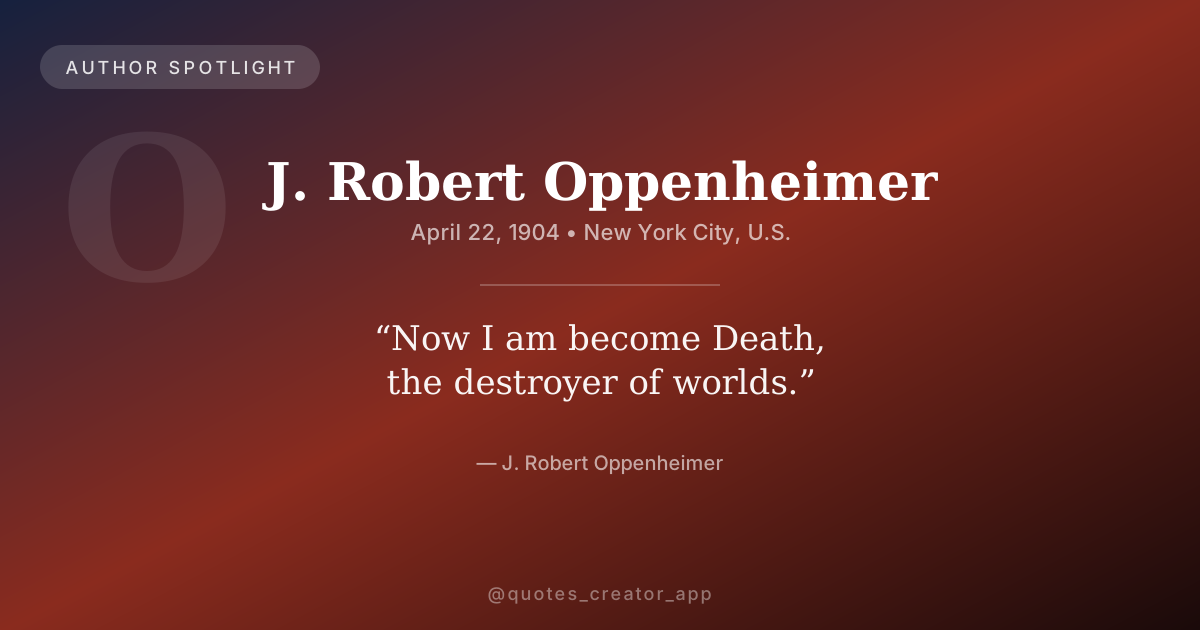
“Now I am become Death, the destroyer of worlds.”
The meaning behind these words
This is the most famous sentence of the atomic age, and it is nearly always misunderstood. Oppenheimer, the man who had taught himself Sanskrit under Arthur Ryder and read the Bhagavad Gita in the original, did not reach for a formula when the Trinity fireball rose over the New Mexico desert at 5:29 on the morning of 16 July 1945. He reached for a sacred text. The line is his own translation of a verse from the eleventh chapter of the Gita, in which the god Krishna reveals his cosmic form to the warrior Arjuna and declares himself time, the destroyer of worlds. The archaic grammar — “I am become” rather than “I have become” — echoes the King James Bible and lends the sentence a liturgical gravity. And in choosing it, Oppenheimer was making a precise and terrible point: the men who built the bomb had not simply invented a weapon. They had become instruments of a force they could neither control nor undo.
What makes the sentence endure is its perfect ambiguity, the way it holds triumph and lament in a single breath. Oppenheimer himself never resolved what he felt in that moment — whether the words were a boast, a prayer, or a confession. His brother later recalled a simpler exclamation — “It worked” — but the phrase Oppenheimer chose for posterity was this one, and he returned to it, in interviews and in memory, for the rest of his life. It has become the epitaph of the twentieth century, the shorthand for the instant humanity acquired the power to destroy itself. But read closely, it is not the declaration of a conqueror. It is the voice of a man recognizing, with a scholar’s precision and a believer’s dread, that he has become the thing the scripture warned about. The destroyer of worlds was, in the end, a thin man in a porkpie hat, chain-smoking in the dark, quoting a two-thousand-year-old poem as the sky caught fire.
“We knew the world would not be the same. A few people laughed, a few people cried. Most people were silent.”
The meaning behind these words
Here is the witness, twenty years on, telling us what the world felt like at the exact instant it changed — and the genius of the sentence lies in what it does not say. Oppenheimer does not tell us what he felt. He does not describe the flash, the heat, the sound that rolled across the desert minutes after the light. He describes the people: a few who laughed, a few who cried, and most who were silent. The word that carries the sentence is “silent.” These were some of the most brilliant minds on earth, scientists who had worked for years in obsessive secrecy toward a goal most of them barely dared to name, and when it happened they had no language for it. Laughter and tears are reactions; silence is not a reaction at all, and that is precisely why Oppenheimer chose it. He understood that some events outrun speech, that the most honest response to the unthinkable is, very often, to say nothing.
The structure of the sentence — laughed, cried, silent — is itself a small masterpiece of restraint, a list that ends not with a climax but with an absence, which is its own kind of profundity. It is the quiet of people standing on the far side of a threshold from which there is no return, and it has become one of the most cited descriptions of Trinity precisely because it refuses to moralize. Oppenheimer does not judge the ones who laughed or the ones who wept; he simply reports, with a witness’s exactness, the sound of the world ending and no one knowing what to say. And read in the light of his own later life, the sentence is quietly autobiographical. Oppenheimer belonged, unmistakably, to the third group — the silent ones — the men who understood the scale of the thing too completely to laugh or to cry, and who carried that silence, heavy and permanent, for the rest of their days.
“In some sort of crude sense which no vulgarity, no humor, no overstatement can quite extinguish, the physicists have known sin; and this is a knowledge which they cannot lose.”
The meaning behind these words
This is Oppenheimer’s moral philosophy distilled into a single, meticulously constructed sentence — and it may be the most careful sentence he ever built. Watch how it hedges before it strikes. “In some sort of crude sense,” he begins, a philosopher’s qualifier that narrows the claim even as it makes it, and then he chooses the word he has been circling: sin. Not guilt, not regret, not error — sin. He wanted the full theological weight of it, the sense of a thing done that cannot be undone, a knowledge that is also a stain. The physicists who built the atomic bomb, he was saying, had crossed a line that was not merely political or military but spiritual. They had learned something about the world, and about themselves, that changed them permanently. And no amount of vulgarity, humor, or overstatement — no retreat into cynicism or bravado — could wash it away.
The second half of the sentence is what turns it from a confession into a tragedy: “and this is a knowledge which they cannot lose.” This is not the kind of sin that can be confessed and absolved. It is permanent, carried forever, a burden that cannot be set down and a knowing that cannot be unlearned. For Oppenheimer this was not abstraction. He had been the scientific director of Los Alamos; he had watched the weapon he helped create be used on two cities, and he spent the years after the war trying, in speeches and committee rooms and private agonies, to contain what he had helped unleash. His opposition to the hydrogen bomb, his insistence on international control, his visible unease at the helm of the very establishment that had made him — all of it flowed from the conviction stated here. This is the rarest thing in science: a great scientist using the language of religion to describe the conscience of his own profession, and meaning every syllable of it.
“There must be no barriers to freedom of inquiry… There is no place for dogma in science. The scientist is free, and must be free to ask any question, to doubt any assertion, to seek for any evidence, to correct any errors.”
The meaning behind these words
After the sin comes the sermon, and this is Oppenheimer’s creed of the open society — the principle he believed made science possible, and which he believed science, in turn, was obligated to protect. The sentence is a declaration of intellectual freedom in its purest form: no barriers, no dogma, no question forbidden, no assertion beyond doubt, no error beyond correction. He delivered it in 1949, at the very moment the Cold War was beginning to close around American science, when loyalty oaths and security clearances were already casting their shadow over the laboratories. The timing is the point. Oppenheimer was arguing, in effect, for the very openness that would, five years later, be denied to him — for the right to ask any question and doubt any assertion at a time when the wrong question, or the wrong association, could end a career.
The deeper power of the quote lies in its unstated parallel between science and democracy. Oppenheimer was drawing a line between the method of the laboratory — free inquiry, open correction of error — and the method of a free society, which rests on the same faith that truth is best served by openness and that error is best cured by light. His own security hearing in 1954 was, in this sense, the refutation of everything he believed: a closed proceeding, conducted in a secret world, in which a man was judged not on his science but on his associations, and in which doubt itself was treated as disloyalty. The quote endures for two reasons, then. It names, with luminous clarity, the condition of all honest thought — doubt, question, seek, correct. And it stands as a reminder of what Oppenheimer himself lost when that condition was taken from him, and of why the freedom he defended is worth more than the men who would curtail it.
J. Robert Oppenheimer’s legacy
The measurable legacy is vast and, by any honest accounting, world-historical. Oppenheimer is remembered as the “father of the atomic bomb,” the scientific director who led the Manhattan Project’s Los Alamos Laboratory and oversaw the creation of the first nuclear weapons — the largest and most consequential scientific undertaking in history, a feat that compressed the work of decades into three years and ended the Second World War. But the bomb, for all its size in the popular memory, was only one achievement in a career of extraordinary scientific breadth. His name survives in the Born–Oppenheimer approximation, the Oppenheimer–Phillips process, the Tolman–Oppenheimer–Volkoff limit for neutron stars, and the Oppenheimer–Snyder model of gravitational collapse — the latter a paper, written with his student Hartland Snyder in 1939, that first described in rigorous terms what we now call black holes, and which he himself, absorbed by the coming war, never followed up. He was awarded the Enrico Fermi Award in 1963, and in December 2022 the United States government formally vacated the 1954 decision that had stripped him of his security clearance, declaring the process that ruined him to have been flawed. The record, in the end, was corrected.
The deeper legacy is moral, and it is the one that matters most. Oppenheimer became, in the years after Hiroshima, the conscience of the nuclear age — the scientist who built the bomb and then spent the rest of his life warning the world about it. He lobbied for international control of atomic energy, opposed the hydrogen bomb, and spoke, with a gravity that no one else could command, about what the physicists had come to know. “The people of this world must unite or they will perish,” he said, accepting an award in 1945, and the sentence has not aged so much as it has sharpened. His 1954 security hearing — the “dry crucifixion,” as one observer called it — transformed him into a symbol of something larger than himself: the price that a free society can exact from the very people who serve it best, and the ease with which fear can dress itself up as prudence. The image of the man who built the weapon and then warned against it is, in the end, the central parable of the modern age — the story of knowledge and power, of genius and conscience, of what it means to be responsible for something that can never be undone.
And there is, finally, the legacy of his words, which have outlived his science. “Now I am become Death, the destroyer of worlds” is among the most quoted sentences of the twentieth century — a line from a Hindu scripture, translated by an American physicist, spoken in a New Mexico desert, that has become the shorthand for the dawn of the atomic age and all the dread that came with it. He left behind a rare and contradictory figure: a boy who read Sanskrit and collected minerals, a chain-smoking polymath who wrote poetry and loved the desert, a genius who was also a haunted man, and a patriot whose country, for a time, mistook his conscience for a threat. We are, as the actor Cillian Murphy said in accepting an Oscar for playing him, “all living in Oppenheimer’s world” — a world of terrifying power and permanent unease, in which the questions he asked in 1945 have still not been answered. He gave us the bomb, and he gave us the words with which to fear it. Both gifts endure.
Create graphics with J. Robert Oppenheimer’s quotes
Oppenheimer’s words carry the same weight as his science — precise, haunted, and built to last. Whether you need a line about knowledge and responsibility, about the freedom of inquiry, or about the silence that follows the unthinkable, Quotes Creator helps you turn these quotes into beautiful, shareable designs with custom fonts, gradients, and layouts.
Why we chose J. Robert Oppenheimer
J. Robert Oppenheimer enters this spotlight at a moment when his name is once again among the most-viewed pages on Wikipedia — tens of thousands of readers a day returning to the life of the father of the atomic bomb, a figure whose story has never really left the culture’s imagination. The spike is not hard to explain. We live in his world, as the saying goes, and every fresh turn of the news cycle — every new argument about nuclear weapons, about the ethics of science, about the responsibilities of those who build what the rest of us must live with — sends readers back to the thin, elegant, haunted man who first taught us to fear what knowledge can do. He has never appeared in this series before, and there is no figure in the modern canon more deserving of a proper look.
The five quotes we have selected trace the spine of his life. They begin with the lonely young man who confessed he needed physics more than friends. They move through the desert morning when he quoted the Bhagavad Gita and became, in his own words, death; through the unforgettable memory of the men who laughed, wept, and fell silent; through the philosopher who insisted that physicists have known sin; and finally to the defender of free inquiry who would lose his own freedom to it. These are not the maxims of a man who conquered the world. They are the honest, anguished, luminous reflections of a man who changed it and then could not stop thinking about what he had done — and that, in the end, is a rarer and more valuable legacy than the bomb itself. The father of the atomic bomb was also its conscience. The world is still listening.
— ThinkPeak Studio Editorial Team
Create your own quote graphic with this quote
Turn this line into a shareable graphic in seconds — free, no signup needed. For video quotes and 100+ templates, try the Android app.
Advertisement
Enjoyed this article? Get more like it in your inbox.