On this page
Author Spotlight: James Baldwin
From the Pentecostal pulpits of Harlem, where he preached as a teenager, to the expatriate cafes of Paris, where he wrote his first novel on borrowed francs, to the televised debates where he dismantled a conservative intellectual before a stunned national audience — the life and words of a man who looked at America’s deepest wounds and insisted, against all evidence, that love was the only credible answer.
Who is James Baldwin?
James Arthur Baldwin was born on 2 August 1924 at Harlem Hospital in New York City, the first child of Emma Berdis Jones, a young woman who had fled the racial violence of Deal Island, Maryland, as part of the Great Migration. He never knew his biological father. When James was three his mother married David Baldwin, a labourer and storefront Baptist preacher from New Orleans whose mother had been born into slavery — a detail that collapsed the distance between the nineteenth century and the child’s life with a concussive intimacy. David Baldwin was a man corroded by fury. He was suspicious of white people, suspicious of James’s books, suspicious of anything that pulled the boy away from the narrow salvation he preached. The household on 128th Street swelled with eight younger half-siblings, poverty was constant, and the atmosphere was charged with the stepfather’s paranoia and the mother’s quiet endurance. To be young, Black, and brilliant in that house was to be a provocation. Baldwin coped the way he would cope for the rest of his life: he read. By fifth grade, not yet a teenager, he had consumed Dostoevsky, Dickens, and Stowe. He wrote a song that earned a letter of praise from Mayor Fiorello La Guardia. A short story won a church newspaper prize. At Frederick Douglass Junior High, he was taken under the wing of the Harlem Renaissance poet Countee Cullen, who taught French and planted in the boy a dream of Paris. At De Witt Clinton High School in the Bronx, he edited the literary magazine alongside a young Richard Avedon. His yearbook ambition read “novelist-playwright.” His motto: “Fame is the spur and — ouch!”
Between fourteen and seventeen, Baldwin was a preacher. He had joined the Pentecostal church on Lenox Avenue at a moment of adolescent crisis — the dawning of his attraction to men, the suffocating weight of his stepfather’s expectations, the need to find a voice that could command a room. At Fireside Pentecostal Assembly, “Brother Baldwin” learned what it meant to hold a crowd. He was good at it, terrifyingly good — the rhythm, the crescendo, the authority. But the church, he later wrote, was “a mask for self-hatred and despair.” Salvation stopped at the church door. By 1941 he had left the pulpit, traded the Bible for the typewriter, and begun the long, uncertain work of becoming a writer. He took track-laying jobs in New Jersey, where white coworkers from the South mocked his “uppity” manner. He was refused service at restaurants. In one episode he would immortalise in “Notes of a Native Son,” he hurled a water mug at a waitress who told him Black people were not served — and ran. That same night, back in Harlem, the 1943 race riots erupted. His stepfather died of tuberculosis on 29 July 1943, the same day his mother gave birth to her last child. The funeral was held on Baldwin’s nineteenth birthday. The essay he would later write about these converging catastrophes — the dead father, the burning city, the exploding rage — became one of the essential documents of American literature.
In 1948, twenty-four years old and carrying forty dollars and a Rosenwald Fellowship, Baldwin boarded a plane for Paris. He would say later that he left because he was “afraid of what I might do” if he stayed — that the accumulation of American humiliations had pushed him to a breaking point, and that he needed distance not only from his country but from the version of himself that his country had manufactured. Paris gave him the space to write what became Go Tell It on the Mountain (1953), a semi-autobiographical novel about a boy growing up in a Harlem storefront church — a book Time would later rank among the hundred greatest English-language novels. Notes of a Native Son (1955) followed, a collection of essays that established him as the most penetrating moral analyst of American race relations since Frederick Douglass. Then came Giovanni’s Room (1956), a novel about a doomed love affair between two men in Paris — radical in its time for its refusal to make race the subject, for its insistence that a Black writer could write about white characters, about love, about interiority, without apology. The British publisher initially rejected it, suggesting Baldwin burn the manuscript. He published it anyway. It became a cornerstone of gay literature.
The 1960s made Baldwin a public figure on a scale few writers ever achieve. The Fire Next Time (1963), a book-length essay written as a letter to his nephew and a warning to the nation, sold over a million copies and put Baldwin on the cover of Time. He marched alongside Martin Luther King Jr. and Malcolm X — with whom he had a complicated kinship of mutual respect and theological divergence. He met with Robert Kennedy, with whom he grew disillusioned, and with Medgar Evers, who was murdered days later. In 1965, at the Cambridge Union, he debated the conservative intellectual William F. Buckley on the motion: “The American Dream is at the expense of the American Negro.” The audience of seven hundred predominantly white Cambridge students voted 544 to 184 in Baldwin’s favour. The transcript and footage remain, decades later, a masterclass in moral reasoning — the oratorical child preacher fused with the essayist’s precision, speaking not from notes but from the accumulated weight of a life lived inside what he called “the lie” of American innocence. Buckley never lived that night down. Baldwin never stopped working. He wrote novels, plays, screenplays, a stunning book-length essay on the Atlanta child murders. He taught at universities. He spoke into microphones wherever they were placed. In 1970 he settled in Saint-Paul-de-Vence, a medieval village in the south of France, where he would host a rolling salon of artists, activists, and strangers, and where he died of stomach cancer on 1 December 1987, at sixty-three. At his funeral at the Cathedral of St. John the Divine in New York, Toni Morrison, Maya Angelou, and Amiri Baraka spoke. The choir sang “Leaning on the Everlasting Arms.”
James Baldwin’s most memorable quotes
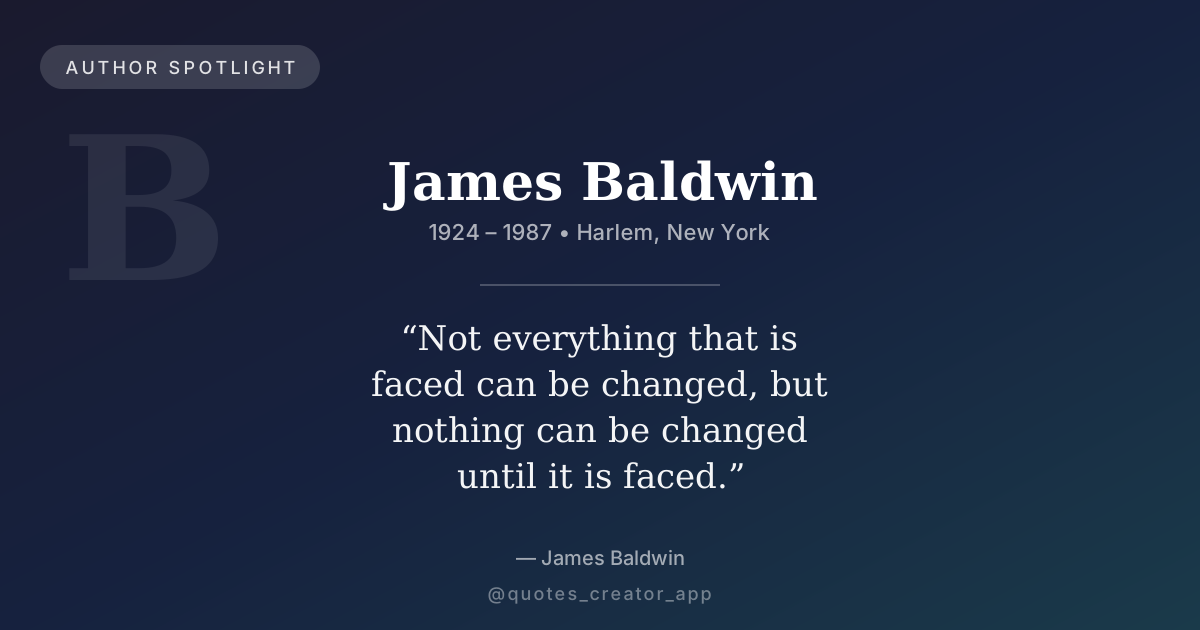
“Not everything that is faced can be changed, but nothing can be changed until it is faced.”
The meaning behind these words
This single sentence performs the work of an entire philosophical treatise. It does something that very few aphorisms manage: it is hopeful and sober in equal measure, and it earns both. The first clause — “not everything that is faced can be changed” — is an admission of limits, a quiet acknowledgment that courage is not omnipotence, that some wrongs are too deep, too structural, too old to be undone by a single act of reckoning. Baldwin was not naive about the durability of racism, the stubbornness of institutions, or the slow pace of justice. He had buried friends. He had watched the civil rights movement claim martyrs and deliver incomplete victories. The first clause is the voice of a man who has no interest in lying to you about what is possible.
But the second clause — “nothing can be changed until it is faced” — is where the sentence becomes a moral imperative. The word “faced” is the operative term. Baldwin did not say “nothing can be changed until it is understood” or “analysed” or “studied.” He said “faced” — a word that implies confrontation, presence, discomfort, the willingness to look at something without flinching. This is the core of his intellectual project. America, he believed, had constructed an elaborate mythology of innocence to avoid facing the reality of what it had done and was still doing to Black people. The mythology was the problem. The refusal to face was the problem. Change was impossible not because the obstacles were insurmountable but because the country had not yet summoned the courage to look at itself without the comfort of a lie. This sentence, in fourteen words, captures Baldwin’s entire diagnostic method: truth is not an academic exercise. It is a confrontation. And there is no path to justice that bypasses it.
“I imagine one of the reasons people cling to their hates so stubbornly is because they sense, once hate is gone, they will be forced to deal with pain.”
The meaning behind these words
This is one of the most psychologically acute sentences ever written about hatred, and it comes from a man who had every reason to hate. Baldwin grew up in a household where his stepfather’s hatred of white people was a palpable force — a cosmology, really — and the young Baldwin understood early that hatred was not an emotion but a structure, a way of organising the world that protected the hater from something more unbearable. The insight is clinical. Hate, in this formulation, is a defence mechanism. It is a lid clamped down over a well of pain that the person cannot afford to open. To release the hate would be to release the grief underneath it — the grief of generations, of fathers lost, of dignity stolen, of a life lived under the constant assault of a society that tells you, in a thousand ways every day, that you do not belong. That grief is vast. Hate, by comparison, is manageable. It gives you an enemy. It gives you a shape. Pain is shapeless and bottomless and you cannot fight it with your fists.
But the sentence is not merely diagnostic; it is quietly, devastatingly compassionate. Baldwin is not excusing hatred. He is explaining it — and in explaining it, he opens a door that the hater had assumed was locked forever. The implication is that the person who hates is not a monster but a wounded person who has chosen a terrible medicine. And if hatred is a choice made in response to pain, then healing is possible — not through argument, not through shaming, but through the difficult work of acknowledging what the hatred has been protecting. This is what separates Baldwin from so many of his peers in the civil rights tradition. He did not believe in the redemption of the racist through moral superiority. He believed in the redemption of the racist through the truth — the truth that the hater’s own humanity is diminished by his hatred, and that the only way to recover it is to feel the pain he has been running from. This is a demanding kind of love. It asks something of the oppressed that no one should have to give. And yet Baldwin gave it anyway, because he believed, with a conviction that bordered on the theological, that the alternative was mutual destruction.
“You think your pain and your heartbreak are unprecedented in the history of the world, but then you read.”
The meaning behind these words
Here Baldwin delivers what might be the most succinct argument for literature ever composed. The sentence is constructed around a pivot — “but then you read” — that transforms the entire meaning of the first half in four words. Before the pivot, the reader is alone in a kind of narcissistic despair: the conviction that no one has ever suffered as I suffer, that my particular wound is singular and isolating. This is not a naive feeling. Solitude in pain is one of the most universal experiences a human being can have, and the paradox — that the feeling of being uniquely cursed is itself utterly common — is hard to grasp from the inside. Baldwin names the feeling with empathy, not condescension. He grants it. Yes, your pain feels unprecedented. That is a real and valid experience.
Then comes the pivot. The act of reading — not as escapism, not as self-improvement, not as the accumulation of cultural capital — but as the discovery that other human beings have felt what you feel, have recorded those feelings, and have left them there for you to find. This is literature as witness. It is a conception of books not as objects but as companions, not as lessons but as proof that you are not alone. For Baldwin, who read his way out of a crowded Harlem apartment and into a life of impossible scope, this was not an abstraction. It was autobiography. He discovered Dostoevsky and discovered that a Russian novelist who died decades before his birth understood something about the human soul that made his own struggles legible. The sentence is also a quiet rebuke to a culture that treats reading as an elite activity. Baldwin, who came from poverty, from a stepfather who saw books as a threat, from a school system that was not designed for him, is saying something radically democratic: the cure for the worst kind of loneliness is free. It is on a shelf. All you have to do is open it.
“Love does not begin and end the way we seem to think it does. Love is a battle, love is a war; love is a growing up.”
The meaning behind these words
Baldwin wrote about love with the same seriousness he brought to race and politics, and this sentence — from the title essay of his collected nonfiction — is his definitive statement on the subject. The opening clause dismantles the romantic fantasy that has governed Western storytelling for centuries: the idea that love arrives as a completed thing, a gift, a thunderbolt, and then fades by some equally mysterious alchemy. Baldwin calls this “the way we seem to think it does” — the “seem” doing a lot of work, suggesting that the culture has sold us a story and we have bought it without inspection. Love, in Baldwin’s alternative account, is not a state but a process. It is not a noun but a verb. It is not something you fall into but something you fight your way through.
The triplet that follows — “a battle, a war, a growing up” — escalates with deliberate precision. Battle is local, a skirmish, a single difficult conversation or a moment of forgiveness. War is structural, the long campaign of commitment across years, across disappointments, across the accumulated debris of two flawed people trying to build something together. Growing up is the deepest level: the recognition that to love another person is to be changed by them, to have your immaturities exposed and addressed, to become someone you could not have become alone. Baldwin, who was gay in an era when homosexuality was criminalised and pathologised, who loved women and men across boundaries of race and nationality, who never married but formed deep and lasting bonds, understood that love was not a refuge from the world’s difficulties but the arena in which those difficulties are most nakedly encountered. His insistence that love is a war is not cynicism. It is the opposite. It is the conviction that the thing is worth fighting for, that the fight itself is the proof of the love, and that the only love worth having is the love that makes you grow.
“The paradox of education is precisely this — that as one begins to become conscious one begins to examine the society in which he is being educated.”
The meaning behind these words
Baldwin delivered this line in a 1963 address to teachers, and it remains one of the most subversive things ever said about the purpose of schooling. The surface meaning is clear: real education is not the passive absorption of information but the awakening of critical consciousness, and critical consciousness, once awakened, will inevitably turn its gaze on the system that claims to be educating it. A student who has truly learned to think will begin to ask uncomfortable questions: Who wrote this textbook? Whose history is being taught? Why are the schools in my neighbourhood underfunded while schools across town are not? The paradox is that the institution of education is simultaneously the mechanism that produces this questioning and the structure most threatened by it. Every teacher, Baldwin implies, is training their own interrogator. Every school is incubating its own opposition. And this is not a failure of education. It is education’s highest purpose.
But the deeper resonance of this quote lies in Baldwin’s own biography. He was a product of the New York City public school system, and he credited specific teachers — Gertrude Ayer, the first Black principal in the city, and Orilla “Bill” Miller, a white teacher from the Midwest — with recognising his mind and refusing to let it atrophy. Miller took him to the theatre, bought him books, and, Baldwin later said, was one of the reasons he “never really managed to hate white people.” Education, in his experience, was not indoctrination. It was liberation. But it was liberation of a very specific kind: the kind that makes you unfit for a society built on lies. This is why Baldwin spoke to teachers with such urgency. He knew that a classroom could be a factory or a sanctuary, depending on the courage of the person standing at the front. The paradox of education is the paradox of Baldwin’s own life: to learn the truth is to become dangerous to the systems that depend on ignorance. And that, he believed, was exactly the point.
James Baldwin’s legacy
The decades since Baldwin’s death in 1987 have done something rare to his reputation: they have enlarged it. Baldwin was famous in his lifetime — Time cover famous, television famous, famous enough to be parodied, famous enough to be attacked by the FBI, which maintained a file on him that ran to 1,884 pages. But the scale of his posthumous influence is of a different order. The 2016 documentary I Am Not Your Negro, Raoul Peck’s adaptation of Baldwin’s unfinished manuscript Remember This House, was nominated for an Academy Award and won the BAFTA for Best Documentary, introducing his voice to a generation too young to have heard him speak. The 2018 film adaptation of his 1974 novel If Beale Street Could Talk, directed by Barry Jenkins, won an Academy Award for Regina King. In 2024, the centenary of his birth was marked by major exhibitions at the New York Public Library and the Smithsonian, new editions of his work, and an outpouring of tributes from writers, activists, and artists across the globe. In an era of renewed reckoning with systemic racism, of movements that bear the unmistakable imprint of his analysis — that racism is not an aberration but a foundation, that whiteness is a fiction maintained by violence, that the price of innocence is truth — Baldwin’s essays are read not as historical documents but as urgent journalism from the front.
But the deeper legacy cannot be measured in adaptations or anniversary commemorations. Baldwin changed what it was possible for a Black intellectual to be. Before him, the dominant model of the Black writer in America was defined by a certain kind of carefully managed respectability. Baldwin refused the role. He was openly gay in a homophobic culture, openly critical of the civil rights establishment’s compromises, openly sceptical of Christianity while retaining the cadences of the pulpit, openly angry without ever surrendering to nihilism. He insisted that he could write about race and sex and class and art all at once, because these things were not separate in his life and he saw no reason to separate them on the page. He modelled a kind of intellectual freedom that was not about transcending identity but about inhabiting it so fully, so honestly, that it became universal. This is why he is read alongside Orwell and Camus in university syllabi across the world. This is why his face appears on protest signs and his words are recited at rallies. This is why, when people ask what an engaged intellectual looks like — someone who speaks truth to power without sacrificing complexity, nuance, or beauty — the answer, more often than not, is James Baldwin. He once wrote: “The place in which I’ll fit will not exist until I make it.” He made it. And it is still there, waiting for anyone brave enough to enter.
Create graphics with James Baldwin’s quotes
James Baldwin’s words carry the rare combination of moral clarity and literary grace — they are equally suited to a protest mural and a quiet moment of reflection. Whether you are looking for inspiration to face difficult truths or want to share his vision of love and justice with others, Quotes Creator helps you turn these quotes into beautiful, shareable designs with custom fonts, colors, and layouts.
Why we chose James Baldwin
August 2026 falls in the immediate aftermath of Baldwin’s 102nd birthday — 2 August — a date that, like Baldwin himself, sits at the intersection of commemoration and reckoning. His centenary in 2024 brought renewed global attention to his work, with major museum exhibitions, new editions, and a sustained wave of public interest that has not receded. But we chose Baldwin for a deeper reason. In an age of algorithmic rage and performative outrage, of public discourse that often substitutes volume for precision and tribal loyalty for moral reasoning, Baldwin stands as a rebuke and a standard. He was angry — incandescently, righteously, justifiably angry — and yet that anger never corrupted his prose, never simplified his thought, never reduced the people he criticised to caricatures. He could stand on a stage in Cambridge and dismantle the most articulate defender of white supremacy in the English-speaking world, not with slogans but with sentences so carefully built that the audience felt the structure of the argument pressing against them like weather. He could write about his stepfather’s cruelty and his mother’s endurance, about the ecstasy and collapse of his religious faith, about the terror and liberation of his sexuality, about the wound of exile and the impossibility of return, and make all of it feel like the same story — because it was. The five quotes we selected trace the arc of that story: the demand that we face what we would rather avoid, the anatomy of hatred as a defence against grief, the discovery of solidarity through reading, the redefinition of love as a struggle that transforms, and the dangerous, liberating truth that education means learning to question the society that educates you. At his best, James Baldwin was not telling Americans what they wanted to hear. He was telling them what they needed to know. He still is.
— ThinkPeak Studio Editorial Team
Create your own quote graphic with this quote
Turn this line into a shareable graphic in seconds — free, no signup needed. For video quotes and 100+ templates, try the Android app.
Advertisement
Enjoyed this article? Get more like it in your inbox.