On this page
Author Spotlight: Jannik Sinner
World No. 1 tennis player, five-time Grand Slam champion, and one of the most philosophical athletes of his generation.
Who is Jannik Sinner?
Jannik Sinner was born on August 16, 2001, in Innichen, in the northern Italian province of South Tyrol, a German-speaking region nestled in the Dolomites. His father worked as a chef and his mother as a waitress at a ski lodge in the family hometown of Sexten. His native language is German, and he grew up in a household where hard work was not a concept to be explained but a rhythm to be lived. From the age of three, Sinner was on skis, and by seven he was already a national champion in giant slalom — one of Italy’s most promising junior skiers. Tennis, at that point, was only his third priority, behind skiing and football. But sport was never absent from his days: mornings on the slopes, afternoons on the football pitch for AFC Sexten, and the occasional tennis lesson squeezed in between. His parents never pushed him toward any single path. They simply let him choose — a gift Sinner would later describe as the single greatest thing they ever gave him.
At 13, the calculus shifted. Sinner was tall and reed-thin — just 35 kilograms — and in skiing, where explosive lower-body power separates champions from also-rans, his body was working against him. More than that, he had begun to understand something about himself: he preferred a sport where one mistake did not end the day. “In skiing, if you make one mistake you cannot win the race,” he would later explain. “In tennis you can make mistakes but still win the match.” He chose tennis and, with his parents’ support, moved alone at 13 to Bordighera on the Italian Riviera to train at the Piatti Tennis Center. He lived with the family of a coach, shared an apartment with two other boys, cooked his own meals, did his own laundry, and completed his high school diploma remotely. It was a childhood that demanded extraordinary self-reliance — and it forged in him the unflappable composure that would become his signature.
The ascent was meteoric but never rushed. At 17, he became the youngest Italian to win an ATP Challenger title. At 18, he won the Next Gen ATP Finals and was named ATP Newcomer of the Year. By 2021, he was the first man born in the 2000s to crack the top 10. But it was 2024 that changed everything. Sinner won his first Grand Slam at the Australian Open, coming back from two sets down against Daniil Medvedev in a final that announced his arrival not just as a champion but as a force of will. He followed it with the US Open title, the ATP Finals crown, and the year-end world No. 1 ranking — the first Italian ever to reach the summit. The accolades stacked up faster than anyone could have predicted: 30 ATP titles, five majors, ten Masters 1000s, two ATP Finals, and back-to-back Davis Cup triumphs leading Italy to its first titles in 47 years. Yet through it all, the defining image of Sinner remained unchanged: the red-haired kid from the mountains, impossibly calm, expression barely flickering between points, as if the chaos swirling around him were happening to someone else.
In 2025, he reached the final of all four Grand Slam tournaments in a single calendar year — a feat of consistency that placed him in rarefied historical company — and won both the Australian Open and his first Wimbledon title, defeating Carlos Alcaraz in a four-set classic on Centre Court. The 2026 season has been even more imperious: a second Wimbledon title, a record five consecutive ATP Masters 1000 crowns, and the completion of the Career Golden Masters at 24 years old, making him the youngest player ever to win all nine Masters tournaments. Outside tennis, he launched the Jannik Sinner Foundation to empower children through education and sport, was named a Time 100 Most Influential Person in Sports, and even had an asteroid designated in his name. He meets popes, records spoken-word features with Andrea Bocelli, and has inspired a national tennis boom in Italy that the media have dubbed simply “the Sinner Effect.” And still, when asked who he is, his answer remains disarmingly simple: “I’m just a simple tennis player, no?”
Jannik Sinner’s most memorable quotes
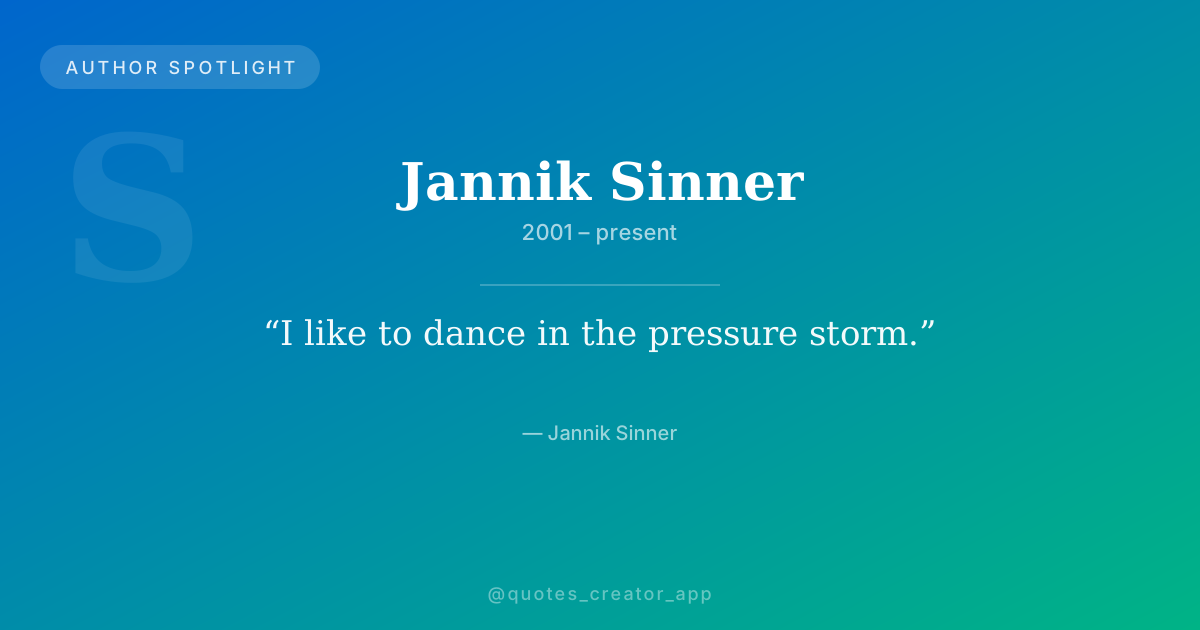
“I like to dance in the pressure storm.”
The meaning behind these words
In just eight words, Sinner captured the philosophy that underpins his entire approach to elite sport. The metaphor is deliberate and revealing. Pressure, for most athletes, is something to be endured — a storm to be weathered, a weight to be carried. But Sinner reframes it entirely. To “dance” in the storm is not to resist it but to move with it, to find rhythm within chaos, to treat the thing that undoes others as a source of energy rather than a source of fear. It is a perspective that speaks to why he can save three consecutive match points against Novak Djokovic and win; why he can come back from two sets down in a Grand Slam final and look, to the outside observer, utterly unbothered.
This quote also reveals something deeper about Sinner’s relationship to his own temperament. He has often been described as cold, robotic, even boring — a criticism he wears with a shrug. But “dancing in the pressure storm” is not about the absence of feeling. It is about channelling feeling into precision. It is the philosophy of an athlete who understands that the highest performance is not emotional detachment but emotional mastery — the ability to feel everything and still execute. For anyone in any field who has ever felt crushed by expectation, Sinner’s words offer a quiet, radical alternative: you do not have to overcome the pressure. You can learn to move with it.
“The reason why I chose tennis was, in tennis you can make mistakes. You can lose points but you can still win the match.”
The meaning behind these words
This is the sentence that explains why a national champion skier walked away from the sport he had dominated since childhood. In competitive skiing, a single error — a misjudged turn, a momentary loss of balance — can end your race entirely. There is no recovery, no second set, no chance to fight back. Tennis, by contrast, is a game of redemption built into its very structure. You can lose the first set, drop your serve, fall badly behind, and still walk off the court a winner. For a thirteen-year-old boy trying to understand why one sport felt suffocating and the other felt like freedom, this distinction was everything.
But the insight goes far beyond sport. What Sinner is describing is a worldview: a belief that life, like tennis, rewards resilience more than it rewards perfection. The people who succeed are not the ones who never make mistakes but the ones who refuse to let their mistakes define the outcome. This is not just a philosophy for athletes — it is a philosophy for anyone who has ever failed and wondered whether they should continue. Sinner’s genius was recognising, at an age when most of us are still figuring out who we are, that a game which allows for error is a game that allows for growth. And he chose the game that gave him room to become.
“I wish that everyone could have my parents because they always let me choose whatever I wanted to. They never put pressure on me even when I played other sports.”
The meaning behind these words
It is deeply telling that in the immediate aftermath of winning his first Grand Slam title — the crowning achievement of a young athlete’s life — Sinner’s thoughts turned not to his coaches, his training, or his own talent, but to his parents. Hanspeter and Siglinde Sinner were not pushy sports parents. They did not map out a career path for their son or pressure him to specialise early. When he wanted to ski, they supported him. When he wanted to play football, they supported him. When, at 13, he told them he wanted to leave home and move 500 kilometres away to pursue tennis, they supported him again. Their gift to him was not resources or connections — it was freedom. And that freedom, Sinner believes, is the foundation of everything he has achieved.
This quote also doubles as a quiet manifesto about how we raise children in an era of hyper-competitive youth sports. The pressure to specialise early, to train relentlessly, to win at all costs has become the default mode of modern parenting in athletics. Sinner’s story stands as a powerful counterexample. He played multiple sports until he was 13. He chose tennis himself, freely and consciously, after years of exploration. And he became world No. 1 anyway — perhaps because he chose it, not because it was chosen for him. His wish that everyone could have parents like his is not just gratitude; it is an invitation to rethink what support really looks like.
“You have to be kind with the pressure. You have to make friendship.”
The meaning behind these words
There is a striking gentleness to this formulation that sets it apart from the language of conventional sports psychology. Athletes are typically taught to “handle” pressure, to “manage” it, to “overcome” it — all verbs that position pressure as an adversary. Sinner does something different. He personifies pressure and offers it kindness. To “make friendship” with the force that destroys so many careers is not a strategy of denial or suppression; it is a strategy of integration. You stop fighting the thing you cannot eliminate and you learn, instead, to coexist with it.
This approach explains perhaps the central mystery of Sinner’s career: how a 24-year-old from a small Alpine town can carry the weight of an entire nation’s expectations — the first Italian world No. 1, the face of a tennis boom, the subject of wall-to-wall media coverage in one of the world’s most passionate sporting cultures — and still look, on court, like he is playing a practice match. He is not pretending the pressure does not exist. He is not armouring himself against it. He has simply decided to be kind to it — and in doing so, to neutralise its power over him. It is a lesson that extends far beyond tennis, into any life where expectation threatens to overwhelm.
“I will control the controllable, which is giving 100 percent, having the right attitude, fighting for every ball. And then we see the outcome. I cannot do more than this. Doesn’t really matter who my opponent is.”
The meaning behind these words
This is Stoicism in a tennis kit. Sinner articulates here one of the most ancient and durable philosophical principles — the distinction between what is within our control and what is not — and applies it with surgical precision to the specific demands of elite competition. He cannot control the outcome of a match. He cannot control whether his opponent plays the best tennis of their life. He cannot control the crowd, the weather, the draw, or the billions of variables that separate victory from defeat. What he can control — and what he therefore commits to controlling with total discipline — is his own effort, his own attitude, his own willingness to fight for every single point.
The final clause is the one that lands heaviest: “Doesn’t really matter who my opponent is.” This is not arrogance. It is the logical endpoint of a philosophy that has fully internalised the limits of its own agency. When you accept that you cannot control your opponent, your opponent’s identity ceases to be relevant to your preparation. Djokovic, Alcaraz, Medvedev, or a qualifier ranked 200th — the approach remains exactly the same. It is a mindset that eliminates fear by eliminating the mental categories that fear feeds on. Sinner does not win because he wants it more than anyone else. He wins because he has built a mental framework so clean, so stripped of unnecessary anxiety, that there is almost nothing left to distract him from the task at hand.
Jannik Sinner’s legacy
Jannik Sinner’s legacy is already extraordinary, and he is only 24 years old. He is the first Italian to reach world No. 1 in the history of the ATP rankings and the youngest man ever to complete the Career Golden Masters — winning all nine ATP Masters 1000 tournaments — a feat achieved by only one other player since the series began in 1990. His five Grand Slam titles span three different surfaces and two continents. He has won the ATP Finals twice without losing a set, a record unmatched in the modern era. And he has done all of this not by following the blueprint of any previous champion but by forging an entirely new template: the Alpine kid with the skier’s balance, the chef’s son with a cook’s patience for incremental improvement, the polyglot introvert who became the most famous athlete in a country of 59 million people without ever raising his voice.
But trophies only tell part of the story. What may prove to be Sinner’s most enduring contribution is the “Sinner Effect” — the explosion of tennis participation and viewership in Italy that has followed his rise. Tennis clubs across the country report unprecedented waiting lists. His Davis Cup triumphs turned a sport that had long lingered in the shadow of Italian football into a national obsession. Through his foundation, he is investing in the next generation, ensuring that the doors opened by his success remain open for children who might never otherwise pick up a racket. And in an era of professional sport defined increasingly by noise — by hot takes, social media drama, and manufactured controversy — Sinner has modelled something quieter and, in its own way, more radical: that excellence does not require theatrics, that you can be the best in the world and still be a normal person, and that the most powerful response to pressure is not resistance but friendship. He is not just building a trophy cabinet. He is building an argument for a different way of being a champion.
Create graphics with Jannik Sinner’s quotes
Jannik Sinner’s words carry the same precision and poise as his backhand — universally relatable and quietly profound. Whether you are looking for motivation before a big moment, a reminder to stay calm under pressure, or a quote to share with someone who needs perspective, Quotes Creator helps you transform these words into beautiful, shareable designs with custom fonts, gradients, and layouts.
Why we chose Jannik Sinner
Jannik Sinner represents something increasingly rare in professional sport: an athlete whose public persona is not a performance but a reflection of something genuinely held. His quotes are not rehearsed clichés — they are windows into a mind that has been thinking seriously about pressure, failure, agency, and growth since he was a teenager making the biggest decision of his young life. Fresh off his second consecutive Wimbledon title and having just completed the Career Golden Masters in record time, Sinner is not only the best tennis player in the world — he is one of the most interesting. His words deserve to be read, shared, and reflected upon far beyond the baseline.
— ThinkPeak Studio Editorial Team
Create your own quote graphic with this quote
Turn this line into a shareable graphic in seconds — free, no signup needed. For video quotes and 100+ templates, try the Android app.
Advertisement
Enjoyed this article? Get more like it in your inbox.