On this page
Author Spotlight: Jared Leto
From a broken-down piano in a commune in Louisiana, where his mother taught him that art and life were the same thing, to the stage of the Dolby Theatre, where he accepted an Academy Award for inhabiting a transgender woman dying of AIDS with a ferocity that made the industry recalibrate what acting could be — Jared Leto has spent three decades refusing every category anyone has tried to place him in. Actor, musician, director, entrepreneur, climber of the Empire State Building at fifty-two: the through-line is not a single craft but a single conviction. The bridge between a dream and reality, he has always insisted, is work.
Who is Jared Leto?
Jared Joseph Leto was born on 26 December 1971 in Bossier City, Louisiana, to Constance Leto, a free-spirited woman of Cajun ancestry who joined the hippie movement and raised her sons amid a revolving cast of artists, photographers, musicians, and theatre-makers. His parents divorced when he was a child. His father, whom he barely knew, died by suicide when Jared was eight — a loss that would quietly shape the intensity with which he later poured himself into characters grappling with grief, absence, and reinvention. Constance moved the family constantly: Louisiana, Colorado, Wyoming, Virginia, Haiti. “Moving around a lot was a normal way of life,” Leto later said. The itinerancy gave him something he would spend his career trying to recreate: the ability to become someone new in every new place. He dropped out of school in the tenth grade but rallied, finishing at Emerson Preparatory School in Washington, D.C., before enrolling at the University of the Arts in Philadelphia to study painting. He then transferred to the School of Visual Arts in New York City, where he wrote and starred in his own short film, Crying Joy. In 1992, at twenty-one, he moved to Los Angeles with five hundred dollars and a backpack. He slept in a shelter. Nobody handed him anything.
The 1990s saw Leto build a career with unnerving speed and diversity. He landed a role on the cult television series My So-Called Life (1994) as the brooding Jordan Catalano, a part that made him a teen idol — and which he immediately fled. His breakthrough came with Prefontaine (1997), playing the doomed Olympic runner Steve Prefontaine with a physical commitment that would become his signature: six weeks of training, adopting the athlete’s voice and upright running style until the resemblance became uncanny. Terrence Malick cast him in The Thin Red Line (1998). David Fincher placed him opposite Brad Pitt in Fight Club (1999), where Leto’s Angel Face was beaten to a pulp in one of the most viscerally disturbing scenes in modern cinema. Then, in 2000, came the role that announced him as a serious actor: Harry Goldfarb, the heroin addict in Darren Aronofsky’s Requiem for a Dream. To prepare, Leto lived on the streets of New York City, abstained from sex for two months, and starved himself to lose twenty-eight pounds. After filming, he retreated to a monastery in Portugal to regain his health. Peter Travers of Rolling Stone wrote that Leto “excels by going beyond Harry’s gaunt look to capture his grieving heart.” The performance established a template: Leto would not simply play a character. He would disappear into one, at whatever physical and psychological cost.
While his acting career accelerated, Leto was building something else in parallel. In 1998, he and his older brother Shannon formed a rock band in Los Angeles. They called it Thirty Seconds to Mars — a name taken from a disseration by a former Harvard professor who argued that humanity’s technological acceleration was literally taking us closer to the edge of destruction. Leto refused to let his Hollywood fame be used to promote the band. They played small clubs under pseudonyms. Their debut album (2002) was a slow burn, but their second, A Beautiful Lie (2005), went platinum and turned them into an arena act. Leto directed the band’s music videos under the pseudonym Bartholomew Cubbins — a Dr. Seuss character — filming in the Arctic Circle, the Forbidden City in Beijing, and a defunct aerospace plant in Los Angeles. The videos won MTV Awards; the tours broke records. In December 2011, Thirty Seconds to Mars entered the Guinness World Records for the most live shows performed during a single album cycle: three hundred and nine concerts across nearly two years. The band’s sixth studio album, It’s the End of the World but It’s a Beautiful Day (2023), marked two decades of a project that had grown from a side pursuit into one of the most durable careers in modern rock. Leto had become that rarest of creatures: a person who had reached the absolute summit of two entirely separate creative disciplines.
If the 2000s established Leto’s range, the 2010s proved his refusal to be domesticated by success. In 2013, after a five-year hiatus from film acting to focus on music, he returned in Jean-Marc Vallée’s Dallas Buyers Club as Rayon, a drug-addicted transgender woman with AIDS. He lost thirty pounds, shaved his eyebrows, waxed his body, and refused to break character for the entire twenty-five-day shoot. The performance won the Academy Award for Best Supporting Actor, the Golden Globe, the Screen Actors Guild Award, and a cascade of critics’ prizes. His acceptance speech was characteristically unflinching: he dedicated the award to “the thirty-six million people who have lost the battle to AIDS” and to dreamers everywhere. Then, rather than consolidate, he detonated expectations. He played the Joker in Suicide Squad (2016), sending live rats and used condoms to his castmates — behaviour he later described as an attempt to “create a dynamic of surprise and spontaneity.” He portrayed the replicant visionary Niander Wallace in Blade Runner 2049 (2017), a suspected serial killer in The Little Things (2021), the buffoonish Paolo Gucci in House of Gucci (2021), and the shape-shifting vampire Morbius (2022). In November 2023, at fifty-two, he became the first person to legally scale the Empire State Building — a stunt to promote a world tour. As of 2026, with Masters of the Universe, in which he plays Skeletor, climbing the streaming charts, Leto remains incapable of settling into any single identity. He is not interested in being consistent. He is interested in being alive.
Jared Leto’s most memorable quotes
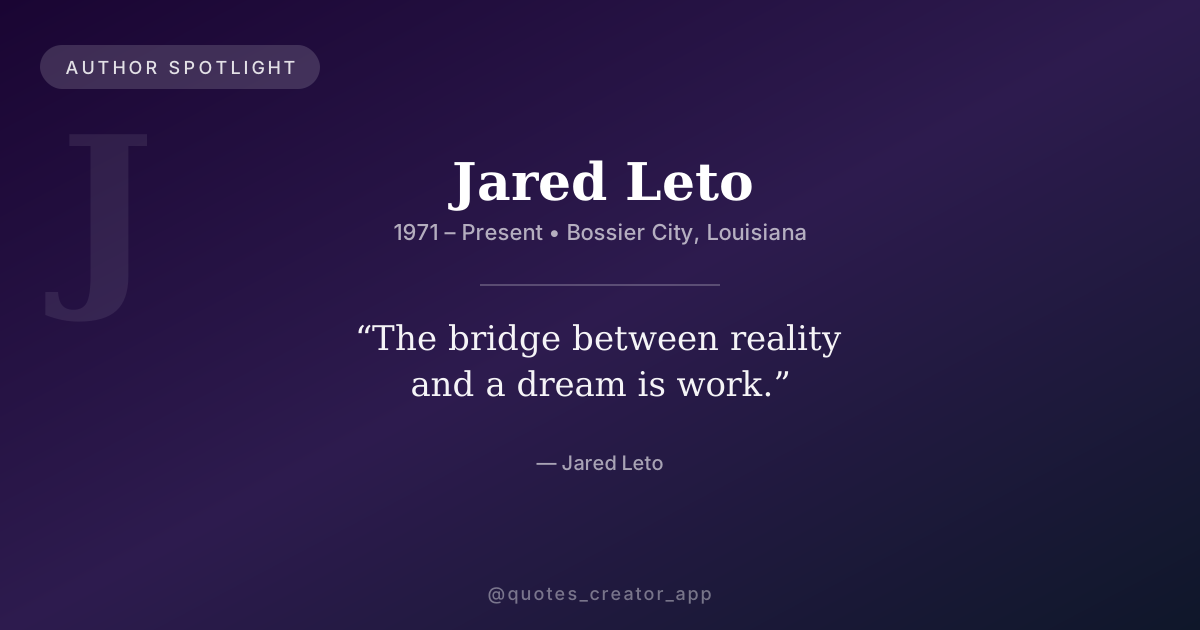
“The bridge between reality and a dream is work.”
The meaning behind these words
On the surface, this is a maxim of the self-help age — a platitude that could appear on a motivational poster. But in Leto’s mouth, and measured against Leto’s life, it becomes something closer to a physical law. The statement is not aspirational. It is descriptive. Leto is not saying that work ought to be the bridge between dreams and reality. He is saying that it is the bridge, the only bridge, and that anyone who tells you otherwise is selling a fantasy. The evidence is the body of work: the twenty-eight pounds lost for Requiem, the sixty-seven pounds gained for Chapter 27, the gout that put him in a wheelchair, the six weeks of Olympic-level training to approximate the stride of a middle-distance runner, the six hours of daily prosthetic application to age from thirty-four to a hundred and eighteen in Mr. Nobody, the seventy songs written to find twelve worth releasing, the sixty hours of footage shot to produce an eight-minute music video. These are not anecdotes of eccentricity. They are data points on a graph that traces a single, unwavering line: nothing of value appears without labour, and labour of the kind Leto practises requires a tolerance for discomfort that most people will never cultivate because most people, quite reasonably, prefer comfort to greatness.
The sentence also contains, in compressed form, a subtle democratic argument. Leto does not say that the bridge between reality and a dream is talent, or luck, or connections, or the right zip code. He says work — something that is, in principle, available to anyone willing to endure it. This is not naïve. Leto knows the world is not fair; he arrived in Los Angeles with five hundred dollars and slept in a shelter, and he has never pretended that structural obstacles do not exist. But the statement is pointed in its refusal to make excuses. It is addressed, one suspects, as much to himself as to anyone else. It is what he tells himself when a role requires him to lose thirty pounds in a month, or when an album refuses to cohere, or when he is standing at the base of the Empire State Building looking up at a thousand feet of vertical glass. The bridge is not inspiration. The bridge is not vision. The bridge is the unglamorous, repetitive, punishing process of showing up and doing the thing until the thing exists. Everything else is waiting.
“I think that to explore the uncomfortable and the politically incorrect is the job of the artist.”
The meaning behind these words
This sentence is the closest thing Leto has ever offered to a personal manifesto, and it explains a career that has frequently baffled critics who prefer their artists to stay in a single, legible lane. The word “explore” is doing important work here. Leto is not advocating for transgression as an end in itself — the cheap shock of the provocateur who offends simply to be noticed. Exploration implies curiosity, investigation, a willingness to go somewhere you have not been and report back honestly on what you find. The uncomfortable, in this formulation, is not an aesthetic choice. It is a territory. And the artist’s job — not the artist’s option, not the artist’s occasional indulgence, but the job — is to map that territory for the rest of us. This is why Leto has played a heroin addict whose arm is amputated in a prison hospital, a transgender woman dying of AIDS in 1980s Texas, the man who murdered John Lennon, a replicant who blinds his creations as an act of mercy, and a comic-book psychopath who sends live rats to his colleagues. Each of these roles required him to occupy a position that most people, including most actors, would actively avoid. And each of them, at their best, forced an audience to spend two hours in the company of someone they would ordinarily cross the street to avoid.
The second half of the sentence — “the politically incorrect” — is more contentious and requires more careful parsing. Leto is not aligning himself with any particular political movement. He is describing a relationship to orthodoxy. In his view, the artist who only says what is approved, who only represents what is fashionable, who only explores territory that has been pre-cleared by the cultural gatekeepers of the moment, has abdicated the central responsibility of the vocation. This is not a right-wing argument or a left-wing argument. It is an argument about the nature of art itself, and it places Leto in a tradition that includes everyone from Lenny Bruce to the Sex Pistols to Chris Rock — artists who understood that the moment an audience becomes comfortable, the art has stopped working. The controversy that has followed Leto throughout his career — the accusations of method-acting excess on the set of Suicide Squad, the criticism of his casting as a transgender character in Dallas Buyers Club, the recent sexual misconduct allegations — complicates this position considerably. It raises the question of where exploration ends and exploitation begins, of whether the artist’s freedom to explore the uncomfortable includes the freedom to make other people uncomfortable in ways they did not consent to. Leto has not resolved this question, and perhaps it cannot be resolved. But the sentence remains, in its bluntness, a useful provocation: if art does not disturb, what is it for?
“I fail enough and I beat myself up enough. I don’t need anybody else to do it for me.”
The meaning behind these words
There is a particular kind of exhaustion in this sentence — the exhaustion of someone who has spent decades being his own harshest judge and has learned, over time, that no external critic can compete with the critic who lives inside his own head. The statement is defiant but not triumphant. It is the defiance of someone who has been wounded and is telling you, not quite convincingly, that he does not need your sympathy. Leto has been mocked, parodied, and pilloried. His Joker was the subject of memes before the film even opened. His band’s earnest arena-rock grandiosity has been dismissed as pretentious. His method-acting stories — the dead pigs, the anal beads, the refusal to break character — have been seized upon as evidence of a self-seriousness that borders on parody. A less resilient person would have retreated. Leto’s response, encoded in this sentence, is to absorb the blows and, almost perversely, to claim them as irrelevant. The implication is that whatever the world has thrown at him, he has already thrown something worse at himself. This is either a statement of profound self-awareness or a defence mechanism so deeply ingrained that it has become indistinguishable from a personality. It is probably both.
The sentence also illuminates something about the psychology of extreme achievement. The people who reach the top of two entirely unrelated fields — acting and music, in Leto’s case — are rarely well-adjusted in the conventional sense. They are driven by an internal standard that is permanently set higher than any external standard could ever be. The Academy Award, the platinum albums, the Guinness World Record — these are not endpoints. They are signposts on a road that has no destination, because the internal voice that says “not good enough” does not go quiet when the trophy arrives. It simply adjusts the baseline. Leto is describing, with a kind of bleak candour, what it feels like to be that person: someone whose relationship to his own work is fundamentally adversarial, who approaches every project as a battle against his own limitations, and who has learned, over thirty years, that the only way to survive that battle is to make peace with the fact that it will never end. The critics will come and go. The inner critic is permanent. And Leto has decided, whether wisely or not, to treat this as a strength rather than a pathology.
“It’s not only music. It’s not only art. It’s a community. It’s a sense of having a place to belong.”
The meaning behind these words
To understand why this sentence matters to Leto, you have to understand something about his childhood. He moved constantly. States, schools, houses, communities — nothing held. His father was absent, then dead. His mother was loving but peripatetic. The result was a boy who learned to be a chameleon — to fit in anywhere because he belonged nowhere — and who grew into a man for whom the concept of home was not a place but a feeling, one he had rarely experienced and was not sure he would ever find. When he says that Thirty Seconds to Mars is not only music but a community, he is describing something he spent the first two decades of his life searching for without knowing what to call it. The band’s fanbase, known as the Echelon, is famously intense — a global network of listeners who treat the concerts not as entertainment but as gatherings of a tribe, who tattoo the band’s symbols on their bodies, who describe the music in the language of salvation. Leto has been accused of cultivating this devotion cynically. The sentence suggests a different interpretation: he needs it as much as they do.
There is a larger argument embedded here about what art is actually for. The conventional view holds that art is an object — a song, a film, a painting — produced by an artist and consumed by an audience. Leto’s view, expressed in this sentence and demonstrated across two decades of touring, is that art is a relationship. The object is merely the occasion for the relationship. The real thing that happens when a band plays a song and a crowd sings it back — louder, sometimes, than the band itself — is not the transmission of a creative product from producer to consumer. It is the creation, in real time, of a temporary society, a miniature civilisation built on shared feeling. This is why Leto has spent so much of his life on tour buses and in arenas, even when he could have been on film sets collecting pay cheques and Oscar nominations. The stage offers something the screen cannot: the immediate, physical proof that you are not alone. For someone whose earliest memories are of leaving, that proof is worth more than any award.
“I win and succeed only ‘cause I fail so much. I fail all the time. I wrote seventy songs just to have twelve good ones.”
The meaning behind these words
This is the least glamorous statement about creativity ever uttered by a major artist, and it is almost certainly true. The ratio is the point. Seventy to twelve. That is an eighty-three per cent failure rate, and Leto is not lamenting it. He is boasting about it. The boast is peculiar but important: it reframes failure not as the opposite of success but as the raw material from which success is built. Every one of those twelve songs depended on the fifty-eight that were discarded. The discards were not wasted time. They were the necessary precondition for the keepers. This is a profoundly un-American idea in a culture that fetishises the overnight success, the natural genius, the effortless masterpiece. Leto is insisting, with the specificity of the seventy-to-twelve ratio, that nobody gets to twelve without passing through fifty-eight. The people who appear to have arrived fully formed simply did their failing in private.
The sentence also functions as a kind of permission — permission to produce bad work, which is the hardest permission for a perfectionist to grant himself. Leto, by his own admission, is someone with what he calls a “hyper-focused disorder,” a person who cannot let go of a task until it meets an internal standard that is itself subject to perpetual upward revision. The danger of that disposition is paralysis. If everything must be perfect, nothing gets finished. The escape hatch is the embrace of failure as a process rather than an outcome. You write the bad song so you can find the good one. You shoot the unusable footage so you can recognise the shot that works. You fail, repeatedly and publicly, so that you can succeed, occasionally and privately, at a level that justifies all the failure. This is not a comforting philosophy. It demands a tolerance for waste, for frustration, for the long stretches of apparent fruitlessness that precede any genuine breakthrough. But it is a philosophy that has produced an Academy Award, fifteen million album sales, and a career that has now outlasted most of the people who were supposed to replace him. The numbers, as Leto would be the first to point out, do not lie.
Jared Leto’s legacy
The word most often applied to Jared Leto, by admirers and detractors alike, is “intense.” It is a word that flattens him, as single words always flatten people, but it gestures toward something real. The intensity is not a stylistic choice. It is a structural feature of a life organised around the refusal of half-measures. In an industry that rewards versatility, Leto has been something rarer: a completist. He does not dabble in music when he is between film roles; he tours the world for two years and sets a Guinness World Record. He does not take a role and phone it in; he loses or gains a third of his body weight and spends months in physical pain. He does not direct a music video as a vanity project; he drags a film crew two hundred miles north of the Arctic Circle and donates the proceeds to the Natural Resources Defense Council. This relentlessness has made him difficult to categorise and easy to mock. The memes, the parodies, the eye-rolling at his method-acting anecdotes — all of these are the cultural immune system’s response to someone who refuses to operate at the ambient temperature of his industry. But the work endures. Requiem for a Dream remains one of the most harrowing portraits of addiction ever filmed. Dallas Buyers Club won three Academy Awards. “The Kill” and “Kings and Queens” are canonical entries in the early-twenty-first-century rock songbook. The Echelon is still out there, getting tattoos.
What Leto has built is a career that functions as a standing argument against specialisation. He is not the only actor who makes music, or the only musician who acts, but he may be the only person alive who has won an Academy Award for acting and fronted a band that has headlined every major rock festival on earth. The duality is not a gimmick. It is the logical expression of a mind that experiences creativity not as a set of discrete disciplines but as a unified field, a single current that can be channelled into whichever vessel is available. The polymath is a romantic figure, but the reality of polymathy is less romantic: it requires a capacity for compartmentalisation that borders on the pathological, and it leaves very little room for anything else. Leto has been a teetotaller since 2007, a vegan for over twenty years — not out of moral preening but out of the practical recognition that a body that is asked to lose thirty pounds in a month and then sing for two hours in an arena cannot also be asked to process alcohol and animal protein. His relationships have been short. His private life has been guarded to the point of opacity. The price of being two people — the actor and the musician, Jared Leto and Bartholomew Cubbins — is that neither of them gets to be fully human. Whether the trade was worth it is a question only Leto can answer. But the architecture he has constructed — the films, the albums, the community, the improbable fact of it all — will outlast the question.
Create graphics with Jared Leto’s quotes
Jared Leto’s words carry the same conviction as his performances: direct, uncompromising, and built on the belief that art should challenge as much as it comforts. Whether you are looking for a reminder that dreams require work, or a call to build communities around what you create, Quotes Creator helps you turn these quotes into beautiful, shareable designs with custom fonts, colors, and layouts.
Why we chose Jared Leto
Jared Leto enters this spotlight at a moment when his name is once again circulating at the top of the cultural conversation. In August 2026, he ranked among Wikipedia’s twenty-five most-viewed figures — a spike driven by the streaming resurgence of Masters of the Universe, in which his performance as Skeletor has been widely reassessed, and by the enduring public fascination with the method-acting mythology that surrounds him. But the timing is secondary to the substance. We chose Leto because his career poses questions that resist easy answers. What is the relationship between artistic commitment and personal cost? Can an actor inhabit the lives of the marginalised without exploiting them? Does the intensity that produces great work excuse the behaviour that sometimes accompanies it? These questions have been sharpened by the sexual misconduct allegations that surfaced in 2025 and 2026 — allegations Leto has denied, but which complicate any assessment of his legacy and which we acknowledge here because an honest portrait cannot edit out the shadows.
And yet the work remains, and the work matters. The five quotes we have selected trace the arc of Leto’s philosophy as an artist and as a person: the insistence on labour as the only bridge between imagination and accomplishment, the belief that art’s duty is to disturb rather than soothe, the admission that self-criticism is both his engine and his burden, the recognition that creative work is hollow unless it builds community, and the hard-won wisdom that success is a numbers game — that you have to write the seventy bad songs to get to the twelve that last. These are not the maxims of a comfortable life. They are the operating principles of someone who has never been comfortable, and who seems to regard comfort as the enemy of everything worth doing. In an era of shortcuts and optimisation, Jared Leto stands as a monument to the opposite proposition: that there is no shortcut, that the long way is the only way, and that a life spent building bridges between dreams and reality is a life that will leave a mark, however contested, on everyone who crosses them.
— ThinkPeak Studio Editorial Team
Create your own quote graphic with this quote
Turn this line into a shareable graphic in seconds — free, no signup needed. For video quotes and 100+ templates, try the Android app.
Advertisement
Enjoyed this article? Get more like it in your inbox.