On this page
Author Spotlight: Jeff Bezos
American entrepreneur who founded Amazon and Blue Origin, reshaping commerce, cloud computing, and private spaceflight
Who is Jeff Bezos?
Jeffrey Preston Bezos was born on January 12, 1964, in Albuquerque, New Mexico, to a seventeen-year-old mother, Jacklyn, who finished high school while raising him. When Jeff was four, she married Miguel Bezos, a Cuban immigrant who had arrived in the United States alone as a teenager and who adopted Jeff as his own. The family moved to Houston and later Miami, but the formative summers of Bezos’s childhood were spent on his grandfather’s ranch in Cotulla, Texas, where he learned to repair windmills, vaccinate cattle, and fix machinery with whatever was on hand. That early lesson in resourcefulness stuck. As a boy he rigged an electric alarm to keep his siblings out of his room, converted the family garage into a laboratory, and graduated as valedictorian of Miami Palmetto Senior High School before earning degrees in electrical engineering and computer science from Princeton University in 1986.
Bezos spent his twenties on Wall Street, rising quickly through roles at Fitel, Bankers Trust, and the quantitative hedge fund D. E. Shaw, where he became a senior vice president by age thirty. In 1994, he came across a statistic that changed his life: the World Wide Web was growing at roughly 2,300 percent a year. Applying what he called a “regret minimization framework,” he asked himself whether, at eighty, he would regret leaving a lucrative finance career to chase the internet wave. The answer was obvious. He quit, drove cross-country to Seattle, and founded Amazon in his garage in mid-1994, launching it in July 1995 as an online bookstore. The company survived the dot-com crash, expanded into virtually every category of commerce, and invented entire industries along the way, from cloud computing with Amazon Web Services to e-readers with the Kindle.
What set Bezos apart was never a single product but a set of operating principles he repeated with almost religious consistency: obsess over customers rather than competitors, invent on their behalf, be patient, and treat every morning as “Day 1,” the mindset of a hungry startup rather than an incumbent defending its position. His annual shareholder letters became required reading in business schools, arguing for long-term thinking in a world addicted to quarterly results. He championed the willingness to be misunderstood for long periods, a stance that turned skeptics’ mockery of Amazon’s razor-thin profits into one of the great vindications in corporate history. By 2018, Forbes had named him the “richest man in modern history,” and he held the title of world’s wealthiest person from 2017 to 2021.
Bezos stepped down as Amazon’s CEO on July 5, 2021, handing the reins to Andy Jassy and becoming executive chairman, but his ambitions only widened. Through Blue Origin, the spaceflight company he founded in 2000, he flew to the edge of space aboard New Shepard in July 2021 and continues to pursue a vision of millions of people living and working in space. He purchased The Washington Post in 2013, funds climate initiatives through the ten-billion-dollar Bezos Earth Fund, and backs the 10,000 Year Clock, a monument to long-term thinking built inside a Texas mountain. With a net worth of roughly 284 billion dollars in 2026, he remains one of the most consequential and closely watched figures in global business.
Jeff Bezos’s most memorable quotes
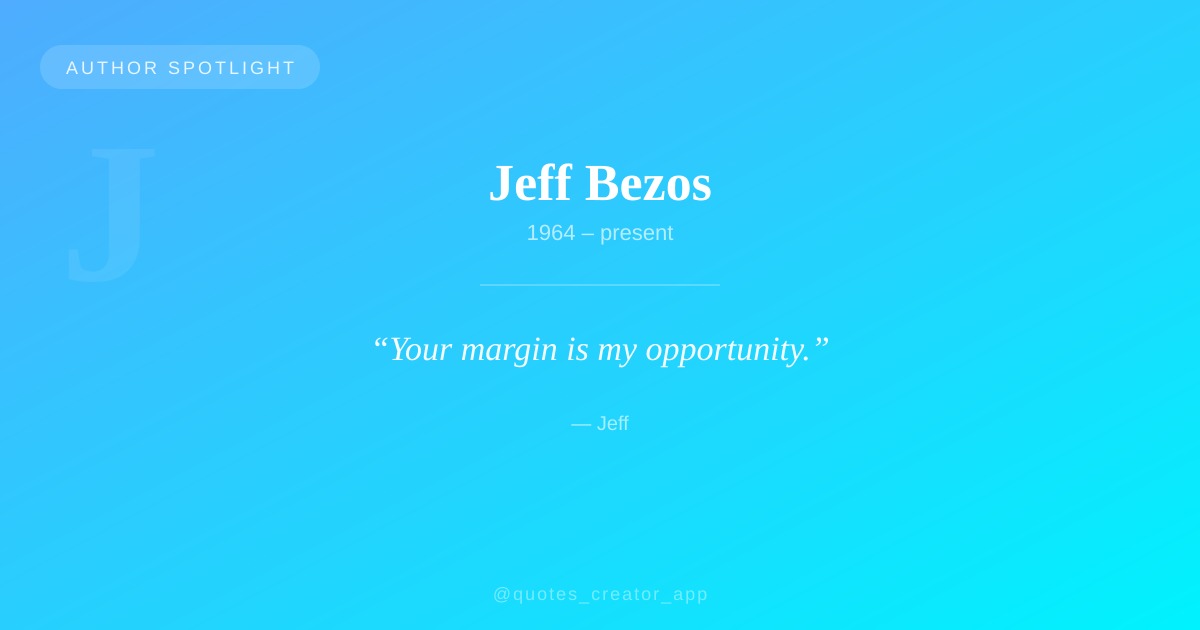
“Your margin is my opportunity.”
The meaning behind these words
Five words that terrified entire industries. In this famously blunt formulation, Bezos declared that any company living comfortably on fat profit margins was, in effect, subsidizing his next business plan. Where rivals saw healthy pricing, he saw inefficiency that a leaner, more patient competitor could strip away and hand back to customers. It is the distilled logic of Amazon’s entire history: sell at razor-thin margins, reinvest everything, and let scale do the work that markup does for everyone else.
The quote endures because it reframes competition as a moral question about who benefits from a transaction. Bezos bet that the loyalty earned by relentlessly lowering prices would compound into something far more valuable than any single quarter’s profit, and decades of retail history proved him right. For entrepreneurs, the line doubles as a warning and an invitation: wherever an incumbent has grown complacent, there is an opening for someone hungrier. It remains one of the most quoted strategic principles in modern business.
“If you have a really good idea, stick to it, but be flexible on how you get there. Be stubborn on your vision but flexible on the details.”
The meaning behind these words
This is Bezos’s answer to one of the hardest puzzles in any ambitious undertaking: knowing when persistence becomes stubbornness and when adaptability becomes drift. His solution is to split the problem in two. The vision, the destination that justifies the whole journey, deserves near-irrational commitment. The details, the tactics and timelines and product decisions along the way, deserve none at all. Amazon held its vision of being Earth’s most customer-centric company for three decades while cheerfully abandoning failed experiments like the Fire Phone within a year.
In the same interview, Bezos added that people who are right a lot are the ones who change their minds frequently, re-analyzing the same data and waking up to new conclusions. That pairing is what makes the advice so durable. It grants permission to be wrong in public about the small things, precisely because the big thing remains fixed. For anyone building a company, writing a book, or changing a career, the quote offers a practical compass: defend the destination fiercely, and hold every map lightly.
“The thing I have noticed is when the anecdotes and the data disagree, the anecdotes are usually right. There’s something wrong with the way you are measuring it.”
The meaning behind these words
Coming from the man who built one of the most data-driven companies on the planet, this is a startling confession. Bezos explained it while describing his famous practice of forwarding customer complaint emails to executives with a single character added: a question mark. When a metric dashboard says customers are happy but a single email says otherwise, Bezos learned to trust the email. Dashboards measure what you thought to measure; anecdotes reveal what you forgot to ask.
The quote is a masterclass in intellectual humility for the analytics age. It does not reject data; it rejects the complacency of believing your instruments are the territory. Every organization eventually optimizes for its own metrics, and the customer’s lived experience quietly diverges from the numbers on the wall. Bezos’s insight, that a leader’s job is to hunt for that divergence rather than celebrate the dashboard, is arguably more relevant now, in an era of AI-driven measurement, than when he first said it.
“That kind of divine discontent comes from observing customers and noticing that things can always be better.”
The meaning behind these words
“Divine discontent” is one of the most poetic phrases Bezos ever attached to a business principle. He used it to describe the engine behind Amazon’s customer obsession: customers are never satisfied, even when they say they are, and their expectations rise the moment you meet them. Rather than resenting that treadmill, Bezos treated it as sacred. The perpetual gap between what is and what could be is not a burden; it is the clearest possible roadmap for invention.
This lesser-known quote reveals the optimistic core beneath Bezos’s competitive exterior. Competitor-focused companies wait for rivals to move first; customer-focused companies are pulled forward by discontent that never runs out. Two-day shipping became two-hour delivery not because a competitor demanded it, but because someone noticed that waiting is worse than not waiting. For creators and builders in any field, the phrase is a reminder that dissatisfaction, properly aimed, is a renewable source of energy rather than a cause for despair.
“I want thousands of entrepreneurs doing amazing things in space, and to do that we need to dramatically lower the cost of access to space.”
The meaning behind these words
Bezos has often said that Amazon was only possible because the heavy infrastructure already existed: postal services, payment systems, and telecommunication networks built by others over decades. Blue Origin, in his telling, is his attempt to pay that debt forward. He sees his role not as the person who builds the space colonies but as the one who lays the road, using his resources to drive down launch costs so that a future generation of founders can experience what he calls a dynamic, entrepreneurial explosion into space.
The quote captures the scale of thinking that defines Bezos’s second act. Where his first act compressed the world’s goods into a single store, his second aims to move heavy industry off the planet entirely so that Earth can be preserved. Whether or not that vision arrives on schedule, the framing is instructive: the greatest contribution a successful builder can make is often infrastructure, the unglamorous groundwork that makes thousands of other dreams affordable. Gradatim ferociter, Blue Origin’s motto, says it plainly: step by step, ferociously.
Jeff’s legacy
Jeff Bezos changed the default expectations of daily life. The idea that nearly anything can arrive at your door within a day, that infinite computing power can be rented by the minute, and that a bookstore can become a trillion-dollar technology company all trace back to a garage in Seattle in 1994. Amazon Web Services quietly became the backbone of the modern internet, powering everything from startups to streaming services to government agencies. His shareholder letters, his “Day 1” philosophy, and mechanisms like the six-page memo and the empty chair for the customer have been absorbed into the operating culture of thousands of companies that otherwise share nothing with Amazon.
His legacy is still being written, and it is genuinely contested territory: critics point to Amazon’s labor practices, market power, and the sheer concentration of wealth he represents, while admirers see the purest modern case study in long-term thinking rewarded. What is beyond dispute is the breadth of the bet he is making on the future, from the Bezos Earth Fund’s ten-billion-dollar climate commitment to Blue Origin’s road to space to a clock designed to tick for ten thousand years. Half a century from now, people may remember the everything store as the smallest thing he built.
Create graphics with Jeff’s quotes
Jeff Bezos’s words have a timeless quality that makes them perfect for quote graphics. Whether you are sharing on Instagram, creating a vision board, or looking for daily inspiration, Quotes Creator helps you transform these quotes into beautiful, shareable designs with custom fonts, gradients, and layouts.
Why we chose Jeff
Jeff Bezos is trending again this week, and not by accident. As the world’s attention swings between a historic World Cup and a new wave of AI-driven entrepreneurship, Bezos keeps surfacing in conversations about what it takes to build for the long term. We featured one of his quotes as a Quote of the Day back in June, but a single quote cannot hold the full arc of a paperboy-turned-engineer who bet his career on a statistic, embraced being misunderstood for decades, and is now spending his fortune on climate repair and roads to space. His words about vision, data, discontent, and margins have become the shared vocabulary of modern building, which makes him exactly the kind of figure this series exists to explore in depth.
— ThinkPeak Studio Editorial Team
Create your own quote graphic with this quote
Turn this line into a shareable graphic in seconds — free, no signup needed. For video quotes and 100+ templates, try the Android app.
Advertisement
Enjoyed this article? Get more like it in your inbox.