On this page
Author Spotlight: José Mourinho
From a failed mathematics exam and a first-day walkout from business school in Setúbal, to the touchline of the Santiago Bernabéu, where he returned in July 2026 to manage the biggest club on earth for the second time — José Mourinho has spent four decades insisting on one thing above all others: that football is won in the mind before it is won on the pitch. Interpreter, physical-education teacher, translator, coach, icon, pantomime villain, self-styled “Special One”: the through-line is not a tactic but a conviction. Winning, he has always maintained, is not a style. Winning is the point.
Who is José Mourinho?
José Mário dos Santos Mourinho Félix was born on 26 January 1963 in Setúbal, Portugal, into a family already tethered to the game. His father, Félix Mourinho, was a professional goalkeeper who played for Vitória de Setúbal and Belenenses and earned a single cap for Portugal; his mother, Maria Júlia, was a primary-school teacher. The family’s fortunes were entangled with the town’s: Mourinho’s great-uncle Mário Lêdo controlled Setúbal’s sardine-canning industry under the Salazar dictatorship and bankrolled the construction of Vitória’s Estádio do Bonfim, where the boy would spend his childhood watching his father train. Football, in other words, was not an ambition the young José discovered. It was the atmosphere he breathed. But the path was never smooth. He failed mathematics in his final year of secondary school and missed his chance to enrol in physical-education college; his mother, ever practical, enrolled him in a private business school, believing it the surer route to a career. Mourinho walked out on his first day. Sport, not commerce, was the only subject that had ever interested him, and he transferred instead to the Instituto Superior de Educação Física in Lisbon, where the humanist kinesiologist Manuel Sérgio became the first of his great mentors. He later travelled to England and Scotland for coaching courses, where the former Scotland manager Andy Roxburgh took note of a young Portuguese whose drive and attention to detail were, even then, unusual.
His playing career was short and unremarkable — and he knew it. Mourinho joined Belenenses’ youth side, then drifted through the Portuguese lower leagues with Rio Ave, Sesimbra and Comércio e Indústria, where he was captain and once pulled a teammate from a burning car. At twenty-four he made the most clear-sighted decision of his early life: he lacked the pace and power to be a professional, so he stopped pretending otherwise and became a coach. He worked as a physical-education teacher and youth coach at Vitória de Setúbal, then, in 1992, seized the job that changed everything: translator and assistant to the English manager Bobby Robson at Sporting CP. The role was nominally linguistic, but Mourinho turned it into an apprenticeship. He followed Robson to Porto and then, in 1996, to Barcelona, gradually taking over tactical planning, opposition analysis and, famously, the press conferences. When Robson left, Mourinho stayed to work under Louis van Gaal, who trusted his studious assistant enough to let him coach Barcelona B and even take charge of the first team for the Copa Catalunya in 2000. The lesson Mourinho took from Robson he would repeat for the rest of his life: “When you win, you shouldn’t assume you are the team, and when you lose, you shouldn’t think you are rubbish.” From Van Gaal he learned discipline, structure and the cold science of preparation. The translator had become a tactician.
The ascension was sudden and total. Given his first senior job at Benfica in September 2000, he left within months after a board dispute, then briefly managed União de Leiria, lifting a small club to heights it had never known. Porto came calling in January 2002, and what followed made his name across Europe: two Primeira Liga titles, a UEFA Cup in 2003, and, in 2004, the UEFA Champions League, won with a team of largely unknown players who dismantled Monaco 3–0 in the final. The next act was even more audacious. Hired by Roman Abramovich’s newly monied Chelsea in the summer of 2004, Mourinho introduced himself to the English press with a sentence that has never been bettered as a piece of self-branding: “Please don’t call me arrogant, but I’m European champion and I think I’m a special one.” He then delivered Chelsea their first league title in fifty years, and a second the season after, conceding a mere fifteen goals in the process. At Inter Milan he went further still, winning Serie A in his first season and, in 2010, an unprecedented continental treble — the first in Italian history — completed with a Champions League triumph over Barcelona, the team most considered unbeatable. He was crowned the inaugural FIFA World Coach of the Year that same year, then moved to Real Madrid, where his 2011–12 side set La Liga records for points (100) and goals (121) in a single season.
What came next has been, in its own way, as instructive as what came first. Mourinho returned to Chelsea in 2013 and won another league title in 2015 before being sacked the same year amid a catastrophic collapse. Manchester United followed in 2016, where he won the Community Shield, League Cup and Europa League in his first season, then Tottenham Hotspur in 2019 — where he was dismissed days before a League Cup final, an indignity that stung him deeply. Yet he kept winning trophies, and in the unlikeliest of places: at Roma, between 2021 and 2024, he delivered the club’s first European title with the inaugural UEFA Europa Conference League in 2022, its first trophy of any kind since 2008, making him the first manager to win a major European competition with four different clubs and only the third to lift all three of UEFA’s current club competitions. Spells at Fenerbahçe and a second stint at Benfica followed, and in July 2026, at sixty-three, he returned to Real Madrid — the “biggest ship on the planet,” as he once called it. By any accounting, the record is staggering: league championships in four countries, the European Cup won with two clubs, and every UEFA club trophy in existence. Named Portuguese Coach of the Century in 2015, Mourinho has spent a lifetime being compared to the great Helenio Herrera — another man who believed, above all, that winning was a philosophy rather than an outcome.
José Mourinho’s most memorable quotes
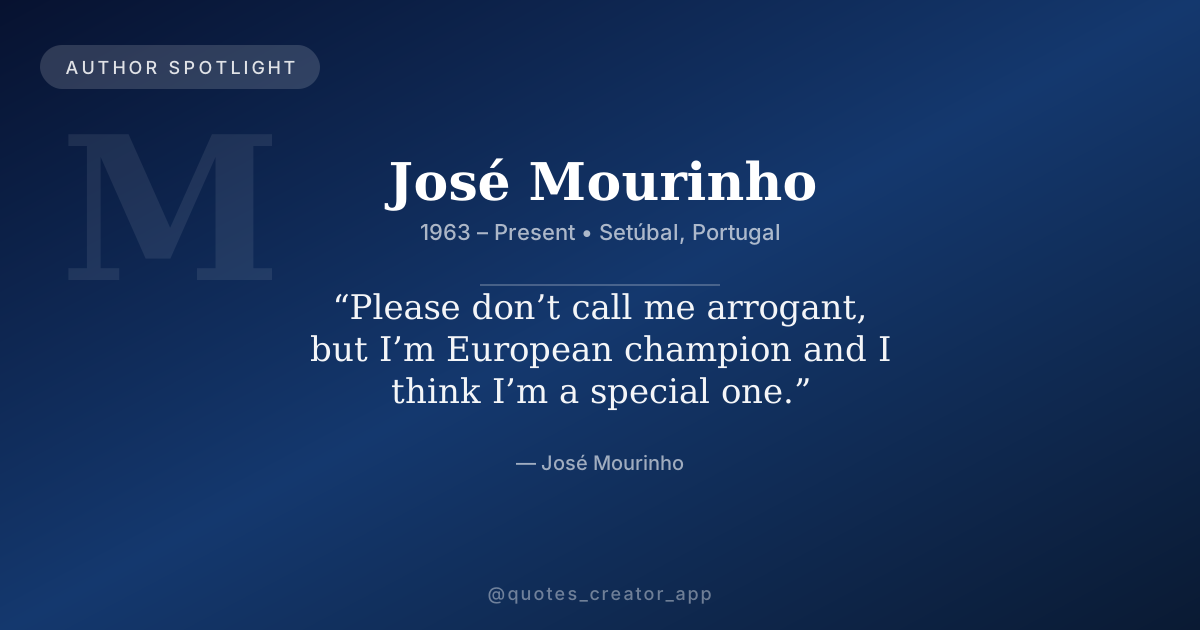
“Please don’t call me arrogant, but I’m European champion and I think I’m a special one.”
The meaning behind these words
Read cold, this is the most brazen sentence in the modern history of football — and that is precisely its genius. It was June 2004, and a forty-one-year-old Portuguese manager with no playing pedigree to speak of was being introduced to the English press, an institution that regarded foreign coaches with suspicion and flashy ones with contempt. Into that room walked a man who had just won the Champions League with Porto, a club from outside Europe’s big five leagues, and he opened not with humility but with a claim. Yet notice the structure of the sentence: the word “arrogant” is pre-emptively disarmed before the claim is even made. He is not boasting, he insists; he is merely stating what is true. “I’m European champion” is not a wish or an ambition but a fact, verifiable by anyone in the room, and from that fact he draws a conclusion — “I think I’m a special one” — whose modesty is only apparent. He did not say he was the best coach in the world. He said he was special, a word chosen with surgical care, for “special” asserts not superiority but singularity, the refusal to be measured by any existing yardstick. It was, in its way, a philosophical statement: I am not competing with the men you think I should be competing with. I am in a category of my own.
The deeper significance lies in what the sentence did, because it did not merely describe a man — it created one. “The Special One” became the self-fulfilling prophecy around which an entire career was built. Mourinho understood something about leadership that most managers never grasp: that confidence is contagious, that a team becomes what its manager behaves as if it already is. Chelsea’s players — many of them talented but trophyless, dismissed by the press as mercenaries — began to believe they were special because the man in charge treated the word as self-evident fact. There is also, buried in the bravado, a democratic defiance. Here was a man who had arrived at the summit of his profession through translation, study and the long apprenticeship of a nobody, and his first public act was to refuse to defer to the established order of the game. The sentence was aimed not at the journalists but at the entire aristocracy of football — the decorated managers, the storied clubs, the notion that greatness must be inherited slowly. The risk, of course, was built into the reward: the same persona that lifted him made him a target, and the press that laughed with him in 2004 would be sharpening its knives by 2007. But that is the nature of a gambit. You do not get to be special, Mourinho understood, without being willing to be hated.
“It’s not important how we play. If you have a Ferrari and I have a small car, to beat you in a race I have to break your wheel or put sugar in your tank.”
The meaning behind these words
This is the clearest statement Mourinho ever gave of his footballing philosophy, and it explains both his greatness and his critics. He was speaking at Inter Milan in 2010, on the eve of a Champions League tie against Barcelona, the team of Lionel Messi, Xavi and Andrés Iniesta — a side so gifted that it was then being called the greatest ever assembled. Mourinho’s metaphor is an act of ruthless honesty about resource asymmetry. The Ferrari is Barcelona: a club with superior talent, superior wealth and a philosophy of possession football that the whole world had fallen in love with. The small car is everyone else. And the conclusion he draws is deliberately offensive to football’s romantics: that when you are outgunned, you do not try to outgun — you sabotage. “Break your wheel or put sugar in your tank” is the language of a man who regards the aesthetics of the game as a luxury available only to those who can afford to lose. The sentence is a repudiation of the idea, sacred in Spain and increasingly everywhere, that how you win matters as much as whether you win. For Mourinho, that idea is a delusion of the privileged. The only question that matters is the result.
But there is a second, more subtle argument hidden inside the bravado, and it is easy to miss. Mourinho is not conceding defeat to the Ferrari. He is describing the precise conditions under which the small car beats it. The point of the metaphor is that intelligence — strategy, planning, the willingness to do the ugly thing — can overcome material superiority. The man who drives the small car and still wins the race is, by any honest accounting, the more skilful driver, because he won with less. This was never an admission of inferiority; it was a boast about the power of mind over resources. He proved the metaphor in the most literal way imaginable: Inter lost the away leg to Barcelona that season, then beat them 3–1 at home and went on to win the treble, absorbing pressure and striking on the counter with a discipline that bordered on the monastic. When his critics accused him of “parking the bus,” he replied that he had parked the plane. The Ferrari-and-small-car quote endures because it is true in more arenas than football: in any contest where resources are unequal, the smaller party survives not by imitating the larger but by being cleverer, more disciplined, and more willing to do what the larger party considers beneath it. It is not a philosophy of defeat. It is a philosophy of asymmetric victory.
“I am prepared. The more pressure there is, the stronger I am. In Portugal, we say the bigger the ship, the stronger the storm. Fortunately for me, I have always been in big ships.”
The meaning behind these words
Here Mourinho offers a theory of pressure that inverts the conventional wisdom. We are taught to think of pressure as a corrosive force, something that erodes the unprepared and breaks the fragile. Mourinho reverses the polarity: pressure, in his formulation, is not what destroys a person but what reveals one. “The more pressure there is, the stronger I am” is a statement about his own constitution, but it is also a definition of what he believes a leader is — someone for whom the weight of expectation is fuel rather than burden. The Portuguese proverb he invokes, “the bigger the ship, the stronger the storm,” does the philosophical work. It reframes adversity as evidence of significance. A great storm only forms around a great ship, so the storm is not something to be feared but something to be read: it is the world’s way of telling you that what you are attempting matters. Mourinho was speaking on the day he was unveiled at Real Madrid, the club he himself called “the biggest ship on the planet,” and the subtext was unmistakable: I did not come here despite the pressure. I came here because of it.
The quote also lays bare the engine that drove his entire career, for better and worse. From Porto to Chelsea to Inter to Real Madrid, Mourinho never chose the comfortable job — he chose the hardest one available, each time escalating the size of the ship and therefore the strength of the storm. This is the psychology of a man who measures his own worth by the size of the challenge, and it explains a great deal. It explains why he took the Chelsea job when it was a trophy-hungry project built on new money; why he took Inter when the club had not won the European Cup in forty-five years; why he took Real Madrid when its board expected the Champions League every season. It also, in a darker register, foreshadows the pattern that would define his later years: the so-called “third season syndrome,” the tendency for his teams to combust after two years of maximum-intensity siege mentality. A man who feeds on pressure eventually exhausts the people around him, and a leader whose identity is fused with the storm has no idea who he is in calm weather. But that is the price of the psychology he describes, and it is worth noting that Mourinho would pay it gladly, again and again, rather than ever admit that the smaller ship might be the wiser choice. For him, the storm was not the cost of the job. The storm was the point of the job.
“I am José Mourinho and I don’t change. I arrive with all my qualities and my defects.”
The meaning behind these words
This sentence is a declaration of integrity, and like all of Mourinho’s best lines, it contains its own undoing. “I don’t change” is, on its face, a statement of principle — the refusal of a man who has been criticised his whole career for his confrontational style, his siege mentality, his war with referees and rivals, to bend into something more palatable. In an industry where managers are constantly being coached, packaged and sanded down by communications departments, Mourinho offers the opposite: an authentic, unreconstructed self. And the second half of the sentence is what makes it more than mere stubbornness. “I arrive with all my qualities and my defects” is an admission of self-knowledge that is almost disarming. He is not claiming to be perfect. He is claiming to be known. He is saying: I am offering you the whole man, not a curated version of him, and if you hire me you hire the defects along with the qualities. It is the rarest thing in public life — a figure who refuses to perform a sanitised version of himself, and who insists, almost as a point of honour, on being judged in his totality.
Yet the sentence is also, in the long view, the key to his tragedy, because the defects he refuses to change are precisely the ones that ended his tenures everywhere. The same combustible intensity that produced the siege mentality of Porto, Chelsea and Inter eventually produced the acrimonious exits from Chelsea, Manchester United and Tottenham. The man who does not change is, in one sense, admirable — a fixed point in a shifting world, a person of integrity in a profession of appeasement. But in another sense, the refusal to change is a form of rigidity, and rigidity is fatal in a game that evolves every year. Tactics changed around him; pressing football came and went; a new generation of players raised on analytics and sports psychology responded badly to the hair-dryer methods that had worked on Frank Lampard and John Terry. Mourinho’s answer to this was, in effect, to double down — to insist that his way had won twenty-six trophies and therefore needed no revision. The quote is thus a perfect portrait of the man in miniature: the same quality that made him great — an unshakeable belief in his own method — is the quality that made him, eventually, obsolete. He would rather fail as himself than succeed as someone else. There is something genuinely noble in that. And there is something genuinely costly in it, too.
“I prefer not to speak. If I speak, I am in big trouble. In big trouble. And I don’t want to be in big trouble.”
The meaning behind these words
This is the late-career Mourinho — and it is the single most revealing thing he ever said, precisely because it is the inversion of everything he once was. The man who walked into an English press conference in 2004 and declared himself special now stands in front of the cameras in Istanbul in 2024 and says he prefers not to speak. “If I speak, I am in big trouble. In big trouble.” The repetition is deliberate, almost theatrical — a performance of silence that, like all great performances, communicates far more than words could. He is saying the thing precisely by refusing to say it: the referee was wrong, the system is against him, the world is unfair — and he is not going to say any of it, because he has finally learned what it costs. The sentence is, in effect, a complete sentence in its refusal. He tells the audience that there is something to be angry about, that he is angry, and that he has chosen, for once, not to say so out loud. The silence is the message.
What makes the quote moving is the self-awareness in it, and the weariness. This is the man who spent thirty years fighting — referees, governing bodies, rival managers, the press, the world — and who now performs the fight as a kind of knowing pantomime, a man counting the cost of every word before he spends it. There is comedy in the repetition, and there is tragedy too: the firebrand has become a man who knows the routine so well he can quote the consequences before they happen. “And I don’t want to be in big trouble” is the confession of a survivor, someone who has paid enough fines and served enough touchline bans to know that speaking truth to power in football has a price. It humanises him in a way that a thousand trophies cannot. The “Special One” has not, after all, been defeated or silenced into conformity; he has simply grown wise enough to understand that the fight and the self-preservation can no longer be pursued at the same time. It is the rare quote that reads differently at every age: a joke to the young, an explanation to the middle-aged, and to anyone who has ever held their tongue in the face of injustice, a small, exhausted, oddly dignified elegy for the version of yourself who would have said it out loud.
José Mourinho’s legacy
Mourinho’s legacy will always be double, and any honest accounting must hold both halves at once. The first half is the trophies, and they are, by any measure, among the most impressive in the history of the sport: twenty-six major honours, league championships in four different countries, the European Cup won with two different clubs, and the unique distinction of being the only manager to have won all three of UEFA’s current club competitions. He took Porto, a club from a league most of Europe ignored, and won the Champions League with it. He took Chelsea, fifty years without a title, and won the Premier League in his first season. He took Inter Milan and delivered the first treble in Italian history. He took Real Madrid and broke the scoring and points records of a century-old competition. Whatever else is said about him, this cannot be argued away: no manager of his generation converted underdogs into champions with such repeated, mechanical success. He did not inherit great teams; he built them, and he won with them everywhere he went.
The second half of the legacy is the man himself — the persona, the philosophy, and the shadow it cast. Mourinho changed what it meant to be a football manager. Before him, managers were backroom figures; after him, they were front-page celebrities, and the press conference became a legitimate tactical arena in which matches could be influenced before kickoff. He professionalised the siege mentality, the “us against the world” psychology that binds a squad into a fortress. He gave the language of football some of its most durable phrases — “parking the bus,” “the Special One” — and he made pragmatism a respectable philosophy in an age that increasingly worshipped possession for its own sake. But the shadow is inseparable from the light. The third-season collapses, the acrimonious exits, the falling-out with a generation of players, the sense that the game eventually moved past him — these too are part of what he leaves behind. His July 2026 return to Real Madrid, at sixty-three, is the perfect coda to a career that has never known how to stop: the man who refuses to change, back on the biggest ship on the planet, once more betting that winning, in the end, will justify everything. Whether it does, the argument itself — about style and substance, beauty and victory, the price of authenticity — is one he has forced football to have. That argument, as much as the trophies, is his true legacy.
Create graphics with José Mourinho’s quotes
José Mourinho’s words carry the same conviction as his management: direct, uncompromising, and built on the belief that results matter more than appearances. Whether you are looking for a reminder that pressure can be fuel, or a case for winning the ugly way, Quotes Creator helps you turn these quotes into beautiful, shareable designs with custom fonts, colors, and layouts.
Why we chose José Mourinho
José Mourinho enters this spotlight at a moment when his name is once again surging through the cultural conversation. In August 2026, his Wikipedia pageviews spiked roughly fivefold — from a baseline of around eight thousand views a day to more than fifty thousand — a surge driven by his July 2026 return to Real Madrid, the club he has repeatedly called the biggest ship on the planet, and by the renewed public fascination with a manager who has now come full circle to the place where his legend was, in some ways, first tested to breaking point. But the timing is secondary to the substance. We chose Mourinho because, in an age of increasingly interchangeable, media-trained coaches, he remains what he has always been: a genuine philosopher of winning, a man whose every public statement doubles as a thesis about power, pressure, and the cost of success.
And yet the work remains, and the work matters. The five quotes we have selected trace the arc of a life and a mind: the self-creation of the “Special One,” the ruthless pragmatism of the small car against the Ferrari, the inversion of pressure from burden into fuel, the defiant constancy of a man who refuses to change, and the late, weary wisdom of a man who has finally learned when to hold his tongue. These are not the maxims of a comfortable life. They are the operating principles of someone who has never been comfortable — and who regards comfort, in football and perhaps in everything, as the enemy of achievement. In an era that increasingly prizes style over substance, José Mourinho stands as a monument to the opposite proposition: that winning is not a style, that winning is the point, and that a man who spends his whole life proving it — whatever the collateral damage — will leave a mark that no amount of revisionism can erase. However contested, the mark endures.
— ThinkPeak Studio Editorial Team
Create your own quote graphic with this quote
Turn this line into a shareable graphic in seconds — free, no signup needed. For video quotes and 100+ templates, try the Android app.
Advertisement
Enjoyed this article? Get more like it in your inbox.