On this page
Author Spotlight: Kevin Keegan
From a coal-mining village in Yorkshire to the summit of world football — the story of a man who never stopped believing, never stopped fighting, and never stopped feeling every moment as if it were his last.
Who was Kevin Keegan?
Joseph Kevin Keegan was born on 14 February 1951 in the mining village of Armthorpe, near Doncaster, to a Geordie father and a Yorkshire mother. His grandfather Frank was a colliery inspector who heroically saved lives in the West Stanley Pit disaster of 1909, and his father Joe worked in the pits before becoming a lifelong Newcastle United supporter. Young Kevin was given his first football by his uncle and his first boots — a second-hand pair of Winit boots bought from a sports shop run by a former Doncaster Rovers centre forward — after his father won a bet on the horses. He played football at Hyde Park using his baby brother’s pushchair as a goalpost. At 15, he once ran 50 miles from Nottingham to Doncaster with two friends — an act of sheer willpower that, he later claimed, prepared him physically and psychologically for every pre-season training session and match he would ever face.
Keegan’s journey from obscurity to greatness is the stuff of football folklore. Discovered playing Sunday league football in 1966, he was offered a trial by a fellow player who was impressed by his relentless energy. That trial led to a contract at Fourth Division Scunthorpe United, where the club could not afford football nets and trained on a rugby pitch. In 1971, Liverpool’s legendary manager Bill Shankly paid £33,000 for the 20-year-old — a sum Keegan negotiated up from £45 to £50 a week in wages. At Anfield, he formed a devastating strike partnership with John Toshack, won three First Division titles, two UEFA Cups, an FA Cup, and, in his final game for the club, the European Cup. His six years at Liverpool were glorious, but Keegan wanted more. In 1977 he made the bold decision to leave England and join Hamburger SV in West Germany, a move few British players dared to make. There, he became a national icon, won the Ballon d’Or in 1978 and 1979 — to date, one of only a handful of Englishmen to win the award even once — and led Hamburg to a Bundesliga title and a European Cup final.
But Keegan’s heart always belonged to the North East. In 1982, he stunned the football world by dropping down to the Second Division to join Newcastle United, the club his father had loved. In two seasons he scored 48 goals in 78 league games, dragged Newcastle to promotion, and cemented a bond with the Geordie faithful that remains utterly unique. After retiring in 1984, he stayed away for eight years. When he returned as manager in 1992, with the club languishing near the bottom of the second tier and facing potential relegation to the third, he saved them from the drop, won promotion as champions the next season, and then came within a whisker of winning the Premier League title in 1996. His Newcastle side played with the same swagger, fearlessness, and emotional openness that had defined his playing career. “The Entertainers,” they were called, and for a glorious moment, they had all of English football believing.
Keegan went on to manage Fulham (promotion won), the England national team (resigned after a gutting defeat), and Manchester City (promotion won), before returning to Newcastle in 2008 for a brief, tumultuous second spell that ended in acrimony with the club’s ownership. Through every triumph and setback, one quality remained constant: his refusal to be anything other than himself. He was raw, emotional, impulsive, and impossibly honest — a manager who cried on live television, who produced the most famous post-match rant in British sporting history, and who never lost the wide-eyed wonder of the boy from Armthorpe who just loved to kick a ball. Kevin Keegan passed away on 20 July 2026 at the age of 75, leaving behind a legacy that stretches far beyond trophies and promotions. He leaves behind the memory of a man who proved, definitively, that you can lead with your heart and still reach the very top.
Kevin Keegan’s most memorable quotes
“Everything I’ve done I’ve done with enthusiasm and passion.”
The meaning behind these words
If you could distill Kevin Keegan into a single sentence, this would be it. Enthusiasm and passion were not ornaments on his personality; they were the engine. From his earliest days at Scunthorpe United — where he would do weighted runs up and down the cantilever stand just to make himself stronger — to his final press conferences as England manager, Keegan operated at full emotional throttle. He was incapable of phoning it in, whether that meant running a training drill, negotiating a contract, or telling a room full of journalists exactly what he thought about Alex Ferguson.
There is something profoundly honest in this statement. Keegan understood something that many high achievers forget: that how you do a thing matters as much as the outcome. He never won a league title as a manager, but his Newcastle side of the mid-1990s is remembered with more affection than many teams that did. Why? Because they played with joy. Because their manager looked like he was living every pass, every tackle, every goal as if it were happening to him personally. “Enthusiasm and passion” may sound like simple words, but when you spend a lifetime backing them up with relentless effort, they become a philosophy.
“I will love it if we beat them, love it!”
The meaning behind these words
No single sentence in the history of English football broadcasting is more instantly recognisable than this one. On the night of 29 April 1996, with Newcastle United chasing Manchester United for the Premier League title, Keegan sat before the Sky Sports cameras and delivered what would become his defining public moment. Triggered by Alex Ferguson’s suggestion that teams “try harder” against Manchester United than they did against Newcastle, Keegan abandoned all the careful calm of a Premier League manager. His voice cracked. His eyes widened. He leaned into the camera and, with the raw vulnerability of a fan who had spent his life savings on a season ticket, told the world exactly how he felt. “I will love it if we beat them, love it!”
Three decades later, the clip still circulates, still resonates, still makes people smile. But it deserves to be understood for what it really was: not a man losing his composure, but a man so emotionally invested in his work that he could not — would not — pretend to be detached. In an era of increasingly corporate, press-trained football, Keegan’s outburst was a reminder that sport is supposed to feel like something. It was unpolished, unstrategic, and utterly human. The world of football will never see anything quite like it again.
“What is success? It isn’t only about winning, but playing in a certain way.”
The meaning behind these words
This deceptively simple observation gets to the heart of Keegan’s managerial philosophy — and, in many ways, explains why he never quite got the ultimate prize as a coach. Keegan believed that football should entertain, that it owed something to the people who paid to watch it, that the manner of victory mattered. His Newcastle team of the 1990s was built to attack, to thrill, to pour forward in waves. They scored goals for fun and conceded them in equal measure. A 4–3 win was, to Keegan, more satisfying than a 1–0 grind. He once said that if someone offered him a guaranteed 1–0 victory, he would not take it because the fans deserved more.
In the cold calculus of modern sport, this kind of idealism can look naive. And yet, decades later, the Entertainers are remembered. Other teams won more, but they are not celebrated in the same way. Keegan’s definition of success — that it is not only about the scoreline but about the experience, the beauty, the feeling — is one that resonates far beyond football. It is a challenge to any definition of achievement that reduces everything to outcomes. It asks us to consider whether a life well lived might be measured by more than just the final tally.
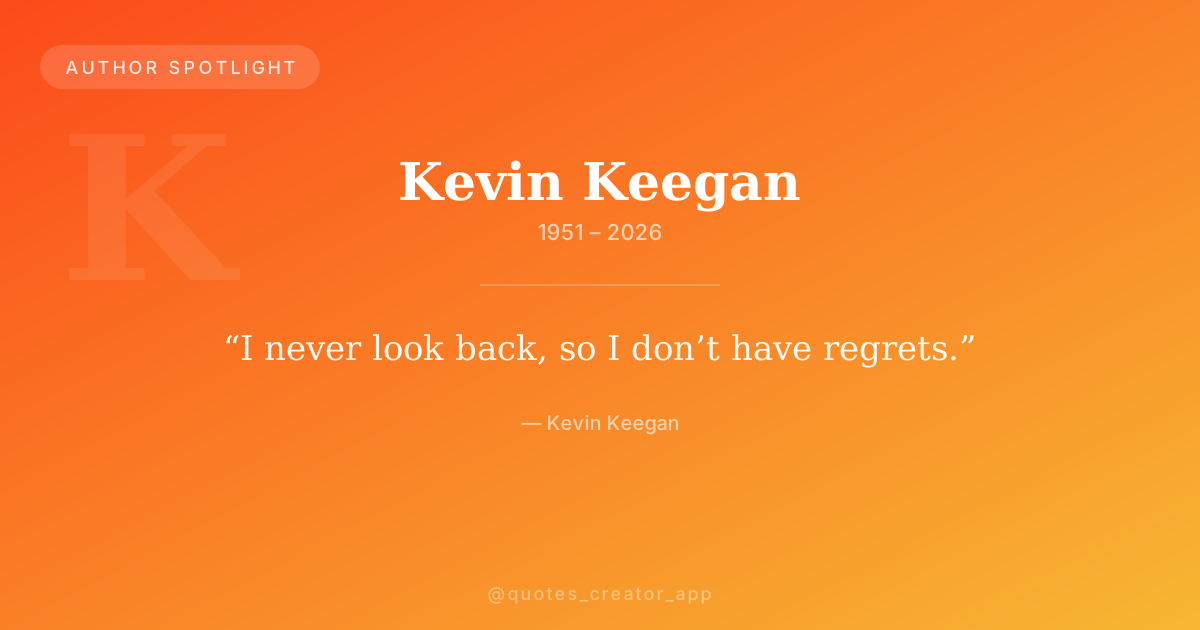
“I never look back, so I don’t have regrets.”
The meaning behind these words
There is a stoic simplicity to this line that belies the turbulence of Keegan’s career. He could have had regrets. He could have regretted walking away from the England job after a single defeat. He could have regretted his ill-fated return to Newcastle in 2008, when a dispute with the club’s director of football drove him out after just eight months. He could have regretted the title that got away in 1996, the Champions League final with Hamburg in 1980, the injuries that limited his international career. But Keegan chose not to live in the rear-view mirror.
This forward-facing philosophy is what made Keegan such a compelling leader, even in defeat. Players who worked under him describe a manager who never dwelt on mistakes, who believed the next match always offered a fresh start. It is a mindset that served him well as a player, too — this was a man who, at 31, dropped down a division to join a struggling Newcastle side when he could have coasted at the top. He was always running toward the next thing. “I never look back” is not denial; it is a conscious choice to keep moving, to keep believing, to keep living with the same enthusiasm and passion that defined everything he touched.
Kevin’s legacy
Kevin Keegan’s legacy cannot be measured solely in medals, though there are plenty of those: three league titles, two UEFA Cups, an FA Cup, a European Cup, two Ballons d’Or, a Bundesliga title, 63 England caps, 204 club goals, and three promotions won as a manager. What makes Keegan distinct is how he achieved what he did — and how people felt watching him do it. He was the small man with the giant heart, the £33,000 signing from the Fourth Division who became the best player in Europe. He was the manager who made an entire city believe they could win the league, not through tactical genius or defensive organisation, but through sheer force of personality and the conviction that football was meant to be beautiful.
In the days since his passing, tributes have poured in from Liverpool, Hamburg, Southampton, Newcastle, Manchester City, Fulham, and the England national team — each club claiming a piece of him, each fanbase remembering him in their own way. This is the mark of a truly great figure: he belonged to everyone. And in the midst of a 2026 World Cup summer, with football once again the global conversation, Keegan’s life feels like a reminder of what the game can mean beyond the scorelines and the balance sheets. He was, in the truest sense, one of us — a fan who got to live the dream, and who never stopped being grateful for it.
Create graphics with Kevin’s quotes
Kevin Keegan’s words carry the same fire and honesty that defined his life. Whether you are sharing on Instagram, creating a vision board, or looking for daily motivation, Quotes Creator helps you transform these quotes into beautiful, shareable designs with custom fonts, gradients, and layouts.
Why we chose Kevin
Kevin Keegan passed away on 20 July 2026, and the outpouring of love from across the football world has been extraordinary. He was more than a great player and manager. He was the embodiment of a kind of passion that feels increasingly rare. In an age of analytics and careful statements, Keegan was gloriously, recklessly human. He cried, he raged, he believed, and he made everyone around him believe too. For a generation of football fans, he was not just a sporting figure but a emotional touchstone — proof that you could wear your heart on your sleeve and still conquer the world. That is a legacy worth celebrating.
— ThinkPeak Studio Editorial Team
Create your own quote graphic with this quote
Turn this line into a shareable graphic in seconds — free, no signup needed. For video quotes and 100+ templates, try the Android app.
Advertisement
Enjoyed this article? Get more like it in your inbox.