On this page
Author Spotlight: Lindsey Graham
U.S. Senator from South Carolina (2003–2026), former Air Force JAG colonel, and one of the most candid voices in American politics
Who was Lindsey Graham?
Lindsey Olin Graham was born on July 9, 1955, in Central, South Carolina, a small town where his parents, Millie and Florence, ran a pool hall, liquor store, and restaurant. He was the first member of his family to attend college, graduating from the University of South Carolina in 1977 with a degree in psychology, followed by a law degree from the university’s law school in 1981. Tragedy struck early: his mother died of Hodgkin’s disease when he was 21, and his father died shortly after, leaving the 22-year-old Graham to adopt his 13-year-old sister Darline and raise her as his own. These formative experiences, growing up in a working-class household and confronting loss at a young age, shaped his worldview and gave him the blend of toughness and empathy that would define his public life.
Graham joined the U.S. Air Force in 1982, serving in the Judge Advocate General’s Corps as a military prosecutor and defense attorney, eventually becoming the Air Force’s chief prosecutor in Europe. He remained in the reserves for decades, retiring as a colonel in 2015 and receiving a Bronze Star Medal for his legal work supporting military operations in Iraq and Afghanistan. Elected to the South Carolina House of Representatives in 1992 and to the U.S. House in 1994, he gained national prominence as a House impeachment manager during the trial of President Bill Clinton in 1998. He was elected to the U.S. Senate in 2002, where he would serve for over two decades, chairing both the Senate Judiciary Committee and the Senate Budget Committee. He formed a close bond with Senators John McCain and Joe Lieberman—the self-styled “Three Amigos”—and became known for his willingness to reach across the aisle on immigration reform, national security, and judicial confirmations, even as his politics evolved from maverick Republican to close Trump ally.
Graham was a self-described hawk who believed deeply in American military power and the nation’s role as a global leader. He advocated for strong support of Israel, Ukraine, and NATO, and frequently warned about the threats posed by Iran, China, and international terrorism. His political journey was one of the most closely watched transformations in modern Washington: a fierce critic of Donald Trump during the 2016 primaries who later became one of the president’s most loyal and influential allies. Graham never apologized for the shift, framing it as pragmatic necessity. “I went from, ‘O.K., he’s president’ to ‘How can I get to be in his orbit?’” he told The New York Times in 2019. His candor about his own motivations—whether on Supreme Court nominations, foreign policy, or impeachment—set him apart in a chamber where careful evasion is the norm.
On July 11, 2026, Lindsey Graham died at the age of 71, just two days after his birthday and only weeks after winning the Republican nomination for what would have been his fifth term in the Senate. His death marks the end of a three-decade career in national politics during which he was, by turns, a consensus builder, a partisan warrior, a presidential candidate, and a key architect of the modern federal judiciary. He leaves behind a legacy as one of the most quotable—and at times controversial—figures in recent American history, a man whose words captured both the earnestness and contradictions of his era.
Lindsey Graham’s most memorable quotes
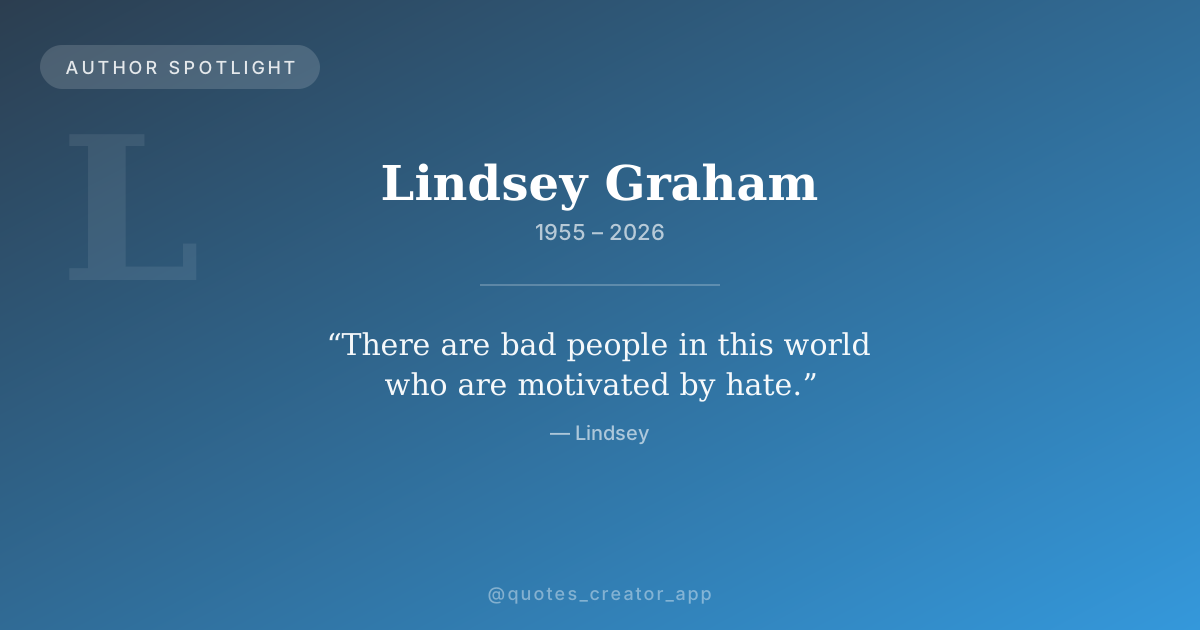
“There are bad people in this world who are motivated by hate.”
The meaning behind these words
On June 17, 2015, a 21-year-old white supremacist walked into Emanuel African Methodist Episcopal Church in Charleston, South Carolina, and murdered nine Black parishioners during a Wednesday night Bible study. The massacre shook the nation and pierced Graham’s home state at its spiritual core. In the hours and days that followed, as politicians offered carefully worded statements that danced around the shooter’s motive, Graham went directly to the point: there are bad people in this world motivated by hate. He did not hide behind mental illness narratives or post-hoc rationalizations. He named what he saw. The quote’s power lies in its stark refusal to equivocate. In nine plain words, Graham offered a moral diagnosis that cut through the noise of cable news speculation and political hedging.
The statement also reflects a theme that ran through Graham’s entire foreign policy worldview. He believed that evil was not an abstraction, that there were genuine adversaries—whether a lone gunman in a Charleston church, a terrorist organization in the Middle East, or a hostile regime in Tehran—who acted from genuine malevolence. This was not political rhetoric for him; it was a conviction forged in his years as a military lawyer, where he saw firsthand the consequences of violence. The Charleston quote has endured because it does what the best political speech does: it tells the truth simply, without adornment, in a moment when truth is the only thing a wounded community can bear to hear.
“I know the difference between the world as we wish it to be and the world as it is.”
The meaning behind these words
Delivered before the American Israel Public Affairs Committee, this line distills Graham’s foreign policy philosophy into a single sentence. The speech that surrounded it was a portrait gallery of the world’s problems: rockets from Gaza, Hezbollah attacks from Lebanon, an Iran governed by Holocaust deniers, an Afghanistan where young girls could not attend school, and a United Nations that produced reports Graham considered biased against Israel. He moved methodically between “the world as we wish it to be”—peaceful, democratic, governed by rule of law—and “the world as it is”—divided, armed, and dangerous. The refrain became the spine of his worldview: you cannot fix what you refuse to see.
What makes this quote more than a foreign policy talking point is its unspoken challenge to the idealist tradition in American politics. Graham was effectively saying: good intentions are not enough. Wishing for peace does not produce it. The world has real enemies, real dangers, and real victims, and the obligation of leadership is to confront them with clear eyes. This was the argument he made consistently, whether on the Senate floor defending military aid to Ukraine, in committee hearings grilling State Department officials on Iran, or in campaign speeches warning about the resurgence of great-power competition. It is a worldview that frustrates dovish critics and energizes hawkish allies, but it is consistent. Graham never pretended the world was safer than it was, and he never apologized for believing that American power was the best instrument for making it safer.
“I want you to use my words against me. If there’s a Republican president in 2016 and a vacancy occurs in the last year of the first term, you can say, ‘Lindsey Graham said, let’s let the next president, whoever it might be, make that nomination,’ and you could use my words against me, and you’d be absolutely right.”
The meaning behind these words
In March 2016, Senate Majority Leader Mitch McConnell refused to hold hearings for Merrick Garland, President Barack Obama’s nominee to the Supreme Court, arguing that the vacancy should be filled by the next president since the election was less than nine months away. Graham endorsed the blockade but did something unusual for a politician: he invited people to hold him accountable if the circumstances were ever reversed. “Use my words against me,” he said, laying down a marker of personal consistency. He went further, stating that any future Republican president facing a vacancy in the last year of a first term should also defer to the next president. It was a rare moment of a senator leaving himself no room to maneuver.
When Ruth Bader Ginsburg died in September 2020, less than two months before the presidential election, the reversal came swiftly. Graham endorsed filling the seat immediately under President Trump, and those exact words from 2016 were played back to him on every news network. The quote became a case study in political accountability, both because Graham had invited the scrutiny and because he ultimately ignored his own standard. Whether one views this as rank hypocrisy or pragmatic adaptation, the 2016 statement remains remarkable: a politician voluntarily creating a benchmark against which his future actions would be measured. In an institution that thrives on plausible deniability, Graham gave his critics the receipts.
“Count me out. Enough is enough.”
The meaning behind these words
On January 6, 2021, after a violent mob stormed the U.S. Capitol in an attempt to overturn the results of the 2020 presidential election, the Senate reconvened that evening to finish certifying Joe Biden’s victory. Graham, who had been one of Donald Trump’s most reliable allies, took the floor and delivered words that stunned the chamber. He spoke of his journey with Trump as a “hell of a journey,” acknowledged Biden as the lawfully elected president, and then, with visible emotion, said: “Count me out. Enough is enough.” For a man who had spent four years defending the president on television and in committee hearings, it was a line that seemed to close a chapter.
The quote matters not because it signaled a permanent break—Graham would continue to work with Trump in subsequent years—but because it revealed where his personal red line lived. Graham could tolerate policy disagreements, inflammatory tweets, and political maneuvering. But the violent attempt to subvert a democratic election, an attack on the very chamber where he had spent decades of his life, crossed a threshold he could not abide. It was the closest Graham ever came to a public repudiation of the Trump era’s excesses, and it has been cited ever since as evidence that even the most loyal allies can have a moment of clarity. The five words are blunt, unadorned, and final—everything a turning-point line should be.
Lindsey’s legacy
Lindsey Graham’s thirty-year career in public service resists easy categorization. He was a bipartisan negotiator on immigration reform who championed comprehensive bills with Democrats like Chuck Schumer, yet also a fierce partisan who declared during the first Trump impeachment that he was “not trying to pretend to be a fair juror.” He was a military lawyer who earned a Bronze Star and a Senate hawk who never met a defense appropriation he did not support. He was a Trump critic who became a Trump confidant, a South Carolina conservative who golfed with John McCain, and a Judiciary Committee chairman who shepherded hundreds of federal judges through confirmation. The contradictions are not bugs in his story; they are the story.
Graham’s most enduring institutional legacy may be his role in reshaping the federal judiciary. As Judiciary Committee chairman from 2019 to 2021, he moved an unprecedented number of conservative judges onto the federal bench, including three Supreme Court justices. He took enormous pride in this work, viewing it as the most concrete and lasting impact a senator could have on American life. But his broader legacy is the example of an old-school Senate operator who understood that relationships—with colleagues, with presidents, with the press—were the real currency of Washington. He was, to the end, a figure who believed that politics was personal, and that showing up and speaking plainly mattered more than ideological purity tests. Whether you agreed with him or not, Lindsey Graham leaves behind a body of words—plain, quotable, and unfiltered—that will be studied by anyone trying to understand this turbulent chapter of American political life.
Create graphics with Lindsey’s quotes
Lindsey Graham’s words have a blunt, quotable quality that makes them perfect for quote graphics. Whether you are sharing on Instagram, creating a vision board, or looking for daily inspiration, Quotes Creator helps you transform these quotes into beautiful, shareable designs with custom fonts, gradients, and layouts.
Why we chose Lindsey
Lindsey Graham passed away on July 11, 2026, just two days before this spotlight was published. His death closes a chapter on a three-decade Senate career that spanned the Clinton impeachment, the post-9/11 wars, the Tea Party wave, the Trump presidency, and the reshaping of the federal courts. Graham had a rare gift for speaking in plain, memorable sentences—whether he was condemning hate, explaining foreign policy, or setting a standard he knew would be tested. In an era of carefully focus-grouped political speech, his willingness to say what he thought, consequences be damned, made him endlessly quotable and genuinely distinctive. We believe his words reward a second look.
— ThinkPeak Studio Editorial Team
Create your own quote graphic with this quote
Turn this line into a shareable graphic in seconds — free, no signup needed. For video quotes and 100+ templates, try the Android app.
Advertisement
Enjoyed this article? Get more like it in your inbox.