On this page
Author Spotlight: Lionel Messi
The boy from Rosario who redefined greatness through quiet determination and supernatural talent
Who was Lionel Messi?
Lionel Andrés Messi was born on June 24, 1987, in Rosario, Argentina, to a steel factory worker and a part-time cleaner. From the age of four, he was inseparable from a football. But at eleven, his life took a dramatic turn when doctors diagnosed him with growth hormone deficiency — a condition that required expensive monthly injections his family could not afford. At thirteen, Barcelona took a monumental gamble: they offered to pay for his medical treatment if he moved to Spain. Messi left his country, his extended family, and everything familiar behind in pursuit of a dream that seemed impossibly distant. The shy, diminutive boy who barely spoke in the locker room would go on to become the most decorated footballer in history.
Messi made his competitive debut for Barcelona at seventeen and never looked back. Over seventeen seasons, he amassed an astonishing 672 goals for the club, won ten La Liga titles and four Champions League trophies, and collected 34 pieces of silverware — a club record. He holds the records for most goals in a calendar year (91), most goals in La Liga history (474), and most Ballons d’Or (eight). When financial turmoil forced his heartbreaking departure from Barcelona in 2021, he joined Paris Saint-Germain before moving to Inter Miami in 2023, where he immediately transformed American football and became the first active MLS player to receive the Presidential Medal of Freedom. His 2022 World Cup triumph with Argentina — the nation’s first in 36 years — was the crowning moment of a career that had already surpassed every conceivable benchmark.
What sets Messi apart philosophically is the chasm between his superhuman output and his strikingly ordinary approach to life. He has described himself as “just another footballer,” and those who know him confirm that he means it. His game is driven by instinct, not calculation; he does not visualize plays or memorize opponents’ patterns but rather reacts in real time with a creativity that borders on the inhuman. Yet beneath this effortless exterior lies an obsessive work ethic. He arrives early, stays late, and treats every training session as an opportunity to improve something — anything. This paradox of natural genius fused with relentless discipline is what separates him from every peer: he makes the impossible look routine not because he was born to it, but because he has spent every day since childhood refusing to accept any ceiling.
By 2026, Messi had become the first footballer to appear on Forbes’ World’s Billionaires list with a net worth of $1.1 billion, yet those closest to him insist that money has never been a motivating factor. He has said he would play for free. That sentiment is not empty rhetoric — it is the organizing principle of his life. Whether guiding Argentina to its third World Cup final, collecting back-to-back MLS MVP awards, or quietly funding children’s hospitals through the Leo Messi Foundation, he has remained the same soft-spoken Rosario kid who left home at thirteen with nothing more than a dream and a left foot that would change history.
Lionel Messi’s most memorable quotes
“You can overcome anything, if and only if you love something enough.”
The meaning behind these words
This single sentence contains the entire architecture of Messi’s improbable journey. As a child, he faced a medical condition that threatened to derail his athletic ambitions before they began. The growth hormone injections he needed cost his family roughly $900 a month — an impossible sum for working-class parents in 1990s Argentina. What carried him through was not talent, which was abundant, but love: a love for football so consuming that leaving his country at thirteen felt less like sacrifice and more like necessity. The quote resonates because it reframes hardship not as something to endure but as something that dissolves in the presence of genuine passion. Messi is not saying love makes obstacles disappear; he is saying that love makes the work of overcoming them feel inevitable rather than impossible.
This philosophy extends beyond football. Across disciplines — art, science, entrepreneurship — there is a consistent pattern: those who reach the summit are rarely the most naturally gifted; they are the ones whose attachment to the craft is so deep that quitting never registers as an option. Messi’s career is a twenty-year case study in that principle. He never set out to be the greatest player in history. He simply loved football too much to let anything — not his body, not Barcelona’s financial collapse, not Argentina’s decades-long trophy drought — stand in the way.
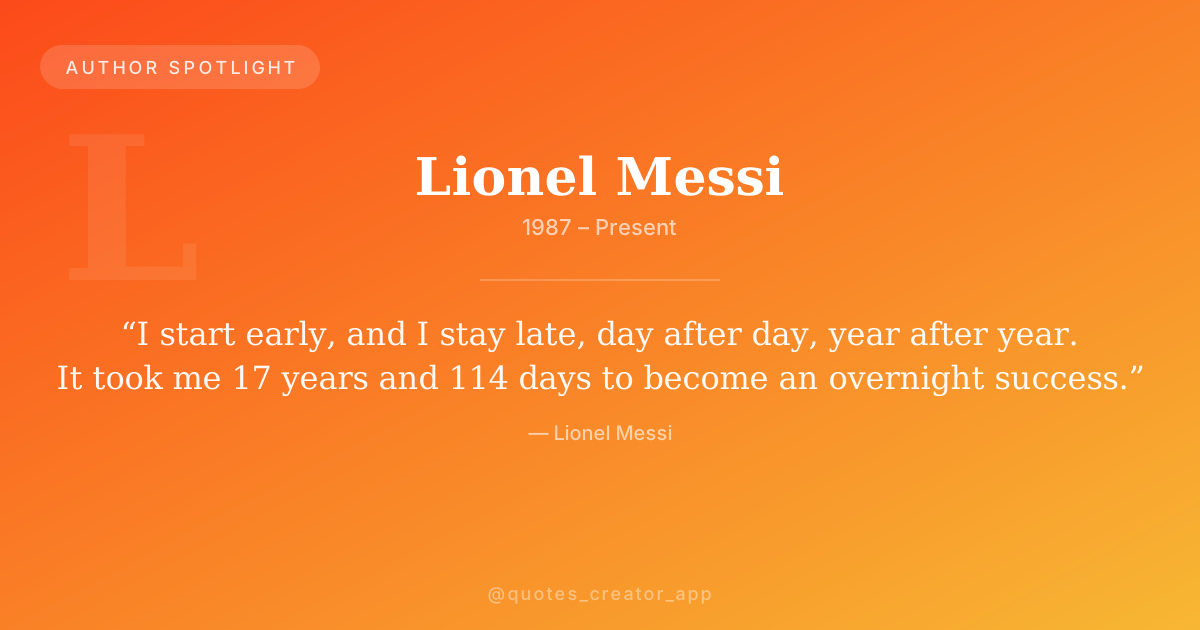
“I start early, and I stay late, day after day, year after year. It took me 17 years and 114 days to become an overnight success.”
The meaning behind these words
In an era that glorifies the startup unicorn, the viral moment, and the young prodigy who seems to arrive fully formed, this quote is a bracing corrective. Messi debuted for Barcelona at seventeen and within three years was being compared to Diego Maradona. To the outside world, his rise looked meteoric. What this quote reveals is the glacial infrastructure beneath the surface: seventeen years of invisible work before anyone used the word “great.” The phrase “overnight success” is deployed with wry irony — Messi understands that the label is a fiction, a shorthand people use to avoid confronting the uncomfortable truth that excellence is almost never spontaneous.
This commitment to daily discipline is what distinguishes Messi from the countless talented players who flickered and faded. Football history is littered with teenage sensations who dominated headlines for a season or two before vanishing. Messi sustained his peak for nearly two decades, a feat of physical and mental endurance that may be even more remarkable than the trophies themselves. The quote doubles as a challenge to anyone in any field: are you willing to show up early and stay late, day after day, year after year, with no guarantee of recognition? Because that is what the path actually looks like.
“The best decisions aren’t made with your mind, but with your instinct.”
The meaning behind these words
Here lies the key to understanding what makes Messi unplayable on a football pitch. Opponents, analysts, and coaches have spent twenty years trying to decode his decision-making: how does he know, in a split second, which of five passing lanes to choose, which direction to feint, when to accelerate and when to pause? The answer, according to Messi himself, is that he does not think at all. His creative process is entirely intuitive. While most elite players operate on a blend of preparation and improvisation, Messi claims he never visualizes plays or pre-plans sequences. He simply receives the ball and does what the moment demands. This makes him impossible to predict because there is no plan to decipher; his genius exists in a realm that predates conscious thought.
There is a broader application here that transcends sport. Western culture places enormous faith in rational deliberation — the careful weighing of pros and cons, the spreadsheet, the five-year plan. Messi offers a counter-narrative: that the body and subconscious mind contain a wisdom that the conscious mind cannot access, and that the highest level of performance in any domain often requires getting out of your own way. His career is an argument for trusting the instincts that have been honed through thousands of hours of practice, for letting the accumulated experience speak rather than the anxious inner voice that second-guesses everything.
“I’m more worried about being a good person than being the best football player in the world. When all this is over, what are you left with? When I retire, I hope I am remembered for being a decent guy.”
The meaning behind these words
This is the quote that most fully captures the man behind the mythology. In an industry that rewards self-promotion, Messi has spent his entire career deflecting attention toward his teammates. He prefers winning team titles over collecting individual accolades, and he has consistently described the Ballon d’Or — which he has won more than any other player — as secondary to collective success. What this quote reveals is a value system fundamentally at odds with the celebrity-industrial complex. Messi measures his life not by trophies or bank balances but by the kind of person he is when the stadium lights go off and no one is watching. In an age of carefully curated personal brands, this insistence on decency over dominance is quietly radical.
The question embedded in the quote — “When all this is over, what are you left with?” — is one that every high achiever must eventually confront. Careers end. Records are broken. Fame is fleeting. What persists is the impact you had on the people around you, the kindness you showed when it was inconvenient, the example you set for those who followed. Messi’s hope to be remembered as a “decent guy” is not false modesty; it is the endpoint of a life philosophy that places humanity above accolades. And perhaps that is why, despite the jaw-dropping statistics, what fans love most about him is not the goals but the quiet dignity with which he has carried himself through every triumph and every failure.
Lionel’s legacy
Lionel Messi’s legacy in football is already secure: he is, by virtually every quantifiable measure, the greatest player to ever kick a ball. But the more enduring legacy may be what he represents beyond the sport. He is proof that greatness does not require charisma in the traditional sense. He did not need to be loud, confrontational, or theatrical. He did not need to manufacture rivalries or court controversy to remain relevant. In a world that often conflates volume with substance, Messi demonstrated that quiet excellence, sustained over decades, speaks louder than any press conference or social media campaign ever could.
His journey from a growth-hormone-deficient child to a global icon also rewrites the script on what it means to overcome adversity. His story is not one of dramatic, cinematic triumph but of slow, steady, unglamorous work. He left home, he endured injections, he weathered devastating losses with Argentina that nearly drove him to retire, and he kept going. For anyone struggling through the long middle stretch of their own journey — the years where no one is watching and the finish line is nowhere in sight — Messi’s career is a quiet reminder that persistence is a form of genius in itself. As the 2026 World Cup unfolds with Argentina once again in the final, the boy from Rosario who was told he was too small stands at the center of football’s biggest stage, not because he was destined to be there, but because he never once considered being anywhere else.
Create graphics with Lionel’s quotes
Lionel Messi’s words have a timeless quality that makes them perfect for quote graphics. Whether you are sharing on Instagram, creating a vision board, or looking for daily inspiration, Quotes Creator helps you transform these quotes into beautiful, shareable designs with custom fonts, gradients, and layouts.
Why we chose Lionel
As the 2026 FIFA World Cup reaches its climax with Argentina in the final, Lionel Messi is once again the most talked-about athlete on the planet. But this spotlight is not about the goals or the trophies — it is about the philosophy behind them. Messi offers a rare example of someone at the absolute pinnacle of his field who measures success not by external validation but by internal standards: hard work, instinct, love of the craft, and basic human decency. In an age of relentless self-promotion, his quiet, persistent excellence feels almost subversive. We chose Messi because his words contain a blueprint for greatness that applies far beyond football.
— ThinkPeak Studio Editorial Team
Create your own quote graphic with this quote
Turn this line into a shareable graphic in seconds — free, no signup needed. For video quotes and 100+ templates, try the Android app.
Advertisement
Enjoyed this article? Get more like it in your inbox.