On this page
Author Spotlight: Malala Yousafzai
From a schoolgirl blogging under a pseudonym in Taliban-occupied Swat Valley to the youngest Nobel laureate in history — a journey through the words, the courage, and the unwavering conviction of a young woman who made the world listen.
Who is Malala Yousafzai?
Malala Yousafzai was born on 12 July 1997, in Mingora, a city in Pakistan’s Swat Valley, into a lower-middle-class Sunni Muslim family of Pashtun ethnicity. The family could not afford a hospital birth, so she was delivered at home with the help of neighbours. Her father, Ziauddin Yousafzai, was a poet, a school owner, and an educational activist who ran the Khushal Public School — a chain of private schools in the valley. He named his daughter after Malalai of Maiwand, a legendary Pashtun poet and warrior woman who rallied Afghan forces against the British in 1880. From the earliest years, Ziauddin treated his daughter as something entirely special: he let her stay up at night to talk politics after her two younger brothers had been sent to bed. He encouraged her ambition. He took her to the local press club in Peshawar in September 2008, when she was eleven, to deliver her first public speech. “How dare the Taliban take away my basic right to education?” she asked, in words that would be carried by newspapers and television channels across the region. The speech was a small thing — a child at a press club — but the question she asked contained within it a moral clarity that the whole world would soon be forced to reckon with.
In early 2009, when Malala was eleven years old, the Pakistani Taliban under Maulana Fazlullah tightened its grip on the Swat Valley. Television and music were banned. Women were forbidden from going shopping. Bodies of beheaded policemen were displayed in town squares. And on 15 January 2009, the Taliban issued an edict: no girl could attend school. More than a hundred girls’ schools were blown up. It was in this atmosphere of terror that the BBC Urdu service came up with an idea: ask a schoolgirl to blog anonymously about life under the Taliban. After other candidates withdrew out of fear, Ziauddin suggested his own daughter. The BBC editors, concerned for her safety, insisted she use a pseudonym. And so, under the name Gul Makai — “cornflower” in Pashto, taken from a character in a Pashtun folktale — Malala began writing. She hand-wrote her entries and passed them to a reporter who scanned and emailed them. Her first entry appeared on 3 January 2009. She wrote about her fear of going to school, about the sound of artillery fire at night, about watching her classmates disappear one by one as families fled the valley. She wrote: “I had a terrible dream yesterday with military helicopters and the Taliban.” She was eleven years old, writing sentences that would eventually be read by millions, chronicling a nightmare from inside it.
The blog ended in March 2009, but Malala’s public life was only beginning. A New York Times documentary followed her family through the displacement and trauma of the Second Battle of Swat. She gave interviews on Pashto and Urdu television. Archbishop Desmond Tutu nominated her for the International Children’s Peace Prize. She received Pakistan’s first National Youth Peace Prize. And as her profile grew, so did the danger. Death threats appeared in newspapers and were slipped under her door. The Pakistani Taliban held a meeting in the summer of 2012 and voted unanimously to kill her. On 9 October 2012, a gunman boarded her school bus, asked “Who is Malala?”, and shot her in the head. The bullet traveled eighteen inches — through her left eye socket, down her neck, and into her shoulder. Two other girls were wounded. Malala was airlifted to a military hospital in Peshawar and then transferred to the Queen Elizabeth Hospital in Birmingham, England, where she underwent multiple surgeries, including a decompressive craniectomy to relieve brain swelling and an eight-hour operation to repair her facial nerve. She did not die. And when she emerged from her coma, she did not retreat. Within nine months of being shot, she stood at the podium of the United Nations and delivered a speech that would be heard around the world.
In the decade since, Malala has done what no one — not the Taliban, not her critics, not the cynics — could have predicted. She co-authored the international bestseller I Am Malala (2013). She became the youngest-ever Nobel Peace Prize laureate at seventeen, sharing the prize with children’s rights activist Kailash Satyarthi. She co-founded the Malala Fund with Shiza Shahid, directing millions of dollars toward girls’ education projects in countries from Pakistan to Nigeria to Afghanistan. She completed a degree in Philosophy, Politics, and Economics at Lady Margaret Hall, Oxford, graduating with honours in 2020. She became the youngest-ever Honorary Fellow at Linacre College, Oxford, in 2023. She produces film and television through her company Extracurricular, telling stories about women whose lives reflect the struggles she has spent her own life fighting. In 2021, she married Asser Malik, a manager with the Pakistan Cricket Board. And in 2025, she published Finding My Way, a memoir reflecting on her journey from the Swat Valley to the global stage. At twenty-nine, Malala Yousafzai is no longer the schoolgirl who blogged under a pseudonym. She is something rarer: a moral witness whose authority has only deepened with time, a young woman who survived an attempt on her life and used the attention it generated not to build a brand but to build a movement.
Malala Yousafzai’s most memorable quotes
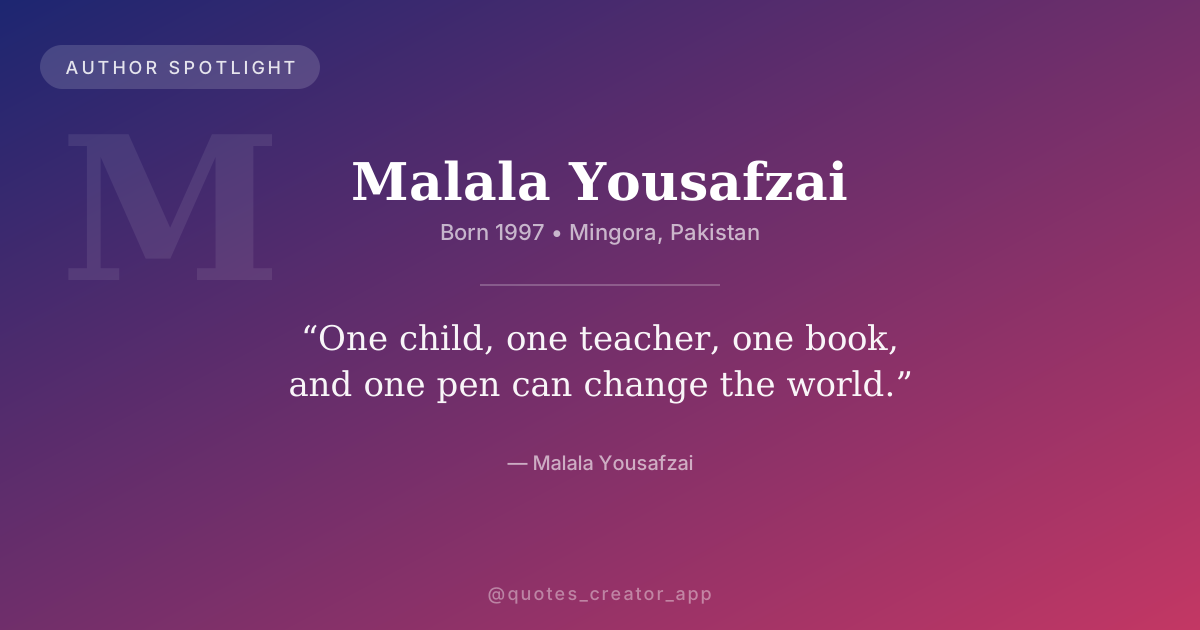
“One child, one teacher, one book, and one pen can change the world.”
The meaning behind these words
This sentence — perhaps the most quoted line Malala has ever spoken — achieves something that very few political slogans manage: it is simultaneously simple enough for a child to understand and profound enough to sustain a lifetime of activism. The structure is deliberately cumulative. “One child” — the individual, the person who dares to want something different. “One teacher” — the relationship, the irreplaceable human transaction that no technology and no curriculum can substitute for. “One book” — the knowledge, the inheritance of centuries compressed into pages. “One pen” — the agency, the tool by which the child becomes not merely a recipient of education but a producer of it. Each item builds on the last, and the verb that closes the sentence — “change the world” — is deliberately ambitious. She is not saying education makes life better, or easier, or more comfortable, though it does all those things. She is saying it changes the world. The claim is maximal, and she means it literally.
What gives the sentence its weight is the person who speaks it. Malala is not a politician running for office or a tech executive selling a product. She is a girl who was shot in the head for insisting she had a right to sit in a classroom. When she says that one book and one pen can change the world, she is speaking from the far side of a lived experiment. The Taliban tried to kill her because they believed — correctly, from their perspective — that a girl with a book and a pen was a threat to their entire system of power. They were not wrong. The sentence is not a platitude; it is a report from a battlefield, delivered by someone who nearly died on it and has chosen to stay on it.
“The terrorists thought they would change my aims and stop my ambitions, but nothing changed in my life except this: weakness, fear and hopelessness died. Strength, power and courage was born.”
The meaning behind these words
This passage — delivered on her sixteenth birthday, her first public speech since the shooting, at the first-ever Youth Takeover of the United Nations — is remarkable for what it refuses to do. It does not describe the attack. It does not name the attackers. It does not ask for sympathy or revenge. Instead, it performs a complete inversion of the expected emotional trajectory. The Taliban intended to silence her; the result, she tells the world, was the precise opposite. The things that died were not her ambitions, her aims, or her voice, but the internal obstacles that might have prevented her from pursuing them. Weakness, fear, hopelessness — these are not external enemies but internal states. And she declares them dead. The verbs are chosen with surgical precision: weakness died, strength was born. This is the language of transformation, not recovery. She is not saying she healed; she is saying she became something new.
The rhetorical architecture of the passage is built on a binary: the terrorists’ intentions on one side, the actual outcome on the other. “They thought they would change my aims” — that is the prediction. “Nothing changed in my life except this” — that is the rebuttal. And then she enumerates what did change, and the list is entirely internal, entirely within her control. The tactical genius of this move is that it deprives the attackers of any power they might have claimed. You cannot take credit for someone’s courage. You cannot claim victory when your bullet produced the opposite of what you intended. Malala does not just survive the story; she takes authorship of it. The Taliban wrote one chapter, and she has spent every year since writing the rest.
“I told myself, Malala, just take a shoe and hit him. But then I said, if you hit a Talib with your shoe, then there would be no difference between you and the Talib. You must not treat others with cruelty and that much harshly. You must fight others but through peace and through dialogue and through education.”
The meaning behind these words
When Malala appeared on The Daily Show at sixteen, she had already survived an assassination attempt, addressed the United Nations, and published an international bestseller. Jon Stewart, a man whose entire career had been built on finding the right thing to say, asked her what she would do if a Taliban gunman confronted her again. Her answer — which left Stewart visibly moved and, for one of the few times in his television career, speechless — contains a complete moral philosophy in three movements. The first movement is human: she imagines hitting her attacker with a shoe, which in Pashtun culture is a gesture of the deepest possible contempt. She allows herself the fantasy of retaliation. The second movement is the turning point: she catches herself, recognising that meeting cruelty with cruelty would erase the moral distinction between her and the person who shot her. This is not abstract principle; it is a teenager, speaking to a late-night host, working through the logic of nonviolence in real time. The third movement is the alternative: fight through peace, through dialogue, through education. Not surrender. Not passivity. Fight — the verb is deliberate and confrontational. But the weapons are words, not bullets.
The sequence is extraordinary because it moves, in the space of a few sentences, from anger to restraint to conviction. She does not pretend she has never wanted revenge. She admits the impulse and then reasons her way past it. This is what separates Malala’s nonviolence from the sanitised, sentimental version that is easy to admire from a distance. Her nonviolence is not the absence of anger; it is the conscious decision to channel anger into something more durable than retaliation. “I even want education for your children as well,” she went on to tell Stewart, explaining what she would say to a Taliban gunman. This is the hardest demand her philosophy makes: that you extend to your enemy the same thing you are fighting for yourself. Most political movements never get there. Malala arrived at it before she turned seventeen.
“I tell my story not because it is unique, but because it is the story of many girls.”
The meaning behind these words
This sentence, from the opening pages of her memoir, is a quiet act of radical humility. Malala had every right to centre herself. She had survived an assassination attempt, addressed the United Nations, and become the most famous teenager on earth. The instinct — and the publishing industry’s expectation — would have been to write a book about the exceptional individual who overcame extraordinary circumstances. Instead, Malala opens by rejecting that framing. Her story is not unique. It is representative. She is not special; the circumstances that made her famous — a girl denied education, a girl threatened with violence, a girl who refused to be silenced — are the circumstances of millions. She is simply the one the cameras found.
The rhetorical move is devastating because it takes the spotlight that the world had placed on her and redirects it. You came here to read about me, she tells the reader, but the point of my story is that it belongs to everyone. This is not false modesty; it is a strategic choice about how to use fame. Most people who survive a tragedy and become internationally known use their platform to tell their own story. Malala used hers to insist that her story was not the one that mattered most. The millions of girls who are not on television, who do not have book deals, who cannot speak at the United Nations — they are the subject of this sentence. Malala is the narrator, not the protagonist. The protagonist is every girl who has ever been told she cannot learn.
“Traditions are not sent from heaven, they are not sent from God. It is we who make cultures and we have the right to change it and we should change it.”
The meaning behind these words
At the Girl Summit in London, Malala addressed an issue that gets to the heart of why girls are denied education in so many parts of the world: the appeal to tradition. It is an argument she had encountered her entire life, in Pakistan and beyond — that girls should not go to school because that is not how things are done, because it contradicts cultural norms, because the ancestors would not have approved. Her response is a complete refusal to grant tradition any moral authority. Traditions are not divine. They did not descend from heaven. They are human inventions, made by specific people in specific historical circumstances for specific reasons — and anything made by humans can be unmade by humans. The theological framing is deliberate: by saying traditions are not sent from God, she is preemptively blocking the conflation of culture with religion that is so often used to justify the oppression of women. She is a practising Muslim; she knows the difference between scripture and custom, and she refuses to let anyone blur them.
The second half of the sentence is a declaration of agency and obligation. “It is we who make cultures” — the passive voice of tradition (“this is how things are done”) is replaced by the active voice of collective responsibility. We made this. And if we made it, we can change it. And if we can change it, we should. The sequence is logic dressed as conviction. The language is simple, but the claim is enormous: that human beings are not bound by the past, that the way things have always been is not a sufficient reason for the way things should remain, and that the correct response to a harmful tradition is not accommodation but transformation. Coming from a seventeen-year-old girl from a conservative Pashtun family in a region where tradition carries the weight of law, the sentence is not merely a statement of opinion; it is a line drawn in the sand, and a map for crossing it.
Malala Yousafzai’s legacy
The most measurable dimension of Malala’s legacy is institutional. The Malala Fund, which she co-founded in 2013, has invested tens of millions of dollars in girls’ education projects across Pakistan, Afghanistan, Nigeria, Syria, Brazil, and Ethiopia. The fund operates on a model that is quietly radical: rather than building its own schools from scratch, it identifies and supports local education activists — the people who know their communities, understand the cultural dynamics, and are already doing the work. This is the community-organising approach that Malala learned from her father, scaled to global dimensions. The fund has advocated successfully for policy changes, including an increase in Pakistan’s education budget and legislation protecting girls’ right to twelve years of free, safe, quality education. These are not symbolic victories; they are line items in government budgets and clauses in legal codes, the unglamorous machinery by which principles become facts on the ground.
But the deeper legacy is harder to quantify and, in the long run, likely more consequential. Malala changed what the world imagines a young Muslim woman from a conservative society can be. She is devout, moderate, feminist, and unwilling to apologise for any of these things. She wears a headscarf and demands the right to education. She forgave her attackers and insisted on accountability for the ideology that produced them. She is a Pashtun from the Swat Valley and an Oxford graduate, a Nobel laureate and a newlywed, a global icon who still speaks of returning to Pakistan to serve her country. She has become the most prominent citizen Pakistan has produced in a generation — and she has done it without ever raising her voice in anger, without ever trading her principles for access, without ever letting the machinery of fame separate her from the cause that made her famous. At twenty-nine, the girl who blogged for the BBC under a borrowed name has become the author of her own story and the co-author of a movement that will outlast her. One child, one teacher, one book, and one pen really did change the world — or at least a large and meaningful piece of it.
Create graphics with Malala Yousafzai’s quotes
Malala’s words carry the moral clarity that comes only from someone who has risked everything for what she believes. Whether you are sharing on social media, preparing a presentation, or looking for daily inspiration, Quotes Creator helps you turn these quotes into beautiful, shareable designs with custom fonts, gradients, and layouts.
Why we chose Malala
We are publishing this spotlight in early August 2026, fourteen years after the Taliban shot a fifteen-year-old girl for the crime of wanting an education — and fourteen years into the extraordinary second act that followed. Malala has been a public figure for more than half her life, and her words have been quoted so often that it is easy to forget how strange and brave they are: a teenager telling Jon Stewart she would not hit her attacker with a shoe, a seventeen-year-old Nobel laureate telling world leaders that traditions are not sent from heaven, a young woman who survived a bullet to the head and responded not with bitterness but with a book, a fund, a degree from Oxford, and a career spent insisting that the story that matters most is not hers but the story of the 130 million girls who are still out of school. We chose Malala because her quotes are not ornaments; they are arguments. And the argument she has been making since she was eleven years old — that every girl has the right to learn, and that the forces that deny her that right are human inventions that human beings can dismantle — is still being fought, and still being won, one classroom at a time.
— ThinkPeak Studio Editorial Team
Create your own quote graphic with this quote
Turn this line into a shareable graphic in seconds — free, no signup needed. For video quotes and 100+ templates, try the Android app.
Advertisement
Enjoyed this article? Get more like it in your inbox.