On this page
Author Spotlight: Matthew Perry
He was the funny one — the one with the timing, the one whose delivery could bend any line into a punchline, the one who turned a sarcastic, frightened young man named Chandler Bing into one of the most recognisable comic performances in the history of television. And for most of the ten years the world was laughing at him, he was quietly dying. Matthew Perry spent half his life fighting an addiction that nearly killed him more times than he could count, and the other half trying to turn that fight into the single thing he wanted to be remembered for: helping other people climb out of the hole he knew so intimately. This is the story of a man who understood, better than almost anyone, that the joke and the pain come from the same place — and who spent his last years trying to make the pain mean something.
Who is Matthew Perry?
Matthew Langford Perry was born on August 19, 1969, in Williamstown, Massachusetts, into a family that was, from the start, a study in restless ambition and fractured belonging. His mother, Suzanne Marie Morrison (née Langford), was a Canadian journalist who served as press secretary to Prime Minister Pierre Trudeau; his father, John Bennett Perry, was an American actor and former model. The marriage did not last. Perry’s parents separated when he was a year old, and his mother married the Canadian broadcast journalist Keith Morrison, the man who raised him. He grew up mostly in Ottawa, Ontario — with stretches in Toronto and Montreal — attending Rockcliffe Park Public School and Ashbury College, and he spent his childhood as the eldest child of a blended family that kept growing, accumulating four younger half-siblings on his mother’s side and a half-sister on his father’s. He was, by his own account, the kid who never quite felt he belonged. At ten he began acting out — stealing, smoking, letting his grades slip, and, in a detail he later confessed with rueful pride, beating up a fellow Ottawa student who would grow up to be Canadian prime minister Justin Trudeau. The loneliness had a precise shape in his memory: “I was so often on the outside looking in, still that kid up in the clouds on a flight to somewhere else, unaccompanied.” At fourteen he took his first drink, and it was, he would write decades later, the moment the war began. He was drinking every day by his eighteenth birthday. There was one thing, in those years, that gave him a sense of mastery: tennis. He practised for up to ten hours a day and became a top-ranked junior player in Canada, with a genuine shot at a professional career — until, at fifteen, he moved to Los Angeles to live with his father, where the competition was so much deeper that the dream quietly expired. What replaced it was acting. He enrolled at the Buckley School in Sherman Oaks, took improvisation classes at L.A. Connection, and graduated in 1987 already certain of what he wanted to be.
The climb to stardom was longer than the legend remembers. His first credited role was a small part on the series 240-Robert in 1979, when he was still a child, and through the 1980s he assembled the usual apprenticeship of a working young actor — guest spots on Charles in Charge and Silver Spoons, a three-episode arc on Growing Pains as a character who dies in a drunk-driving accident, a regular role on the short-lived Second Chance. His film debut came in 1988 with A Night in the Life of Jimmy Reardon, and he spent the early 1990s bouncing between sitcoms — Sydney, Beverly Hills, 90210, Home Free — never quite landing. Then came the kind of accident that rewrites a life. He was contractually committed to a pilot called LAX 2194, a comedy set two centuries in the future in an airport baggage department, which made him unavailable for a part in a new show called Six of One. When the LAX 2194 pilot collapsed, he was free to read for the other project — soon retitled Friends — and was cast as Chandler Bing. He was twenty-four, the youngest member of the ensemble. The show premiered in September 1994 and became one of the defining cultural events of the decade. By 2002 the six leads were earning a million dollars per episode. Chandler — the sarcastic, commitment-phobic, emotionally evasive data processor who deflected every feeling with a joke — became Perry’s second skin, and his precision timing, his elastic delivery, his peculiar gift for turning an ordinary line into a weapon of comic deflation, earned him an Emmy nomination and a permanent place in the language of television.
But the man on the soundstage was fighting a private war that almost no one saw clearly. He had become, in his own words, an alcoholic by fourteen, and the pressures of sudden, global fame detonated the addiction that had been lying in wait. A jet-ski accident in 1997 introduced him to Vicodin, and within a few years he was taking as many as fifty-five pills a day, his weight collapsing to 128 pounds. In May 2000 he was hospitalised with alcohol-induced pancreatitis; in February 2001 he walked off the set of Friends and checked into rehab for addictions to Vicodin, methadone, amphetamines, and alcohol — an interruption so total that he later confessed he had no memory of three years of the show, including an entire season. His castmates staged an intervention that failed; they loved him, but they could not save him, because the disease was inside him. The nadir came in 2018, when his colon burst from years of opioid abuse. He spent two weeks in a coma, was given a two percent chance of survival by the doctors, was placed on a machine that took over the work of his heart and lungs, and woke to find himself attached to a colostomy bag he would carry for nine months. By his own estimate he spent nine million dollars on his addiction, endured fourteen stomach surgeries and fifteen stays in rehab, and attended roughly six thousand Alcoholics Anonymous meetings over thirty years. In October 2022 he published Friends, Lovers, and the Big Terrible Thing, a memoir of startling candour that became a New York Times bestseller — a book written, as he put it, for people like him and for the people who love people like him. It was not a redemption story. It was a reckoning, offered by a man who had stopped pretending he was cured and started being honest about the fact that he never would be.
The final chapter was an attempt to make the suffering useful. He worked steadily through the 2000s and 2010s — in Aaron Sorkin’s Studio 60 on the Sunset Strip, in The Ron Clark Story, which brought him Golden Globe and Emmy nominations, in 17 Again, in the sitcoms Mr. Sunshine, Go On, and The Odd Couple, and in his own play The End of Longing, which he described as “an exaggerated form of me as a drunk.” But the work that mattered most to him was the work no camera captured. In 2011 he lobbied Congress as a celebrity spokesperson for the National Association of Drug Court Professionals, arguing for courts that treat addiction as an illness rather than a crime. In 2013 he received the Champion of Recovery Award from the White House Office of National Drug Control Policy and opened Perry House, a sober-living facility for men in his former Malibu mansion. He said, more than once, that he wanted to be remembered for helping people get sober more than for anything he had done on screen. He died on October 28, 2023, at the age of fifty-four, drowned in his hot tub after a fatal dose of ketamine — an ending that was at once an accident and the inevitable terminus of a lifelong disease. Days later, the National Philanthropic Trust established the Matthew Perry Foundation to carry on the work he had chosen for himself. Five people who supplied him with the drug were ultimately charged; all five pleaded guilty. The man who had spent his life making a world laugh had, in the end, left behind something more durable than laughter: a warning, and a hand reaching out to the next person drowning.
Matthew Perry’s most memorable quotes
“It’s been more than a show. It’s been a wonderful support group. It’s a group of people that love each other, that come together every day to try to make America laugh. What better thing is there to do than that?”
The meaning behind these words
This sentence, spoken as Friends wound toward its finale in the spring of 2004, is a rare and revealing thing: a global celebrity describing his fame not in terms of money, ratings, or prestige, but in terms of love and duty. Listen to what he actually claims. The show was never a job or a product. It was a “support group,” a community of six people who “love each other” and who “come together every day” for a purpose that has nothing to do with commerce and everything to do with the strange, old-fashioned dignity of making strangers laugh. The word “America” is deliberate and almost quaint — he is reaching back toward an older idea of television, the broadcast era in which a single show could gather a whole country around a shared joke. And then the kicker, asked as a genuine question: “What better thing is there to do than that?” It is not rhetorical, exactly. It is the honest bewilderment of a man who has accidentally stumbled into the thing that matters and cannot quite believe his luck.
The sentence has a second, more private meaning that only became clear in retrospect. When Perry called the cast his “support group,” he was not speaking loosely. He was in the middle of the worst years of his addiction, and those five people — Jennifer, Courteney, Lisa, Matt, David — were among the few who knew, who tried to help, who staged the intervention that failed but never walked away. Years later, at the reunion in 2021, he elaborated with heartbreaking clarity: after the show ended, if any two of them ran into each other at a party, that was the end of the night — they would sit together and talk until the party was over, because they had met somebody who mattered more than anyone else in the room. The quote, then, is a love letter disguised as a press line. It is the sound of a man telling the truth about what had actually saved him, in the only way he knew how: by making it sound like a joke about his job.
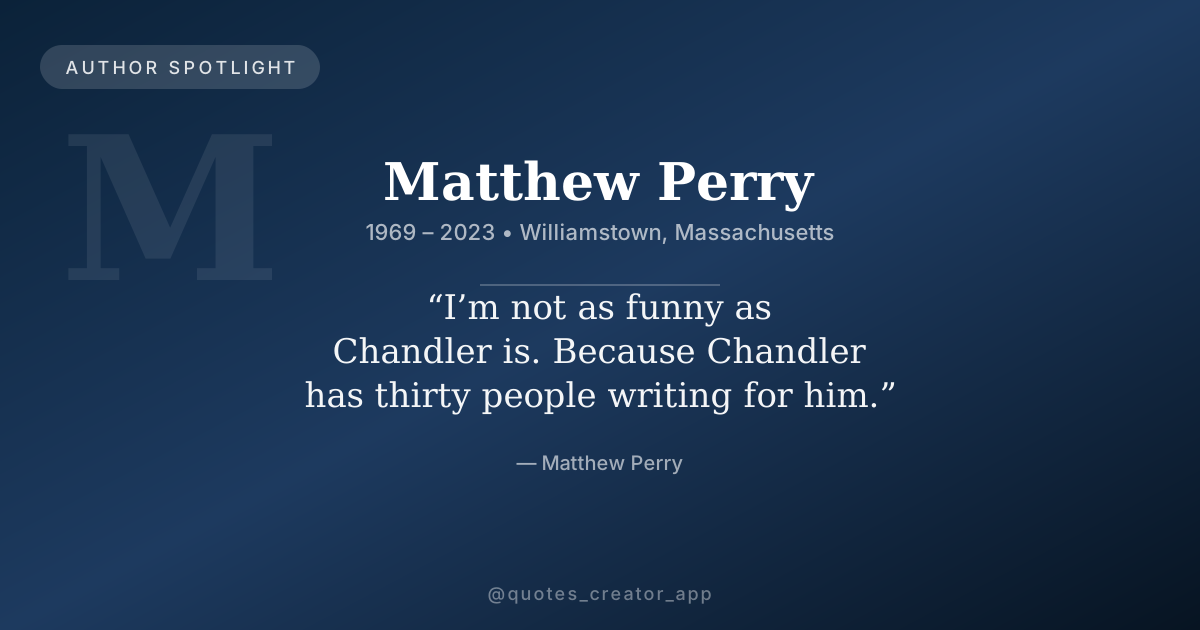
“I’m not as funny as Chandler is. Because Chandler has thirty people writing for him.”
The meaning behind these words
On its surface this is a disarmingly humble sentence, the kind of self-deprecating quip that made Perry beloved in interviews. But it is doing something precise and slightly devastating. He is drawing a clean line between the character and the man, and insisting — gently, but firmly — that the character is not him. The world had spent six years conflating Matthew Perry with Chandler Bing, treating the actor as if he were the wisecrack. Perry understood that this conflation was a kind of erasure. The joke was the product of a team — thirty writers, a writers’ room, a craft of comedic engineering — while he was simply the instrument who delivered it. To say “I’m not as funny as Chandler is” is not false modesty. It is a man trying to recover his own identity from a role that had swallowed it whole.
And there is something darker underneath. The reason he needed to insist on the distance between himself and Chandler is that the distance was precisely what was disappearing. In the very year he spoke these words, his addiction was at its most acute; he was taking dozens of pills a day, his weight was collapsing, and the bright, precise instrument that delivered Chandler’s lines was being slowly hollowed out from within. The public wanted the funny man, and the funny man was vanishing. When he says “Chandler has thirty people writing for him,” he is also saying something unspoken: nobody is writing lines for me. The real man, the one behind the character, had to face his life without a punchline to deflect it. That is the quiet tragedy folded into the joke — the funniest man on television, admitting that the only thing he could reliably produce on his own was not a laugh but a wound.
“Dating Julia Roberts had been too much for me. I had been constantly certain that she was going to break up with me. Why would she not? I was not enough; I could never be enough; I was broken, bent, unloveable. So instead of facing the inevitable agony of losing her, I broke up with the beautiful and brilliant Julia Roberts.”
The meaning behind these words
This passage, from the memoir he wrote twenty years after the events it describes, is the clearest window Perry ever opened onto the engine of his self-destruction. He was dating the most famous woman in the world — Julia Roberts, at the height of her power — and the relationship terrified him, not because she was cruel or withholding, but because he was convinced he did not deserve her. Look at the sequence of the sentence: “I was not enough; I could never be enough; I was broken, bent, unloveable.” Each clause tightens the noose. It moves from a doubt (“not enough”) to a certainty (“could never be enough”) to a verdict (“broken, bent, unloveable”), until the only rational response is to flee. He broke up with her — he says it plainly — to pre-empt the abandonment he was certain was coming. Better to leave than to be left. Better to be the author of the ending than its victim.
The passage matters because it names the thing that addiction so often grows out of: not a craving for the drug, but a conviction of one’s own worthlessness that predates it and outlives it. The child who felt like an outsider, “that kid up in the clouds on a flight to somewhere else, unaccompanied,” grew into a man who could not accept love when it was handed to him, because some deep part of him believed it was a mistake that would eventually be corrected. The drink and the pills were, in this reading, not the disease but the anaesthetic for the disease — a way of numbing the unbearable certainty of being unlovable. Perry was able to articulate all of this only in middle age, from the far side of a near-fatal relapse, and the clarity of the prose is the measure of the distance he had travelled. He was no longer the man who fled from love. He was the man who could look that man in the eye and describe him without flinching.
“The best thing about me, bar none, is if somebody comes up to me and says, ‘I can’t stop drinking, can you help me?’ I can say yes and follow up and do it.”
The meaning behind these words
In the year before he died, Matthew Perry was asked the question every celebrity is eventually asked — what do you want to be remembered for? — and his answer was unlike any his fame had prepared us for. He did not say Friends. He did not say Chandler Bing, or the Emmy, or the million dollars an episode. He said this: that if a stranger walked up to him and asked for help stopping drinking, he could say yes — and not merely say it, but “follow up and do it.” The phrase “bar none” is doing enormous work. It is a ranking. Of everything he had ever done, of every achievement a global audience would consider the measure of his life, the single best thing about him was a quiet, untelevised competence: the ability to help another alcoholic get sober. Not the fame. Not the fortune. The hand reaching back.
This is the sentence that reorganises the whole of Perry’s life into a coherent meaning. The addiction, the relapses, the coma, the two percent chance of survival, the nine million dollars, the six thousand meetings — all of it, in this light, becomes not a tragedy but a credential. Only someone who has been to the bottom of that particular well can reach the person still falling and mean it when he says he knows how to climb out. The work he did in his final years — the drug-court lobbying, Perry House, the memoir written explicitly “for people like me and for people who love people like me” — was all in service of this single claim. He understood, with a clarity that humbles most of us, that the thing that had nearly destroyed him was also the only thing that could give his life its final worth. And he wanted, more than anything, to be known not as the man who made the world laugh, but as the man who answered when someone asked for help. The joke was the gift he gave the world. This was the gift he gave himself.
Matthew Perry’s legacy
The most obvious measure of Matthew Perry’s legacy is the one he himself considered the least important, and it is vast. Chandler Bing became one of the defining comic creations of television — a character whose cadence (“could I be any more…?”) entered the everyday speech of millions and whose blend of sarcasm and vulnerability redefined what a sitcom man could be. Perry did not merely tell jokes; he built a character out of the jokes, so that Chandler’s humour read as armour, a defence mechanism worn by a frightened boy who used wit to keep the world at arm’s length. Critics recognised it at the time and have recognised it since: there was a rare strain of genuine feeling beneath the surface of the funniest performance on television, and it is no accident that the character who laughed off every feeling became, by the end, the one who grew up and let himself be loved. Friends remains one of the most-watched and most-streamed shows in the world, a comfort object for successive generations who were not yet born when it first aired, and at the centre of its enduring power is Perry’s precision, his timing, his gift for turning pain into a punchline that made the pain bearable for everyone watching.
But the legacy he would have chosen is the other one, and it is the more important. In the months before his death, Perry said that when he died he knew people would talk about Friends, and that he was glad of it — but that “as far as my so-called accomplishments go, it would be nice if Friends were listed far behind the things I did to try to help other people.” The Matthew Perry Foundation, established days after he died, carries forward the work he considered the best thing about himself: supporting people struggling with addiction, the same people he spent his last years trying to reach. His memoir sold in the millions because it told the truth about a disease that thrives on secrecy, and every reader who saw themselves in its pages — the outsider, the drinker, the one who fled from love because they believed they were unlovable — received the same message he offered the stranger who asked for help: I know how to do this, and I will help you. That is the paradox at the heart of Matthew Perry’s life. He was a man who made an entire planet laugh while he himself was suffering more than almost anyone watching could have guessed. And in the end, the thing he wanted most was not to be remembered for the laughter, but for the reaching back. He got it.
Create graphics with Matthew Perry’s quotes
Matthew Perry’s words carry the same rare quality that made him a great comic — they are honest, precise, and unafraid of the difficult thing. Whether you are looking for a line about friendship that will land with a room full of people, or a reminder that helping someone else is the most meaningful work there is, Quotes Creator helps you turn these quotes into beautiful, shareable designs with custom fonts, colors, and layouts.
Why we chose Matthew Perry
Matthew Perry enters this spotlight at a moment when his name is surging through the cultural conversation once again. His Wikipedia page has drawn tens of thousands of views a day through this August — a surge tied to the long legal epilogue of his death, as the last of the five people who supplied him with the drug that killed him received their sentences in the spring and summer of 2026, and to the approach of what would have been his fifty-seventh birthday on August 19. But the timing, as it always is with these spotlights, is secondary to the substance. We chose Matthew Perry because his is one of the few lives in which the most famous thing about a person — the thing everyone knows — is also the least important thing about them. Everyone knew Chandler Bing. Far fewer knew the man behind him: the lonely boy from Ottawa, the addict who nearly died more times than he could count, the advocate who wanted to be remembered for helping other people get sober. We chose him because the gap between those two men is where his real story lives.
The four quotes we have selected trace the spine of that story. They begin with the man who described Friends not as a show but as a support group — the sound of someone telling the truth about what actually saved him. They move through the gentle, devastating humility of “I’m not as funny as Chandler is,” a man insisting on the distance between himself and the mask he wore. They reach the memoir’s raw confession about Julia Roberts, the moment he named the conviction of his own unlovability that had fuelled decades of self-destruction. And they end where he would have wanted them to end: with the sentence in which he ranked helping a fellow addict above every other achievement of a life lived in the brightest spotlight imaginable. These are not the tidy maxims of a comfortable life. They are the words of a man who spent his life learning, painfully and publicly, that the joke and the wound come from the same place — and who spent his final years trying to turn that wound into a ladder for the next person climbing out. The laughter belongs to all of us. The reaching back was his alone.
— ThinkPeak Studio Editorial Team
Create your own quote graphic with this quote
Turn this line into a shareable graphic in seconds — free, no signup needed. For video quotes and 100+ templates, try the Android app.
Advertisement
Enjoyed this article? Get more like it in your inbox.