On this page
Author Spotlight: Maya Angelou
From the silence of a childhood trauma to a voice that would define American letters — the story of a woman who transformed pain into poetry, and poetry into a movement for human dignity.
Who is Maya Angelou?
Marguerite Annie Johnson was born on April 4, 1928, in St. Louis, Missouri, to Vivian Baxter, a nurse and card dealer, and Bailey Johnson, a doorman and navy dietitian. Her parents’ marriage dissolved when she was three, and she and her older brother Bailey Jr. were sent alone by train — with tags on their wrists — to live with their paternal grandmother, Annie Henderson, in the segregated town of Stamps, Arkansas. The world they entered was defined by the color line: Black children crossed the street when white people approached, Black men were lynched for looking a white woman in the eye, and the town’s Black quarter lived in a separate economy, a separate reality, a separate America. But in her grandmother’s general store, which served as the social and economic heart of the Black community, young Marguerite encountered a different model of Black life — one defined not by fear but by dignity, labor, and faith. Her grandmother, whom she called Momma, ran that store with a silent, indomitable authority. She taught Marguerite that cleanliness was next to godliness, that hard work was a form of prayer, and that a Black woman in Arkansas could walk with her head high even when the world told her to bow. These lessons became the foundation of everything Maya Angelou would become.
At seven, during a visit to her mother in St. Louis, Marguerite was raped by her mother’s boyfriend. She told her brother, the man was arrested, and he was found dead the next day — likely killed by her uncles. Believing her voice had caused a man’s death, she stopped speaking. For nearly five years, she lived in self-imposed silence. She read voraciously — Shakespeare, Poe, Dunbar, the Bible — internalizing the rhythms of language without producing a syllable of her own. It was a neighbor, Mrs. Bertha Flowers, who gently coaxed her back into speech by introducing her to literature and insisting that poetry must be heard aloud to be understood. “Words mean more than what is set down on paper,” Mrs. Flowers told her. “It takes the human voice to infuse them with the shades of deeper meaning.” When Marguerite began to speak again, she did so with a voice that had been forged in the crucible of silence — deliberate, musical, aware of the weight of every syllable. The girl who could not speak became, over the course of a lifetime, one of the most listened-to voices on earth.
At sixteen, determined to prove she could earn a living and raise a child — she was pregnant with her son Guy — Marguerite took a bewildering variety of jobs: streetcar conductor in San Francisco (the first Black woman to hold the position), fry cook, nightclub dancer, prostitute, madam. She married a Greek sailor named Tosh Angelos, divorced him, and from that union kept a version of his surname that would become indelible: Angelou. Throughout the 1950s, she performed as a calypso singer and dancer, touring Europe with a production of Porgy and Bess and recording an album called Miss Calypso. In 1959, at the invitation of novelist John Oliver Killens, she moved to New York City, joined the Harlem Writers Guild, and discovered her true vocation. She also met Martin Luther King Jr. and became the northern coordinator for the Southern Christian Leadership Conference. After King’s assassination on her fortieth birthday in 1968 — a death that devastated her — her friend James Baldwin persuaded her to write down the stories she had been telling at dinner parties. The result was I Know Why the Caged Bird Sings, a memoir of her first seventeen years, published in 1969 to immediate acclaim. It was the first nonfiction bestseller by an African American woman, and it launched a literary career that spanned seven autobiographies, seven collections of poetry, three books of essays, and multiple plays, screenplays, and spoken-word albums.
In the decades that followed, Angelou became something more than a writer. She became a public institution — a figure whose presence on a stage, at a podium, or on a television screen conferred moral seriousness. In 1993, at the invitation of Bill Clinton, she recited her poem “On the Pulse of Morning” at the presidential inauguration, becoming the first poet to do so since Robert Frost in 1961. She received over fifty honorary degrees, taught at Wake Forest University for more than thirty years as the Reynolds Professor of American Studies, and was awarded the Presidential Medal of Freedom by Barack Obama in 2010. Yet for all the honors and accolades, she remained, in her own telling, fundamentally the same person — a six-foot-tall Black woman from Stamps, Arkansas, who had learned that survival itself could be a form of art. She died on May 28, 2014, at the age of eighty-six, having written, spoken, and lived a life that was, in every sense, a testimony. “I did then what I knew how to do,” she once said. “Now that I know better, I do better.” That sentence, more than any biography, explains who Maya Angelou was: a woman who never stopped learning, never stopped growing, and never stopped believing that human beings could rise above the circumstances that would define them.
Maya Angelou’s most memorable quotes
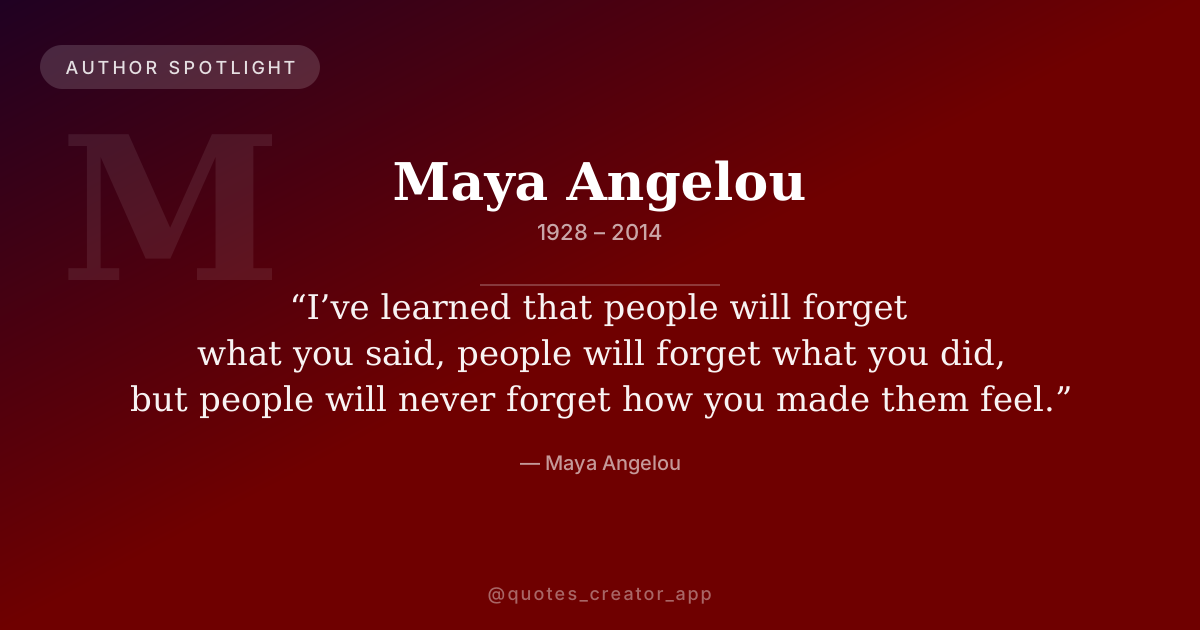
“I’ve learned that people will forget what you said, people will forget what you did, but people will never forget how you made them feel.”
The meaning behind these words
This is arguably Angelou’s most quoted sentence, and with good reason. It contains a theory of human interaction that is at once simple and profound: the content of our speech and the record of our actions are stored in the mind, but the emotional residue of our presence is stored in the body. A person might not remember the advice you gave them at a difficult moment, but they will remember whether you made them feel heard or dismissed. An employer might forget the details of a quarterly presentation, but they will not forget whether you made them feel confident or anxious. This is not sentimentality; it is psychological realism. Cognitive science has since confirmed what Angelou intuited: emotional memory is more durable, more vivid, and more accessible than semantic or episodic memory. The feeling of being understood, respected, or loved outlasts the words that created it.
But the quote also contains a warning. It means that our effect on other people is not a function of our intentions but of our presence. You can give a technically correct answer and leave someone feeling small. You can deliver a brilliant critique and leave someone feeling diminished. The measure of our communication is not what we meant to convey but what the other person received. Angelou, who had spent five years of her childhood unable to speak, understood that language is a vehicle for something deeper than information. It is a vehicle for presence. What lingers after a conversation is not the data exchanged but the quality of the attention paid. This insight transforms how we should think about leadership, parenting, teaching, friendship — every domain in which human beings interact. It is not enough to say the right thing. You must be the kind of person whose presence makes others feel more fully human.
“There is no greater agony than bearing an untold story inside you.”
The meaning behind these words
Angelou wrote this sentence about her own experience of silence, but it applies to anyone who has ever swallowed the truth of their own life. The “untold story” is not merely a sequence of events waiting to be narrated. It is the self that cannot fully exist until it is witnessed. To bear an untold story is to carry a version of yourself that has never been confirmed by another person’s recognition. It is to live in solitary confinement within your own consciousness. For Angelou, this was literal: after her rapist was killed, she believed her voice was a weapon and refused to speak for five years. The story of what had happened to her — the rape, the guilt, the terror — was sealed inside her, and the seal was her own silence. The agony she describes is the agony of being invisible to others and, in a sense, invisible to oneself.
This line also explains why Angelou spent her life urging people to speak, write, sing, testify — to get the story out. She understood memoir not as self-indulgence but as survival. To tell your story is to take the chaos of lived experience and give it form, meaning, and most importantly, a witness. It is to say: this happened, and I am still here. The alternative — bearing the untold story — is a form of spiritual suffocation. This is why her work resonated so powerfully with readers who had experienced trauma, racism, abuse, or any form of erasure. She was telling them something they already knew in their bones: that silence is not peace, that forgetting is not healing, and that the story untold is a wound that never closes. The only way out is through articulation.
“Do the best you can until you know better. Then when you know better, do better.”
The meaning behind these words
This sentence is one of the most forgiving and practical moral principles ever articulated. It does not demand perfection. It does not require you to have known at twenty what you would learn at forty. It simply asks that you act on whatever moral knowledge you currently possess, and that you remain open to the possibility that your current knowledge is incomplete. The first clause — “do the best you can until you know better” — releases you from retroactive guilt. You are not a villain for having held beliefs or made choices that your future self would reject. You were, at the time, operating at the edge of your understanding. The second clause — “Then when you know better, do better” — contains the sharper demand. Once you have learned, you are responsible. Ignorance, once dispelled, cannot be pleaded as an excuse. The grace in this formulation is matched by its rigor.
The sentence also encodes a theory of moral growth that is radically opposed to both rigid absolutism and moral relativism. Absolutism says: there is one correct moral code, and deviations from it are sins. Relativism says: what is right depends on your perspective, so there is no real standard. Angelou offers a third option. There is such a thing as knowing better — you can genuinely learn, genuinely grow, genuinely become more capable of moral perception. But the process of learning is gradual, and the standard is not whether you were right in the past but whether you are responsive to what you have learned in the present. This is a deeply humane vision. It allows for the reality of human fallibility while refusing to let anyone off the hook. You can be forgiven for what you did not know. You cannot be forgiven for refusing to learn. This sentence, applied honestly, would transform most arguments about politics, history, and personal conduct. It is a rule for becoming a better human being without despising the human being you used to be.
“You may not control all the events that happen to you, but you can decide not to be reduced by them.”
The meaning behind these words
This is the philosophical core of Angelou’s entire body of work: the distinction between what happens to you and what you do with what happens to you. The first part of the sentence states an obvious but often evaded truth: you are not the author of most of the events that shape your life. You did not choose your parents, your century, your nation, your genetic inheritance, the economy you were born into, or the thousand accidents of fate that determine so much of human experience. Much of life is circumstance, and circumstance is not under your control. Angelou, a Black woman born in the Jim Crow South to parents who could not raise her, who was raped as a child, who worked as a prostitute and a madam, who buried friends and lovers and heroes, knew this truth in her bones. But the second half of the sentence contains the defiant, almost spiritual counterclaim.
”You can decide not to be reduced by them.” The operative word is “decide.” It is a choice. You can be shaped by your suffering, taught by it, deepened by it — but you need not be smaller because of it. This is not the toxic positivity that insists you must find the silver lining in every tragedy. Angelou never claimed that everything happens for a reason or that suffering is a gift. She claimed something more radical: that you retain, even in the worst circumstances, the power of interpretation. You get to decide what the story means. The person who loses a job can decide to see it as a humiliation or as a redirection. The person who survives abuse can decide to see themselves as permanently damaged or as a survivor with hard-won wisdom. The events are the same either way. The decision — and it is a decision, one that must be remade every morning — is yours. This is what existentialists call radical freedom. Angelou called it rising.
“I can be changed by what happens to me. But I refuse to be reduced by it.”
The meaning behind these words
This variation on the earlier theme is, if anything, more precise. The distinction between being “changed” and being “reduced” is one of the most important discriminations in moral psychology. To be changed by experience is unavoidable. Every significant event — love, loss, success, failure, cruelty, kindness — alters who you are. The person who emerges from a divorce is not the same person who entered the marriage. The person who survives a war is not the same person who enlisted. To pretend otherwise is to falsify your own life. Angelou concedes this fully: what happens to you changes you. The question is whether the change is expansive or contractive. Does your experience make you more compassionate or more bitter? More open or more defensive? More capable of love or more guarded against it? These are not the same thing as being forced by circumstances into a smaller version of yourself.
The word “refuse” is the engine of the sentence. It is not that Angelou denied being affected. She acknowledged the effects and then made a conscious, deliberate, publicly declared choice about what she would permit those effects to mean. This is a posture, not a one-time achievement. Refusal is a discipline. It requires waking up every day and deciding, again, that you will not be defined by what was done to you. It requires vigilance against the seductive narrative of victimhood, not because victimhood is shameful but because it is insufficient. You were a victim. That is a fact. But you are also a mother, a writer, a friend, a citizen, a force. The facts of your biography are not the sum of your identity. Angelou spent her entire career modeling this refusal — turning the raw material of trauma into literature, turning silence into eloquence, turning the particular agony of being a Black girl in Arkansas into a universal testament to the human capacity for transcendence. She was changed by what happened to her. She was not reduced. And the distinction between the two is the difference between surviving and living.
Maya Angelou’s legacy
The institutional legacy is easy to catalog. Seven autobiographies that rewrote the rules of what memoir could be, transforming private pain into public art and proving that the life of a Black woman from the segregated South was not merely interesting but central to the American story. Fifty-plus honorary degrees from universities across the world. A Presidential Medal of Freedom. A chair at Wake Forest University where, for three decades, she taught students not just how to write but how to live, how to care, how to pay attention. A poem delivered at a presidential inauguration that asked Americans to “lift up your eyes upon this day breaking for you” — a line that, in its quiet injunction to wake up and see what is possible, captured the civic religion of a nation that still believes, against considerable evidence, in the possibility of renewal. Her books have sold tens of millions of copies. They are taught in schools on every continent. I Know Why the Caged Bird Sings has been translated into dozens of languages, challenged by school boards, banned by libraries, and rediscovered by each new generation of readers who find in its pages a mirror for their own struggles and a map for their own survival.
But the deeper legacy cannot be quantified. Maya Angelou changed the emotional and moral vocabulary available to millions of people. She gave language to experiences that had no language. When she said “still I rise,” she gave a slogan to every person who had ever been knocked down. When she said “people will never forget how you made them feel,” she shifted the way ordinary people thought about their interactions with neighbors, colleagues, children, and strangers. Her voice — that unmistakable, deep, unhurried, musically cadenced voice — became synonymous with wisdom itself. She was, in the truest sense, a public philosopher: someone whose ideas were not confined to academic journals but circulated through talk shows, commencement speeches, poetry readings, and social media posts, reaching people who would never read a work of academic philosophy. She demonstrated that profundity need not be obscure, that moral seriousness need not be solemn, and that a life marked by suffering can produce not bitterness but boundless, radiant love. When she died in 2014, the tributes poured in from presidents and poets, from the famous and the anonymous, from people she had mentored and people she had never met who nonetheless felt that they had lost a mother. That is the measure of her legacy: not the prizes on the shelf but the number of human beings who, having encountered her words, felt themselves enlarged by the encounter.
Create graphics with Maya Angelou’s quotes
Maya Angelou’s words are made for reflection — and for sharing. Whether you are looking for a daily affirmation, a caption for social media, or a gift for someone who needs to hear they can rise, Quotes Creator turns her timeless wisdom into beautiful, shareable designs with custom fonts, colors, and layouts.
Why we chose Maya Angelou
More than nine decades after her birth in St. Louis and more than a decade after her death, Maya Angelou’s Wikipedia pageviews remain among the highest of any literary figure in the world — a testament to the enduring hunger for her words. We chose Angelou because she represents something increasingly rare in public culture: a voice that combined moral authority with emotional generosity, that offered wisdom without condescension and hope without naïveté. She was a survivor of childhood sexual abuse who became a sexual assault counselor and a voice for survivors. She was a teenage mother who raised a son while building a career. She was a Black woman in a white literary establishment who refused to write for white audiences or to be confined by white expectations. She wrote for everyone, and everyone heard her. The five quotes we selected represent the arc of her philosophy: the centrality of emotional presence, the necessity of telling your story, the discipline of moral growth, and the refusal to be reduced by what you cannot control. Maya Angelou did not merely write poems and memoirs. She wrote a manual for becoming fully human, and the world is better for having read it.
— ThinkPeak Studio Editorial Team
Create your own quote graphic with this quote
Turn this line into a shareable graphic in seconds — free, no signup needed. For video quotes and 100+ templates, try the Android app.
Advertisement
Enjoyed this article? Get more like it in your inbox.