On this page
Author Spotlight: Michelle Trachtenberg
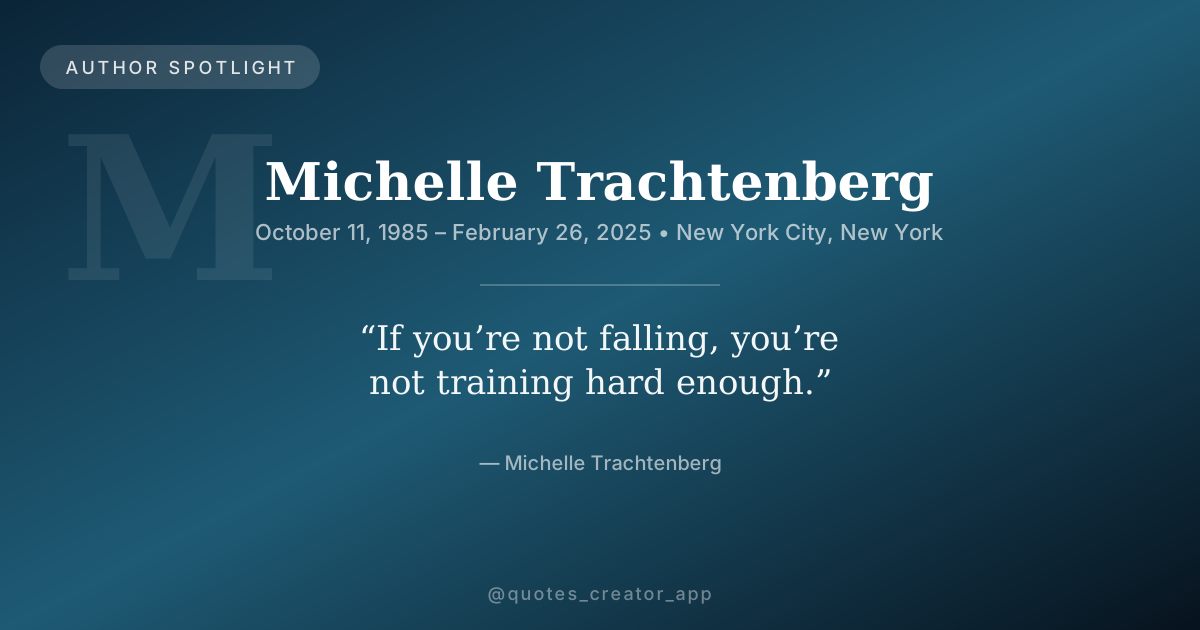
The list of child actors who survive their own childhoods is short, and the list of child actors who survive them intact is shorter still. Michelle Trachtenberg belongs, against every statistical warning, to both. She was a working actress before she could read, a household face by eleven, and by the time she died — at thirty-nine, in February 2025, in a New York apartment her mother would find her in — she had spent thirty-five of those years in front of a camera without ever quite becoming the cautionary tale her industry seems to require. She was Harriet the Spy, the ordinary girl who watches the world and writes it down. She was Dawn Summers, the impossible little sister. She was Georgina Sparks, the most deliciously unrepentant villain on television. And she was Casey Carlyle, the physics prodigy who taught a generation that the girl who wins is the one willing to fall. “If you’re not falling, you’re not training hard enough,” she said, promoting a movie about ice skating, and the sentence turned out to be the thesis of her entire life. This is the story of a child star who kept getting back up — and of the quiet, private falling that came at the very end.
Who is Michelle Trachtenberg?
Michelle Christine Trachtenberg was born on October 11, 1985, in New York City, the daughter of Lana, a bank manager, and Michael Trachtenberg, a fiber-optics manager. Her parents were Jewish immigrants — her father from Germany, her mother from Ukraine — and the household carried both the particular intimacy of immigrant ambition and the particular pressure of it. She was raised in Sheepshead Bay, Brooklyn, where she attended The Bay Academy for the Arts and Sciences before the family moved west to Los Angeles, where she finished school at Notre Dame High in Sherman Oaks. The work began almost before the childhood did: she made her first television appearance at age three, in a commercial for Wisk detergent, and would go on to appear in more than a hundred of them. It is a detail that reads, in hindsight, like a prophecy — a small child, scrubbed and rehearsed, selling the idea of clean clothes to strangers, while the girl underneath began the long apprenticeship of being looked at.
The leap from commercials to something like fame happened fast. Her television debut came on Law & Order, and she quickly became a fixture of children’s television, playing Nona F. Mecklenberg on Nickelodeon’s The Adventures of Pete & Pete and Lily Montgomery on the soap opera All My Children. Then, in 1996, at the age of ten, she was handed the title role in Harriet the Spy, the film adaptation of Louise Fitzhugh’s beloved novel — a role that required her to leave Pete & Pete while its third season was still running and to become, overnight, the face of a generation’s childhood. A Young Artist Award followed for the short-lived sitcom Meego, and in 1999 she played Penny Brown in Disney’s Inspector Gadget. By the time she was fourteen, she had done what most actors never do in a lifetime, and she had done it before she was old enough to drive. The question that would define the rest of her life — whether she could survive the thing that had made her — was already waiting.
Adolescence brought the role that would make her immortal. In 2000, at fifteen, she joined the cast of Buffy the Vampire Slayer as Dawn Summers, the younger sister of Sarah Michelle Gellar’s title character — a character introduced, in one of television’s boldest gambits, as if she had always been there, a sister the audience and Buffy herself were simply expected to remember. The role won Trachtenberg another Young Artist Award and three Saturn Award nominations and made her a defining figure for the show’s devoted audience; her nomination for a Daytime Emmy as host of the Discovery Kids series Truth or Scare ran alongside it. The years that followed were a masterclass in refusing to be typecast. She played Jenny in the 2004 sex comedy EuroTrip, and then, in the same year, turned in the most serious work of her young career as Wendy in Gregg Araki’s Mysterious Skin, a film about childhood abuse that was the diametric opposite of everything else on her résumé. She was a spoiled pop star on Six Feet Under, a physics prodigy torn between Harvard and figure skating in Ice Princess, a kidnapped video blogger on Law & Order: Criminal Intent, and a slasher victim in the 2006 Black Christmas remake. In 2008 she took the role that would come to define her adult career — Georgina Sparks, the deliciously amoral schemer of Gossip Girl, a part she would return to for the show’s entire run and, in 2022, reprise in its HBO revival.
The back half of her career was quieter, more varied, and in its own way braver. She starred on the NBC medical drama Mercy, in the 2009 fantasy comedy 17 Again, and in films like Killing Kennedy and Sister Cities. She moved behind the camera, executive-producing the teen drama web series Guidance and Tubi’s true-crime series Meet, Marry, Murder, and she returned to the character who started it all, voicing the role in an animated Harriet the Spy series in 2023. By 2016 she was a member of the Writers Guild of America, working on screenplays — including one based on the book Toy Monster — and telling interviewers that she was still, all these years later, inspired by the girl she had played at ten. Her final film appearance came in 2024, as the narrator of the documentary Spyral, a project about people struggling with mental illness. It was, she said, a story that mattered to her. Few who watched it knew how much.
Michelle Trachtenberg’s most memorable quotes
“I never had a stage mother, which is probably one of the reasons why I’m still doing this.”
The meaning behind these words
Every industry has its cautionary tale, and Hollywood’s favorite is the child star — the prodigy pushed too hard by an ambitious parent, the talent mined until there is nothing left, the wreckage that ends up in the tabloids. Trachtenberg spent her whole life being asked, in one form or another, how she had avoided becoming that story, and this sentence is her clearest answer. The stage mother, in her telling, is not a villain but a variable — the difference between a childhood that is a career and a childhood that is a childhood. “I never had a stage mother” is a quiet boast that is also a quiet warning. It says that she was allowed to be an actress without being turned into a product, that the adults around her did not confuse her worth with her box office, and that this absence of pressure — this specific, unglamorous, enormous thing — is what let her keep working into adulthood when so many of her peers did not.
The second half of the sentence carries the weight. “Which is probably one of the reasons why I’m still doing this” is spoken at twenty, at the precise moment when most child stars are either being reclassified as has-beens or checked into treatment — and there is something almost statistical in her tone, as if she had studied the actuarial tables of her own profession and concluded that she was, against the odds, on the surviving side of them. The word “probably” is doing delicate work: it is honest about the fact that nobody really knows why some make it and some do not, that survival in her industry is part luck and part something no one can name. But the sentence is not modest. It is the statement of a young woman who understood, with unusual clarity, that her longevity was not an accident, that she had been protected from the worst of the machine by the ordinary decency of the people who raised her. She was saying, in effect, that she had been given something most child actors never get — the chance to just be a kid who acts, rather than a kid whose acting is the only thing that matters.
“If you’re not falling, you’re not training hard enough.”
The meaning behind these words
She said it about figure skating, about the months of brutal training that went into playing a girl who could land a triple, and on its face it is a sentence about athletics — the practical truth that a skater who never falls is a skater who is not pushing hard enough, that the ice punishes complacency, that mastery is built out of a thousand small failures. But the line has outlived the movie it was spoken to promote because it names something far larger than sport. Falling, in this telling, is not the opposite of success but its precondition; it is the evidence that you are attempting something hard enough to fail at. In a culture that teaches children — and especially girls — to be careful, to be flawless, to be liked, there is something quietly revolutionary about the sentence. It gives permission to fail, and more than permission, it makes failure a kind of proof that you are doing the work.
Read against the arc of her own life, the quote deepens into something almost unbearably poignant. Trachtenberg was, by any measure, a person who kept falling and kept getting back up — through the gauntlet of child stardom, through the industry’s endless effort to reduce her to a single look, through the long middle stretch of a career that never again reached the heights of Buffy or Gossip Girl, through the private struggles of her final years that only became public after she was gone. She did not fall and quit; she fell and trained harder. The line is her most quoted for a reason, and the reason is that it is both a philosophy and a self-portrait. She was, right to the end, someone who believed — or wanted to believe — that the falling was part of it, that the point was not to avoid the ice but to keep getting up on it. The tragedy of her story is not that she fell. It is that the last falling happened somewhere none of us could see, in a body and a life that had already endured so much, and that this time there was no getting back up.
“I was always wanting to learn and be one of those actresses who can actually hold a conversation as opposed to standing there looking pretty.”
The meaning behind these words
This is the sentence of a young woman who had spent her entire life being looked at, and who had decided, early and firmly, that she wanted to be heard instead. The phrase “standing there looking pretty” is doing the quiet demolition of an entire career path — the one Hollywood has always offered to its young actresses, the one that pays well and asks nothing in return but compliance, the one that reduces a person to a face and a figure and a red-carpet smile. Trachtenberg names it not with fury but with a kind of dismissive clarity, the tone of someone who has seen what that life looks like from the inside and has decided it is not enough. What she wants instead — to learn, to hold a conversation, to be the kind of actress who has something to say — is a small act of defiance disguised as a career aspiration. In an industry that has always preferred its women ornamental, wanting to be smart is a form of rebellion.
And she meant it. The proof is in the work she chose — the willingness, at nineteen, to take the harrowing role of Wendy in Mysterious Skin when she could have coasted on teen comedies; the restless refusal to be one thing, moving from slasher to sitcom to drama to voice work to animation; the slow, deliberate turn, in her thirties, toward the other side of the camera, toward producing and writing and the quiet craft of building stories rather than just appearing in them. That move — into the Writers Guild, onto screenplays, behind the camera — was the logical end of this sentence. She did not want to stand there looking pretty; she wanted to make things, to have a hand in the work, to be more than the image. There is a particular sadness in reading the line now, knowing how it ends — because the actress who wanted so badly to be taken seriously as a person, as a mind, spent her final months being scrutinized by strangers who looked at a photograph of her and decided they could see, from the outside, whether she was well.
“I’m happy and healthy.”
The meaning behind these words
In early 2024, strangers on the internet began leaving comments on Michelle Trachtenberg’s photographs, announcing that she looked sick. They pointed at her weight, at a faint yellowness around her eyes, at the ordinary evidence of a body changing with age and illness and time, and they concluded — with the casual authority that only strangers possess — that something was wrong. Her answer was these three words. “I’m happy and healthy.” It is the most ordinary sentence in the world, the kind of thing anyone might type in response to a concerned relative, and in its context it is devastating. She was not, it turned out, healthy — she was navigating the aftermath of a liver transplant and the complications that would, a year later, be listed as her cause of death — and the sentence she used to defend herself against the public’s unsolicited diagnosis reads now like a wish, or a prayer, or a shield held up against the very thing that was already happening to her.
The deeper meaning of the quote has less to do with her health than with the relationship it reveals between a person and the public that had watched her for thirty years. She had spent her whole life being seen — by cameras, by directors, by fans, by the internet — and in the end, the seeing itself became a kind of violence. Strangers who had never met her felt entitled to comment on her body, to demand she account for it, to insist that their distant glance knew more about her condition than she did. Her response — polite, firm, a little tired — was the response of someone who had learned long ago how to manage the public’s gaze: reassure, deflect, protect. And there is something heartbreaking in the gap between the words and the truth, between the public performance of wellness and the private reality of a body failing. The actress who had wanted, above all, to be heard rather than merely looked at was, at the end, reduced once more to an image — and the image was being dissected, frame by frame, by people who had never once asked her how she was. She answered them anyway, with grace, with the words she knew they wanted to hear. It was the last performance she ever gave.
Michelle Trachtenberg’s legacy
The most obvious measure of Michelle Trachtenberg’s legacy is the work, and it is larger and stranger and more varied than almost anyone gives it credit for. She was, in the truest sense, a generational performer — someone whose face was stitched into the childhood of millions of people who never met her. For a certain cohort, she will always be Harriet, the kid with the notebook who noticed everything. For another, she will be Dawn, the impossible sister who made a show about vampires feel like a show about family. For another, she will be Georgina, the villain it was impossible not to love, or Casey, the girl who taught a generation of girls that being smart and being strong were not in competition. Very few actors get to be the defining face of even one of those things. She was all of them, and she moved between them with an ease that disguised how hard the work really was — the work of refusing to be one thing, of refusing to be reduced, of refusing to let an industry that had owned her childhood own the rest of her too.
But the deeper legacy, the one that will outlast the streaming catalogs, is the example she set for what it means to survive. The child star is one of our culture’s most durable tragedies — we build them up as children and then, when they stumble, we consume the fall with the same appetite we once brought to the ascent. Trachtenberg refused to be that story. She did not flame out; she kept working, kept learning, kept moving into new rooms — writing, producing, directing her own attention toward the work of making things rather than merely being seen. She was, by the account of everyone who knew her, kind, private, and quietly stubborn about living her life on her own terms. And when her health began to fail, she faced it the way she had faced everything else: with the same public composure she had learned at three, reassuring the people who watched her that she was fine, protecting her privacy to the last. There is something almost unbearably consistent about it — the child who learned to smile for the camera spent her final months smiling for it still.
And there is, finally, the legacy of the questions her death forced us to ask, too late. The strangers who commented on her body did not know they were watching someone in the final year of her life; the culture that had spent thirty years looking at her never quite learned to see her. Her friend and Harriet the Spy co-star Rosie O’Donnell put it as plainly as it can be put: “I loved her very much. She struggled the last few years. I wish I could have helped.” Sarah Michelle Gellar, who played her sister on screen, promised that the world would remember. And so it will — not because she was famous, but because she was real, and because the girl who once played a spy who wrote everything down ended up teaching us, by the shape of her whole life, the thing Harriet always knew: that being seen is not the same as being known, and that the truest story is the one a person tells in her own words, in her own time, for herself. She never got to finish telling hers. It is the rest of our job now to tell it gently.
Create graphics with Michelle Trachtenberg’s quotes
Michelle Trachtenberg’s words carry the same quality that made her so easy to grow up with — they are warm, funny, quietly defiant, and built to be shared. Whether you need a line about resilience and falling forward, about refusing to be reduced to how you look, or about the quiet courage of just keeping going, Quotes Creator helps you turn these quotes into beautiful, shareable designs with custom fonts, colors, and layouts.
Why we chose Michelle Trachtenberg
Michelle Trachtenberg enters this spotlight at a moment when the public has, once again, turned its attention to her. In August 2026, her Wikipedia pageviews surged to the hundreds of thousands — driven by the quiet afterglow of a career that ended far too soon and by the enduring hold her characters still have on the people who grew up with them. But the timing, as it always is with these spotlights, is secondary to the substance. We chose Michelle Trachtenberg because her life is one of the rare ones that functions as both a story and a lesson. She was the child star who made it — who came through the machine that destroys so many of its young with her sense of self intact, her ambition undimmed, and her kindness, by every account, fully in place. And then, at the end, she became something harder to look at: a reminder of how cruelly we treat the people we have decided we own, and how little our watching ever has to do with actually seeing them.
The four quotes we have selected trace the spine of that story. They begin with the young woman’s clear-eyed account of her own survival — “I never had a stage mother” — the sentence in which she named the ordinary decency that protected her from the machine. They move through her most famous line, the one about falling and training, which turned out to be less a skating maxim than the operating principle of a whole life. They reach her quiet rebellion — the refusal to just stand there looking pretty — the declaration of a mind determined to be more than its own image. And they end, as her life did, with the three ordinary words she used to reassure a watching world that she was fine — “I’m happy and healthy” — a sentence that now reads as both a shield and a farewell. These are not the tidy maxims of a comfortable life. They are the words of a woman who spent thirty-five years being watched and who, at the very end, asked only to be left alone to be herself — and who deserves, now, to be remembered not as an image but as the person behind it: smart, stubborn, kind, and braver than any of us knew.
— ThinkPeak Studio Editorial Team
Create your own quote graphic with this quote
Turn this line into a shareable graphic in seconds — free, no signup needed. For video quotes and 100+ templates, try the Android app.
Advertisement
Enjoyed this article? Get more like it in your inbox.