On this page
Author Spotlight: Mitch McConnell
American politician and attorney, longest-serving Senate Republican leader in history who reshaped the federal judiciary through four decades of strategic political mastery.
Who was Mitch McConnell?
Born February 20, 1942, in Sheffield, Alabama, Addison Mitchell McConnell III was shaped early by adversity. At age two, he contracted polio, but his mother was determined he would walk again — taking him to Warm Springs, Georgia, for the same treatments founded by Franklin D. Roosevelt. The family moved to Louisville, Kentucky, when McConnell was a child, and that state would become both his home and his political identity for the next half-century. He graduated from the University of Louisville in 1964 and earned his law degree from the University of Kentucky College of Law in 1967. His early interest in politics was sparked by an internship with Senator John Sherman Cooper, a moderate Kentucky Republican who modeled a vanishing tradition of bipartisan statesmanship.
After serving as chief legislative assistant to Senator Marlow Cook and as Deputy Assistant Attorney General under President Gerald Ford, McConnell was elected Jefferson County Judge/Executive in 1977. In 1984, he pulled off a stunning upset to unseat Democratic incumbent Walter Dee Huddleston, becoming Kentucky’s first Republican senator since 1968. Over the next four decades, McConnell climbed the Senate leadership ladder methodically — chairing the National Republican Senatorial Committee from 1997 to 2001, serving as Majority Whip from 2003 to 2007, then as Republican Leader from 2007 until his departure from leadership in 2025. Along the way, he became the longest-serving Senate party leader in American history, a record unlikely to be broken soon.
McConnell’s political philosophy is best understood as institutional mastery fused with strategic pragmatism. He rarely delivered soaring oratory, preferring instead to wield the Senate rulebook like a chess manual — blocking, delaying, and outmaneuvering opponents through procedural expertise. “Think of me as the Grim Reaper,” he said of his determination to stop Democratic legislative priorities. His approach rewarded patience, discipline, and a willingness to absorb criticism in service of what he considered his signature achievement: transforming the federal judiciary. McConnell believed deeply in the Senate as an institution, but he also believed in using every procedural lever at his disposal to advance conservative goals. In his view, winning was not about making the most noise — it was about making the right moves at the right time.
McConnell’s most lasting impact will undoubtedly be the federal bench he reshaped. Over 230 lifetime-appointed federal judges were confirmed during the first Trump administration, including three Supreme Court justices — Neil Gorsuch, Brett Kavanaugh, and Amy Coney Barrett. His decision to block Merrick Garland’s Supreme Court nomination in 2016, while fast-tracking Barrett’s confirmation just days before the 2020 election, stands as one of the most consequential strategic gambits in modern political history. Named three times to the Time 100 list of the world’s most influential people, McConnell announced in February 2025 that he would not seek an eighth Senate term. After stepping down from leadership and experiencing a series of health scares, he has largely withdrawn from public view, leaving behind a political legacy as complex and controversial as American democracy itself.
Mitch McConnell’s most memorable quotes
“The single most important thing we want to achieve is for President Obama to be a one-term president.”
The meaning behind these words
When McConnell uttered this sentence to the National Journal in October 2010, he crystallized a philosophy of opposition that would define an era. The statement was striking not for its partisanship — every opposition leader wants the president to lose — but for its open articulation of pure political warfare as the primary goal. McConnell was not offering a competing vision for healthcare, taxes, or foreign policy. He was stating, without euphemism, that the single most important priority was denying the president a second term. It was a declaration that legislating would take a backseat to undermining.
This quote endures because it perfectly captures the strategic mindset that McConnell brought to minority leadership. He understood that in an era of polarized media and 24-hour news cycles, clarity of purpose mattered more than complexity of argument. By reducing his party’s mission to a single, memorable sentence, McConnell aligned every Republican senator behind one objective. It worked: Republicans took the House in 2010, the Senate in 2014, and the White House in 2016. Whether one views the statement as cynical realism or corrosive hyper-partisanship, it remains one of the most honest declarations of political intent ever made by a legislative leader.
“One of my proudest moments was when I looked Barack Obama in the eye and I said, ‘Mr. President, you will not fill the Supreme Court vacancy.’”
The meaning behind these words
This remark, delivered to a home-state audience in August 2016, reveals the personal pride McConnell took in wielding institutional power for ideological ends. When Justice Antonin Scalia died unexpectedly in February 2016, McConnell announced within hours that the Senate would not consider any Supreme Court nominee from President Obama. The unprecedented blockade of Merrick Garland — a widely respected moderate judge who had previously been confirmed by voice vote — held for 293 days. It was a gamble of historic proportions, and it succeeded beyond what even McConnell may have predicted when Donald Trump won the presidency.
The quote is remarkable for its unapologetic tone. Political leaders typically frame controversial decisions in the language of principle or constitutional duty. McConnell instead expressed raw satisfaction — pride, even — in telling a sitting president that he could not exercise one of the most fundamental powers of his office. It illuminates what McConnell valued most: not the appearance of bipartisanship or comity, but the tangible outcomes that institutional leverage could produce. The seat that Garland was denied was ultimately filled by Neil Gorsuch, shifting the Court’s balance for a generation. For McConnell, that was the point of power: not to be liked, but to win.
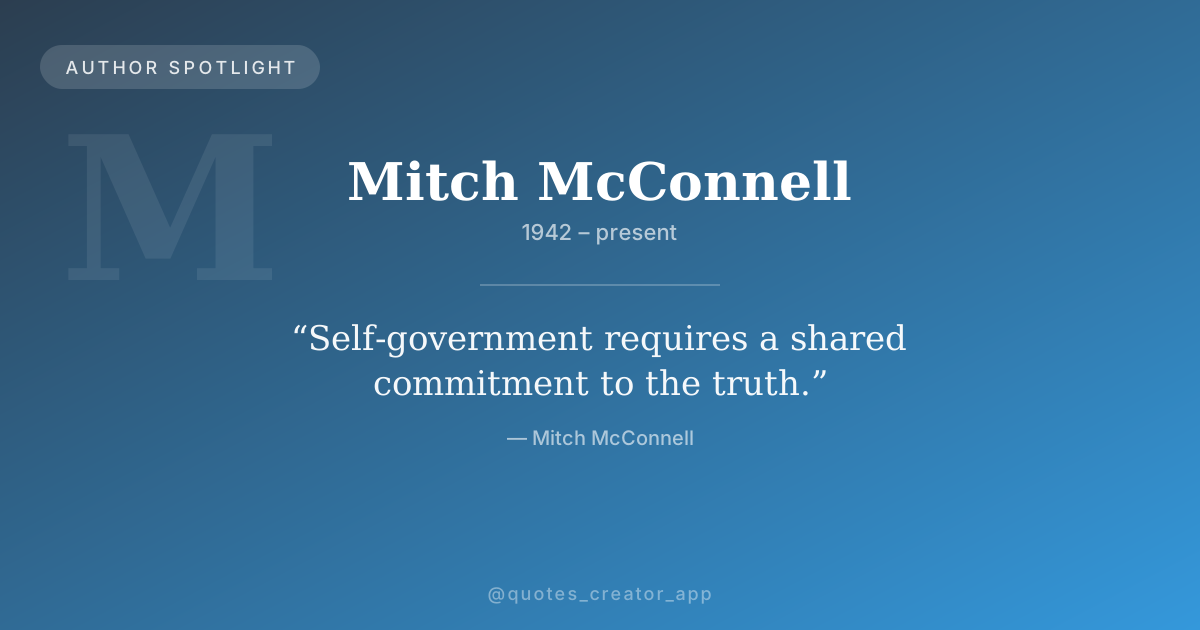
“Self-government requires a shared commitment to the truth and a shared respect for the ground rules of our system. We cannot keep drifting apart into two separate tribes with a separate set of facts and separate realities.”
The meaning behind these words
Delivered in the early hours of January 7, 2021, after the Capitol had been cleared of rioters and the Senate had reconvened to certify the Electoral College results, this speech represented a rare moment of open principle from a leader known for tactical opacity. McConnell framed the choice before the Senate not as a partisan question but as a test of constitutional self-government itself. The invocation of “shared commitment to the truth” and “shared respect for the ground rules” was a direct repudiation of the election fraud narrative that had driven the mob into the Capitol hours earlier.
This passage stands apart in McConnell’s rhetorical record because it addresses something larger than electoral strategy or judicial appointments. It speaks to the framework within which all political competition must occur — a common baseline of fact and process. For a politician who spent decades wielding institutional rules as weapons, the speech was a reminder that rules only function when both sides agree they exist. The quote resonates beyond its immediate context because it names a problem that has only deepened: the splintering of the American public into parallel information ecosystems where consensus about even basic events becomes impossible.
“The mob was fed lies. They were provoked by the President and other powerful people.”
The meaning behind these words
This statement, delivered two weeks after the Capitol attack and just before Joe Biden’s inauguration, was McConnell’s most direct public attribution of responsibility to Donald Trump. The language is blunt and prosecutorial: the mob was not merely misguided or overzealous; they were fed lies, deliberately provoked by the President and those who amplified his false claims. For a politician who had spent four years carefully managing his relationship with Trump — supporting most of his agenda while occasionally delivering calibrated criticism — this was a sharp break in tone.
Yet the full story is more complicated. McConnell condemned Trump’s conduct while voting to acquit him in the impeachment trial, arguing that the Senate lacked constitutional jurisdiction over a former president. This tension — between McConnell’s words and his institutional decision — encapsulates the central paradox of his legacy. He was willing to name the lie and its consequences, but unwilling to use the constitutional remedy available to him. For critics, it was the ultimate example of proceduralism in service of political expediency. For defenders, it reflected a genuine constitutional conviction that impeachment was not designed for former officials. Either way, the quote stands as a stark moral indictment from a man who rarely issued them.
Mitch McConnell’s legacy
No single senator in the modern era has reshaped the American judiciary as profoundly as Mitch McConnell. By blocking dozens of Obama-era judicial nominees while confirming a flood of conservative judges under Trump, he fundamentally altered the third branch of government in ways that will echo for decades. The three Supreme Court justices confirmed during his tenure as majority leader have already delivered landmark rulings on abortion, gun rights, affirmative action, and presidential immunity. Beyond the courts, McConnell’s strategic innovations — from his prolific use of the filibuster to his willingness to hold Supreme Court seats vacant for nearly a year — have become permanent features of Senate warfare that neither party will relinquish.
History will likely judge McConnell as the most effective procedural tactician the Senate has ever produced, and simultaneously as a principal architect of the chamber’s transformation from a deliberative body into a theater of permanent conflict. He leaves office at a moment when his own party is increasingly defined by figures who reject the institutionalism he championed. His January 6 speech — warning that democracy cannot survive without shared truth — now reads as both a prescient warning and an incomplete reckoning. Whether McConnell will be remembered as the Senate’s great defender or as the man who perfected its dysfunction depends, in large part, on whether the constitutional guardrails he invoked in his final major speech can still hold.
Create graphics with Mitch’s quotes
Mitch McConnell’s words capture the strategic mindset of a political tactician who reshaped American governance. Whether you are a student of politics, a debater looking for sharp arguments, or someone who values political clarity over political poetry, Quotes Creator helps you transform these quotes into beautiful, shareable designs with custom fonts, gradients, and layouts.
Why we chose Mitch
Mitch McConnell represents a fascinating subject for Author Spotlight because his power has always been exercised through words as much as votes — the carefully worded statement, the strategically timed interview, the floor speech that shifts the terms of debate. Love him or loathe him, no American politician in the last half-century has been more effective at translating procedural knowledge into lasting institutional change. His quotes offer a masterclass in political communication: direct, unapologetic, and relentlessly focused on outcomes. In an era of performative politics, McConnell reminds us that the most consequential words are often the ones delivered quietly, with a clear eye on the long game.
— ThinkPeak Studio Editorial Team
Create your own quote graphic with this quote
Turn this line into a shareable graphic in seconds — free, no signup needed. For video quotes and 100+ templates, try the Android app.
Advertisement
Enjoyed this article? Get more like it in your inbox.