On this page
Author Spotlight: Naomi Osaka
From a kid with a racket in Osaka to a four-time Grand Slam champion and one of the most powerful voices in sports — a look at the athlete, the advocate, and the woman who changed what it means to be strong.
Who is Naomi Osaka?
Naomi Osaka was born on October 16, 1997, in Chūō-ku, Osaka, Japan, to Leonard François, a Haitian-American, and Tamaki Osaka, a Japanese woman. Her parents met in Sapporo while Leonard was studying in Japan, and Naomi carries both cultures in her name, her face, and her story. The family moved to the United States when she was three, settling on Long Island, New York, where her father began coaching her and her older sister Mari in the style of the Williams sisters’ father — a blueprint he studied and adapted. By the time she was a teenager, Osaka was training at the Chris Evert Academy in Florida, and at sixteen she turned professional.
Her breakthrough arrived at the 2018 US Open, where she defeated Serena Williams in a final that became one of the most-watched and most-debated moments in tennis history. She won her second major at the 2019 Australian Open, then backed it up with a second US Open title in 2020 and a second Australian Open in 2021. At her peak, she was ranked World No. 1, and between 2018 and 2021 she won four of the eight Grand Slams she entered — a dominance that placed her alongside the greats of the modern era.
Yet Osaka’s career has always been about more than match totals. In May 2021, she withdrew from the French Open after being fined for skipping mandatory press conferences, revealing that she had been suffering from bouts of depression and anxiety. The announcement drew both support and criticism, but it permanently shifted the conversation about mental health in professional sports. In the years that followed, she became an advocate and an entrepreneur: she launched Kinlò, a mineral-based sunscreen line designed for melanin-rich skin; published the children’s book The Way Champs Play; and served as a producer on documentaries and media projects that center underrepresented voices. Osaka has never separated the athlete from the person, and that refusal — to compartmentalize, to perform toughness — is what makes her stand out in an industry that has long demanded both.
Naomi Osaka’s most memorable quotes
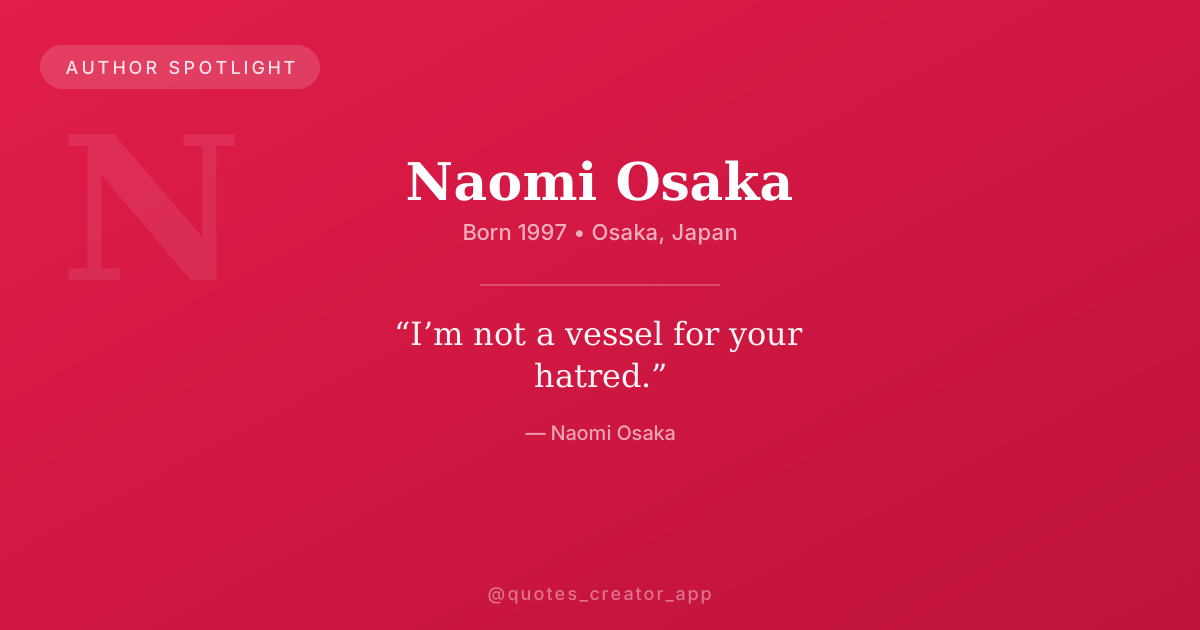
“I’m not a vessel for your hatred.”
The meaning behind these words
Osaka wrote this sentence in a statement posted to social media on May 31, 2021, after being fined $15,000 for declining to appear at mandatory press conferences during the French Open. She explained that she had been suffering from depression since the 2018 US Open and that press conferences triggered her anxiety. The line is direct and final: she is not asking for understanding; she is stating a boundary. The word “vessel” is precise — it suggests that she has been used as a container for other people’s emotions, expectations, and projections. She is refusing that role in plain terms.
At a time when professional athletes were expected to accept press obligations as part of the contract, Osaka asserted that a platform is not a liability, and that the person on the court does not owe the world unlimited access to her pain. The sentence became a rallying cry for athletes across every sport who had quietly endured the same dynamic. It marked the moment when the demand for performative toughness in elite competition began to be openly questioned — not by critics or commentators, but by the athletes themselves.
“I feel like I’m kind of built for this. The bigger the moment, the more I’m able to lock in.”
The meaning behind these words
This is Osaka describing her competitive temperament with the same matter-of-factness she brings to every part of her game. Unlike athletes who draw energy from crowd noise or rivalry, she has described her calm in big moments as almost mechanical: she focuses, she executes, she does not flinch. The phrase “kind of built for this” is characteristically modest — she is not claiming superiority; she is reporting a fact about her own psychology, as though she has simply been lucky enough to be wired for pressure.
The second sentence is the key: “the bigger the moment, the more I’m able to lock in.” Osaka is identifying a direct correlation between stakes and clarity. Where many athletes tighten under pressure, she narrows. That temperament is rare in any profession, and she treats it as an honest assessment rather than a boast. It helps explain how she was able to win four Grand Slams before the age of 25, including two at the US Open where the spotlight is brightest and the noise is loudest.
“I’m trying to be more open about the fact that I have anxiety. Because I think a lot of people have it and they’re scared to say it.”
The meaning behind these words
This quote captures Osaka’s shift from private struggle to public advocacy in the weeks following her French Open withdrawal. She did not retreat from the spotlight; she redirected it. In her Time interview and subsequent appearances, she began speaking about mental health in a way that few top-tier athletes ever had. She was not offering clinical advice or prescriptive solutions; she was offering company — the simple, powerful act of saying “me too” from the highest platform in sports.
The sentence is effective because of the final clause: “they’re scared to say it.” Osaka is not just normalizing anxiety; she is naming the fear that surrounds admitting it — fear of being seen as weak, fear of losing opportunities, fear of being handled differently. By being the one to say it out loud, on a global stage, she gives others permission to do the same. This is what advocacy looks like when it comes from lived experience rather than a script, and it is why her words on this subject have outlasted any single tournament or ranking.
“I’ve always felt that I’m a mix of two cultures, and that’s something I’ve learned to embrace.”
The meaning behind these words
Osaka’s biracial identity — Japanese and Haitian — has been a defining thread in her public life. In Japan, she has sometimes been seen as not fully Japanese; in the United States and beyond, her Japanese surname and features have led others to assume she is one thing or another without asking. For years she navigated that in-between space quietly, but as her platform grew, she began speaking about it directly. This quote captures the nuance: she did not always feel comfortable straddling two worlds; embracing it was something she had to learn.
The key word is “learned.” She did not arrive at this embrace easily; it required growing into a sense of self that did not need external validation. For fans who share a mixed-race background, her journey has been quietly powerful. She represents a way of being that does not require choosing one side, and she has carried that message into her professional life — representing Japan on the global stage while speaking English, Spanish, and Japanese, and showing that identity is not a compromise but an asset.
“The way I see it, I’m playing with house money. I’m already here, so I might as well go for broke.”
The meaning behind these words
Osaka has reached for this gambling metaphor several times in her career to describe how she approaches the biggest matches. “House money” is the casino’s money that you are playing with after you have won enough to cover your original bet — meaning she has already won simply by being on this stage. Applied to tennis, it reframes pressure as privilege: she has already proved she belongs; everything after that is a chance to be bold.
This philosophy explains a great deal about her playing style and her temperament. It is why she could step onto Arthur Ashe Stadium at nineteen and trade blows with Serena Williams in a final; it is why she could back up one Grand Slam with another and another. She does not treat success as something to protect but as something to extend. The line is also a useful life philosophy beyond sports — a reminder that the most creative, most courageous work often happens when we stop trying to preserve what we have and start playing for what we could become.
Naomi Osaka’s legacy
The most visible measure of Osaka’s legacy is athletic. Four Grand Slam championships. A former World No. 1 ranking. One of the highest-paid female athletes in the world for five consecutive years (Forbes). She was the first Asian player to hold the top ranking in singles and the first Japanese player to win a Grand Slam. Her matches drew record television audiences across Asia, and she headlined tournaments in Tokyo, Beijing, and Melbourne that had never before seen that level of global attention. She remains one of the most marketable athletes on the planet, with endorsement partnerships that span luxury fashion, travel, and technology.
The more enduring legacy is structural. Osaka changed what it is possible for an athlete to say out loud. By withdrawing from the French Open and refusing to apologize for prioritizing her mental health, she made it acceptable for other athletes — in tennis, in basketball, in gymnastics, in soccer — to admit that they were struggling too. She created a template for how athletes can be entrepreneurs, authors, and advocates without leaving their sport behind. And for a generation of young people who share her mixed heritage, her anxiety, or simply her refusal to perform a version of strength that costs too much, the lesson is not just that you can be honest about who you are — it is that honesty, in the end, is its own kind of power.
Create graphics with Naomi Osaka’s quotes
Naomi Osaka’s words carry a clarity and courage that make them ideal for quote graphics. Whether you are sharing on social media, creating a vision board, or looking for daily motivation, Quotes Creator helps you transform these quotes into beautiful, shareable designs with custom fonts, gradients, and layouts.
Why we chose Naomi
We are publishing this spotlight in July 2026, a moment that feels right to step back from point totals and rankings and remember what Naomi Osaka has meant to the wider culture. She is not merely a champion who won four majors; she is the athlete who looked at a system that demanded silence and said, calmly, that she would not participate. The five quotes we selected are not her five most famous one-liners — they are the five that trace the arc from a teenager in Osaka to a woman who used her platform to redefine what strength looks like. In an era that is still learning how to talk about mental health, identity, and the cost of performance, her words remain a quiet, steady guide.
— ThinkPeak Studio Editorial Team
Create your own quote graphic with this quote
Turn this line into a shareable graphic in seconds — free, no signup needed. For video quotes and 100+ templates, try the Android app.
Advertisement
Enjoyed this article? Get more like it in your inbox.