On this page
Author Spotlight: Neil Gaiman
From a childhood spent in books to becoming one of the most decorated storytellers of his generation — a look at the writer, the mythmaker, and the man who proved that fiction is the lie that tells the truth.
Who is Neil Gaiman?
Neil Richard MacKinnon Gaiman was born on November 10, 1960, in Portchester, Hampshire, England, into a family of Polish-Jewish heritage. He taught himself to read at four and soon devoured everything from C. S. Lewis to Dennis Wheatley. His childhood was steeped in books, comics, and the strange magic of the fantastical. By ten he was reading J. R. R. Tolkien’s The Lord of the Rings from a school library that only carried the first two volumes — so he kept checking them out, rereading them year after year, waiting for the third. That patience, that willingness to live inside an unfinished story, would come to define his entire career.
Gaiman began as a journalist in the early 1980s, writing interviews and book reviews for British magazines. In 1984 he published a biography of Duran Duran and co-edited Ghastly Beyond Belief, a quotation book that sold out its first edition. But it was comics that called to him most. After reading Alan Moore’s Swamp Thing, he was galvanized. He wrote Black Orchid for DC Comics, and then, in 1989, launched The Sandman — a series that followed the anthropomorphic personification of Dream through 75 issues of myth, horror, history, and heart. It became one of the best-selling comics of all time and made Gaiman the first writer to win the World Fantasy Award for a comic book.
From there he moved into novels, producing a run of beloved works that spanned children’s literature, adult fantasy, and everything in between: Good Omens with Terry Pratchett (1990), Stardust (1999), American Gods (2001), Coraline (2002), Anansi Boys (2005), The Graveyard Book (2008), and The Ocean at the End of the Lane (2013). His trophy case is almost absurd: Hugo, Nebula, Bram Stoker, Newbery, and Carnegie medals. He is the only author ever to win the Newbery and Carnegie for the same book (The Graveyard Book). He co-created the television adaptations of Good Omens and The Sandman, wrote for Doctor Who, and has served as showrunner, screenwriter, and narrator across mediums. Through it all, he has insisted on one thing: that stories are not escape from reality, but the deepest way into it.
What makes Gaiman singular is not just the breadth of his work but the consistency of his voice. He writes about gods and monsters and ordinary people caught between them, and he does so with a warmth that never curdles into sentimentality. He believes in the power of libraries, the necessity of daydreaming, and the moral duty of making beautiful things. His work has shaped the fantasy landscape for three decades and has inspired a generation of writers, artists, and readers to believe that the world can be different — and that the stories we tell can help make it so.
Neil Gaiman’s most memorable quotes
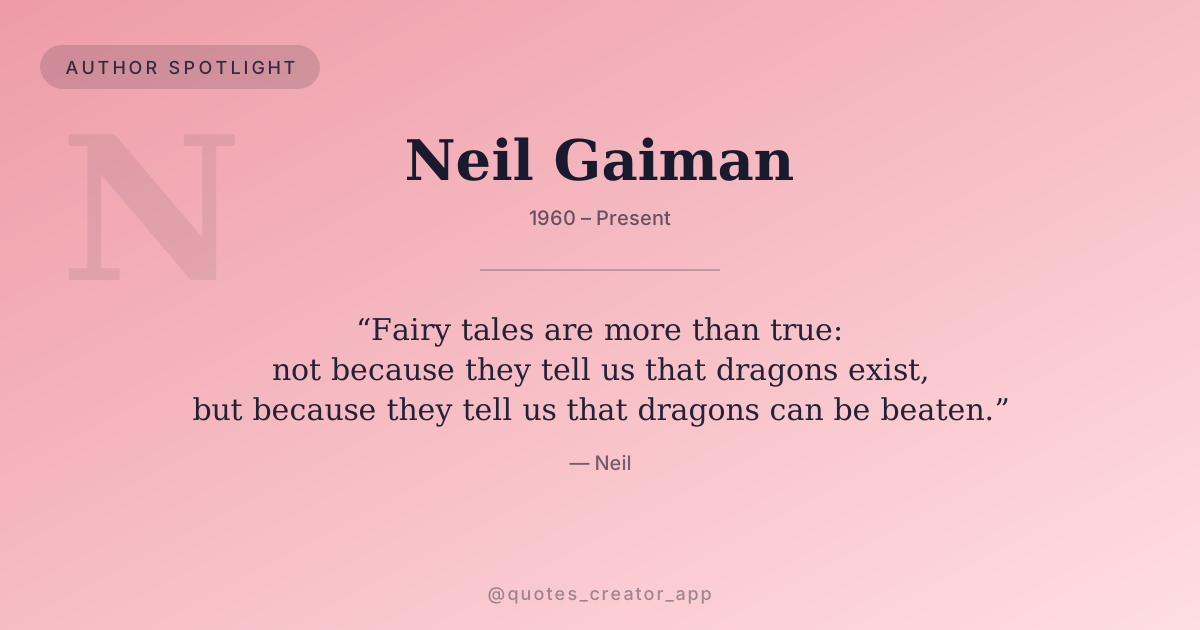
“Fairy tales are more than true: not because they tell us that dragons exist, but because they tell us that dragons can be beaten.”
The meaning behind these words
This sentence, tucked inside a children’s book about a girl who ventures into a parallel world ruled by a button-eyed monster, has become Gaiman’s most quoted line — and for good reason. It distills the entire philosophy of fantasy literature into a single, elegant paradox. The truth of a fairy tale is not literal; it is structural. Dragons are real not as biological facts but as symbols of the overwhelming, the terrifying, the seemingly insurmountable. The real gift of the story is not the dragon’s existence but its defeat. Gaiman is arguing that stories prepare us for hardship by showing us that hardship can be overcome.
In an age increasingly skeptical of fiction’s value, this quote is a quiet manifesto. Gaiman is not defending fantasy as escapism; he is defending it as a form of moral and psychological training. The child who reads about a dragon being slain is not being distracted from reality — she is being shown a blueprint for courage. The line echoes G. K. Chesterton, whom Gaiman has cited as a profound influence, and who once wrote that fairy tales give children their first clear idea of the possible defeat of the bogey. Gaiman simply sharpened the point until it could fit on a page of a book for ten-year-olds.
“Google can bring you back a hundred thousand answers. A librarian can bring you back the right one.”
The meaning behind these words
Gaiman delivered this line during a lecture on libraries, and it has since become a rallying cry for librarians, educators, and anyone who believes that information without curation is noise. The observation is deceptively simple: the internet has given us unprecedented access to facts, but access is not the same as understanding. A search engine returns results ranked by algorithm — popularity, recency, advertising — not by accuracy, relevance, or wisdom. A librarian does the opposite: she listens, interprets, and applies professional judgment to find exactly what someone needs.
The quote also reflects Gaiman’s deep and genuine affection for libraries as institutions. In his 2013 Reading Agency lecture, he called libraries “the gates to the future” and warned that closing them was “stealing from the future to pay for today.” For a man who built a career wandering through the libraries of myth, religion, and folklore, the distinction between raw data and curated knowledge is not academic — it is the difference between a pile of bricks and a cathedral. The librarian is not a gatekeeper; she is an architect of meaning.
“I think… I would rather recollect a life misspent on fragile things than spent avoiding moral debt.”
The meaning behind these words
This line opens Fragile Things, a collection of short stories and poems, and it serves as both an aesthetic credo and a justification for a life devoted to the imagination. “Fragile things” are the stories, the poems, the artworks that have no obvious utility but that make life worth living. Gaiman is aware that writing fantasy is not building bridges or curing diseases — it is, in the eyes of the world, a fragile occupation. But he counters the charge not by arguing that art is useful, but by questioning the value of a life that avoids vulnerability entirely.
The phrase “moral debt” is the key. Gaiman seems to be saying that there is an ethical dimension to the choice of how we spend our time. To avoid doing what matters because it might not be practical, or because it might fail, or because it is “only” art — that is itself a kind of moral failure. The life misspent on fragile things is not wasted; it is a life that took risks, that made things, that chose meaning over safety. It is a sentence that could serve as an epitaph for Gaiman’s entire career, and perhaps for every artist who has ever had to explain why they do what they do.
“Fiction is the lie that tells the truth, after all.”
The meaning behind these words
This is Gaiman’s most concise and powerful defense of fiction. In nine words, he collapses the ancient philosophical debate about the value of storytelling. Yes, fiction is made up — it is, technically, a lie. But it is a lie in service of a deeper truth. The events of a novel never happened, but what the novel reveals about love, loss, jealousy, courage, or the human condition can be truer than any newspaper article. The paradox is that by departing from factual reality, fiction can arrive at emotional and moral reality more directly than any straight line.
Gaiman delivered this line in a lecture about the future of libraries, reading, and daydreaming — an argument that the imaginative life is not a luxury but a necessity. In a world increasingly dominated by data, metrics, and measurable outcomes, his insistence on the truth-telling power of lies feels almost subversive. It is also a deeply personal statement: Gaiman has spent four decades writing about gods who walk among us, doors that open into other worlds, and graveyards that raise children. He knows better than anyone that none of it is real. And he knows, too, that none of that matters, because the truths it contains are as real as anything you will find in a history book.
“Ideas are more difficult to kill than people, but they can be killed, in the end.”
The meaning behind these words
American Gods is built on the premise that gods exist as long as people believe in them, and that they fade — sometimes die — when belief shifts elsewhere. This line, spoken matter-of-factly by the mysterious Wednesday, is the novel’s theological core. Ideas, like gods, are sustained by collective attention. They are not immortal by nature; they require constant renewal. When a society stops telling a story, that story does not merely become forgotten — it becomes extinct. The observation is both ancient and urgent, a reminder that the stories we choose to keep alive are the ones that will shape the future.
There is also a more personal reading. Gaiman himself has spent his career generating ideas — characters, worlds, mythologies — that have taken on lives of their own. The Sandman, Coraline, Shadow Moon, and the rest are not just characters in books; they are ideas that readers have carried into their own lives. The line is a warning as much as a observation: ideas must be tended. They must be told and retold, written and rewritten, shared and adapted. A story that nobody tells is not merely quiet; it is dead. Gaiman’s entire body of work can be read as an argument against that silence.
Neil Gaiman’s legacy
Gaiman’s influence on contemporary fantasy and popular culture is difficult to overstate. The Sandman single-handedly proved that comic books could be literary — that sequential art was not a ghetto for superheroes but a medium capable of myth, philosophy, and profound emotional complexity. It paved the way for Watchmen’s critical reception and for the entire prestige-comics movement that followed. His novels have sold tens of millions of copies worldwide, and their adaptations — Stardust, Coraline, American Gods, Good Omens, The Sandman — have reached audiences far beyond the page. He is among a handful of living writers whose name, on its own, signals a certain kind of imaginative ambition.
But his most enduring legacy may be the way he has framed what stories are for. No major writer of his generation has argued as passionately and as consistently for the moral and psychological necessity of fiction. His lectures on libraries, reading, and daydreaming have been viewed millions of times and quoted in graduation speeches, library-funding campaigns, and literacy programs around the world. He has made the case, over and over, that the imagination is not a luxury — it is a tool for survival, a way of rehearsing courage, and a method for building empathy. In an era of algorithmic content and culture-war fatigue, that case feels more necessary than ever.
Create graphics with Neil Gaiman’s quotes
Neil Gaiman’s words have a timeless quality that makes them perfect for quote graphics. Whether you are sharing on Instagram, creating a vision board, or looking for daily inspiration, Quotes Creator helps you transform these quotes into beautiful, shareable designs with custom fonts, gradients, and layouts.
Why we chose Neil
We are publishing this spotlight in July 2026, a year that has seen new generations discover The Sandman on Netflix and Good Omens reach its spectacular conclusion. Gaiman has recently been at the center of cultural conversations about art, authorship, and accountability — conversations that make it worth revisiting what his work has meant and continues to mean. The five quotes we selected are not all the most famous things he has ever said; they are the ones that best trace the arc from a journalist who loved comics to a writer who changed how we think about the very act of telling stories.
— ThinkPeak Studio Editorial Team
Create your own quote graphic with this quote
Turn this line into a shareable graphic in seconds — free, no signup needed. For video quotes and 100+ templates, try the Android app.
Advertisement
Enjoyed this article? Get more like it in your inbox.