On this page
Author Spotlight: Nigel Farage
British politician, broadcaster, former MEP, Leader of Reform UK, Member of Parliament for Clacton, and the architect of Brexit
Who is Nigel Farage?
Nigel Paul Farage was born on April 3, 1964, in Farnborough, Kent, to Barbara Stevens and Guy Justus Oscar Farage, a stockbroker who worked in the City of London. When Nigel was five, his father — struggling with alcoholism — left the family home, an event that shaped the young Farage’s view of resilience and self-reliance. He was educated at Dulwich College, a fee-paying private school in south London, where he joined the Conservative Party at age 14 after being inspired by a visit from Enoch Powell. Farage spent his formative years steeped in the free-market convictions of Margaret Thatcher and Ronald Reagan. He left the Conservatives in 1992, appalled by John Major’s signing of the Maastricht Treaty, which he saw as a surrender of British sovereignty to an unelected European bureaucracy. That same year, having spent a decade as a commodities trader in the City, he joined the Anti-Federalist League — the precursor to what would become his life’s work.
In 1993, Farage was a founding member of the UK Independence Party (UKIP). He was elected to the European Parliament in 1999 and would spend the next 21 years there — not as an assimilated insider, but as the institution’s most relentless internal critic. His 2010 speech to EU Council President Herman Van Rompuy, in which he called Belgium “pretty much a non-country” and compared Van Rompuy’s charisma to “a damp rag,” made him a YouTube sensation and a fixture of European political theatre. Elected UKIP leader in 2006, Farage built the party from the fringe into an electoral force: in 2014, UKIP won the most seats in the European Parliament elections, a result that directly pressured Prime Minister David Cameron into promising the 2016 EU membership referendum. The Leave campaign’s 52-48 victory on June 23, 2016, was the culmination of a quarter-century of agitation by a man whom the political establishment had spent years dismissing. After the referendum, Farage resigned as UKIP leader. In 2018, frustrated by the slow pace of Brexit negotiations, he co-founded the Brexit Party (later renamed Reform UK), which won the most votes at the 2019 European elections, becoming the largest single party in the parliament.
Farage’s worldview is defined by three unwavering convictions: national sovereignty is non-negotiable, remote bureaucracies are inherently hostile to democracy, and ordinary people deserve a voice against the professional political class. He describes himself not as a politician but as a businessman who entered politics reluctantly, driven by what he saw as a betrayal of the British people. His rhetorical toolkit — a pint of beer in hand, the unbuttoned pub-shirt persona, a willingness to say things others considered unsayable — made him the most effective populist communicator of his generation. Critics call him a demagogue; supporters see him as the only politician willing to speak uncomfortable truths. What both sides agree on is his singular historical significance: Britain voted to leave the European Union, and no single individual did more to make that happen than Nigel Farage. In 2024, on his eighth attempt at a Westminster seat, he was finally elected Member of Parliament for Clacton, walking into the Commons as leader of the party he had refounded.
Farage’s career has been punctuated by survival against the odds. In 2010, during a general election campaign flight, the light aircraft he was traveling in crashed after a UKIP banner tangled in the tailplane. Farage walked away with broken ribs and a fractured spine, later remarking that he had “more vigor and vim and gusto than I ever had before.” In 2023, he became the center of a national scandal when his bank accounts were closed without explanation by Coutts, an elite private bank, in what became known as the de-banking affair — an episode that sparked a parliamentary debate, the resignation of the NatWest CEO, and a national conversation about cancel culture in finance. In 2024, he appeared on ITV’s I’m a Celebrity…Get Me Out of Here! and finished third, describing the 23-night jungle experience as transformative. And in July 2026, while under investigation over an undeclared £5 million gift from a supporter, he announced his intention to resign as MP, triggering a by-election in Clacton that he plans to recontest — framing it as a “people versus the establishment” referendum on his own conduct.
Nigel Farage’s most memorable quotes
“I’m not really a politician. I’m actually a businessman. I supported Margaret Thatcher, I believed in Ronald Reagan, I believe in free markets, I believe in small government, enterprise, hard work, and I believe in a taxation system that doesn’t punish those who do well in life.”
The meaning behind these words
This is Farage’s self-portrait in a paragraph — and it is a deliberate act of political positioning. By insisting he is “not really a politician,” Farage distances himself from the very class he seeks to disrupt. In British political culture, the phrase carries tremendous weight: it signals that the speaker is not one of the careerists who have never held a real job, never run a business, never faced a payroll deadline. It is the same rhetorical move made by Margaret Thatcher when she touted her upbringing in a grocer’s shop, and by Ronald Reagan when he reminded audiences he had been a union leader and a Hollywood actor before entering politics. Farage is telling his audience: I come from your world, not theirs. The invocation of Thatcher and Reagan is also a statement of ideological lineage. He is not a generic populist but a specific kind — a free-market small-government libertarian-conservative whose Euroscepticism is rooted in a conviction that the EU is an anti-democratic regulatory machine that crushes enterprise and self-determination.
The closing line — “I believe in a taxation system that doesn’t punish those who do well in life” — reveals the economic philosophy that has underpinned Farage’s career. He is making a moral argument, not merely a fiscal one: taxation should not be punitive, and success should not be penalized. This conviction was forged during his years as a commodities trader, watching governments impose rules on markets they did not understand. For Farage, the EU epitomized this problem: a remote, unaccountable bureaucracy that taxed and regulated without consent. His genius was to connect economic grievance with democratic grievance, making people feel that their loss of control over their own country was not an abstraction but a daily reality. The quote remains his most complete ideological statement — a mission statement for a political career that has always been animated by the belief that ordinary people should be able to keep more of what they earn and decide more of how they are governed.
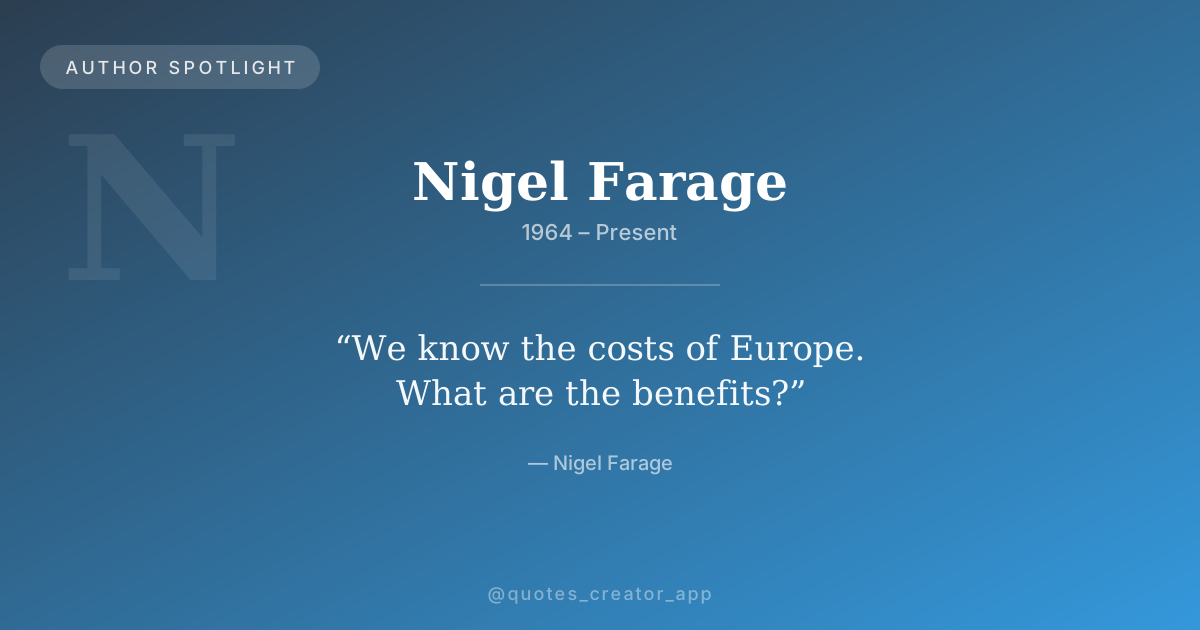
“We know the costs of Europe. What are the benefits?”
The meaning behind these words
This is one of the shortest and most devastating political questions ever posed, and it encapsulates Farage’s rhetorical method in its purest form. He does not make an argument. He asks a question — and by asking it, he frames the entire debate. For decades, the pro-European consensus in Britain had assumed that EU membership was a net good, that the benefits (trade, free movement, peace) were self-evident, and that the costs (membership fees, regulations, loss of sovereignty) were a price worth paying. Farage’s counter-strategy was brilliantly simple: demand that the advocates of European integration justify their position in plain, tangible terms. When they could not — when their answers devolved into abstract talk of influence and soft power — the question itself became the argument. The quote works because it feels like common sense. It appeals to the household budget instinct: if you can’t explain the benefits of a cost, you should stop paying it.
The timing matters too. In 2012, the eurozone crisis was in full swing. Greece, Ireland, Portugal, and Spain were grappling with austerity measures imposed by the European troika. The British contribution to the EU budget had reached £19 billion in the same year Farage posed his question. By linking the abstract dissatisfaction with Brussels to a concrete, pocketbook concern, Farage turned Euroscepticism from a niche intellectual position into a mass movement. He took an idea that had been the preserve of a few Conservative backbenchers and academics and made it a pub conversation. The question, in its blunt simplicity, became a kind of anthem: it was printed on placards, repeated on doorsteps, and ultimately answered by 17.4 million British voters on June 23, 2016. Its enduring power lies in the fact that, for millions of people, it has never been satisfactorily answered.
“Dare to dream that the dawn is breaking on an independent United Kingdom.”
The meaning behind these words
Spoken in the early hours of June 24, 2016, after the BBC projected a Leave victory, this sentence has the cadence of history. Farage, who hours earlier had effectively conceded defeat after the polls closed, found himself addressing a jubilant crowd at the Leave.EU celebration party. The phrase is carefully constructed: “dare to dream” suggests that national independence was once considered an impossible fantasy, something only the politically naive would voice aloud. By urging the British people to “dare,” Farage frames the Brexit vote not as a negative, fearful rejection of Europe, but as a hopeful, courageous assertion of national dignity. The word “dawn” is freighted with meaning: it evokes a new beginning, the end of a long night, and the promise of renewal. For Farage’s supporters, it was the culmination of a quarter-century campaign whose success the political establishment had repeatedly declared impossible.
The resonance of this line owes something to another iconic phrase from that same night: “Let June 23 go down in our history as our independence day.” Both quotes share a thematic core: the assertion that Brexit was not a policy decision but an act of national liberation. The comparison to Independence Day implicitly equates the European Union with an imperial power, and Britain with a colony that had thrown off its chains without a shot being fired. This framing proved enormously potent — and enormously divisive. Critics argue it oversimplifies a complex geopolitical reality; supporters see it as the truth that decades of political correctness had suppressed. What is undeniable is that Farage, in a single evening, gave an emerging political identity its poetry. However one judges Brexit, the phrase “dare to dream” captures something essential about how political movements are built: not on spreadsheets alone, but on the belief that the impossible can be made real.
“We have fought against the multinationals, we have fought against the big merchant banks, we have fought against big politics, we have fought against lies, corruption and deceit — and today honesty, decency and belief in nation is going to win. And we will have done it without having to fight, without a single bullet being fired.”
The meaning behind these words
This is Farage at his most triumphal and his most revealing. The list of enemies — multinationals, merchant banks, big politics, lies, corruption, deceit — is striking because it aligns him not with the economic elites he elsewhere champions but with a populist language of resistance against entrenched power. Farage spent much of his career arguing for free markets and deregulation; here, he positions himself as a champion of the little guy standing against the forces of globalization. This is not a contradiction but a distinction: Farage has always been comfortable with free markets at the national level, where democratic governments can regulate them, while deeply suspicious of supranational capitalism that operates beyond the reach of voters. His target is not wealth but unaccountable wealth — the kind that lobbies in Brussels, shifts profits across borders, and treats nation-states as inconveniences. In casting Brexit as an uprising against this transnational order, he fuses left-wing economic grievance with right-wing cultural nationalism into a single, volatile political compound.
The most arresting phrase in the quote is the final clause: “without a single bullet being fired.” Farage, who had been accused of stoking xenophobia and hatred, here insists that Brexit was a peaceful revolution — that the ballot box, not the barricade, was the weapon. This is a deliberate contrast with the violent nationalism of Europe’s past, and it serves to position Farage’s movement within the tradition of democratic, parliamentary change rather than the extremism of the far right. Whether this distinction holds in the historical record remains a matter of fierce debate, but the rhetorical move is shrewd: by invoking the specter of bullets not fired, Farage reminds his audience that the alternative to democratic nationalism is not internationalism but something much darker. The quote is a self-conscious attempt to write the history of Brexit even as it was being made, and to ensure that history recorded it as a triumph of ordinary people over extraordinary odds.
Nigel’s legacy
Nigel Farage’s legacy is inseparable from the most consequential political event in modern British history: the decision to leave the European Union. He did not pull the lever alone — he needed David Cameron to grant the referendum, Boris Johnson to lead the Leave campaign, and 17.4 million voters to defy the polls — but he applied the pressure for 25 years, and without that pressure, the referendum would never have happened. Political historians now routinely describe him as the most influential British politician never to have held high government office. His ability to frame complex constitutional questions as common-sense kitchen-table issues transformed the way British political communication works. The current leader of the Conservative Party, Kemi Badenoch, and Prime Minister Keir Starmer both govern in a landscape that Farage fundamentally reshaped. His Reform UK party is now a serious electoral force, polling above 20% in the aftermath of his 2026 Clacton by-election gambit, and has forced the two major parties to compete on ground — immigration, sovereignty, cultural identity — that they once considered off-limits.
But Farage’s legacy extends beyond Britain. The Brexit vote sent shockwaves through the entire European project, emboldening Eurosceptic movements in France, Italy, the Netherlands, and across the continent. His 2020 farewell speech to the European Parliament, in which he told assembled MEPs that “we love Europe, we just hate the European Union,” and predicted that Brexit would “start a debate across the whole of Europe,” was widely dismissed at the time as bluster. Yet in the years since, the EU has faced mounting pressure from nationalist movements in multiple member states, and the fundamental questions Farage spent his career asking — Who governs? By what consent? At what cost? — have become mainstream political discourse from Warsaw to Paris. Love him or loathe him, Nigel Farage changed the Western political conversation. He proved that an outsider with conviction, persistence, and a talent for provocation could dismantle a consensus that had seemed unassailable for half a century. That is a legacy few politicians of any era can claim.
Create graphics with Nigel’s quotes
Nigel Farage’s words have a rhetorical punch that makes them perfect for quote graphics. Whether you are sharing on Instagram, creating a vision board, or looking for daily inspiration, Quotes Creator helps you transform these quotes into beautiful, shareable designs with custom fonts, gradients, and layouts.
Why we chose Nigel
On July 7, 2026 — yesterday as we write this — Nigel Farage resigned as the Member of Parliament for Clacton, triggering a by-election in which he intends to stand again, framing it as a “people versus the establishment” referendum on his conduct. In an era when politicians routinely cling to power regardless of scandal, the act of resigning and asking voters to re-hire you is either an act of profound democratic conviction or a political gamble of breathtaking audacity — or both. Either way, it is vintage Farage. On a day when millions of people were Googling his name, we wanted to step back from the headlines and examine the ideas and rhetoric that made him one of the most consequential figures of the 21st century. Whether you celebrated or despaired on June 24, 2016, the words of the man who helped make that day possible demand to be understood — because they changed the world.
— ThinkPeak Studio Editorial Team
Create your own quote graphic with this quote
Turn this line into a shareable graphic in seconds — free, no signup needed. For video quotes and 100+ templates, try the Android app.
Advertisement
Enjoyed this article? Get more like it in your inbox.