On this page
Author Spotlight: Nirmal Purja
From a village in Nepal without electricity to climbing all fourteen of the world’s 8,000-metre peaks in the time it takes most teams to prepare for one — a portrait of the man who turned “impossible” into a starting line.
Who is Nirmal Purja?
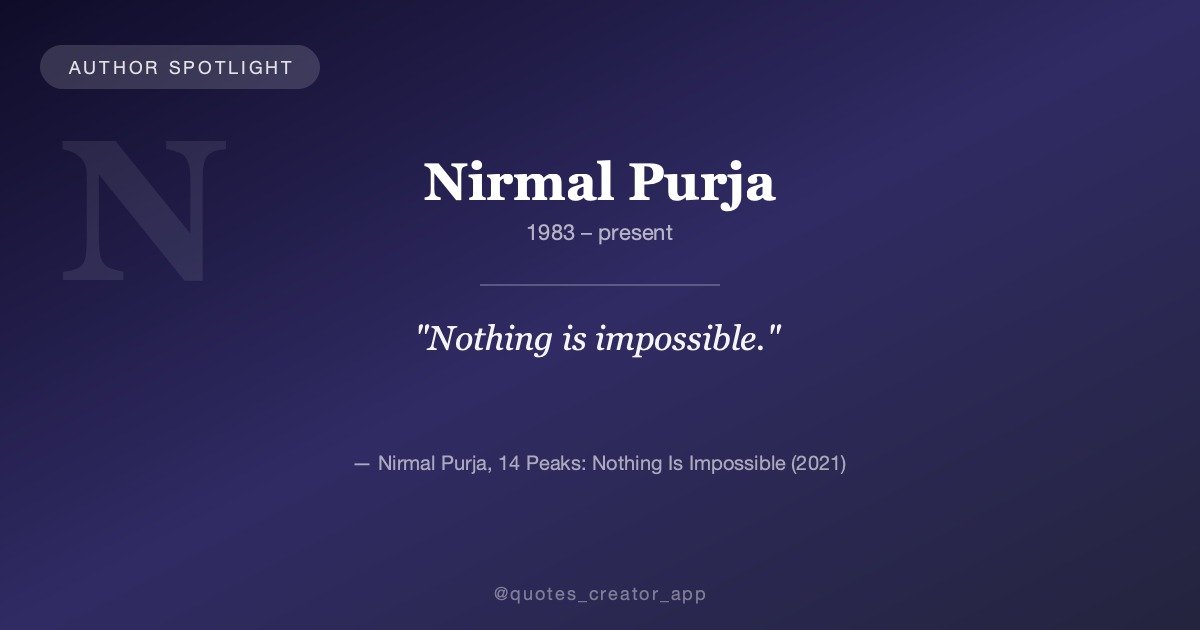
Nirmal Purja — known universally as “Nims” or “Nimsdai” — was born on July 25, 1983, in Dana, a small village in Nepal’s Myagdi District perched 1,600 metres above sea level in the shadow of Dhaulagiri. His father was a Gurkha soldier; his mother came from a farming family. Because their marriage crossed caste lines, both were disowned by their families, and Purja grew up in conditions of genuine poverty. “As a kid, I remember I didn’t even have flip-flops,” he later told National Geographic. His three older brothers became Gurkhas and pooled their military salaries to send him to an English-speaking boarding school — a decision that would shape everything else.
In 2003, Purja joined the British Army’s Brigade of Gurkhas, and in 2009 he was accepted into the Royal Navy’s Special Boat Service (SBS), becoming the first Gurkha to join the elite unit. He served as a cold-weather warfare specialist, operating in every theatre of war in which Britain was engaged. In 2018, he made a decision that stunned his senior officers: he turned down an invitation to join the SAS and resigned from active service, walking away from a life-changing pension to pursue high-altitude mountaineering full-time. He was thirty-five years old, had no career as a professional climber, and was about to attempt something no human being had done before.
What followed was Project Possible 14/7 — a plan to summit all fourteen of the world’s 8,000-metre peaks in seven months. The previous record was just under eight years. Purja completed it in six months and six days between April and October 2019, shattering the record by a margin that defied belief. Along the way he climbed Everest, Lhotse, and Makalu in 48 hours, summited K2, and took a photograph of overcrowding on Everest that went viral in The New York Times and sparked a global conversation about commercial climbing. The entire journey was captured in the Netflix documentary 14 Peaks: Nothing Is Impossible (2021), which introduced his philosophy — and his battle cry of “Nims is coming!” — to a global audience of millions.
In the years since, Purja has continued to redefine the boundaries of what mountaineers can attempt. In January 2021, he and a team of Nepali climbers completed the first winter ascent of K2 — the “Savage Mountain” — a feat that had repelled every expedition since 1987. He summited without supplemental oxygen, becoming the first person to do so on K2 in winter. In 2024, he became the first person to summit the 14 peaks and the Seven Summits both with and without oxygen. By mid-2026 he had amassed over fifty ascents of 8,000-metre peaks — more than any climber in history — and launched the Hat-Trick Challenge: a third round of all 14 peaks and the Seven Summits, self-funded, with all sponsorship directed to the Nimsdai Foundation. His foundation runs the Big Mountain Clean Up, removing thousands of kilograms of waste from the high peaks, and funds education and emergency aid for Himalayan communities. Through it all, Purja has kept one belief at the centre: that nothing is impossible, and that the word is not a fact but a surrender.
Nirmal Purja’s most memorable quotes
“Giving up is not in the blood.”
The meaning behind these words
Six words, delivered in Purja’s matter-of-fact cadence, that compress an entire worldview into a single sentence. The line appears early in the Netflix documentary, and it functions less as a motivational slogan and more as a statement of identity. Purja is not saying he chooses not to give up; he is saying that giving up is not a category his blood recognises. This is the language of the Gurkhas, whose regimental motto is “Better to die than be a coward,” and of the Special Forces, where the distinction between the possible and the impossible is treated as a failure of imagination rather than a fact of physics.
What makes the line stick is its complete absence of self-dramatisation. There is no pause for effect, no crescendo. He says it the way someone else might say “I’ll have the chicken.” That flatness is the point. Resilience, in Purja’s telling, is not a heroic posture. It is simply the way his body and his culture operate — a baseline condition, not something you have to psych yourself up to achieve. The line also invites a useful question: what would your life look like if you believed the same thing about yourself?
“I was told my project was impossible. I was told I would die. I was told no one had ever done it in the history of mankind. And that was exactly why I had to try.”
The meaning behind these words
These lines form the thesis of Purja’s memoir, Beyond Possible, and they reveal a psychology that reverses the standard relationship between evidence and action. For most people, the fact that something has never been done is a warning sign. For Purja, it is the reason to begin. The shift is subtle but complete: he is not arguing that the sceptics are wrong — he is arguing that their certainty is the fuel. “That was exactly why I had to try” turns opposition into invitation.
The rhetorical structure is worth noting. Three sentences beginning with the same passive construction (“I was told”) build a case against the project, and then the fourth sentence — the one that carries the active verb “try” — overturns all three. This is a writerly instinct at work: the rhythm of the prose mirrors the rhythm of the action it describes. The whole tradition of high-altitude mountaineering, from Mallory to Messner, has been driven by people who heard “impossible” and decided it meant “nobody has tried hard enough yet.” Purja’s innovation was to compress the timescale from eight years to six months and to film the whole thing for Netflix.
“The human body can take far more than we give it credit for. The limits are all in the mind.”
The meaning behind these words
After annihilating the speed record for the fourteen peaks, Purja was asked — repeatedly — how it was physically possible. His answer, stripped to its core, is this sentence, and it articulates a position that sits somewhere between athletic science and stoic philosophy. The statement asserts two separate things: first, an empirical claim about human biology (the body is stronger than we assume), and second, a claim about the source of most people’s limitations (the mind, not the body, imposes the ceiling). Coming from a man who just climbed higher and faster than anyone in history, the claim carries the authority of lived experience.
The line also operates as a hinge between Purja’s military past and his mountaineering present. Special Forces selection is designed to find the point where the mind breaks before the body does, and to push that point further out. What Purja brought from the SBS to the Himalayas was not just technical cold-weather skill but a specific kind of mental conditioning: the discovery that, as he put it elsewhere, “when you think you are done, you are only 40 per cent done.” The body matters — it must be trained, fed, rested — but the gap between what almost anyone can endure and what most people actually endure is occupied by the stories they tell themselves about what they can handle.
“I come from a place where everything feels impossible. There was no electricity in my village. No roads. No hospitals. And yet my parents sent me to an English-speaking boarding school. They made the impossible possible. And that is what I have tried to do with my life.”
The meaning behind these words
Among all of Purja’s quotes, this is the one that most explicitly connects his Himalayan achievements to his childhood beginnings. He is refusing the lonely-genius narrative of mountaineering lore — the lone man against the mountain — and substituting a story about intergenerational sacrifice. The “they” who made the impossible possible were his parents and brothers, people with no wealth or power, who simply pooled what they had and aimed it at a single child’s future. The grammar of the passage makes it clear that Purja sees his own Project Possible not as an individual triumph but as the logical continuation of a family strategy.
There is something quietly political in this framing. By historicising his own success, Purja pushes back against the exoticising narratives that Western media sometimes applies to Nepali and Sherpa climbers — the idea that they are “naturally” suited to altitude, as if culture and training had nothing to do with it. His achievements were not inevitable, and he wants you to know it. They were built, like everything else, on decisions: his parents’ decision to marry across caste lines, his brothers’ decision to send him to school, his own decision to walk away from a military pension. The mountains are the stage; the decisions are the play.
Nirmal Purja’s legacy
The most immediate measure of Purja’s legacy is the record book. He has climbed the fourteen 8,000-metre peaks a record three times — once with oxygen in 6 months and 6 days (2019), once without oxygen in 2 years and 5 months (2024), and he is currently working on a third round through the Hat-Trick Challenge. As of early 2026, he had completed over fifty successful ascents of 8,000-metre peaks, setting the record for the most summits by any climber. He holds Guinness World Records for the fastest three-peak traverse of Everest, Lhotse, and Makalu, broke his own record for the fastest Everest-to-Lhotse traverse without oxygen in May 2026 (13 hours), and completed the first winter ascent of K2 — all of K2, without supplemental oxygen — in 2021 alongside nine other Nepali climbers.
The longer legacy, however, is less about records than about representation. Purja is one of the first Nepali mountaineers to become a global household name in his own right — not as a Sherpa supporting a Western expedition, but as the leader, the brand, the face on the poster. The Netflix documentary 14 Peaks was watched by tens of millions and introduced the world to a style of high-altitude climbing that is fast, fiercely collaborative, and unapologetically proud of its Nepali roots. The documentary’s success opened doors for other Nepali climbing stories and challenged the colonial residue that still colours how Himalayan achievements are reported and funded. Purja also launched the Nimsdai Foundation’s Big Mountain Clean Up, a programme that has removed thousands of kilograms of waste from the death zone while providing paid work and infrastructure for the communities living below those peaks. His book, Beyond Possible, has been translated into over a dozen languages and has become a staple text for people who want a manual on what it looks like to ignore the word “impossible” and simply begin.
Create graphics with Nirmal Purja’s quotes
Nirmal Purja’s words carry the weight of someone who has tested every limit he set out to break. Whether you are looking for motivation, training for your own challenge, or simply want a daily reminder that most limits are mental ones, Quotes Creator helps you turn these quotes into beautiful, shareable graphics — framed however you want, in whatever colours speak to your own impossible project.
Why we chose Nims
We are publishing this spotlight on the first day of August 2026, a moment when Nirmal Purja has been in the global news cycle for reasons both remarkable and deeply concerning. His climbing career — which has already made him the most prolific 8,000-metre summiteer in history — speaks for itself. But we chose this moment to spotlight his work because his words have always been the engine underneath the achievement. The four quotes we selected are not the four most dramatic things he has said at altitude. They are the four that trace the full arc: from his childhood, through his military years, into his records, and back to the quiet conviction — shared by his family long before he ever touched a mountain — that “impossible” is not a fact, just a bet you can decline to take.
— ThinkPeak Studio Editorial Team
Create your own quote graphic with this quote
Turn this line into a shareable graphic in seconds — free, no signup needed. For video quotes and 100+ templates, try the Android app.
Advertisement
Enjoyed this article? Get more like it in your inbox.