On this page
Author Spotlight: Russell Westbrook
He played every possession as if it might be his last, and if you want to know why, the answer is a name, not a statistic: Khelcey Barrs III. Russell Westbrook entered high school at five-foot-eight, unranked and unnoticed, and left the game eighteen seasons later as the most prolific triple-double machine the sport has ever seen — the owner of a record so far ahead of its nearest rival that it once looked untouchable, and a two-word creed that carried him the whole way. “Why not?” was never a slogan to Westbrook. It was a life strategy, forged in grief and doubt, sharpened against a thousand critics, and aimed always at the same target: proving that the boy from Hawthorne who was never supposed to make it could outlast, outwork, and out-will everyone who told him he couldn’t. This is the story of the player who turned being doubted into a superpower.
Who is Russell Westbrook?
Russell Westbrook III was born on November 12, 1988, in Long Beach, California, to Russell Westbrook Jr. and Shannon Horton, and raised in the neighboring city of Hawthorne with a younger brother, Raynard, shadowing his every move. His was an ordinary, disciplined childhood — by his own account he was in the house nine days out of ten, steered by parents who taught him right from wrong and by the knowledge that a little brother was watching. But the two facts that would come to define him were both set in stone before he ever reached high school. The first was a friendship: his closest companion was a boy named Khelcey Barrs III, a gifted young basketball player whom everyone, including the two of them, assumed was destined for stardom. The second was a tragedy. In May 2004, at the age of sixteen, Barrs collapsed and died of an enlarged heart during a pick-up game. Westbrook, then fifteen, was devastated — and, in the way that grief can harden into purpose, he resolved to live and play for them both. He has never once taken the court without a “KB3” wristband on his arm, and the initials are stitched into every pair of shoes he has ever worn.
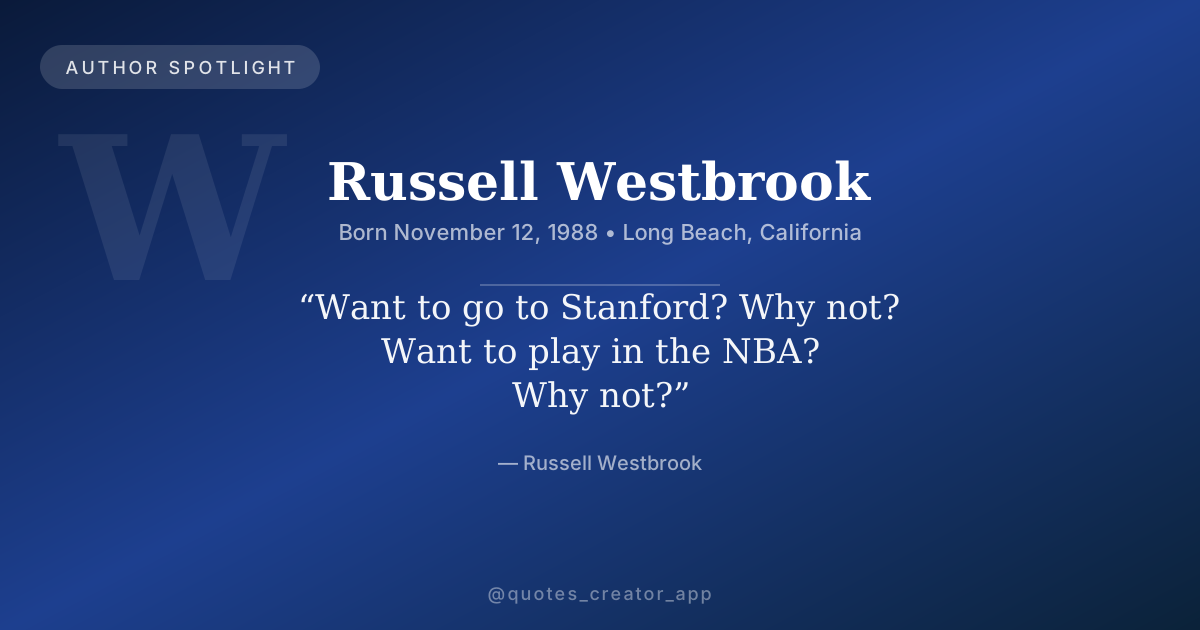
The basketball world, however, was not paying attention. Westbrook entered Leuzinger High School standing just five-foot-eight and weighing 140 pounds, with size-14 feet that hinted at a growth spurt that had not yet arrived. He did not crack the varsity starting lineup until his junior year, and he did not receive his first college recruiting letter until the summer before his senior season. It was in that crucible of being overlooked — watching his dead best friend receive the scholarship offers that never came for him — that the motto was born. He and his friends began answering every impossibility with the same two words: Why not? Want to go to Stanford? Why not? Want to play in the NBA? Why not? The growth spurt finally arrived that summer, adding seven inches to his frame, and as a senior he averaged 25.1 points, 8.7 rebounds, 3.1 steals, and 2.3 assists, willing Leuzinger to a 25–4 record and, at last, onto the radar of UCLA’s Ben Howland. At UCLA he wore number 0 — the number of doubters he believed would outnumber him, a reminder that nobody thought he belonged — and he played his way from a three-points-a-game freshman reserve into the Pac-10 Defensive Player of the Year, with two Final Four runs to his name before he declared for the draft.
The NBA took him fourth overall in the 2008 draft — selected by the Seattle SuperSonics, who relocated to Oklahoma City six days later and became the Thunder. What followed was one of the most consequential runs any franchise has enjoyed. Over eleven seasons in Oklahoma City, Westbrook became the Thunder’s all-time leading scorer, reached the 2012 NBA Finals alongside Kevin Durant and James Harden, and, after the two of them departed, transformed himself into the single most audacious statistical force the league had witnessed in half a century. In 2016–17, carrying a depleted roster on his back, he averaged a triple-double for an entire season — 31.6 points, 10.7 rebounds, and 10.4 assists per game — and broke Oscar Robertson’s fifty-five-year-old record with forty-two triple-doubles in a single season, a feat so unfathomable that it had been considered untouchable. He won the NBA’s Most Valuable Player Award that season, and then, incredibly, did it again the next year. And the year after that. By the time he left Oklahoma City he had averaged a triple-double in three consecutive seasons and four times in five years, a statistical signature no player had produced since Robertson, and one that effectively redefined what a six-foot-four point guard could be.
The back half of his career was a wandering, often bruising lesson in how the league treats its most uncompromising stars. He was traded to Houston to reunite with Harden in 2019, then to Washington in 2020 — where, on May 10, 2021, he passed Robertson to become the all-time career leader in triple-doubles — then to his hometown Los Angeles Lakers in 2021, where the fit curdled into a public, unrelenting blame game that gave the world its cruelest nickname for him, “Westbrick.” He weathered it the only way he knew how, with his head down and his intensity untouched, moving on to the Clippers, then to the Denver Nuggets, where in November 2024 he became the first player in history to record 200 career triple-doubles, and finally to the Sacramento Kings. In his final season he kept climbing the all-time lists with a quiet dignity that felt like a closing argument: he surpassed Jason Kidd to become the most prolific rebounding guard in history, joined LeBron James as the only players ever to reach 25,000 points and 10,000 assists, passed Robertson to become the highest-scoring point guard in NBA history, and crossed the 27,000-point mark. On August 12, 2026, he announced his retirement. The boy who was told he was too small had finished as a nine-time All-Star, a nine-time All-NBA selection, a two-time scoring champion, a three-time assists leader, a member of the NBA’s 75th Anniversary Team, and a two-time Olympic gold medalist — with a record 208 triple-doubles that may never be touched.
Russell Westbrook’s most memorable quotes
“My friends and I started that motto early in high school — that attitude, that mentality — from way back then: Want to go to Stanford? Why not? Want to play in the NBA? Why not?”
The meaning behind these words
Everything about Russell Westbrook’s public identity is contained in these two words, and this sentence is the closest he has ever come to explaining where they came from. Listen to what he is actually describing. The motto was not invented by a marketing team, and it was not retrofitted onto his story after the championships and the MVP award arrived. It was born “early in high school,” in the years when he was a five-foot-eight reserve who had not yet received a single recruiting letter, when the dream of playing in the NBA looked to everyone around him like a child’s fantasy. The questions he lists — Want to go to Stanford? Want to play in the NBA? — were not hypotheticals. They were the exact impossibilities the world kept putting in front of him, each one met with the same refusal to accept the premise. “Why not?” is not really a question in Westbrook’s mouth. It is a rejection of the question that came before it — the implicit “why would someone like you think you can?” that followed him for two decades.
What makes the phrase so powerful is that it is radically simple. Most motivational philosophy is elaborate; Westbrook’s is two syllables that any kid in any gym can say out loud. But the simplicity is the point, because the motto was designed to be said in the face of a doubt, immediately, in the moment the doubt appears. There is a quiet, almost defiant logic to it: if you cannot give a good reason why not, then the answer is yes. And Westbrook spent eighteen seasons demonstrating that he could rarely think of a good reason why not. The boy who was too small became an MVP. The guard nobody recruited became the all-time triple-double king. The motto that began as a private joke among teenagers in Hawthorne became the name of his foundation, his signature Jordan Brand line, and his documentary — the two words that, more than any statistic, will outlast his playing career.
“I’ve always had to prove myself to people growing up. I had to show them that I could do this and I could do that and paying no mind to what the critics said.”
The meaning behind these words
This is Westbrook naming the engine that drove him for nearly two decades, and there is a crucial tension folded into it. On one side there is the raw, almost abrasive independence: “paying no mind to what the critics said.” On the other there is the quiet acknowledgment that the critics were always there, that he spent his entire life having to prove himself to people who had already decided he was not enough. The two halves of the sentence are not contradictory; they are complementary halves of the same survival strategy. You cannot spend your life proving yourself to people if you also spend it listening to them. To outwork a world that doubts you, you must simultaneously care enormously about proving it wrong and care not at all about what it says while you do. Westbrook held both postures at once — a feat of psychic discipline that most people never manage.
And the sentence explains a great deal about why he played the way he did, with a fury that could look like anger and was, in truth, closer to testimony. Every explosive drive to the rim, every chest-thumping, every refusal to sit down or slow down was an argument being made to an audience that had already rendered its verdict. The tragedy — and the nobility — of Westbrook’s later career is that the audience never stopped rendering verdicts. In Los Angeles, the “critics” he had always ignored grew louder than ever, and the nickname they gave him stung in a way that even his armor could not entirely absorb. Yet he kept showing up, kept proving, kept paying no mind, because the alternative was to become the person they said he was. The line is a reminder that being underestimated is not a condition to be escaped but a fuel to be burned, and that Westbrook burned it, game after game, until there was nothing left to prove to anyone but himself.
“Every day when I get on the floor I give it my all and play because you never know what tomorrow holds.”
The meaning behind these words
On the surface this reads like the standard boilerplate of the dedicated athlete — give it your all, live in the moment, seize the day. But for Westbrook, the final clause is not a cliché; it is the scar tissue of a specific, devastating loss. His best friend Khelcey Barrs III died suddenly at sixteen, a healthy-seeming teenager who stepped onto a basketball court for an ordinary pick-up game and never came home. Westbrook was fifteen when it happened, and the lesson it burned into him was not abstract. Tomorrow is not guaranteed, because he watched tomorrow be taken from the person he loved most, for no reason, without warning. When he says he plays every day as though he does not know what tomorrow holds, he is not performing. He is describing the only rational response to having learned, as a child, that tomorrow can be ripped away at any moment.
This is the sentence that finally explains the man’s famous intensity — the quality that made him both the most thrilling and the most polarizing player of his generation. There was no load management in Westbrook’s vocabulary, no night off, no business decision, because to treat a single game as disposable was, in his accounting, to betray the boy who never got to play another one. The “KB3” wristband he never removes, the initials on every sneaker, the way he played each possession as though it were the last he would ever get — all of it flows from this single sentence. Grief, properly metabolized, becomes urgency. And urgency, sustained over eighteen years and more than a thousand games, becomes something that looks to the outside world like rage but is, from the inside, an act of remembrance. He was never simply playing for himself. He was playing for two.
“I’m never satisfied. I’m always trying to get better and learn from my mistakes.”
The meaning behind these words
This is the sentence that separates Westbrook from the thousands of talented players who never become great. Talent explains the first triple-double; it does not explain the two hundred and eighth. What explains the record is the disposition captured here, in three plain sentences that amount to a single idea: the moment of arrival is the moment the work begins again. Westbrook reached heights that would have satisfied almost anyone — the MVP, the scoring titles, the Finals appearance, the largest guaranteed contract in NBA history at the time — and yet his defining psychological trait, by his own testimony, was that none of it was ever enough. The phrase “never satisfied” is usually a stock answer in sports interviews, trotted out and instantly forgotten. From Westbrook it was a verifiable fact of his career, demonstrated season after season in the way he returned from every setback — every knee surgery, every trade, every round of boos — having added something new to his game.
The second half of the sentence is the part most people overlook, and it is the part that humanizes him. “Always trying to get better” is the easy thing to say; “learn from my mistakes” is the hard thing to do, because it requires admitting that you make them. For a player as proud and as scrutinized as Westbrook — a man who was criticized for his shooting, his turnovers, his “single-mindedness” — the willingness to acknowledge error and correct it was the quiet counterpoint to his ferocious public stubbornness. The two ideas are not in conflict. He refused to let critics define him, but he never refused to let them teach him. It is a subtle and mature distinction, and it is precisely why the last act of his career was so moving: an aging superstar, stripped of the spotlight, reinventing himself as a role player and a mentor, still chasing improvement at thirty-seven. “Never satisfied” did not mean never grateful. It meant never finished.
Russell Westbrook’s legacy
The most obvious measure of Russell Westbrook’s legacy is written in the record books, and it is staggering. He is the all-time leader in career triple-doubles, with 208 — a number that stands more than two dozen clear of Oscar Robertson’s mark, which had itself endured for nearly half a century and was long considered untouchable. He is the only player in history to average a triple-double in four seasons, and one of only three to do it even once. He holds the record for the most rebounds by a guard, ranks among the top ten in all-time assists, and finished as the highest-scoring point guard the game has ever produced. In 2021 he was named to the NBA’s 75th Anniversary Team, an honor that places him among the seventy-five greatest players in the history of the sport. These are not the résumé lines of a specialist or a compiler; they are the résumé lines of a player who fundamentally rewrote the boundaries of what his position could accomplish.
But the deeper legacy is the one that cannot be counted in a box score, and it is the “Why Not?” mentality he turned into a kind of secular gospel. Before Westbrook, the triple-double was a rare curiosity, an occasion to stop and marvel; after him, it became an expectation, a language in which greatness was spoken. More importantly, he made being doubted into a badge of honor. He was told he was too small, too raw, too reckless, too selfish, too much — and he answered every version of that criticism by simply refusing to be smaller, calmer, safer, or less than what he was. For a generation of young athletes who were themselves told they could not, Westbrook’s entire existence became a permission slip. His story — the unrecruited five-foot-eight teenager who lost his best friend and spent the rest of his life playing for two — is the purest expression of the idea that effort, directed relentlessly and without apology, is its own form of genius.
And then there is the legacy he built away from the court, quietly and with the same intensity. Through the Russell Westbrook Why Not? Foundation, established in 2012, he has funded community-based education and family programs designed to teach young people the self-confidence he had to manufacture for himself. His unisex streetwear label, Honor the Gift, is a love letter to Hawthorne and the inner-city neighborhoods that shaped him, and his creative direction of True Religion and his record-setting Jordan Brand partnership made him as much a fashion icon as a basketball one. He produced Tulsa Burning, the Emmy-nominated documentary about the 1921 Tulsa Race Massacre, drawn from his years in Oklahoma City, and told his own story in the documentary Passion Play. The boy who once could not afford the clothes he dreamed of wearing became the man who built an empire from his own taste, his own city, and his own refusal to be boxed in. That is the complete arc of Russell Westbrook: an underdog who did not merely overcome the doubt — he converted it into art, into records, and into a two-word philosophy that now belongs to everyone who has ever needed to believe the answer to “why not?” is yes.
Create graphics with Russell Westbrook’s quotes
Russell Westbrook’s words carry the same quality that made him one of the most electric players ever to step on a court — they are direct, defiant, and built to be repeated. Whether you need a line about refusing to quit, about proving the doubters wrong, or about the two words that can reframe any obstacle, Quotes Creator helps you turn these quotes into beautiful, shareable designs with custom fonts, colors, and layouts.
Why we chose Russell Westbrook
Russell Westbrook enters this spotlight at the close of the story — and at the peak of the conversation around it. On August 12, 2026, he announced his retirement from professional basketball, and his Wikipedia page surged to more than one hundred thousand views a day as fans and critics alike scrambled to take the measure of the eighteen-year career that had just ended. The timing, as it always is with these spotlights, is secondary to the substance. We chose Russell Westbrook because his is one of the rare lives in which the most impressive thing about a person — the record — is not the most important thing about them. Everyone knows the triple-doubles. Far fewer know the boy behind them: the five-foot-eight high-school reserve nobody recruited, the teenager who buried his best friend and resolved to play for them both, the man who spent two decades answering every doubt with a two-word question that was really an answer. We chose him because the distance between that boy and that record is where his real story lives.
The four quotes we have selected trace the spine of that story. They begin with the origin of “Why Not?” — the motto born in a high-school gymnasium, among friends, when the dreams were still impossibly far away. They move through the underdog’s creed, the confession that he spent his whole life proving himself to people who had already written him off, and the lesson in paying no mind to the critics while outworking all of them. They reach the sentence that explains his ferocity — “you never know what tomorrow holds” — the quiet grief of a man who has been playing for two ever since the age of fifteen. And they end with the refusal to settle, the “never satisfied” that turned talent into a record that may outlive the sport. These are not the tidy maxims of a comfortable life. They are the words of a man who turned being underestimated into the engine of everything he became, and who walked away from the game, at last, with nothing left to prove — except to the friend who had believed in him from the start.
— ThinkPeak Studio Editorial Team
Create your own quote graphic with this quote
Turn this line into a shareable graphic in seconds — free, no signup needed. For video quotes and 100+ templates, try the Android app.
Advertisement
Enjoyed this article? Get more like it in your inbox.