On this page
Author Spotlight: Ryan Gosling
Canadian actor and musician known for his range from indie dramas (Half Nelson, Blue Valentine) to blockbusters (Barbie, La La Land, Drive, Project Hail Mary)
Who is Ryan Gosling?
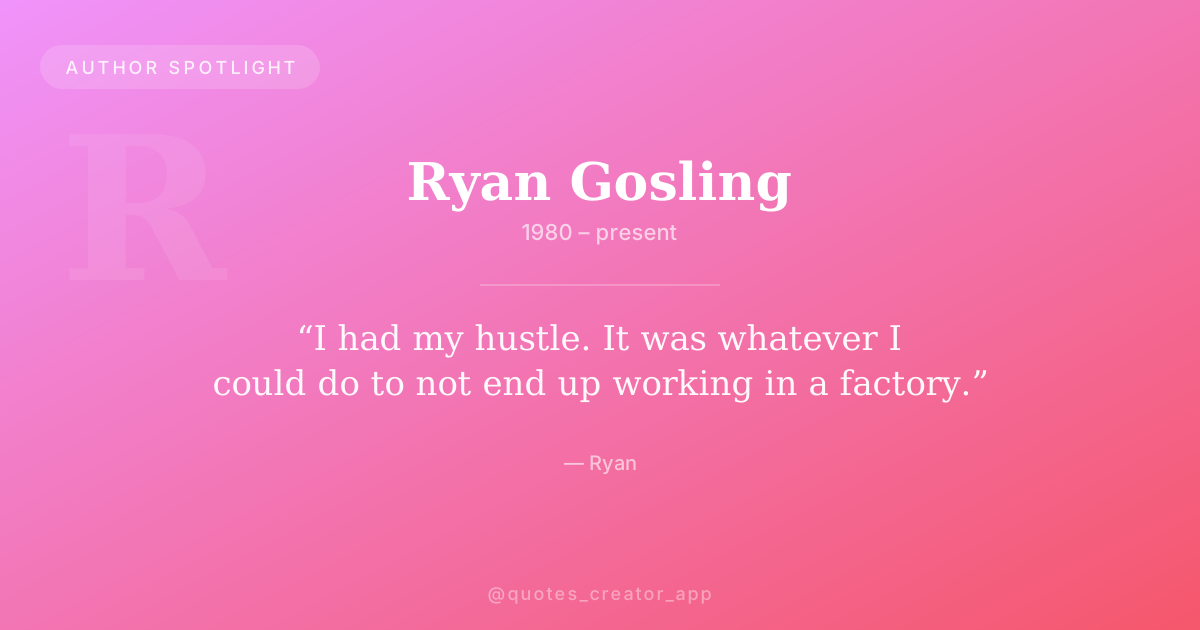
Ryan Thomas Gosling was born on November 12, 1980, in London, Ontario, to a traveling paper-mill salesman and a secretary. His childhood was unsettled and often difficult: the family moved frequently, his parents divorced when he was 13, and he was raised thereafter by his mother alongside his older sister Mandi. He was diagnosed with ADHD, prescribed Ritalin, and was homeschooled after struggling in conventional classrooms. In first grade, inspired by the film First Blood, he brought steak knives to school and threw them at classmates during recess — a story he has recounted with a mixture of embarrassment and bemusement. He had no friends until he was 14 or 15, and he has spoken candidly about how performing became the one arena where he received praise and found self-worth. Encouraged by his sister, he sang at weddings, danced with a local ballet company, and performed in his uncle’s Elvis tribute act. “I had my hustle,” he later told The Guardian. “It was whatever I could do to not end up working in a factory.”
At 12, Gosling won a spot on Disney’s The All New Mickey Mouse Club, which relocated him to Orlando and placed him alongside future stars Britney Spears, Justin Timberlake, and Christina Aguilera. After the show ended, he returned to Canada for a string of teen-TV roles — Breaker High, Young Hercules — before dropping out of high school at 17 and committing entirely to acting. His breakthrough came with The Believer (2001), in which he played a Jewish neo-Nazi with a ferocity that won the Sundance Grand Jury Prize and prompted the Los Angeles Times to call his performance “electrifying and terrifyingly convincing.” Then came The Notebook (2004), the Nicholas Sparks adaptation that transformed him into a global heartthrob. But Gosling refused to be typecast. Over the next decade, he constructed one of the most eclectic filmographies in Hollywood: a drug-addicted teacher in Half Nelson (2006, his first Oscar nomination), a man in love with a sex doll in Lars and the Real Girl (2007), a stoic getaway driver in Drive (2011), a charismatic pick-up artist in Crazy, Stupid, Love (2011), a jazz pianist dreaming of old Hollywood in La La Land (2016, his second Oscar nomination), Neil Armstrong in First Man (2018), and an irrepressibly sincere Ken in Barbie (2023, his third Oscar nomination).
What distinguishes Gosling from many of his contemporaries is his apparent indifference to the machinery of stardom. He has spoken repeatedly about needing to step away from acting to regain perspective, and he took a four-year hiatus between 2018 and 2022. He directs (the polarizing Lost River, 2014), makes music with his indie-rock duo Dead Man’s Bones, co-owns a Moroccan restaurant in Beverly Hills, and has two daughters with the actress Eva Mendes, his partner since 2011. He has also devoted significant time to humanitarian causes, traveling to Darfur, Uganda, and the Democratic Republic of Congo with organizations like the Enough Project and Invisible Children. “I grew up in a family of strong women,” he has said, “and I owe any capacity I have to understand women to my mother and big sister.” That grounding — in difficulty, in restlessness, in the steady influence of women — runs through nearly every choice he makes.
In 2026, Gosling is once again at the center of the cultural conversation. His starring role in Project Hail Mary, the long-awaited adaptation of Andy Weir’s science fiction novel, has drawn critical acclaim for a performance that balances scientific wonder with emotional vulnerability. At San Diego Comic-Con in July 2026, Marvel Studios announced that Gosling will play Johnny Blaze / Ghost Rider in the Marvel Cinematic Universe, and earlier in the year he was confirmed to star in Shawn Levy’s Star Wars: Starfighter. After nearly three decades in the public eye, Gosling has become that rare figure who can move between auteur cinema and franchise juggernauts without ever seeming to lose the idiosyncratic, slightly off-center sensibility that has defined him from the start.
Ryan Gosling’s most memorable quotes
“I had my hustle. It was whatever I could do to not end up working in a factory. If I had to shake it like a showgirl, I was going to do it.”
The meaning behind these words
Gosling delivered this line while reflecting on his childhood in Cornwall, Ontario, where his father sold paper-mill supplies and the prospect of factory work loomed as the default future. He was not being hyperbolic. He sang at weddings alongside his uncle, an Elvis impersonator who performed as “Elvis Perry.” He danced with a local ballet troupe. He auditioned relentlessly for anything that might get him out. The quote captures an underappreciated dimension of his story: Gosling was not a child of privilege who stumbled into acting through connections. He was a kid who recognized, with unusual clarity, that his options were limited and that performance was the one skill he could monetize. The word “hustle” is significant here — it acknowledges that talent alone was never going to be enough, and that the willingness to do whatever the moment required was the real difference-maker.
The quote also demystifies something that Hollywood mythmaking tends to obscure. We like narratives of discovery — the waitress spotted at a diner, the farm boy who wandered onto a set — but Gosling’s version is more honest and more instructive. He worked. He worked in ways that were not glamorous, and he did not pretend they were. “If I had to shake it like a showgirl,” he said, with a self-awareness that strips away any pretense of dignity. It is a statement about the economics of ambition, about the gap between where you start and where you want to be, and about the refusal to let that gap become permanent. For anyone who has ever felt that their dreams were too big for their circumstances, the line resonates because it tells the truth: the hustle is not beneath you. The hustle is the point.
“I feel like I think like a woman, because I grew up with my mother and my sister so I’ve just been programmed to think like a girl. That’s my own reality so it’s a doorway into a world for me.”
The meaning behind these words
When Gosling said this in 2011, it arrived in a cultural moment that was not yet having the conversations about masculinity, emotional intelligence, and gender that would become mainstream in the decade that followed. He was not making a political statement; he was describing, with characteristic directness, the psychological architecture of his upbringing. After his parents’ divorce, Gosling lived with his mother and older sister, and he has credited that domestic arrangement with shaping his entire worldview. He has said that he is drawn to films with strong female characters because strong women inhabited his actual life. This is not an actor performing sensitivity for press coverage. It is someone describing the intuitive logic of his own experience.
The quote is also a quiet dismantling of a certain kind of Hollywood masculine archetype. Gosling has played tough, silent men — the Driver in Drive, the brooding romantic lead in The Notebook, the stoic astronaut in First Man — but he has never played them as emotionally inaccessible. Beneath the surface restraint, his characters are almost always leaking feeling. That quality, which critics have alternately praised and puzzled over, has its roots in this self-described programming. He thinks like a woman, he says, not as provocation but as simple fact. And from that orientation comes a body of work that has consistently treated the interior lives of his female co-stars — Rachel McAdams, Michelle Williams, Emma Stone, Margot Robbie — as co-equal to his own, a dynamic that is rarer in mainstream cinema than it should be.
“All my characters are me. I’m not a good enough actor to become a character. I hear about actors who become the role and I think ‘I wonder what that feels like.’ Because for me, they’re all me.”
The meaning behind these words
This is a startlingly humble admission from one of the most acclaimed actors of his generation, and it cuts against the mythology that surrounds great screen acting. We want to believe that actors disappear into roles, that they become other people through some alchemical process of empathy and technique. Gosling, who has been nominated for three Academy Awards and won a Golden Globe, is telling us he cannot do that — or at least that he does not experience his work that way. Every character is an extension of the self, not an escape from it. This is not false modesty; it is a description of a particular kind of artistic process, one rooted in excavation rather than transformation. He is not building characters from the outside in, with accents and mannerisms and prosthetics. He is finding the part of himself that belongs in the story and letting it speak.
The quote also explains something about Gosling’s specific appeal. He has rarely played characters who feel fully foreign to him — no period-piece aristocrats, no villains of pure malice, no figures from historical epochs so distant that they require complete reinvention. Even Neil Armstrong, the most historically specific role he has taken, was rendered through Gosling’s signature emotional restraint, a performance built on what was withheld rather than what was performed. The connective thread across his filmography — a lonely teacher, a romantic dreamer, a stunt driver with a code, a doll named Ken confronting the void — is a man trying to figure out who he is by being, in controlled circumstances, everyone he might have been. “They’re all me,” he says, and if that is a limitation, it is also the source of his authenticity.
“I’ve lost perspective on what I’m doing. I think it’s good for me to take a break and reassess why I’m doing it and how I’m doing it. And I think this is probably a good way to learn about that. I need a break from myself as much as I imagine the audience does.”
The meaning behind these words
In early 2013, coming off a dizzying run of films — Blue Valentine, Crazy, Stupid, Love, Drive, The Ides of March, The Place Beyond the Pines — Gosling announced he was stepping away from acting. The decision baffled an industry that measures success in momentum. Why would an actor at the peak of his powers, with scripts pouring in and directors lining up, voluntarily walk away? Gosling’s answer was disarmingly honest: he had lost the thread. He could not remember why he was doing the work, and he suspected the audience needed a break from him as much as he needed a break from himself. The self-deprecation in that final line — “as much as I imagine the audience does” — is pure Gosling, and it betrays an understanding that celebrity, unchecked, becomes a kind of mutual exhaustion.
The hiatus lasted nearly four years, and when Gosling returned it was in films that felt deliberately chosen rather than opportunistically taken: The Big Short, The Nice Guys, La La Land. He has taken another extended break since, between First Man in 2018 and The Gray Man in 2022. The willingness to step away — and the willingness to say publicly that you need to — is vanishingly rare in an industry that treats absence as obsolescence. Gosling’s statement functions as a refutation of the always-on, always-hustling logic of modern celebrity. It says that perspective is more valuable than momentum, that the work suffers when the worker is lost, and that sometimes the most productive thing an artist can do is stop. In an era of relentless content production, that stance feels almost radical.
Ryan’s legacy
Ryan Gosling’s career is a rebuttal to several entrenched assumptions about Hollywood stardom. The first is that child actors burn out, flame out, or settle into diminished adulthoods. Gosling began performing at eight, was a Mouseketeer at twelve, and dropped out of high school to pursue acting at seventeen — a profile that statistically should have ended in tabloid decline. Instead, he built a career defined by deliberate reinvention, moving from teen television to Sundance provocations to romantic leading man to action hero to Oscar-nominated dramatic actor to, improbably, a comedic force in the biggest film of 2023. He has done this while maintaining an almost preternatural remove from the machinery of fame, rarely engaging with social media, never courting controversy, and treating his personal life as genuinely private. In an industry that monetizes every dimension of a star’s existence, his refusal to perform his offscreen life is itself a statement.
The second assumption Gosling disrupts is that versatility and coherence are incompatible. His filmography is wildly varied — a neo-Nazi drama, a Nicholas Sparks romance, a marital disintegration, a musical, a sci-fi epic, a superhero franchise, a Barbie movie — yet it holds together because Gosling brings the same quality to every role: a kind of watchful, wounded sincerity that can turn on a dime from tenderness to menace. He has never been the loudest actor in the room, but he has been one of the most reliable, and his three-decade body of work now stands as one of the most interesting careers of his generation. As he enters a new chapter — Ghost Rider in the MCU, a Star Wars film, and whatever strange independent project he will inevitably sneak in between — Gosling remains what he has always been: a working-class kid from Ontario who made his own luck, stayed curious, and never forgot that the best performances come from asking, honestly, who you really are.
Create graphics with Ryan’s quotes
Ryan Gosling’s words have a genuine, unvarnished quality that makes them perfect for quote graphics. Whether you are sharing on Instagram, creating a vision board, or looking for daily inspiration, Quotes Creator helps you transform these quotes into beautiful, shareable designs with custom fonts, gradients, and layouts.
Why we chose Ryan
In July 2026, Ryan Gosling is everywhere. His performance in Project Hail Mary is earning some of the best reviews of his career. At San Diego Comic-Con, Marvel Studios announced he would play Johnny Blaze / Ghost Rider in the MCU, sending waves through the fan community. And a Shawn Levy-directed Star Wars film is on the horizon. But these headlines are not why we chose him. Gosling has built one of the most quietly singular careers in modern Hollywood — a filmography that moves from indie provocations to billion-dollar blockbusters without ever losing the strange, searching quality that made him fascinating in the first place. His words — about the hustle, about identity, about the courage to step away — reward attention because they come from someone who has actually lived them. We think he is one of the most interesting actors of his generation, and his story is still being written.
— ThinkPeak Studio Editorial Team
Create your own quote graphic with this quote
Turn this line into a shareable graphic in seconds — free, no signup needed. For video quotes and 100+ templates, try the Android app.
Advertisement
Enjoyed this article? Get more like it in your inbox.