On this page
Author Spotlight: Sam Neill
Sir Sam Neill (1947–2026) was a New Zealand actor, winemaker, and author best known for Jurassic Park, The Piano, and Peaky Blinders.
Who was Sam Neill?
Nigel John Dermot Neill was born on 14 September 1947 in Omagh, County Tyrone, Northern Ireland, the son of a New Zealand army officer and an English mother. When he was seven, the family moved to Christchurch, New Zealand, settling in the suburb of Cashmere. As a child, Neill had a stammer — something he later described as so severe he found himself “hoping that people wouldn’t talk to me” so he would not have to answer. He began calling himself “Sam” at school because several other boys were named Nigel, and because he felt “Nigel was a little effete for a New Zealand playground.” After attending Christ’s College and the University of Canterbury, where he failed all four units in his first year of law, he discovered acting through university theatre productions. A breakthrough role as Jacques Roux in Marat/Sade at Wellington’s Downstage Theatre led him to Victoria University of Wellington, where he completed his Bachelor of Arts and joined the company as a professional actor — earning $25 a week plus leftover food from the kitchen.
His screen career began with the New Zealand television film The City of No (1971), but it was Sleeping Dogs (1977), the first local film to achieve wide international distribution, that announced his arrival. A string of defining roles followed: the romantic lead opposite Judy Davis in My Brilliant Career (1979), the Antichrist in The Final Conflict (1981), a tormented husband in Andrzej Żuławski’s cult classic Possession (1981), and the Soviet submarine commander in The Hunt for Red October (1990). In 1993 he starred in two of the most acclaimed films of the decade: Jane Campion’s The Piano and Steven Spielberg’s Jurassic Park, where his portrayal of Dr. Alan Grant made him a household name worldwide. His television work was equally distinguished — Golden Globe-nominated performances in Reilly, Ace of Spies (1983) and Merlin (1998), the scheming Cardinal Wolsey in The Tudors (2007), and the menacing Major Campbell in Peaky Blinders (2013–2014). He worked continuously until his final days, with recent projects including the legal drama The Twelve, the Netflix series Untamed, and an announced role in Godzilla x Kong: Supernova.
What set Neill apart from many of his peers was a philosophy rooted not in ambition but in humility. He described himself with characteristic understatement: “I’m serviceable. I’m durable. I get the job done.” Off-screen, he was a winemaker, running Two Paddocks, a vineyard in Central Otago that he described as “a ridiculously time- and money-consuming business” that he would not do if it were not “so satisfying and fun.” He named his farm animals after film industry colleagues and shared his rural life on social media with a warmth that made millions of followers feel like neighbours. In 2022, he was diagnosed with stage 3 angioimmunoblastic T-cell lymphoma, a rare blood cancer. Rather than retreat, he wrote a memoir — Did I Ever Tell You This? (2023) — while undergoing chemotherapy, driven partly by a desire to leave his four children and eight grandchildren “a sense of me.” After his chemotherapy stopped working, he participated in an Australian clinical trial for CAR T-cell therapy, and in April 2026 he announced he was cancer-free. He advocated passionately for wider access to the treatment that had saved him.
Sam Neill died in Sydney on 13 July 2026, at the age of 78. His death, described by his family as “sudden and unexpected,” came as a shock to a world that had just celebrated his recovery. He was knighted as a Knight Companion of the New Zealand Order of Merit, held three citizenships, won an AFI Award, received three Emmy and two Golden Globe nominations, and built a body of work spanning over five decades across film, television, and documentary. But the tribute that perhaps best captures his spirit came not from an awards body but from a co-star on The Twelve, who said simply: “He made everyone feel like they mattered.”
Sam Neill’s most memorable quotes
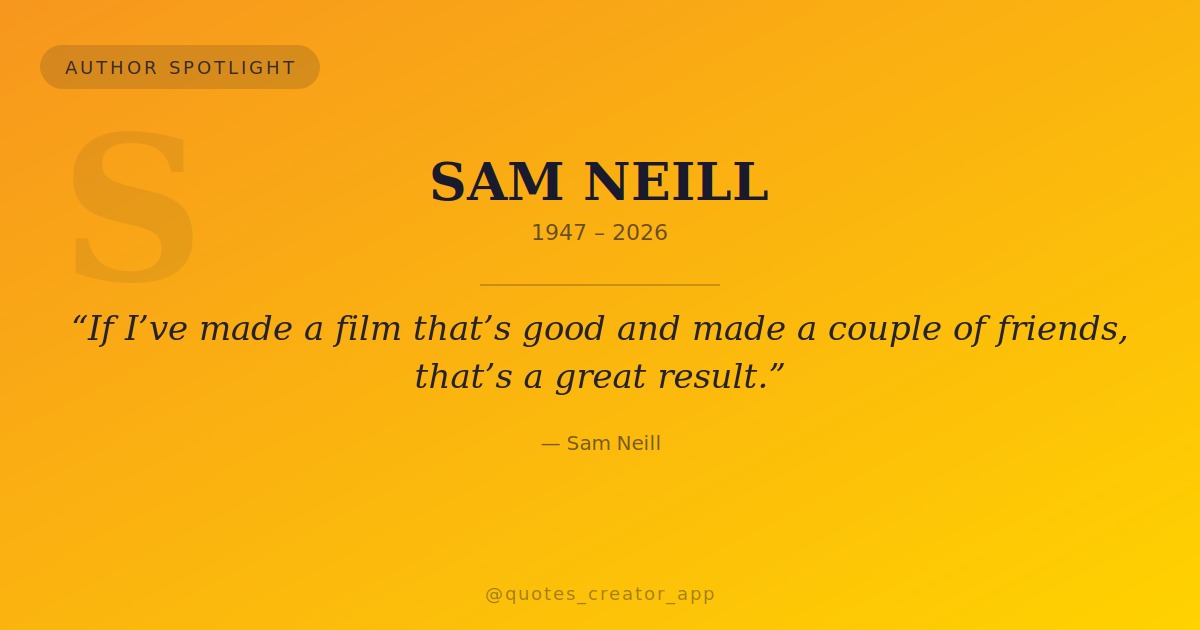
“If I’ve made a film that turns out to be good, that’s a good result. If I’ve made a film that’s good and made a couple of friends, that’s a great result. If I’ve made a film that’s no good, but I made a friend, that’s still another great result.”
The meaning behind these words
This passage captures Neill’s essential humanity with an elegance that feels both surprising and inevitable. In an industry defined by box office returns, awards, and critical acclaim, he recalibrated success around human connection. The progressive structure of his three-tiered framework is telling: it begins with professional achievement, elevates to shared success, and ultimately declares that even professional failure redeemed by friendship constitutes a triumph. This was not hollow sentiment — colleagues across five decades described him as unfailingly generous, a man who made every set feel warmer simply by being on it.
The quote gains additional poignancy from its context. Written during his cancer treatment, it reflects a man staring down mortality and finding that what mattered most was not his filmography but the constellation of relationships built along the way. For millions of fans who grew up watching him outrun velociraptors and navigate submarines, this reframing of success — from prestige to people — is perhaps his most enduring lesson. It is the philosophy of someone who understood, earlier and more deeply than most, that the only legacy that outlasts you is the love you gave and the friendships you kept.
“I raised both arms towards the sky. There is no gesture you can make that says you are alive, on a planet, more than that, with your face turned upwards to the sky. There I was, all old bone and sinew and ribs. And then I looked again. I looked properly at my true self. Without any judgment. And I saw me.”
The meaning behind these words
This remarkable passage comes from a moment when Neill, facing chemotherapy in his mid-seventies, examined his own reflection. What could have been a meditation on decline became instead a declaration of presence. The physical image — arms raised, face to the sky — is primal and defiant: a gesture that predates language, that every human instinctively makes in moments of triumph, surrender, or sheer awe at being here at all. By choosing to see himself “without judgment,” Neill articulated a form of radical self-acceptance that eludes most of us, regardless of our circumstances.
The philosophical architecture is subtle but profound: first the physical body (“old bone and sinew and ribs”), then the move beyond judgment to true seeing, and finally the quiet recognition of self. “I saw me” — three words that carry the weight of a life spent learning to look honestly. The rejection of “better” and “worse” as false categories echoes Buddhist and Stoic traditions, yet it arrives through the voice of a man standing before a mirror, not a scholar behind a lectern. This is wisdom forged in the crucible of illness, and its lasting power lies in its simplicity: you are here, you are you, and that alone is sufficient.
“I’m serviceable. I’m durable. I get the job done.”
The meaning behind these words
This triptych of self-assessment, delivered with characteristic wryness across multiple interviews over the years, distills Neill’s entire professional philosophy into nine words. In an era of actors describing their “craft” and “process” with elaborate seriousness, Neill preferred the language of the tradesman. He was not diminishing his talent — he was rejecting pretension. The words “serviceable” and “durable” evoke tools that last, that do not break under pressure, that are always ready when called upon.
There is a distinctly Kiwi modesty at work here, a cultural aversion to self-importance that Neill carried through a global career spanning five decades, two continents, and some of the most iconic sets in cinema history. It is the same sensibility that led him to name his farm animals after famous colleagues and to describe his knighthood with a shrug. The phrase “I get the job done” is not the language of an artist but of someone who shows up, does the work, and goes home — which is, of course, exactly what the greatest artists do. By refusing to mythologize his profession, he made excellence feel attainable, and by extension, he made himself feel like one of us.
“It doesn’t matter how popular an actor you are: nobody will remember you forever.”
The meaning behind these words
Coming from a man who starred in one of the highest-grossing films of all time and was recognized on streets from Auckland to Amsterdam, this observation carries unusual weight. Neill understood something that the machinery of celebrity is designed to obscure: that fame is not a destination but a temporary condition, a wave that carries you for a time before depositing you back on the shore. This was not cynicism — it was clarity, the perspective of someone who had seen the full arc of his own career, who had been the nearly-man for James Bond, who had weathered hits and misses with the same gentle equanimity.
The quote functions as both a personal credo and a quiet cultural critique. In an age of relentless personal branding and legacy anxiety, where public figures scramble to secure their place in the historical record, Neill’s willingness to acknowledge impermanence feels almost radical. It freed him to make choices based on interest rather than ambition — to do Hunt for the Wilderpeople alongside Jurassic World Dominion, to run a vineyard, to write a memoir not for posterity but for his grandchildren. The irony, of course, is that by making peace with the possibility of being forgotten, he became someone impossible to forget.
“I was christened ‘Nigel.’ It set me back for years.”
The meaning behind these words
This gem of a quote, delivered with the impeccable comic timing that defined his off-screen persona, reveals the man behind the movie star. Neill understood that humor is the most direct route to truth, and his self-deprecating wit was a masterclass in deflecting the absurdities of fame. By joking about his birth name, he was doing something more serious: asserting that identity is chosen, not inherited, and that reinvention is available to anyone willing to laugh at themselves — especially themselves.
The quote also encapsulates his relationship with his adopted homeland. “Nigel” was a British name, suitable for the son of an army officer stationed in Northern Ireland. “Sam” was a New Zealand name, forged in the playgrounds of Christchurch where a boy with an Armagh accent needed all the help he could get to fit in. The name change was not vanity — it was survival, a small act of self-definition by a seven-year-old immigrant learning to navigate a new world. And like everything else Sam Neill did, it was accomplished without fuss, without fanfare, and with a twinkle in the eye that invited you to share the joke.
Sam Neill’s legacy
Sam Neill’s legacy cannot be measured solely in box office receipts or award nominations, though both were substantial. What he leaves behind is rarer: a model of how to navigate extraordinary public success while remaining recognizably human. At a time when many public figures curate their images with surgical precision, Neill’s public presence — his Twitter feed featuring pigs, Pinot Noir, and dad jokes — was a quiet masterclass in refusing to take oneself seriously. He treated fame the way he treated his stammer: as something to be acknowledged, managed with good humor, and ultimately set aside in favor of the things that actually matter.
His death, arriving less than three months after he declared himself cancer-free, closes a chapter that began in a small Northern Irish town in 1947 and spanned nearly every corner of the cinematic imagination. Yet the man who played paleontologists and wizards, spies and cardinals, would likely find any grand summation embarrassing. He would probably prefer we remember him the way he remembered himself: as someone who showed up, did the work, made a few friends, and enjoyed a good glass of his own Pinot along the way. In the end, by his own accounting, that was the great result — and the world is richer for it.
Create graphics with Sam Neill’s quotes
Sam Neill’s words have a timeless quality that makes them perfect for quote graphics. Whether you are sharing on Instagram, creating a vision board, or looking for daily inspiration, Quotes Creator helps you transform these quotes into beautiful, shareable designs with custom fonts, gradients, and layouts.
Why we chose Sam Neill
Sam Neill passed away yesterday, on 13 July 2026, and the world is rediscovering the depth of his wisdom. His memoir, written in the shadow of cancer, contains some of the most honest reflections on mortality and identity we have encountered from any public figure. He was the rare celebrity who became more interesting the closer you looked — a man of three passports who chose a small farm in Central Otago, a global star who preferred his pigs to red carpets, and a knight who described his greatest achievement as the friendships he made along the way. In an era hungry for authenticity, his voice endures as a gentle, witty, and profoundly human reminder of what actually matters.
— ThinkPeak Studio Editorial Team
Create your own quote graphic with this quote
Turn this line into a shareable graphic in seconds — free, no signup needed. For video quotes and 100+ templates, try the Android app.
Advertisement
Enjoyed this article? Get more like it in your inbox.