On this page
Author Spotlight: Shakira
Colombian singer-songwriter, dancer, record producer, and philanthropist known as the Queen of Latin Music
Who is Shakira?
Shakira Isabel Mebarak Ripoll was born on February 2, 1977, in Barranquilla, a vibrant city on Colombia’s Caribbean coast. Her father was a Lebanese jeweler and her mother of Catalan descent, giving Shakira a multicultural foundation that would later infuse her music with Latin, Arabic, and rock influences. She wrote her first poem at four, composed her first song at eight after her half-brother’s tragic death, and by ten was winning local talent competitions. But her path was never smooth: her family went bankrupt when she was eight, her father took her to a park full of orphans to teach her gratitude, and her school choir rejected her because her vibrato was too strong — classmates said she sounded like a goat. At thirteen, she signed a record deal with Sony Music Colombia, and at fourteen she bought her parents a car with her first earnings.
Shakira’s third album, Pies Descalzos (1995), made her a star across Latin America. Dónde Están los Ladrones? (1998) cemented her reputation as a songwriter of uncommon depth. But it was Laundry Service (2001), her first English-language album, that made her a global phenomenon. She sold over 13 million copies of that record alone, and songs like “Whenever, Wherever” and “Hips Don’t Lie” became cross-continental anthems. Over the decades that followed, she accumulated four Grammy Awards, fifteen Latin Grammy Awards, and over 80 million records sold worldwide. She became synonymous with the FIFA World Cup, performing “Waka Waka (This Time for Africa)” in 2010 and becoming the tournament’s most recognizable musical icon. In 2026, she was nominated for the Rock and Roll Hall of Fame — an acknowledgement of a career that spans four decades and has produced number-one albums in each one.
What sets Shakira apart from most global superstars is not her voice or her dance moves or her commercial success. It is the way she has refused to let fame become an end in itself. From the beginning, she saw the spotlight as a tool rather than a destination. Her Pies Descalzos Foundation, named after her breakthrough album, has built and operates schools in some of Colombia’s most impoverished communities — places where children had no paved roads, no potable water, no electricity. In one Cartagena neighborhood, local gangs dissolved entirely after a Barefoot school opened, transforming the social fabric. She has spoken at the United Nations on early childhood education, been appointed to the U.S. President’s Advisory Commission on Educational Excellence for Hispanics, and received the honor of Chevalier of the Order of Arts and Letters from the French government. For Shakira, music and advocacy are not separate pursuits. They are two expressions of the same conviction: that a voice carries a responsibility.
In 2017, her voice nearly disappeared. A vocal cord hemorrhage left her unable to sing, and doctors gave her a stark choice: surgery with uncertain results, or months of silence and prayer. She chose the latter, retreating into a period of depression so deep she could barely leave her bed. Her recovery was slow and spiritual — she meditated, submerged herself underwater for hours to find stillness, and rediscovered why she sang in the first place. When she returned, she was no longer chasing affirmation. She was chasing the pleasure of the act itself. This crisis, and her emergence from it, deepened the philosophical dimension of her work and gave her later albums a raw emotional honesty that resonated with millions. Shakira is not just an artist who survived fame. She is an artist who survived losing the thing that made her herself — and found a reason to keep going.
Shakira’s most memorable quotes
“I always felt that there had to be much more than just shaking it, you know, eternally. Or just making music. There had to be something else to my life.”
The meaning behind these words
At the height of her commercial powers, Shakira asked herself a question that few multimillion-selling artists dare to entertain: is this it? The phrase “just shaking it” is deliberately dismissive — a reference to the belly-dancing, hip-moving image that had made her famous, but also a cage she sensed closing around her. She understood something fundamental about human psychology: that external success, unchecked by internal purpose, can become a kind of prison. The applause never stops, and yet the person receiving it can feel emptier with every ovation. Shakira’s recognition that there had to be “something else” marks the moment she decided to build a life that mattered beyond the stage.
This quote also reveals the philosophical engine that drove her philanthropy. The Pies Descalzos Foundation was not an afterthought or a public-relations exercise. It was the answer to the question she posed here. If music was going to be the vehicle, then education and advocacy would be the destination. Shakira understood that the world gives a platform to the talented, but asks nothing of them beyond performance. Choosing to do more — to build schools, to testify before the United Nations, to pour millions of dollars and years of effort into communities most people ignore — is a deliberate act of reinvention. It turns a pop star into a public servant, and it transforms a career into a legacy.
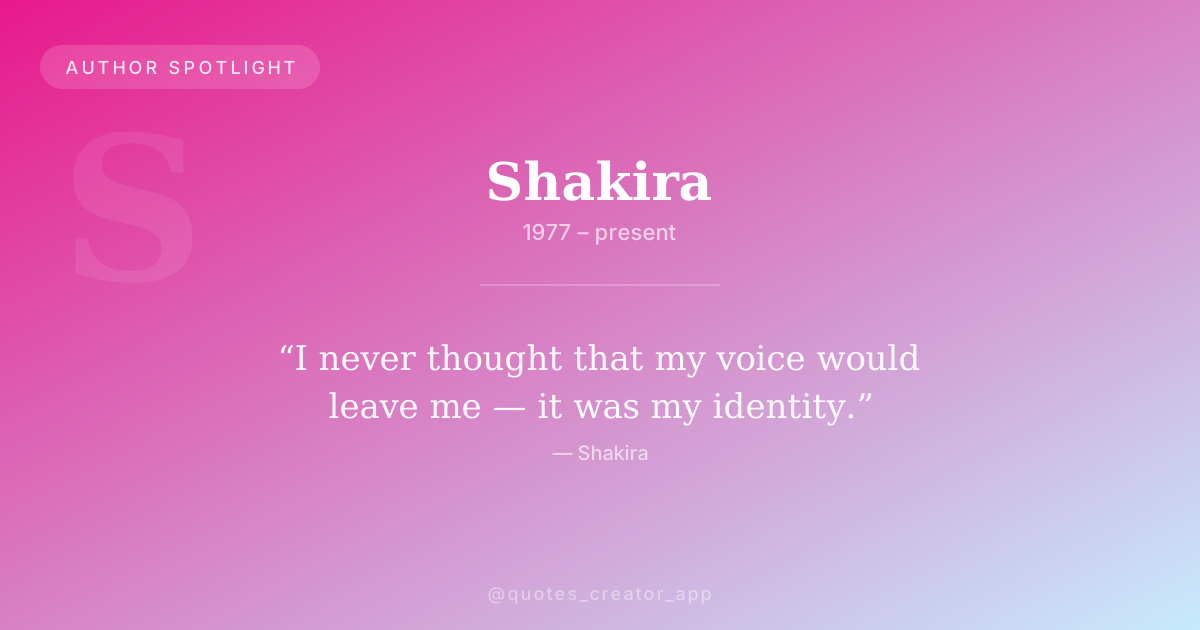
“I never thought that my voice would leave me, because it’s so inherent to my nature. It was my identity. So when I couldn’t sing, that was unbearable. There were times I couldn’t even get out of bed — I was so depressed.”
The meaning behind these words
In 2017, Shakira suffered a vocal cord hemorrhage that forced her to cancel her El Dorado World Tour. For someone whose entire life had been built around her voice — the instrument that had carried her from a little girl singing in Barranquilla to stadiums filled with tens of thousands — the prospect of losing it was an existential threat. She describes her voice not as a skill or a talent but as her identity, something so woven into her being that its absence made her unrecognizable to herself. The depression she describes is not the sadness of a cancelled tour; it is the paralysis of a person who has lost the thread that holds the story of their life together.
What makes this quote universally resonant is that it names a fear we all carry in some form: the fear of losing the thing we believe defines us. For an artist, it is their voice. For an athlete, their body. For a parent, their child. For anyone, their career, their health, their relationships. Shakira’s vulnerability here is staggering because she does not pretend to be strong. She admits to days when she could not get out of bed. In doing so, she gives permission to everyone who has ever felt shattered by loss to name their pain without shame. Recovery, she would later learn, begins not with pretending you are fine but with admitting that you are not.
“You go out in search of affirmation that you’re good, that people like you. But this time it was different — I was out there because I wanted to feel the pleasure of singing.”
The meaning behind these words
This quote marks the turning point in Shakira’s recovery, and it contains a wisdom that applies far beyond the music industry. She admits something most performers would never say out loud: that for years, a significant portion of her motivation came from seeking external validation. The applause, the chart positions, the critical acclaim — these were not just rewards but fuel. She was on stage not only because she loved to sing but because she needed to know that people loved her for singing. This is a brutally honest self-assessment, and it describes a trap that ensnares high achievers in every field: the slow transformation of passion into performance for an audience.
What changed after her vocal cord hemorrhage was not her talent but her reason for using it. Stripped of the machinery of fame — the tours, the interviews, the expectations — she had to rediscover the act of singing as it was when she was a child in Barranquilla, before the record deals and the Grammys and the stadiums. When she says she wanted to “feel the pleasure of singing,” she is describing a return to intrinsic motivation, the pure joy of doing something for its own sake. It is a lesson that transcends celebrity: the most sustainable fuel for any craft is not recognition but love. Recognition fades. Love, when it is genuine, only deepens.
“It depends on the artist. I think some artists are meant to stay and some will disappear. It always happens. It’s natural selection of the species.”
The meaning behind these words
Shakira made this observation during a period when Latin music was experiencing a global resurgence, and journalists kept asking whether it was a bubble destined to burst. Her response is remarkable for its lack of defensiveness. She does not argue that Latin music is here to stay, nor does she demand that the world learn to appreciate it. Instead, she applies a kind of Darwinian logic to art: some artists adapt and endure, others do not, and the distinction is determined by the quality of the work and the depth of the connection it forges. This is neither arrogance nor humility. It is a clear-eyed acceptance of how culture actually works.
There is also a quiet confidence in this quote that speaks to Shakira’s own understanding of her place in music history. She is not worried about whether her music will endure because she knows the work she has put in — the thousands of hours of writing, recording, touring, and refining — and she trusts that it will speak for itself. The “natural selection of the species” metaphor is deliberate. Music, like life, evolves. Artists who cling to a single sound or refuse to grow are the ones who disappear. Those who adapt, who write across languages and genres, who take the stage at three World Cups across three different decades, are the ones who stay. Shakira is not speculating about which category she belongs to. She knows.
Shakira’s legacy
Shakira’s impact on global music is difficult to overstate. Before her crossover, Latin artists rarely achieved sustained mainstream success in English-speaking markets without abandoning their native language. She proved that you could sing in Spanish and still fill stadiums in London, Tokyo, and New York. She opened doors for the wave of Latin artists who followed — from Bad Bunny to Rosalía — by demonstrating that cultural authenticity was not a barrier to global reach but its foundation. The sound she created, a fusion of Latin rhythms, Middle Eastern instrumentation, rock energy, and pop sensibility, had no precedent. It created the template for cross-cultural music in the twenty-first century.
But her most enduring legacy may lie outside the recording studio. The schools her foundation has built in Colombia and Haiti have transformed thousands of lives, and her advocacy for early childhood education has influenced policy in multiple Latin American countries. She proved that a pop star’s platform could be something more than a vehicle for perfume endorsements and brand deals. It could be a lever for structural change. As of 2026, with a Rock and Roll Hall of Fame nomination on the table and a career still in full motion, Shakira remains what she has always been: not just a voice, but a force. And not just a star, but a reason to look up.
Create graphics with Shakira’s quotes
Shakira’s words have a timeless quality that makes them perfect for quote graphics. Whether you are sharing on Instagram, creating a vision board, or looking for daily inspiration, Quotes Creator helps you transform these quotes into beautiful, shareable designs with custom fonts, gradients, and layouts.
Why we chose Shakira
Shakira is more than a pop star. She is a songwriter who has written or co-written the vast majority of her music, a polyglot performer who moves effortlessly between Spanish, English, and Arabic, and a philanthropist whose schools have educated thousands of children in Colombia and Haiti. With the 2026 FIFA World Cup drawing global attention to the cities and cultures she has long championed, and with her Rock and Roll Hall of Fame nomination capping a career that has now spanned four decades, this felt like the right moment to reflect on the philosophy behind the phenomenon. Shakira reminds us that the most powerful voices are not the loudest — they are the ones that carry the weight of someone else’s story.
— ThinkPeak Studio Editorial Team
Create your own quote graphic with this quote
Turn this line into a shareable graphic in seconds — free, no signup needed. For video quotes and 100+ templates, try the Android app.
Advertisement
Enjoyed this article? Get more like it in your inbox.