On this page
Author Spotlight: Shelley Fabares
She was a working actress before she could read, a television daughter to a whole generation, a reluctant pop star, and the leading lady who looked up at Elvis Presley from three different big screens. Shelley Fabares never set out to be a legend; she set out to do the work, and she did it for nearly sixty years with a modesty that never once caught up to her achievements. When her single “Johnny Angel” shot to number one in the spring of 1962, the most famous teenager in America responded with genuine bafflement: “I was stunned about that, to put it mildly. After all, I never could sing.” That sentence — wry, self-deprecating, a little disbelieving — is the key to the woman. She was, from the age of three to the day she left the stage, a professional, and a rare and vanishing kind: the performer who never mistook the size of her spotlight for the size of her own importance. This is the story of the girl next door who turned out to be everywhere, and who stayed, in the end, exactly who she always was.
Who is Shelley Fabares?
Michele Ann Marie Fabares was born on 19 January 1944 in Santa Monica, California, into a family that already had a foot in the business of make-believe. Her father, James Alan Fabares, was a New Orleans man, born in the Algiers district of the city, who had come west; her mother, Elsa Eyler, would die of Alzheimer’s disease half a century later, a loss that shadowed the last years of her daughter’s public life. The girl everyone would come to know as Shelley was the younger of two sisters, and her aunt was Nanette Fabray — née Fabares — the celebrated actress and singer who had shortened the family name for the stage. Talent, in other words, was in the room from the start, but so was something harder to inherit: the quiet professionalism of a show-business household that treated performing as a trade rather than a miracle. Fabares made her acting debut at three, and at ten she appeared on television for the first time in an episode of Letter to Loretta, playing Clara Schumann as a child. She was, by any measure, a veteran before she reached middle school, and she graduated from North Hollywood High School in 1961 having already spent more than a decade in front of cameras.
The part that made her famous arrived in 1958, when she was fourteen. The Donna Reed Show, a family sitcom built around the actress who had won an Oscar for From Here to Eternity, cast Fabares as Mary Stone, the daughter of the household — and in the process handed the country one of its first great television teenagers. The show ran until 1966, and Fabares quickly became a favorite of the teen audience that had discovered her; she would leave the series in 1963 to pursue film and music, returning periodically until the end. The role gave her not only a platform but a teacher. “Donna Reed was simply an extraordinary woman,” Fabares said years later, “a woman of great strength, kindness, integrity and compassion.” Off the back of that national visibility came an unexpected second career. A recording contract produced “Johnny Angel,” a winsome teen-pop ballad about a boy who was perfect in every way but one: he did not know the singer existed. It hit number one on the Billboard Hot 100 in April 1962, sold more than a million copies, went gold, and made the sixteen-year-old Fabares — who had always thought of herself as an actress who happened to sing — a genuine recording star, with the albums Shelley! and The Things We Did Last Summer and a string of follow-up hits to prove it.
The movies came next, and they were glossy. She was one of the leads in the surf picture Ride the Wild Surf in 1964, and then MGM paired her with its biggest star, casting her as the leading lady to Elvis Presley in Girl Happy (1965), Spinout (1966), and Clambake (1967) — three films that fixed her face in the American imagination as the wholesome, bright-eyed girl of a thousand soda fountains. But the wheel turned, as it always does. Film roles dried up in the late 1960s, and Fabares went back to guest spots on shows like The Twilight Zone, Mannix, and The Rockford Files, and to the television films that were becoming the medium’s quiet workhorse. It was there that she gave one of the finest performances of her life: in Brian’s Song (1971), the beloved fact-based drama about the friendship of football players Brian Piccolo and Gale Sayers, she played Joy Piccolo, the wife who watches her young husband die of cancer, and her work earned a Golden Globe nomination. The lean years taught her something she would later put into words with startling clarity: the business was cyclical, and no amount of early fame could protect anyone from its dead stretches.
What followed was the long, steady second half of a life lived entirely in public. Fabares spent the 1970s and 1980s moving from series to series with the ease of a woman who could always find work — The Brian Keith Show, The Practice, Forever Fernwood, a recurring turn as the deliciously self-absorbed Francine Webster on One Day at a Time — and then, in 1989, she landed the role that would define her late career: Christine Armstrong on the sitcom Coach, opposite Craig T. Nelson. The series ran until 1997 and earned her two Primetime Emmy nominations, and in 1994 the Young Artist Foundation honored her with its Former Child Star Lifetime Achievement Award for her work as Mary Stone. She voiced Martha Kent in Superman: The Animated Series and its successors, and from 2004 to 2017 she produced the Screen Actors Guild Awards, a fitting capstone for a performer who had spent her life in service to her fellow actors. In private she married the producer Lou Adler in 1964 (they separated in 1966 and divorced in 1980), and in 1984 she married the actor Mike Farrell, with whom she shared the rest of her life. In October 2000 she underwent a liver transplant after being diagnosed with autoimmune hepatitis — a brush with mortality she met with characteristic quiet — and on 22 August 2026 she died in Los Angeles after a brief illness. She was eighty-two, and she had spent almost every one of those years, in one way or another, on camera.
Shelley Fabares’s most memorable quotes
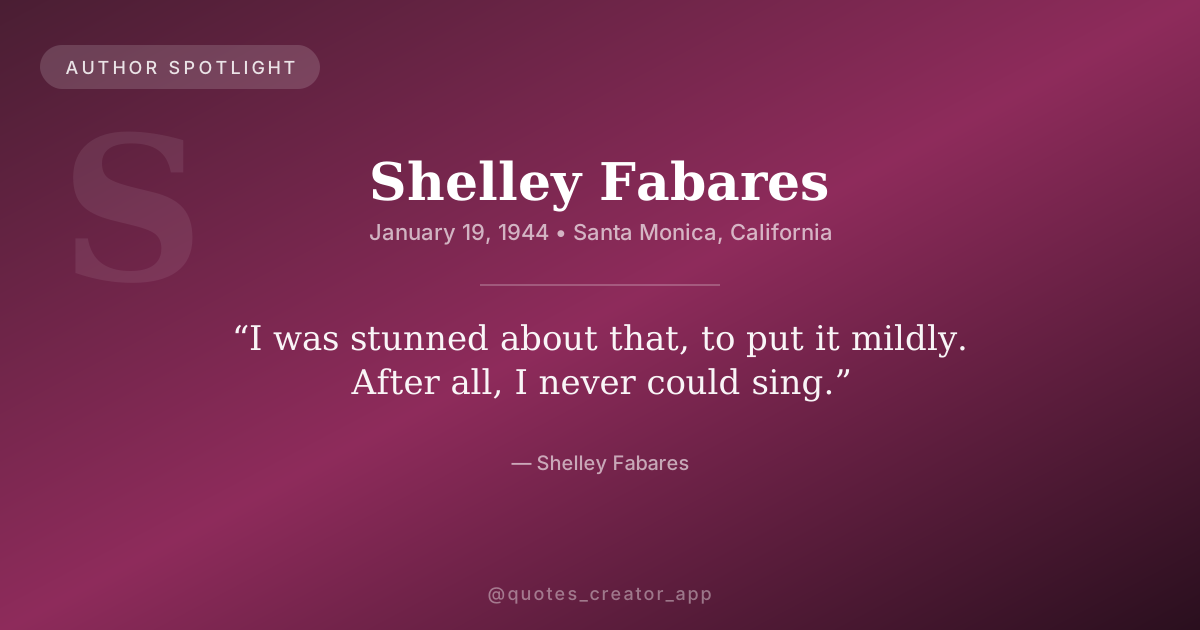
“I was stunned about that, to put it mildly. After all, I never could sing.”
The meaning behind these words
This is the rarest thing in show business: a hitmaker who never believed her own hit. “Johnny Angel” went to number one on the Billboard Hot 100 in April 1962, sold more than a million copies, and made Shelley Fabares — then a sixteen-year-old on a hit sitcom — the most famous teenager in America. And her recollection of the moment, decades later, is not pride but bewilderment. “I was stunned about that, to put it mildly. After all, I never could sing.” The second sentence does the essential work. It is not the false modesty of a star angling for a compliment; it is the honest self-assessment of a woman who had always understood herself to be an actress first, a person who happened to be handed a microphone because the public wanted more of the girl they loved on television. She is drawing a clean, almost clinical distinction between the gift she knew she had — acting — and the one the marketplace insisted on giving her anyway.
The remark also tells us something about how she measured herself. Most performers spend their careers inflating their own legend; Fabares spent hers quietly deflating it. She never needed the number-one record to be the thing she was, because she had something sturdier underneath: a lifelong identity as a worker. The singer was a costume she put on for a season; the actress was who she was. And yet the sentence is not really about singing at all. It is about the strange, arbitrary way fame chooses people — the way it can crown a girl for a voice she never claimed to possess, and leave a true artist unnoticed. Fabares understood that luck as clearly as anyone, and her refusal to be defined by it — to insist, gently, that the singer was never the real her — is a small masterpiece of humility from a woman who had every excuse to believe her own press.
“Donna Reed was simply an extraordinary woman, a woman of great strength, kindness, integrity and compassion.”
The meaning behind these words
Every child star inherits a second parent, and Shelley Fabares inherited an unusually good one. When she was cast as Mary Stone on The Donna Reed Show at fourteen, she was placed opposite an actress who had already won an Academy Award and who brought to the set, by all accounts, the same decency she projected on screen. The word Fabares reaches for first is “simply” — simply extraordinary — and that adverb is doing quiet work. It suggests that Reed’s greatness needed no qualification, no complicated parsing: it was visible, self-evident, the kind of thing a teenage girl could absorb simply by being in the room. Then comes the list — strength, kindness, integrity, compassion — four virtues laid out with the care of someone who has had decades to consider exactly what she learned from this woman, and who has chosen each word deliberately.
The sentence matters because it reveals the formation of Fabares’s own character. A child actor is uniquely vulnerable to the worst of the industry — to the flattery, the pressure, the adults who would use a young performer up. That Fabares emerged from that crucible not only intact but gracious is, by her own account, no accident; it is the direct result of having been mothered, on screen and off, by a woman of unusual decency. She carried those four words — strength, kindness, integrity, compassion — into every subsequent role and every subsequent decade, and when she spoke of Donna Reed she was not merely praising a colleague. She was identifying the source of her own survival. The tribute is also a rebuke, however gentle, to an industry that so often fails its young: a reminder that what protects a child performer is not a contract but the character of the people around them.
“I went to bed on Tuesday having worked since I was 3. I got up Wednesday morning and didn’t work for four years, went to bed Wednesday night after four years, got up and interviewed for a Mannix episode and started working again. I think this business is very cyclical. You go through busy times and you go through dead times.”
The meaning behind these words
Here is the most complete account of a working actor’s life that the era ever produced, compressed into a single breath. The structure is deliberately surreal — a career that had begun at age three and never once stopped, collapsing overnight into four empty years, and then restarting just as suddenly with one audition. Fabares compresses the arc into a single Tuesday and Wednesday, as if the entire industry could turn on the hinge of a single night’s sleep. The image is the point: fame is not a line that rises and falls gracefully; it is a switch that flips without warning, and the person standing in the dark has no control over which way it will go. She tells the story without self-pity, and that is what gives it its authority. There is no complaint here, only observation — the calm, unsentimental voice of a survivor describing the weather of her profession.
And then she draws the moral herself, with a clarity that most commentators on Hollywood never achieve: “This business is very cyclical. You go through busy times and you go through dead times.” The word “cyclical” is doing real philosophical work. It insists that the dead times are not an aberration, not a punishment, not a verdict on your worth — they are simply part of the same turning wheel as the busy times, and they will pass, just as the busy times will. For a woman who had been famous at sixteen and unemployed at twenty-four, that was not a theory; it was a lived fact. The sentence is a gift to every performer who has ever mistaken a dry spell for an ending. Fabares, who had been through both ends of the cycle more than once, knew better: the work comes and goes, but the worker remains.
“I wasn’t a big risk-taker. I should have been more aggressive. I was nervous and scared to try something really different.”
The meaning behind these words
This is a confession, and it is all the more striking for coming from a woman who had, on paper, nothing to confess. By the time she said this, Shelley Fabares had a number-one record, three Elvis Presley films, a Golden Globe nomination, two Emmy nominations, and a career spanning half a century. Yet she looked back on her own choices and saw, with painful honesty, not the successes but the chances she had been too afraid to take. “I wasn’t a big risk-taker. I should have been more aggressive. I was nervous and scared to try something really different.” There is no bravado here, no spin. It is the rare public figure who will admit, out loud, that fear shaped the shape of her life, and Fabares does it without flinching.
The sentence is valuable precisely because it is unguarded. In an industry that rewards self-mythology, she offers the plain truth of a woman who played it safe and wondered what she had left on the table. But read closely, the admission cuts in two directions at once. On one side is regret — the honest acknowledgment that timidity has a cost. On the other is an implicit explanation for why she survived so long when so many of her more reckless contemporaries did not. The caution that she criticizes is the same quality that kept her grounded through six decades of a notoriously unkind business. She may not have been a risk-taker, but she was a finisher — and the willingness to look back on one’s own caution and name it for what it was is itself a kind of courage, and a far rarer one than the swagger she never claimed to have.
“She was wonderful. She saw the world only through her eyes, and it never occurred to her that other people didn’t.”
The meaning behind these words
This is a lesson in acting delivered as a character sketch, and it shows how deeply Fabares thought about the people she played. Francine Webster, her recurring role on One Day at a Time, was by her own description “a rather villainous character” — the kind of self-involved woman the audience was meant to roll its eyes at. But Fabares refused to play her as a cartoon. Instead she found the character’s interior logic and described it with a novelist’s precision: Francine saw the world only through her own eyes, and it never occurred to her that other people didn’t. The key phrase is “never occurred to her.” Francine’s self-absorption was not malice; it was an absence of imagination, a complete and innocent inability to conceive of another person’s perspective. And that, Fabares understood, is what made her wonderful.
The remark reveals a profound empathy at the heart of Fabares’s craft. A lesser performer would have judged Francine and mocked her; Fabares did the harder thing — she climbed inside the woman’s blindness and made it human. “She was wonderful” is not sarcasm; it is appreciation, the delight of an artist who has found a complete person to inhabit. This is the same generosity of spirit she had brought to every role since childhood, and it explains why she was so consistently good for so long: she never looked down on the people she played. Even the villains, even the jokes, deserved to be understood from the inside. That is the mark of a true actor, and it is why Shelley Fabares — for all her talk of not being a risk-taker — took the one risk that matters most in her profession: she made herself vulnerable to the interior lives of strangers, and she let them live through her.
Shelley Fabares’s legacy
The measurable legacy is almost unbelievably broad, and it is the rare kind that stretches across two distinct art forms. As a singer, Shelley Fabares recorded a number-one hit in “Johnny Angel” — a gold-selling single that has never really left the American pop memory, that still turns up on oldies playlists and in period films, and that remains one of the defining sounds of the early 1960s. As an actress, she worked continuously from 1947 to 2006, a span of nearly six decades, appearing in more than a dozen films and a staggering number of television episodes across three of the medium’s most enduring sitcoms — The Donna Reed Show, One Day at a Time, and Coach — while collecting a Golden Globe nomination, two Emmy nominations, and a lifetime-achievement honor from the Young Artist Foundation. She was Elvis Presley’s leading lady in three films, the voice of Martha Kent for a new generation of Superman fans, and, for thirteen years, the producer of the Screen Actors Guild Awards. There are few performers in the history of American entertainment who were, for so long and in so many households, simply present.
The deeper legacy is harder to quantify, and it has to do with what her presence meant. Fabares was the girl next door — not as an insult, the way Hollywood often means it, but as a promise. She represented something the culture has largely lost: the idea of a star who was also a person, a performer who grew up on screen without being destroyed by it, a public figure who could be famous for sixty years and still seem like someone you might sit next to at a diner. In an era that now consumes and discards young stars with brutal speed, her career stands as a rebuke and a model — proof that a child performer can survive, can stay decent, can keep working into old age, if she is lucky enough to be surrounded by people of integrity and strong enough to hold onto her own. She never stopped being a professional, and she never started believing she was more than one. The modesty that kept her grounded is the very thing that now makes her, in retrospect, extraordinary.
And there is, finally, the legacy of her endurance, which was quiet but absolute. She outlived the teen-idol machinery that made her, outlived the film career that sputtered in the late sixties, outlived the sitcoms that came and went around her, and outlived — as few of her peers did — the industry’s habit of forgetting its own. She survived a liver transplant in 2000 and went on working, and she was still a beloved figure when she died in August 2026 at eighty-two, mourned by a public that had watched her, in one form or another, for three quarters of a century. “I went to bed on Tuesday having worked since I was 3,” she once said, describing the rhythm of her strange, cyclical life. She got up on Wednesday and kept going — and she kept going for so long, and with such grace, that the girl who never could sing, and never quite believed her own luck, became one of the most dependable and beloved presences the American living room has ever known. The lights were on, and Shelley Fabares was there.
Create graphics with Shelley Fabares’s quotes
Fabares’s words carry the same quality as her performances — honest, warm, and built to last. Whether you need a line about humility, about surviving the cycles of a hard business, or about the quiet courage of playing it safe, Quotes Creator helps you turn these quotes into beautiful, shareable designs with custom fonts, gradients, and layouts.
Why we chose Shelley Fabares
Shelley Fabares enters this spotlight two days after her death on 22 August 2026, at eighty-two, and at a moment when her name is once again near the top of Wikipedia’s most-viewed pages — more than a hundred thousand readers a day returning to the life of a woman who had been famous since before most of them were born. The spike is the familiar one that follows the loss of any beloved figure, but the depth of it is telling: it speaks to a public that did not simply recognize Fabares but had grown up with her, across three generations of television. We chose her because her life is one of the rare ones that works as both a story and a lesson — the child performer who survived what destroys so many, the teen idol who never believed her own hype, the actress who kept working through the dead times and came out the other side of a sixty-year career as modest and as decent as she began.
The five quotes we have selected trace the spine of that story. They begin with the self-deprecating disbelief of the girl who hit number one and still insisted she never could sing. They move through her tribute to the woman who shaped her — Donna Reed — and through her clear-eyed account of the cyclical cruelty of show business, the fear she admitted had held her back, and the empathy with which she approached even the characters the audience was meant to dislike. These are not the maxims of a woman who conquered Hollywood. They are the honest, unguarded reflections of a woman who endured it, understood it, and never lost herself in it — and that, in the end, is a rarer and more valuable legacy than any number-one record. The girl next door stayed next door. The country is the better for it.
— ThinkPeak Studio Editorial Team
Create your own quote graphic with this quote
Turn this line into a shareable graphic in seconds — free, no signup needed. For video quotes and 100+ templates, try the Android app.
Advertisement
Enjoyed this article? Get more like it in your inbox.